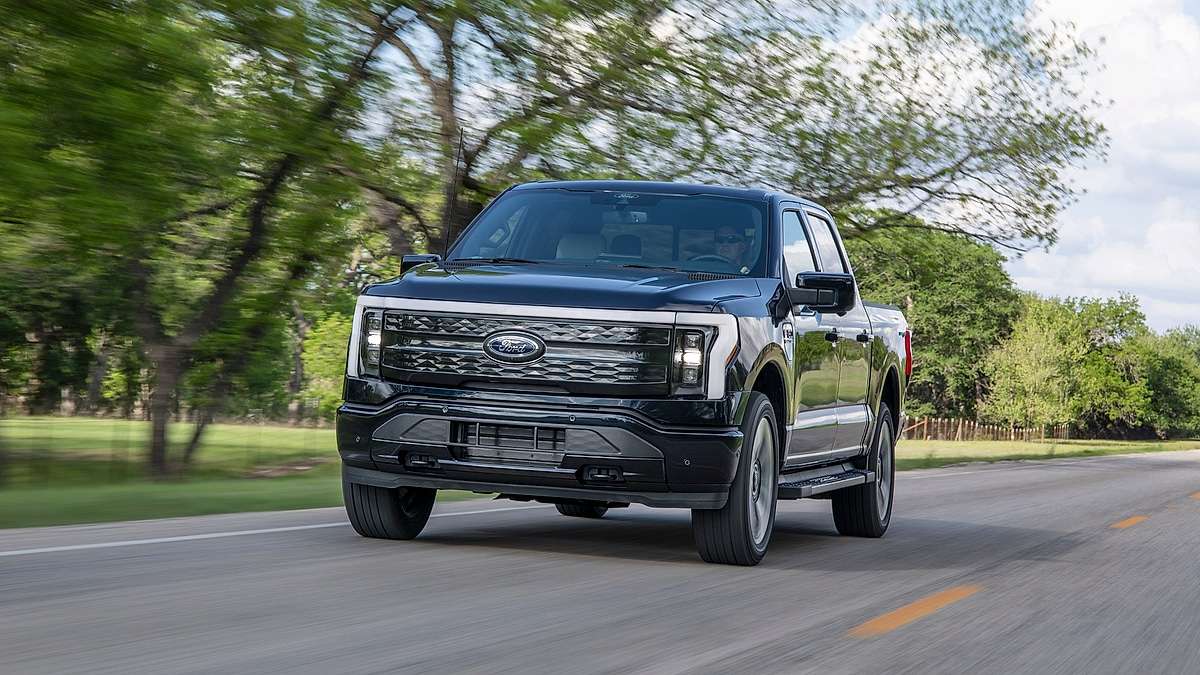

A new Ford F-150 Lightning owner drove off the lot only to be immediately greeted by blind spot and cross-traffic sensor faults, a problem the selling dealer claimed was "perfectly clean" just moments before the paperwork was signed. Further inspection by an independent Ford service center revealed a cracked taillight and a broken sensor, totaling a $3,900 repair bill for a truck supposedly in "perfect condition." This is not merely a case of bad luck; it is a textbook example of a dealer prioritizing a quick sale over transparent disclosure and basic pre-delivery inspection.
This scenario, where a customer takes delivery of an F-150 Lightning with undisclosed, significant defects, erodes trust in the entire used car market, particularly for complex and expensive electric vehicles. When a dealer knowingly passes off a $3,900 repair as a "recall" or an oversight, it shows a problem in how these transactions are handled, leaving buyers responsible for costs that should have been addressed before the sale.
The industry's failure to standardize pre-delivery inspection transparency for used EVs is costing consumers thousands and undermining confidence in dealerships.
“First off, the Ford F-150 Lightning is the best vehicle I have ever driven. I absolutely love it. I had been looking for 8 months for a flash and finally found one (2024, 13k miles)at a good deal, 30 miles from my city that had been shipped up from Vegas, a personal vehicle. I had test-driven a handful previously. On the day I went down to test drive this one, I left my license at a notary’s office. So the salesman took me for a 20-minute drive. He drove well, drove perfectly. The truck had just arrived, hadn’t been detailed or gone through their vehicle check yet. I decided to buy it that day, Saturday, and arranged for me to come back on Monday after the vehicle check and detailing. It was not ready on Monday, but on Tuesday. On Tuesday, they say the truck is ready and in perfect condition, with no notes. I roll down, sign the paperwork, and pay. My ride leaves, and I go get in my new truck, and immediately 2 faults come on. blind spot sensor and cross traffic. I go back to the manager, and he says I can take a loaner or take the truck and drop it at their Ford dealership closer to my house. I decided to take the truck. he said he would call me back that day with an appointment to drop it off again. I asked about the faults, and he said yeah they were in the report that the sales guy told me was perfectly clean The manager who took my money never calls me back. The next day, I call the sales guy, and he says it is a recall and to take it to any dealership, and they will fix it. I scoured the internet and couldn’t find the recall, but I took it to a dealership anyway, which was 15 minutes away. They called back right quick and said it was a cracked taillight and broken sensor, $3900. I relayed this to the dealer I bought the truck from, and I am waiting for a call back
The other bit of problem is to drive the truck for a few days, then finally cut open the cellophane-wrapped charger, and I'm missing both the 120v and 240v adapters. I asked about the charger before I bought the truck, and they said it was the standard Fomoco charger. They ordered the missing pieces. As great as this truck is, this buying experience is horrible. But I love this truck! only vehicle I have ever had that I sing to.”
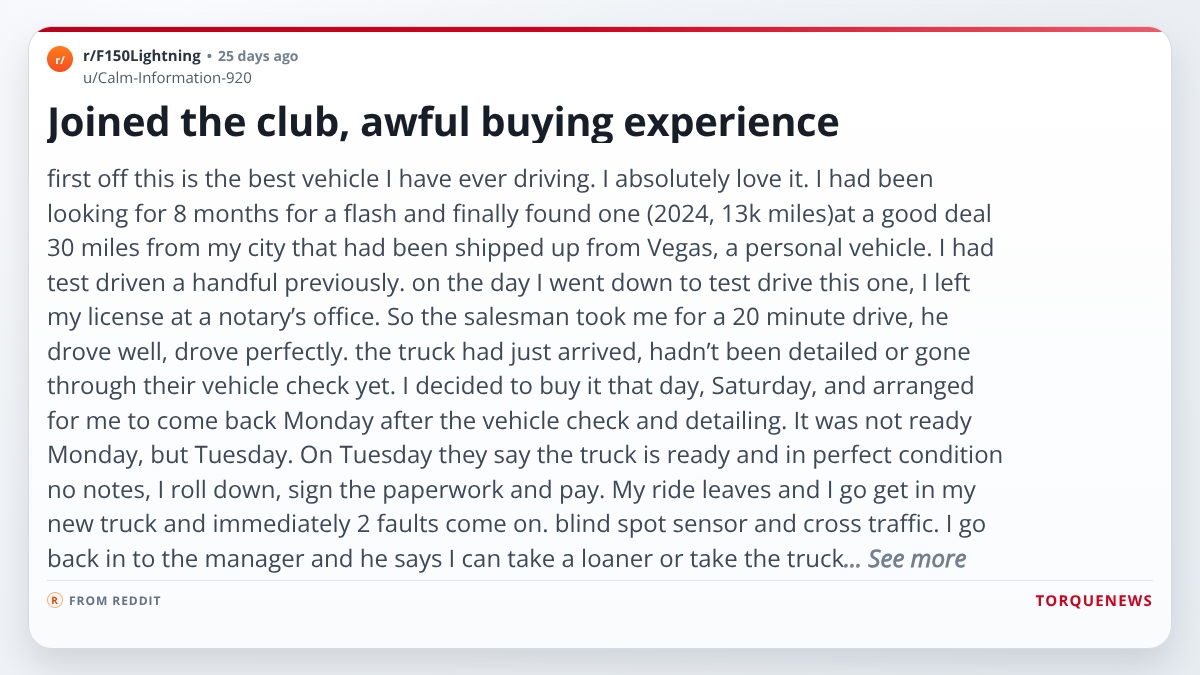
The immediate appearance of fault codes upon delivery, followed by a dealer's manager admitting the issues were "in the report" despite earlier assurances of a "perfectly clean" vehicle, is not merely incompetence; it's a deliberate obfuscation.
Ford F-150 Lightning: Dealer Accountability and Used EV Sales
- The F-150 Lightning, a 2024 model year in this instance, was purchased with 13,000 miles, indicating it was a relatively new used vehicle. Despite its low mileage, it presented significant undisclosed damage requiring a $3,900 repair for a cracked taillight and broken sensor.
- The truck's blind spot and cross-traffic monitoring systems were immediately non-functional upon delivery, critical safety features that should have been verified during any comprehensive pre-delivery inspection. The dealer's manager admitted these faults were known internally, but not disclosed to the buyer.
- The standard Ford Mobile Charger, designed to provide both 120V and 240V charging capabilities, was delivered missing its essential adapters. This omission renders the charger partially or entirely unusable for its intended purpose without additional purchases.
- The dealer's initial response to the faults was to offer a loaner or suggest taking the truck to another Ford dealership, a tactic that shifts responsibility rather than addressing the core issue of selling a damaged vehicle. This strategy delays resolution and places the burden on the buyer.
This sequence of events suggests a conscious effort to push a damaged vehicle through the sales process, hoping the buyer wouldn't notice or would simply absorb the repair costs. The manager's offer of a loaner or a drop-off at another Ford dealer, while seemingly helpful, was a tactic to get the buyer off the lot and shift the problem elsewhere, rather than fixing the vehicle they just sold.

The subsequent discovery of a cracked taillight and broken sensor, leading to a $3,900 estimate, directly contradicts the selling dealer's claims and the salesman's assertion of a "recall." This isn't a minor cosmetic flaw; it's a significant structural and electrical issue that impacts critical safety systems. The experience of Ewokc, a '23 Antimatter Blue Platinum owner, suggests a recurring issue:
Reddit user TheBarbon immediately recognized the dealer's maneuver, commenting:
Thank goodness you immediately went back in and told the manager there were faults. Sounds like nothing is in writing, but they put themselves in a corner. I’d just call and say you’ll take him up on this offer for a loaner and take the truck back and have them fix it.
The Barbon is correct; the verbal admission by the manager that the faults were known, coupled with the dealer's initial offer to "fix it," puts them on the hook. This is where the paper trail, or lack thereof, becomes critical. Any reasonable dealership would have halted the sale, disclosed the damage, and repaired it before delivery. This dealer chose to gamble, and the buyer is now in a protracted battle for resolution.
Beyond the physical damage, the missing 120V and 240V adapters for the mobile charger represent another layer of deceptive practice. The dealer explicitly stated it was the "standard Fomoco charger," implying completeness. This isn't a small omission; for an EV owner, a functional charger with all adapters is as fundamental as a gas cap for an ICE vehicle. It directly impacts the usability of the vehicle from day one.
The dealer letting a customer drive away with non-functional blind spot and cross-traffic monitoring systems shows their disregard for safety and customer satisfaction.
I had the same issue with the mobile charger! Was in the box and wrapped, and I assumed all together. Got home and no way to plug it in, but the dealer said that’s how used cars come, and I can order each for over $100.
This comment reveals a disturbing pattern: dealerships are either unaware of the complete contents of new EV charging kits or are deliberately removing components, then claiming it's "how used cars come." Ford provides these chargers with specific adapters for a reason. To suggest a customer should pay an additional $100+ for essential components that should have been included is a blatant disregard for the customer experience and the expected functionality of a nearly new vehicle. This is not how used cars "come"; this is how dealers shortchange customers.
The broader context of EV sales, especially for models like the F-150 Lightning, is still evolving, and some dealerships are clearly struggling to adapt. UltimatePragmatist, a '22 Lightning Lariat owner, recounted a bewildering delivery experience:
“I ordered my Lightning in early 2021. It was made and delivered in 2022. I lived in a rural place, and my local dealer never reached out (as Ford says they do) prior to the delivery. I called them, and the sales guy was shocked that someone was buying an EV. Anyhow, the truck arrived, and when I got to the dealer, there was a big crowd in the lot, but I just went into the showroom to meet the sales guy. There’s no one in there. I wait a bit, call the sales guy’s cellphone. He doesn’t answer, so I go outside to see what’s going on out there. The crowd is looking at my truck. An old farmer is in the driver’s seat. The person who turned out to be the sales associate was getting in the passenger’s seat, about to let him take a drive. Let’s just say that I stopped that from happening with extreme indignation. Of course, everyone else was upset because here comes this little lady ruining their fun.”
This anecdote, while not directly related to the initial post's damage issues, shows the chaotic and often unprofessional environment surrounding EV sales at some dealerships. From sales staff unaware of EV demand to allowing unauthorized test drives of sold vehicles, these experiences suggest a lack of proper training and respect for the customer. It further reveals the vulnerability of buyers when dealers are not prepared to handle these new technologies with the professionalism they demand, especially in expensive EV trucks such as the F-150 Lightning.

This F-150 Lightning owner's experience is a stark indictment of a dealership's ethical standards and operational competence. The undisclosed $3,900 damage and the missing charger components are not oversights; they are evidence of a system that failed at multiple points, from pre-delivery inspection to sales disclosure. Ford needs to hold its dealer network accountable for these practices, especially as EV adoption grows, because these incidents tarnish the brand's reputation and create unnecessary financial burdens for unsuspecting buyers.
Image Sources: Ford Media Center
About The Author
Noah Washington is an automotive journalist based in Atlanta, Georgia, covering sports cars, luxury vehicles, and performance culture. His reporting focuses on explaining the engineering, design philosophy, and real-world ownership experience behind modern vehicles.
Noah has been immersed in the automotive world since his early teens, attending industry events and following the enthusiast communities that shape how cars are built and driven today. His work blends industry insight with enthusiastic storytelling, helping readers understand not just what a car is, but why it matters.
Noah is also a member of the Southeast Automotive Media Association (SAMA), a professional organization for automotive journalists and industry media in the Southeast.
His coverage regularly explores sports cars, luxury vehicles, and performance-driven segments of the automotive industry, including the evolving culture surrounding Formula Drift and enthusiast builds.
Read more of Noah's work on his author profile page.
You can also follow Noah here:
Set Torque News as Preferred Source on Google
Follow us today...