

In a competitive market, you cannot expect to be successful with a substandard product. If in real-estate, it’s all about “location, location, location,” then in the EV market, it’s all about “range, range, range.” Range is especially important with electric trucks which are expected to be able to tow.
To start off the list of its shortcomings, the Ford F-150 Lightning is essentially a conventional pickup truck retrofitted with an electric drivetrain, resulting in an EPA-estimated range of 230-240 miles with the Standard Range battery and up to 300-320 miles with the Extended Range battery. Compare this to it main rivals, the Chevy Silverado EV and GMC Sierra EV. They offer impressive ranges, with the Silverado EV WT (Work Truck) hitting an EPA-estimated 492 miles (with real-world tests exceeding 500 miles), while the Sierra EV Denali Max Range achieves around 460-478 miles. The GM trucks delivered the range that the market required, and the Ford F-150 Lightning did not.
The F-150 Lightning’s lack of range has been a big point of contention on social media. One good example is on the F-150 Lightning Forum page, entitled “Range Not Close to Advertised”, where Nater posted:
“I just purchased a used 2024 lariat with 10k miles on it. It’s at 91% charge and only shows 236 miles of range...I don’t expect the full 320 miles, but I thought it would be much higher than where it is at now.”
MountainAlive responded with a helpful set of calculations:
“My quick rule of thumb is:
Summer = 2.5 kW/mi
Winter = 1.8 kW/mi (temps below 45F)
Towing = 1.0 kW/mi
Just take those numbers and multiple by your pack size. ER is 131 kW so:
Summer = 327mi range
Winter = 235mi
Towing = 131mi”
WaterboyNorCal provided more evidence of the Lightning’s diminished range:
“I average 2.1 miles/kWh on the highway at 70mph, which means I get about 200 miles of ‘range’ in my SR Lightning. Around town, I average 2.7 miles/kWh, which would translate to a ‘city range’ of about 260 miles. The truck has an EPA range estimate of 240 miles. Then there’s the issue of ‘winter range’…?”
The F-150 Lightning Cancellation Looks Like a Ford Failure, not an EV Problem
Globally, electric vehicle demand remains strong. Roughly one in five new cars sold worldwide in 2025 are electric, with that figure expected to rise to one in four next year. The global market sells about 80 million new vehicles annually, with 16 million in the US. The United States is diverging somewhat in the short and medium term, partly due to shifting incentives and trade barriers.
Current U.S. demand is distorted by a rush ahead of tax credit changes, making it difficult to read true consumer appetite until sales normalize. In the U.S., EVs currently account for about 5% to 6% of US new car sales, down from around 10% earlier. This represents a slowdown, not a collapse. Expectations that EVs would reach 20% to 30% of U.S. sales within a few years now appear unrealistic. A clearer picture of normalized demand is likely to emerge by spring, once incentive driven volatility fades.
Ford’s EV Pullback and Financial Reset
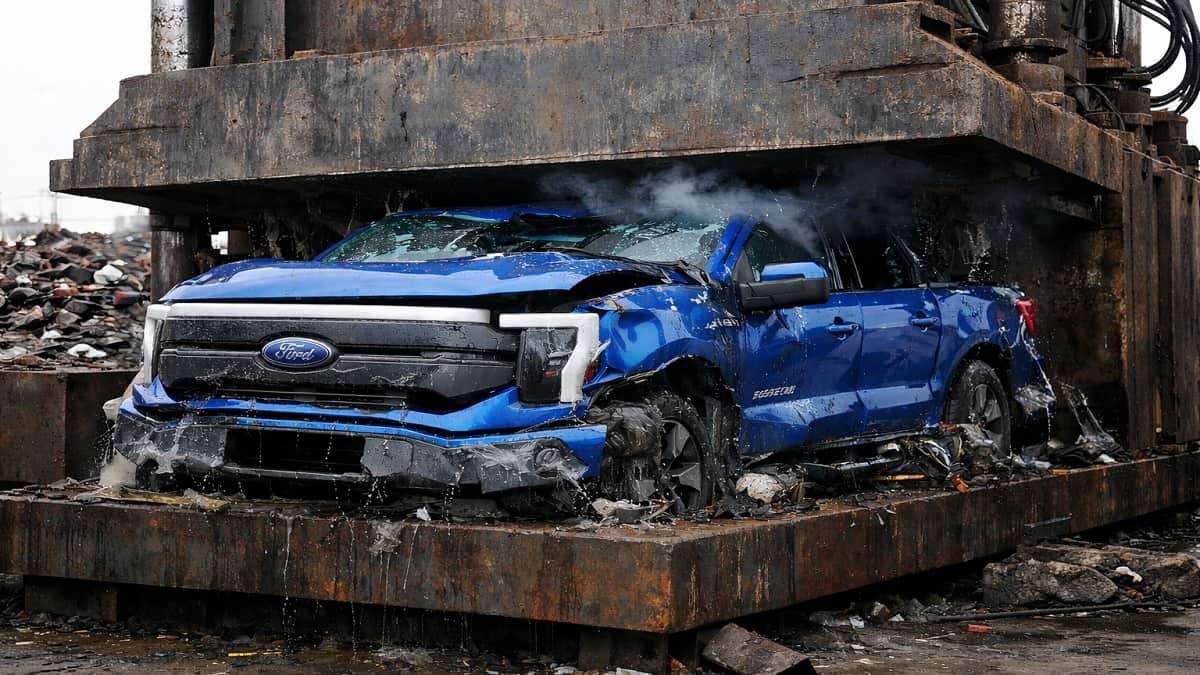
Ford is scaling back its electric vehicle ambitions at a cost of nearly $20 billion. The company is scrapping a planned electric truck and shifting production emphasis back toward gasoline vehicles and hybrids. Most of the charges will hit in the fourth quarter, with Ford saying the restructuring should make its EV division profitable by 2029. Investors reacted positively in the short term, with the stock rising about 1 percent on the news.
EVs Need to be Designed from the Ground up, Not Retrofitted Gas-Powered Vehicles
As stated above, the Ford F-150 Lightning seems to be a retrofitted version of the gas-powered F-150. It enabled Ford to get to market quickly, but with an uncompetitive product. Designing electric vehicles from the ground up matters because EVs have fundamentally different needs than internal combustion engine vehicles. EVs carry heavy battery packs that add significant weight, which requires stronger suspension, different suspension tuning, and different weight distribution. A purpose-built chassis is needed to safely package batteries low in the vehicle while preserving interior space and crash protection. Cooling systems, structural rigidity, aerodynamics, and software integration are also very different in EVs. Retrofitting a gas vehicle with an electric drivetrain often leads to compromises in range, efficiency, handling, and durability that dedicated EV platforms are designed to avoid.
Ford’s Ancient Dealership Model Probably Hurt the F-150 Lightning’s Success
Traditional automakers like the Ford Motor Company struggle with a dealership model that adds cost and buyer frustration. Newer automakers like Rivian, Lucid, and Tesla sell direct to consumers, avoiding dealer margins and keeping pricing transparent and consistent. Ford dealers often added massive markups to the F 150 Lightning. Reports included $50,000 premiums, doubling prices by adding $69,000 to a $51,000 truck, and $30,000 to $40,000 over MSRP, even on base trims, despite Ford warnings. In the end, buyers saw Platinum models near $90,000 balloon to $145,000 or more. That frustration hurt trust and demand, showing how distribution can undermine an otherwise compelling EV.
Policy Uncertainty and Long Planning Cycles
One major issue that Ford faced is the mismatch between poorly thought-out government policy swings and the auto industry’s long investment timelines. Automakers plan products and factories on five-to-ten-year cycles. Rapid shifts in regulations, incentives, and political priorities make it expensive to change course midstream. These reversals create real costs for manufacturers and investors because capital decisions cannot be unwound quickly.
Who Is Winning the EV Race Today
In the near term, success in the EV market will be about agility, fresh products, and navigating tariffs and EV policy shifts. Automakers like Toyota, GM, and Hyundai are benefiting from new models that are resonating with buyers. Others, including Honda, Nissan, Ford, and Stellantis, face challenges due to aging lineups and slower refresh cycles. Looking further ahead, autonomy will become existential. Personal autonomous vehicles are likely to replace conventional cars much like smartphones replaced flip phones.
Bottom Line
Ford’s EV pullback reflects a mix of instability from poorly conceived federal policy, long investment cycles, and imperfect early execution rather than a global rejection of electric vehicles. EV demand worldwide continues to grow, while the US market works through a period of recalibration. Further out, autonomy looks to be the defining long term battleground for automakers. Companies that combine strong products, regulatory credibility, and advanced autonomous systems are best positioned to survive and thrive in the next decade.
What Do You Think?
For pickup buyers, how much range is truly non-negotiable once towing and winter driving are factored in?
Would the F-150 Lightning have been more successful if it were designed as a ground up EV instead of adapting a gas platform?
Chris Johnston is the author of SAE’s comprehensive book on electric vehicles, "The Arrival of The Electric Car." His coverage on Torque News focuses on electric vehicles. Chris has decades of product management experience in telematics, mobile computing, and wireless communications. Chris has a B.S. in electrical engineering from Purdue University and an MBA. He lives in Seattle. When not working, Chris enjoys restoring classic wooden boats, open water swimming, cycling and flying (as a private pilot). You can connect with Chris on LinkedIn and follow his work on X at ChrisJohnstonEV.
Photo credit: Provided by author, Ford media kit
Set Torque News as Preferred Source on Google
Follow us today...




Comments
A dealer in Charlotte, NC…
Permalink
A dealer in Charlotte, NC where I live got a Lightning in 2023 and was charging thirty five thousand over MSRP. I would have bought it at MSRP, but that markup was unfair
The writer was chicken and…
Permalink
The writer was chicken and did not say which government policies he thought were hurting the industry. Is he talking about unreasonable mandates or policy shifts back to common sense.
Thanks for your comment. Let…
Permalink
In reply to The writer was chicken and… by Tony D (not verified)
Thanks for your comment. Let me elaborate. A “return to common sense” would be to stop paying hundreds of billions of dollars in subsidies to the U.S. fossil fuel industry. Why should the highly profitable fossil fuel industry get subsidies, but not the automotive industry that has many more jobs?
The fossil fuel industry receives billions of dollars in subsidies from the U.S. government each year through a combination of tax breaks, direct funding, and regulatory loopholes. According to estimates by organizations like the International Monetary Fund (IMF) and Environmental and Energy Study Institute (EESI), U.S. fossil fuel subsidies total between $10 billion and $20 billion annually in direct federal support, and hundreds of billions more globally when including externalized costs.
Range, Range, Range so true…
Permalink
Range, Range, Range so true. It's the most important thing.
I purchased 2024 lightning…
Permalink
I purchased 2024 lightning flash (extended range battery) and probably best vehicle I've owned. 61 years old and spent years in the car business. Currently own two other Ford trucks. I agree winter range is probably the biggest shortcoming but disagree somewhat on the idea that the lightning is simply an ICE conversion. It's much better balanced as they evened out weight distribution and it's actually much better trailering vehicle than my older super duty but again it's a big hit to the range when towing. Quick, quiet and smooth ride, wife loves to drive it. Feels like Ford got a little greedy at the outset and wasn't able to attract enough buyers but overall it's great. The standard range battery would have been a big disappointment for me. So many people out there that never owned, or driven, an EV that have all the answers......
Agree. The rear suspension…
Permalink
In reply to I purchased 2024 lightning… by Carl (not verified)
Agree. The rear suspension setup is different from the ICE F-150 and the Lightning feels much more comfortable to drive/road trip with.
Housing two Teslas in the garage, the (illogical IMHO) question I get is why didn't I get a Cybertruck? Obviously, I wanted an F-150 that ... well, blended in with other F-150s in a parking lot.
Author fails to provide…
Permalink
Author fails to provide additional details to the article. Articles mentions "range" with Ford's EV at 300-320 EPA rated range while the competition has nearly 500. The difference? The other trucks have a much larger battery pack to enable such. But...at a higher price point. Article is poorly produced without this and other details.
Correct, never quite an…
Permalink
In reply to Author fails to provide… by Bill (not verified)
Correct, never quite an Apples-to-Apples conversation. The GM and Cybertruck have a much bigger battery pack.
Increased range? Sure!
Longer charging time? Crickets.