
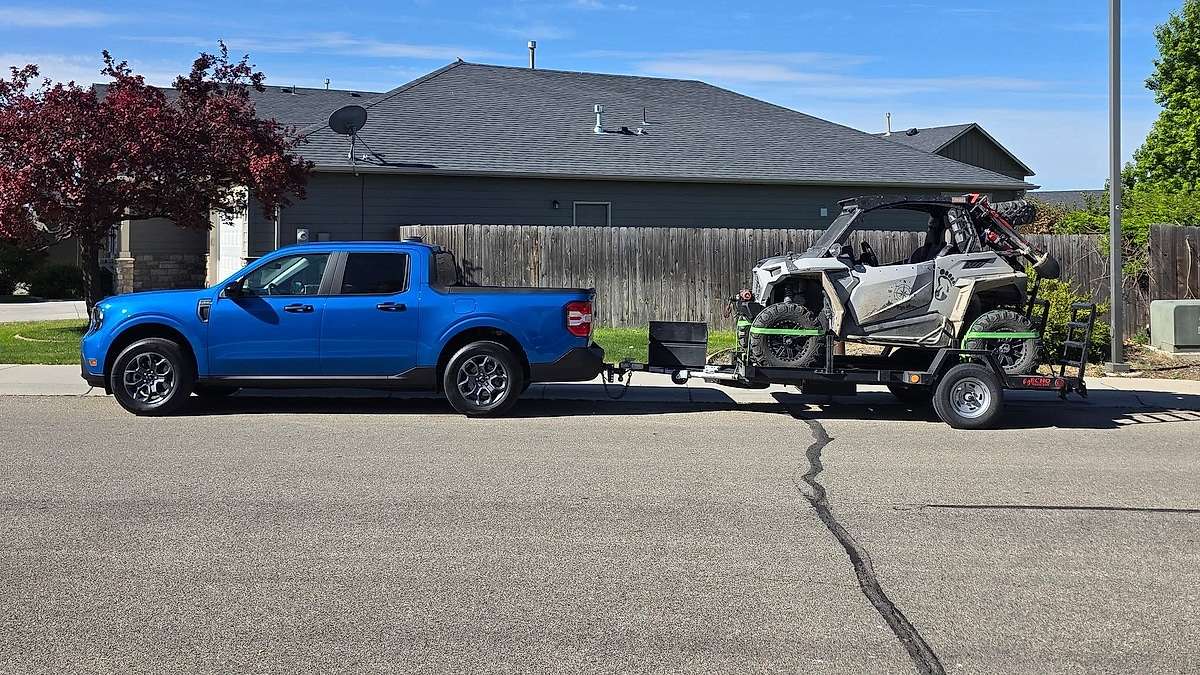

James Stewart’s blue Ford Maverick Hybrid looks almost too small in the photo for the job it just finished.
The truck is hitched to an open utility trailer carrying a Polaris RZR, with the side-by-side sitting high on the trailer, spare tire and gear hanging off the back, and a black storage box mounted near the trailer tongue. It is the kind of setup that makes people in full-size trucks smirk until the fuel receipt shows up.
Stewart says the trip was 212 miles round trip. He filled back up with just under 12 gallons, which worked out to 17.8 mpg. The route was not flat. He lives in Idaho, so the Maverick had to handle hill climbing. He kept the speed below 65 mph. The RZR weighs about 1,600 pounds, the trailer about 750 pounds, and his truck has the 4K Tow Package.
That puts the basic trailer load at 2,350 pounds before fuel, straps, the tongue box, accessories, spare tire weight, cargo, tools, coolers, and whatever else made the trip. For a compact hybrid pickup, that is a real tow.
The result is also more interesting than it looks at first. Stewart said the fuel economy was comparable to his Ram 3500 Cummins pulling at 75 mph. That is exactly the sort of comparison that makes Maverick ownership confusing in the best way. No one serious would pretend a Maverick can replace a heavy-duty diesel for real heavy-duty work. But for a 2,500-ish-pound powersports trailer, the small hybrid starts making an argument that is hard to ignore.
The Photo Explains Why 17.8 MPG Is A Solid Result
The Maverick was not pulling a sleek little teardrop trailer tucked neatly behind the tailgate.
The RZR sits tall. The trailer is open. The side-by-side has exposed tires, a roof, cage, body panels, gear on the rear, and a shape that does nothing friendly for airflow. The truck may only be moving 2,350 pounds before extras, but at 60 to 65 mph the air matters almost as much as the weight. That is why the 17.8-mpg number should not be judged like an empty highway run.
A Maverick Hybrid AWD can be a 30-plus-mpg truck in normal driving. Hook a tall open trailer behind it, send it through Idaho grades, and ask it to hold near-highway speeds, and the hybrid system stops looking like magic. It becomes a small engine and electric motor doing truck work against drag, elevation, rolling resistance, and trailer mass.
Seventeen-point-eight mpg in that setting sounds healthy.
The owner also did the one thing that probably saved the number: he kept speed below 65 mph.
That choice matters more than any trick accessory.
Speed Is The First MPG Lever To Pull
Stewart asked for tips to squeeze out a little better fuel economy.
The boring answer is the best one: stay slow.
A powersports trailer like this punishes speed quickly. The jump from 62 mph to 70 mph may not feel dramatic from the driver’s seat, but the aerodynamic load behind the truck climbs hard. The RZR’s cage, roofline, tires, and rear-mounted gear all become little parachutes. Add Idaho hills, and the Maverick spends more time outside its relaxed efficiency zone.
If 17.8 mpg came with speeds under 65, I would try the same route at 58 to 60 mph before changing hardware. That may feel painfully conservative on open roads, but it is the easiest experiment. No parts. No guesswork. No new hitch. Just time and discipline.
The second experiment would be cruise control only where the terrain allows it. Cruise control can work well on gentle highways. In rolling hills, it may chase speed too aggressively and ask for more throttle at the wrong time. A careful driver can sometimes let the truck bleed a little speed uphill and regain it gently downhill, which saves fuel and keeps the powertrain calmer.
This is especially true with a hybrid.
The Maverick’s system is happiest when the driver avoids forcing it to behave like a diesel pickup with endless torque reserve. Let it work. Do not bully it.
The Load Is Within The Right Conversation, But The Scale Still Matters
On paper, this setup sits comfortably below the Maverick’s 4,000-pound tow rating.
RZR: 1,600 pounds.
Trailer: 750 pounds.
Combined starting point: 2,350 pounds.
That leaves room for accessories and cargo, though real-world trailer weights always creep upward. A spare tire, winch, fuel, mud, tools, cooler, straps, tongue box, and trailer upgrades can add weight quietly. The photo also shows a fairly tall side-by-side, and height creates its own penalty even when the scale number looks friendly.
The bigger question is tongue weight.
Ford rates the Maverick hitch for 400 pounds of tongue load with the 4K package. A properly loaded trailer often wants roughly 10 to 15 percent of total trailer weight on the tongue. For a 2,500-to-2,700-pound real-world setup, that could put tongue weight somewhere around 250 to 400 pounds depending on trailer balance. That is right where owners need to pay attention.
The photo shows the RZR positioned with substantial weight over and ahead of the trailer axle. That may be perfectly fine. It may also be close enough that a tongue scale would be useful. Too little tongue weight can create sway. Too much eats into the truck’s payload and rear suspension margin.
This is the part of towing where guessing gets expensive.
Numbers Maverick Owners Should Notice
- The RZR and trailer start at about 2,350 pounds before gear, fuel, accessories, and the front storage box.
- The truck returned 17.8 mpg over 212 Idaho miles with hill climbing and speeds kept below 65 mph.
- Ford’s 4K Tow Package gives the Maverick Hybrid AWD a 4,000-pound trailer rating, but tongue weight and payload still decide how comfortable the setup feels.
The Maverick Hybrid’s Advantage Shows Up In The Right Use Case
This is the kind of towing job the Maverick Hybrid AWD should be doing.
A side-by-side on an open trailer. A weekend recreation load. A few hundred miles. Hills, but not a commercial haul. Sensible speed. Proper tow package. Enough trailer weight to be meaningful, not enough to require a three-quarter-ton truck.
That is the sweet spot.
The Maverick does not need to prove it can be a Ram 3500. That would be silly. The Ram exists for bigger trailers, higher speeds, heavier tongue weights, mountain grades with more margin, and the kind of loads that make small pickups sweat. The more interesting point is how many owners use big trucks for small-truck jobs.
If the load is 2,500 pounds and the trip is recreational, the Maverick starts to look smart.
It costs less to buy, uses less fuel empty, fits in normal places, drives like a compact crossover most of the week, and still handles a powersports trailer when asked. The 4K package finally lets the hybrid version do that job without forcing buyers into the EcoBoost.
That matters because many Maverick buyers wanted exactly this: hybrid efficiency during the week, enough towing muscle for weekends.
Stewart’s trip is a clean example of that promise working.
Why Comparing It To A Ram 3500 Is Fair And Unfair At The Same Time
The Ram comparison is funny because it is emotionally satisfying.
A little blue Maverick pulls the RZR, comes back at 17.8 mpg, and the owner says that is roughly comparable to his diesel Ram 3500 towing faster. That makes the Maverick look heroic.
The comparison still needs context.
The Ram was reportedly pulling at 75 mph. The Maverick stayed under 65. That 10-mph gap matters enormously. A heavy-duty diesel also carries more drivetrain, tire, axle, and vehicle weight everywhere it goes. It has reserve capacity the Maverick cannot touch. It can handle a much heavier trailer without turning every rating into homework.
But the Maverick wins the smaller argument.
For this specific load, at this specific speed, on this kind of trip, it delivered fuel economy good enough to make the big truck feel unnecessary. That does not threaten the Ram’s purpose. It highlights how often people bring a sledgehammer to a thumbtack.
The Maverick is not the stronger tow vehicle.
It may be the better choice for the job shown in the photo.
The Biggest MPG Gains Will Come From Air, Tires, And Habit
If Stewart wants to improve from 17.8 mpg, I would start with five things.
First, slow down a little more. Try 58 to 60 mph and compare the same route. That will likely do more than any accessory change.
Second, check tire pressures cold on the truck and trailer. Underinflated trailer tires create heat and drag. Underinflated truck tires do the same. Do not exceed sidewall or door-jamb guidance blindly, but start with pressures exactly where they should be for the load.
Third, reduce exposed cargo. Anything strapped high, loose, or hanging off the back adds drag. If gear can go in the truck bed under the rails or inside the front box, that is usually better than leaving it exposed on the trailer.
Fourth, play with RZR placement carefully. A few inches forward or backward can change tongue weight and stability. The goal is not to chase MPG at the expense of safe loading. The goal is stable tongue weight without overloading the rear of the truck.
Fifth, keep the trailer maintained. Wheel bearings, tire condition, alignment, brake drag, and hub temperature matter. A cheap infrared thermometer after a highway run can reveal a hot hub or dragging brake before it becomes a roadside story.
None of that is glamorous.
All of it works.
The Front Box Might Be Helping More Than It Looks
The black box near the trailer tongue caught my eye.
Depending on its shape and height, it may slightly smooth the transition from truck to trailer, or it may simply add weight and convenience. Either way, it is better than stacking loose gear high in the airflow. If Stewart can keep heavier tools, straps, and small cargo in that box while maintaining proper tongue weight, it may help the setup stay tidy.
The bigger aerodynamic offender is the RZR itself.
Open trailers are wonderfully convenient. They are also cruel to MPG. A side-by-side sits in dirty air, with tires, suspension, roll cage, roof, and rear accessories all exposed. An enclosed trailer might streamline some of that mess, but it would add weight and frontal area. For a Maverick, an enclosed trailer could easily make the overall tow feel worse even if the cargo looks cleaner.
That is the tradeoff.
For this truck, the open trailer is probably the right call. Just accept that the RZR is dragging air like a small billboard.
Hills Change The Hybrid Conversation
Idaho matters.
A flatland tow test tells you one thing. A hilly tow route tells you whether the driver is going to enjoy the trip. The Maverick’s hybrid system can help around town, during low-speed movement, and with regenerative braking. On sustained climbs, the gasoline engine has to do real work. On descents, the hybrid system can recover some energy, but a loaded trailer still requires careful speed control and braking discipline.
Ford’s own towing guidance warns that high altitude and heavy loads reduce performance, and that mountainous terrain and high-drag trailers can make it wise to choose more rating than the bare minimum. That is normal towing reality. It matters more in a compact truck.
Stewart’s setup has margin by weight. That is why the result feels encouraging. He was not asking a 4,000-pound-rated Maverick to drag 3,950 pounds through the hills while pretending nothing changed. He gave the truck a realistic load and drove at a realistic speed.
That is how a compact tow vehicle earns trust.
The 4K Package Is Doing Quiet Work Here
The 4K Tow Package is easy to reduce to one number: 4,000 pounds.
The hardware matters just as much.
The package brings the hitch receiver, wiring, cooling upgrades, trailer brake controller, and trailer sway control. Those pieces matter with a trailer like this. A side-by-side trailer may not be extremely heavy, but it has length, height, and momentum. Trailer brakes, if equipped and adjusted properly, can make the whole combination feel calmer. Sway control adds another layer of protection when wind, passing trucks, or uneven roads start testing the setup.
The Maverick Hybrid AWD with 4K is a very different proposition from a base hybrid rated for 2,000 pounds.
That is why I would be cautious about owners using Stewart’s result as permission for every Maverick. The package matters. The load matters. The road matters. The speed matters.
His truck was configured for the job.
A Practical Checklist Before The Next 212-Mile Tow
Before chasing more MPG, I would make the next run more measurable.
Use the same pump, same fill method, and same route if possible. Record average speed. Note wind direction. Note outside temperature. Check tire pressures before leaving. Use a tongue-weight scale. Take the trailer across a public scale loaded exactly as it travels. Record truck axle weights and trailer axle weight. After 50 miles, stop and check straps, hitch, electrical connection, tire heat, and hub temperature.
That sounds like overkill until something feels wrong at 63 mph with a side-by-side behind you.
Once the setup is measured, then the MPG experiments become meaningful. Try 60 mph instead of 65. Try a slightly different RZR position if tongue weight allows. Remove unnecessary exposed cargo. Compare with and without cruise control over rolling terrain. Make one change at a time.
The truck already returned a respectable number. The goal now is refinement, not rescue.
The Real Takeaway For Maverick Hybrid Owners
Stewart’s trip shows why the Maverick Hybrid AWD with 4K Tow has become such an important little truck.
It does not need to win a macho contest. It needs to pull the weekend toy, stay composed, use less fuel than expected, and avoid making the owner wish he had brought the big diesel. On this trip, it appears to have done exactly that.
A 17.8-mpg tow through Idaho hills with a Polaris RZR on an open trailer is a win for a compact hybrid pickup. There is probably a little more efficiency hiding in speed discipline, tire pressure, load placement, and trailer maintenance. There is also a point where chasing another mile per gallon becomes less important than keeping the trailer stable and the drive relaxed.
The Maverick’s best quality is not that it can pretend to be a heavy-duty truck.
Its best quality is that it can handle the kind of real work many owners actually do, then go back to being an efficient daily driver when the trailer is parked.
That is why this photo works. Small truck. Real load. Sensible speed. Good result.
What MPG Are You Seeing While Towing With A Maverick Hybrid?
If you tow with a Ford Maverick Hybrid AWD, what are you pulling, what does the trailer actually weigh loaded, how fast do you drive, and what MPG are you seeing over a full tank? Include terrain, tire pressures, tongue weight if you have it, and whether your truck has the 4K Tow Package.
Thanks for reading everyone. Come back tomorrow, or check our Torque News Home Page for more interesting automotive news articles.
One image by James Stewart from Facebook.
About The Author
Noah Washington is an automotive journalist based in Atlanta, Georgia, covering sports cars, luxury vehicles, and performance culture. His reporting focuses on explaining the engineering, design philosophy, and real-world ownership experience behind modern vehicles.
Noah has been immersed in the automotive world since his early teens, attending industry events and following the enthusiast communities that shape how cars are built and driven today. His work blends industry insight with enthusiastic storytelling, helping readers understand not just what a car is, but why it matters.
Noah is also a member of the Southeast Automotive Media Association (SAMA), a professional organization for automotive journalists and industry media in the Southeast.
His coverage regularly explores sports cars, luxury vehicles, and performance-driven segments of the automotive industry, including the evolving culture surrounding Formula Drift and enthusiast builds.
Read more of Noah's work on his author profile page.
You can also follow Noah here:
Set Torque News as Preferred Source on Google
Follow us today...






