
Raymond Boucher’s F-150 PowerBoost is doing the thing that gets half-ton owners into trouble.
It is making a big travel trailer feel manageable.
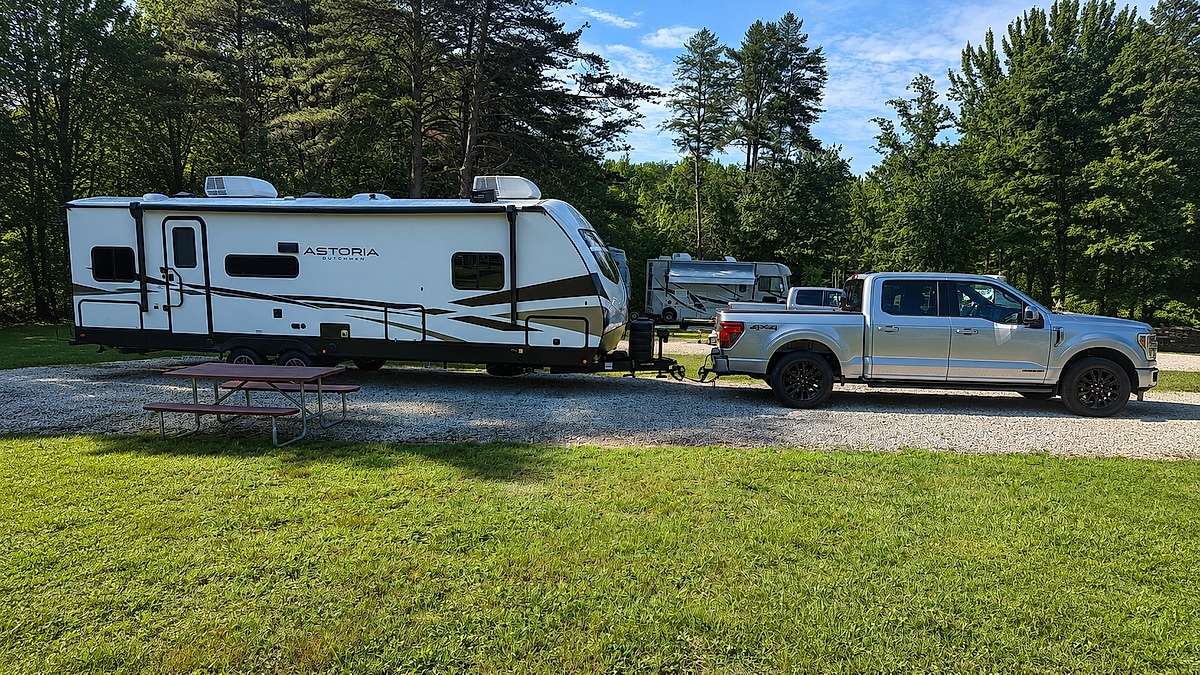
The photo on Facebook shows the Ford hitched to a 30-foot Astoria travel trailer at a campground. The truck sits composed. The trailer is straight. Nothing about the scene screams bad idea. Boucher says the trailer weighs 6,733 pounds empty and carries an advertised 895-pound tongue weight. He is using an Equal-i-zer weight-distribution and sway-control hitch. The truck pulls the camper fine, and stopping has not scared him because he anticipates, slows early, and gives himself room.
- Real-world tongue weight is almost always higher than the brochure number once propane, batteries, and gear are added, often pushing half-ton trucks closer to their payload limits than expected.
- A properly set-up weight-distribution hitch improves stability and ride quality, but it still counts against payload and does not reduce the actual load on the truck.
- Getting a certified scale ticket with the truck and trailer fully loaded is the only reliable way to confirm whether the setup is within safe limits.
Then comes the honest part. He is close to his payload limit, perhaps only a few hundred pounds under it. That is where the whole conversation lives.
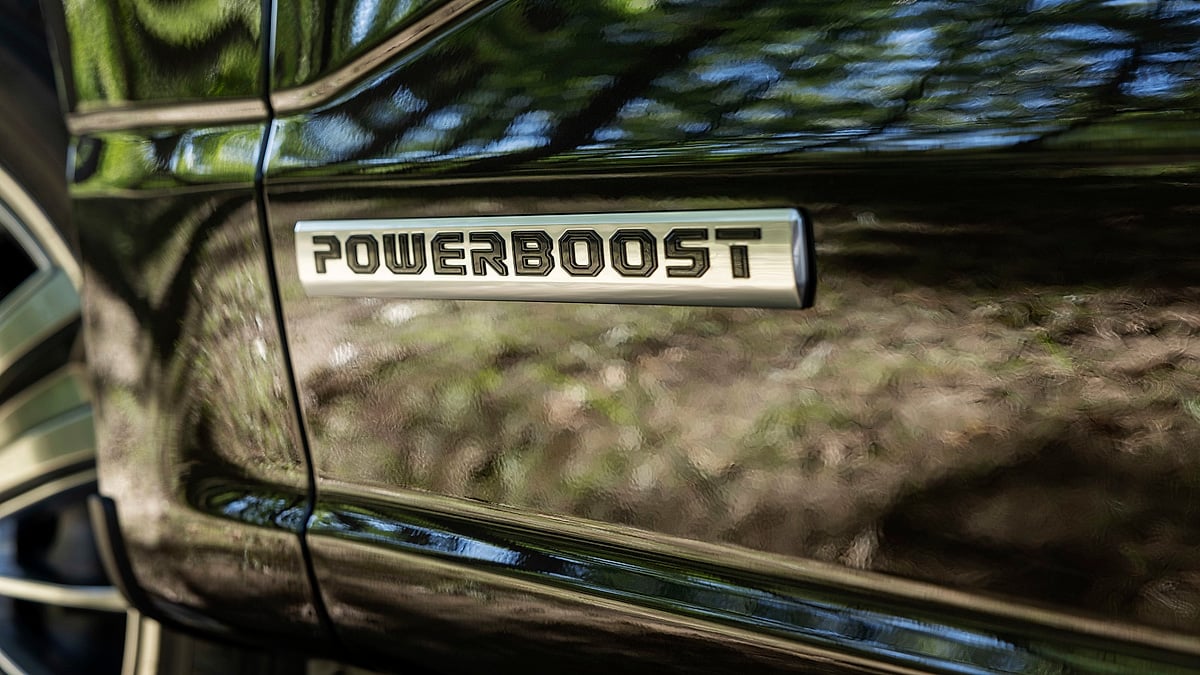
The PowerBoost is a seductive tow vehicle because it gives a half-ton driver a lot of torque, a smooth 10-speed automatic, hybrid assist, and the kind of campsite utility that makes RV owners start justifying monthly payments. A properly equipped 2022 PowerBoost can carry impressive published numbers. Ford lists 430 horsepower, 570 lb-ft of torque, and a maximum trailer rating up to 12,700 pounds.
Those numbers get people’s attention.
The door sticker gets the final vote.
The Trailer’s Dry Tongue Weight Is Already Heavy
The advertised 895-pound tongue weight is the number I would circle first.
That is, before real camping weight gets involved. Propane, batteries, front-storage cargo, tools, food, hoses, leveling blocks, chairs, outdoor mats, water in any tank, dealer-installed accessories, and the weight-distribution hitch itself all start leaning on the truck. A dry tongue weight is a starting line, not a travel number.
Run the rough math.
An 895-pound tongue on a 6,733-pound dry trailer is already 13.3 percent. That is not an oddball percentage for a travel trailer. It is also high enough that a loaded version can move quickly past 1,000 pounds on the hitch.
If the camper leaves the driveway at 7,500 pounds and keeps the same basic balance, the tongue could be near 1,000 pounds. At 8,000 pounds, a 13-percent tongue is roughly 1,040 pounds. At 15 percent, it is 1,200 pounds.
That does not mean Boucher is automatically overweight.
It means the advertised tongue figure is not the number he should trust for a loaded trip.
A 30-foot travel trailer can stay within the tow rating while walking straight into the payload limit. That is the half-ton trap. The engine and transmission may feel perfectly comfortable while the truck’s payload, rear axle, receiver, and tires are doing the quiet hard work.
The PowerBoost Has The Muscle
Nobody should pretend the PowerBoost lacks power.
It is one of the more interesting half-ton powertrains Ford has built. The hybrid system gives the 3.5-liter twin-turbo V6 an electric shove at low speed, the 10-speed keeps the engine where it wants to be, and the truck can feel relaxed with weight behind it. Around a campground or on rolling two-lane roads, that smoothness can make the driver wonder why anyone gets nervous about a 30-foot trailer.
That confidence is useful. It can also be misleading.
A truck that accelerates well can still be loaded too heavily. A truck that feels stable on smooth highway can still run out of payload. A truck that stops calmly in normal traffic can still need more margin during a panic stop, downhill grade, wet road, or crosswind shove from a passing semi.
Power is the easiest part of modern towing.
Modern half-tons have plenty of it.
The hard part is the boring stack of numbers that never shows up in the hero photo: payload label, actual tongue weight, hitch weight, passenger weight, bed cargo, axle readings, tire capacity, frontal area, and gross combined weight.
That is why Boucher’s concern is the right one. He is not asking whether the truck can pull the trailer. He already knows it can. He is asking whether the setup has enough margin to be comfortable.
That question is worth taking seriously.
A Weight-Distribution Hitch Helps, It Does Not Make Weight Disappear
The Equal-i-zer hitch is the right kind of equipment for this trailer.
A properly adjusted weight-distribution hitch can return weight to the front axle, improve steering feel, reduce rear squat, calm the trailer, and help the whole combination feel less busy. Sway control adds another layer of confidence when wind, passing trucks, or uneven pavement start working on the trailer.
That equipment does valuable work.
It does not delete tongue weight.
The hitch itself also weighs something. Depending on the setup, a weight-distribution hitch can easily add 70 to 100 pounds or more to the truck’s payload burden. That weight belongs in the calculation along with people, pets, coolers, tools, tonneau cover, bed gear, and whatever else rides in the truck.
Airbags, helper springs, RoadActive Suspension, and similar upgrades belong in the same mental category. They may improve ride attitude and reduce bounce. They do not rewrite the payload sticker.
A level truck is not automatically a legal or safe truck.
A level truck is just level.
Thirty Feet Of Trailer Is A Wind Problem
Weight gets most of the argument because it is easy to picture.
The wind may be the bigger daily annoyance.
Ford’s towing guide uses trailer frontal area because a trailer is not merely a weight. It is a wall pushed through the air. A 30-foot travel trailer has length, height, width, side area, and a large wake behind it. Even if the scale weight sits below the truck’s rating, the trailer can make the truck work hard on windy interstates.
This is where owner reports start diverging.
One person tows a 7,000-pound flatbed with lumber and says the truck barely notices. Another tows a 6,500-pound travel trailer and says the rig feels nervous in the wind. Both can be telling the truth. The flatbed is mostly for weight. The camper is a weight plus a sail.
Boucher’s setup may feel fine on calm roads with careful driving. A loaded car hauler passing close, a gusty bridge, an uneven overpass, or a long downhill curve can expose the difference between “pulls fine” and “has reserve.”
That is why his own driving habits matter. He says he anticipates and takes his time. Good. That is not cowardice. That is how you tow a large camper with a half-ton and keep the day quiet.
The Scale Ticket Would End The Guessing
The next step is not another comment thread.
It is a CAT scale.
Boucher needs the loaded truck and trailer weighed exactly as they travel. Family aboard. Dog aboard. Camper packed. Propane filled. Batteries installed. Hitch connected. Water at whatever level he normally carries. Bed cargo in place.
The first weigh should capture the truck and trailer with the weight-distribution hitch engaged. A second weigh with the bars released can help calculate how much load the hitch is transferring. A truck-only weigh gives the clean baseline.
Those numbers tell the truth:
actual trailer weight, actual tongue weight, front-axle load, rear-axle load, truck GVW, combined weight, and how much margin remains.
Without that ticket, everyone is guessing from a photo and a brochure.
The truck may be fine.
The truck may be over payload once the camper is ready for a real trip.
The driver deserves to know before a bad road tells him.
The Right Question Is Whether He Has Margin
Boucher’s setup sits in the gray zone where many half-ton travel-trailer owners live.
The truck is powerful enough. The trailer is not absurd for the class. The hitch is appropriate. The owner sounds cautious rather than reckless. The concern is not whether the PowerBoost can move the camper around the campground or cruise down the highway on a calm day.
The concern is how much margin remains when the trip stops being ideal.
Payload margin matters because vacations are never loaded like advertisements. Someone brings extra firewood. A cooler moves into the bed. A tank has more water than expected. A generator comes along. A dog crate appears. The tongue weight climbs. The rear axle gets heavier. The truck still pulls fine, right up until the setup has no room left for surprise.
A few hundred pounds of payload margin can disappear before the family reaches the interstate.
That does not mean every 30-foot trailer requires a Super Duty.
It means the owner should refuse to be comforted by the tow rating alone.
The PowerBoost May Be Perfect For The Right Camper
There is a version of this story where the F-150 PowerBoost is a terrific RV truck.
A properly loaded trailer. Verified axle weights. Payload still inside the door sticker. The front axle was restored by the hitch. Trailer brakes dialed in. Tires at proper pressure. The driver who slows down and plans fuel stops. Pro Power Onboard is available at camp. Hybrid torque on tap. Quiet operation around the site.
That is a strong package.
The PowerBoost’s best RV trick may not be its maximum tow rating. It may be how well it fits the actual camping life when the trailer is sized correctly. It can tow, power equipment, run campsite gear, and behave like a normal family truck the rest of the week.
Boucher may be close to that sweet spot.
He just needs numbers before confidence turns into a habit.
The Door Sticker Beats The Brochure
The clean answer is simple.
Do not ask a Facebook group whether the setup feels okay. Ask the truck.
The truck answers through its payload label, axle ratings, receiver rating, tire ratings, and scale ticket. The trailer answers through loaded tongue weight, actual loaded trailer weight, brake condition, and frontal area.
The PowerBoost will probably keep doing its part. The engine is not the worry. The hybrid torque is not the worry. The owner already says it pulls and stops well enough with careful driving.
Payload is the narrow gate.
If Boucher can load the camper for a real trip, run across a scale, and stay comfortably under the truck’s GVWR, rear axle rating, receiver limit, and tire ratings, then he has something more valuable than reassurance from strangers. He has proof.
If the scale says he is too close, the answer is not shame. It is an adjustment. Move cargo, reduce water, travel lighter, change trailer loading carefully, upgrade the tow vehicle if needed, or choose a smaller camper.
The truck does not care what the comment section thinks.
The scale does not either.
PowerBoost Owners, Post The Door Sticker And Scale Ticket
If you tow a 28-to-34-foot camper with an F-150 PowerBoost, share the truck’s door-sticker payload, loaded trailer weight, measured tongue weight, hitch setup, axle weights, and whether the rig still feels stable in wind.
Have you pushed your PowerBoost close to its limits, or found the perfect balance with your setup? Drop your real-world numbers, lessons learned, and any surprises you’ve run into in the comments; your experience could help the next owner avoid a costly mistake.
First image by Raymond Boucher
About The Author
Noah Washington is an automotive journalist based in Atlanta, Georgia, covering sports cars, luxury vehicles, and performance culture. His reporting focuses on explaining the engineering, design philosophy, and real-world ownership experience behind modern vehicles.
Noah has been immersed in the automotive world since his early teens, attending industry events and following the enthusiast communities that shape how cars are built and driven today. His work blends industry insight with enthusiastic storytelling, helping readers understand not just what a car is, but why it matters.
Noah is also a member of the Southeast Automotive Media Association (SAMA), a professional organization for automotive journalists and industry media in the Southeast.
His coverage regularly explores sports cars, luxury vehicles, and performance-driven segments of the automotive industry, including the evolving culture surrounding Formula Drift and enthusiast builds.
Read more of Noah's work on his author profile page.
You can also follow Noah here:
Set Torque News as Preferred Source on Google
Follow us today...