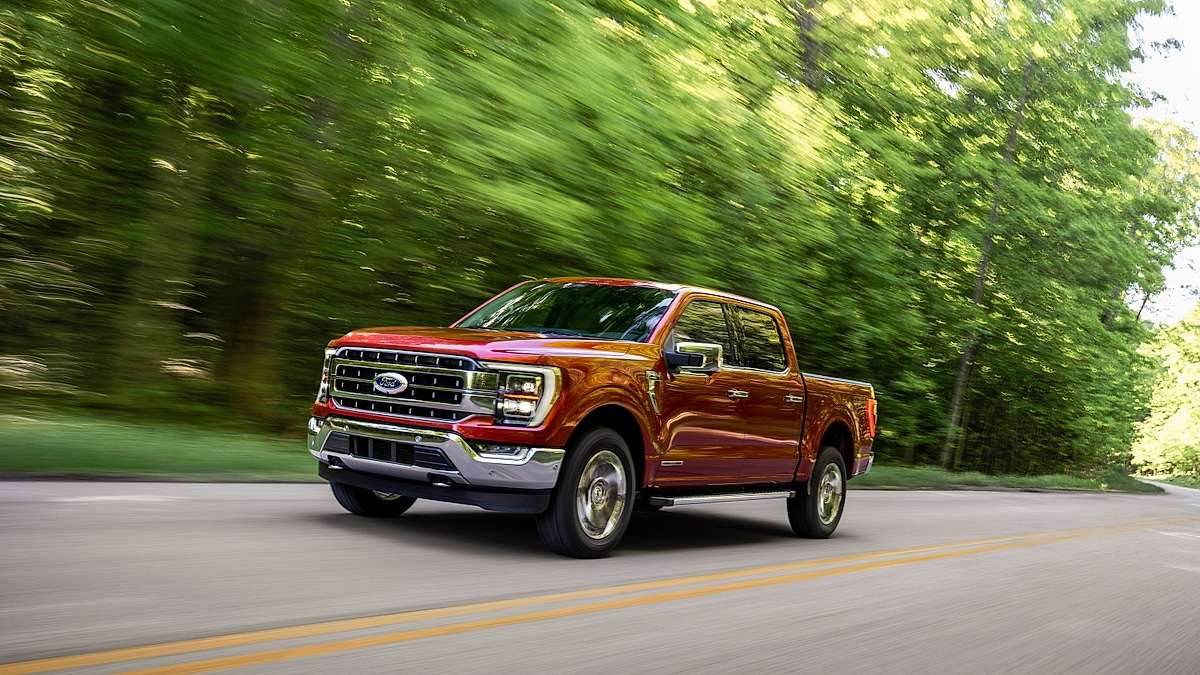

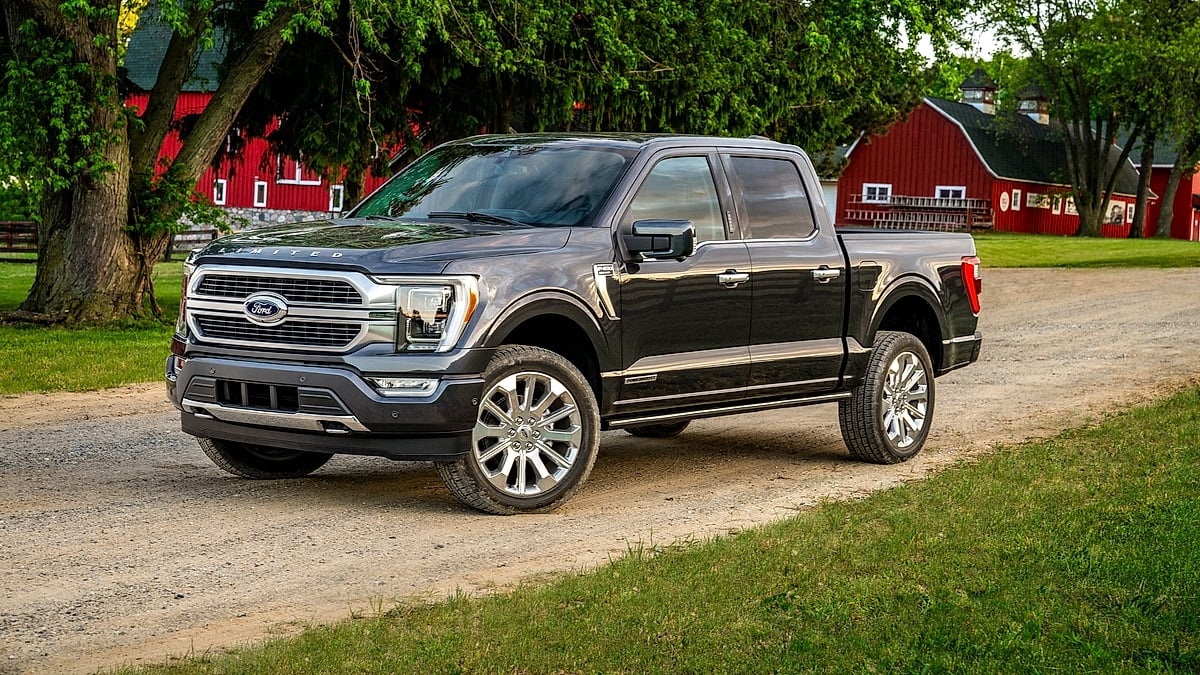
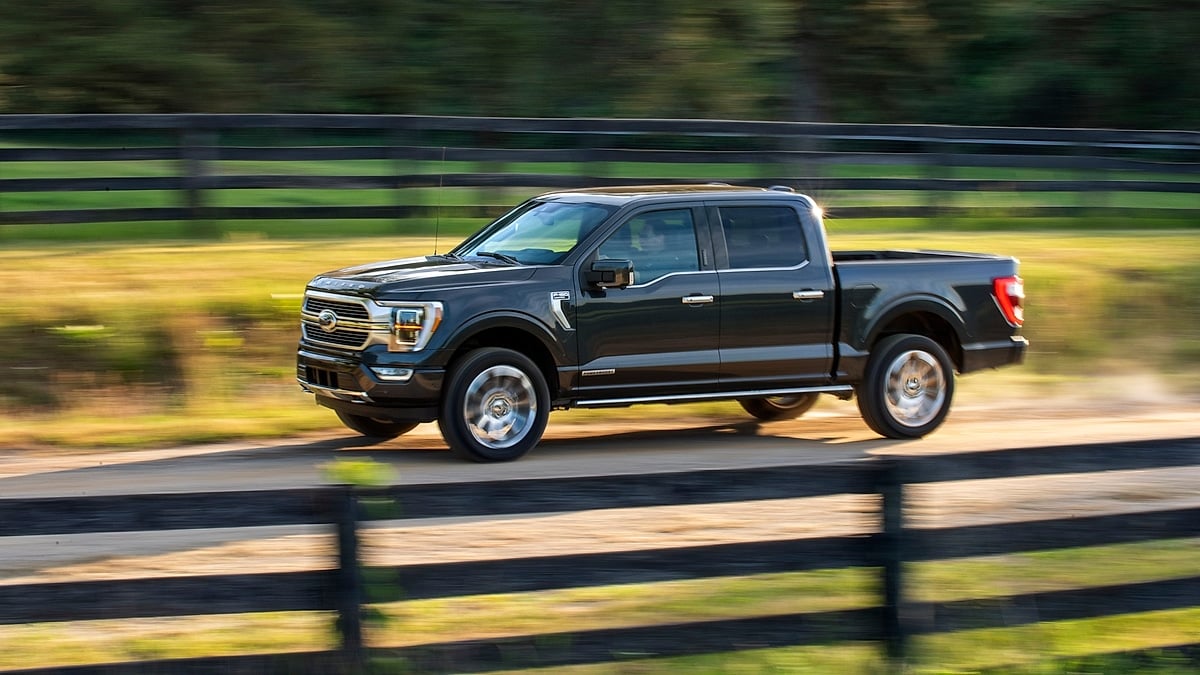
Brandon Lewis bought his 2021 Ford F-150 PowerBoost new. Nearly four years later, he posted in the Ford F-150 PowerBoost Owners group with a simple update that reads like a dare. “I’m nearing 180k miles, and I’m on the same hybrid battery, same under-seat battery, same engine, same transmission on my 2021 that I bought brand new,” Lewis says. Both the factory high-voltage hybrid battery and the under-seat auxiliary battery remain original. Neither has the engine. Neither has the transmission. He has a road trip coming, and he laid it out plainly: “I have a road trip scheduled from Texas to the Redwood National Forest and then Los Angeles to drop my mom off and then back home to Texas.” His reason is stated just as directly. “It is officially the longest-lasting vehicle I’ve ever owned and the one I trust to get us there in comfort.” The post was shared in the Ford F-150 PowerBoost Owners group.
In a follow-up comment, Lewis said an extended warranty covered several repairs, including a valve-body replacement, so “original transmission” should be read as the original transmission assembly, not a completely untouched transmission.
I drove an F-150 PowerBoost in 2021, and I have spent enough hours in these trucks to know the particular low-speed hum the hybrid system makes when it switches to electric mode. It sounds like a distant spaceship, and you notice it most in parking lots. After a few days, you stop hearing it. That sound means the 1.5-kWh lithium-ion pack is doing its job, which is not to power the truck alone for long distances but to fill in torque gaps, run accessories at idle, and recapture energy every time you brake.
What Torque News Checked
We reviewed the Facebook-group post attributed to Brandon Lewis and cross-checked the surrounding technical claims against Ford warranty materials, Ford TSBs, RepairPal estimates, Edmunds long-term-test data, and prior Torque News reporting.
We cross-referenced his mileage claims against Ford’s official hybrid warranty terms. We pulled documented replacement costs from prior dealer quotes published in this outlet. We confirmed the OTA update failure pattern against Ford’s Technical Service Bulletin 22-2117 and its superseding bulletin 22-2150. We compared his experience against Edmunds’ long-term fuel economy data and reviewed forum reports from other high-mileage PowerBoost owners.
The PowerBoost packs 430 horsepower and 570 lb-ft of torque, more torque than any F-150 short of the Raptor R. The EPA rates it at 24 mpg across the board: city, highway, and combined. But here is the thing about that number. Edmunds ran one for 47,288 miles and recorded a lifetime average of 19.9 mpg. Their best single tank was 25.6 mpg. Their best range on one fill-up was 700.3 miles, thanks in part to a 30.6-gallon fuel tank. Those are the real numbers, and they matter because they show what a PowerBoost actually does when a human drives it over real roads with real loads. If Lewis has averaged somewhere in that same neighborhood across 180,000 miles, he has put roughly 9,000 gallons of fuel through this truck. At current prices, that is a number that makes you wince.
But fuel economy is not why this story is worth your time.
The hybrid warranty is worth your time
Ford’s hybrid battery warranty, mandated by federal regulations, covers the high-voltage battery, the battery energy control module, the on-board charger, the inverter, and the DC/DC converter for eight years or 100,000 miles. It explicitly excludes “gradual capacity loss,” which Ford considers normal wear. Lewis is at 180,000 miles. He is 80,000 miles past the warranty limit. If his hybrid battery fails on the road to California, the replacement cost is his alone.
We know what that costs because another owner already paid it. At 103,000 miles, a 2022 PowerBoost Platinum owner was told his hybrid battery was “compromised” with visible burn marks on the wiring and protective cover. The dealer quoted $5,200 to replace it. That owner was 3,000 miles past warranty. Lewis is 80,000 miles past it. RepairPal lists the average cost for a Ford F-150 Hybrid High Voltage Battery Replacement between $3,448 and $3,750, but forum reports from owners suggest quotes as high as $8,500 depending on the dealer and the exact failure mode. The range is wide, but the risk is real.
Here is where it gets genuinely strange. Lewis noted something in his post that would terrify most engineers. “Another interesting fact,” he wrote. “This truck hasn’t had a single over-the-air update in over 3 years.”
Think about that. A hybrid vehicle, with a complex power management system, a 10-speed automatic transmission, and a high-voltage battery, has been running on launch-era software for 180,000 miles. No patches. No bug fixes. No feature updates. The last OTA update many 2021 F-150 owners report receiving was October 2022, software version 3.5.2.
Does Ford know about the issue?
Ford knows this is a problem. Technical Service Bulletin 22-2117, later superseded by TSB 22-2150, specifically addresses OTA update failures on 2021 F-150, Bronco, Edge, and Mustang Mach-E models. The bulletins describe a condition where the Accessory Protocol Interface Module or the Telematics Control Unit fails to accept updates, resulting in a cascade of failed updates and, in some cases, error messages displayed to the owner. Ford’s documentation estimates that roughly 10 percent of affected vehicles require the module recovery procedure outlined in the service bulletins.
The irony is almost too perfect. A truck that cannot update its own software has somehow avoided every major hardware failure for 180,000 miles. Correlation is not causation, and I am not suggesting that avoiding OTA updates somehow protects the battery. But the paradox is worth sitting with. Ford built a hybrid system that, in at least this one case, has survived nearly four years of Texas roads without a single software patch or hardware swap.
Things you notice after driving it
I have driven the PowerBoost on one long haul ride. The seats are comfortable for the first four hours. After that, you start to notice the firmness. The ride is controlled but not plush, and a Ram 1500 with its coil-spring rear suspension still does a better job of smoothing out broken pavement. The hybrid system’s instant torque makes the truck feel quicker than it has any right to be. In Edmunds testing, a PowerBoost XLT hit 60 mph in 5.8 seconds, matching an F-150 Raptor with the base V6. But the PowerBoost vibrates and sounds like a portable gas generator when it is charging the battery aggressively, and that is not a characteristic that improves with age.
Lewis is not unaware of the risk he is taking. He bought this truck new, has put 180,000 miles on it in under four years, and is now planning to drive his mother across the American West in it. That is a statement of confidence that no advertising budget can buy. “It is officially the longest-lasting vehicle I’ve ever owned and the one I trust to get us there in comfort.” Those are his words. It carries weight because it comes from someone with skin in the game, someone who knows that if the hybrid battery dies outside Needles, California, he is paying for the tow and the repair.
Denis Flierl, my colleague at Torque News, recently covered the Ford F-150 and noted that some owners are leaving for other platforms, such as the Dodge Ram. He also noted that long-term data show the 10-speed automatic transmission remains a bigger risk than the ranking suggests. The 10R80 has been dogged by harsh shifting, premature wear, and expensive failures. Lewis still has his original transmission. That fact alone, on a truck with 180,000 miles, is arguably as surprising as the intact hybrid battery.
The reality for owners
The practical reality for anyone reading this who owns a PowerBoost is straightforward. The hybrid battery sometimes fails early, with documented replacements at 55,000 miles. Others fail just past warranty, like the owner at 103,000 miles staring down a $5,200 quote. And then there is Lewis, at 180,000 miles, with a battery that has somehow refused to die. There is no guarantee implied by his experience. If anything, his truck may be an outlier. But outliers matter because they prove the boundary conditions. Ford engineered a PowerBoost drivetrain that, in this owner-reported case, has reached nearly 180,000 miles without replacement of the high-voltage battery, engine, or complete transmission, despite other warranty repairs along the way.
What happens next is the question. Lewis will drive to California. The battery will either make it or it will not. If it does, he will have added another 3,000 or 4,000 miles to a total that already exceeds Ford’s warranty threshold by an almost absurd margin. If it does not, he will join the growing list of PowerBoost owners who have learned that hybrid technology in a full-size truck is not a wear item you can ignore. It is a bet you make every time you turn the key.
I would not take that bet at 180,000 miles. But then again, I am not Lewis. He has already won the bet several times over. The road to the Redwoods will tell us whether his luck holds.
Would you take a road trip like this in your truck? Let us know in the comments below.
About The Author
Noah Washington is an automotive journalist based in Atlanta, Georgia, covering sports cars, luxury vehicles, and performance culture. His reporting focuses on explaining the engineering, design philosophy, and real-world ownership experience behind modern vehicles.
Noah has been immersed in the automotive world since his early teens, attending industry events and following the enthusiast communities that shape how cars are built and driven today. His work blends industry insight with enthusiastic storytelling, helping readers understand not just what a car is, but why it matters.
Noah is also a member of the Southeast Automotive Media Association (SAMA), a professional organization for automotive journalists and industry media in the Southeast.
His coverage regularly explores sports cars, luxury vehicles, and performance-driven segments of the automotive industry, including the evolving culture surrounding Formula Drift and enthusiast builds.
Read more of Noah's work on his author profile page.
You can also follow Noah here:
Set Torque News as Preferred Source on Google
Follow us today...