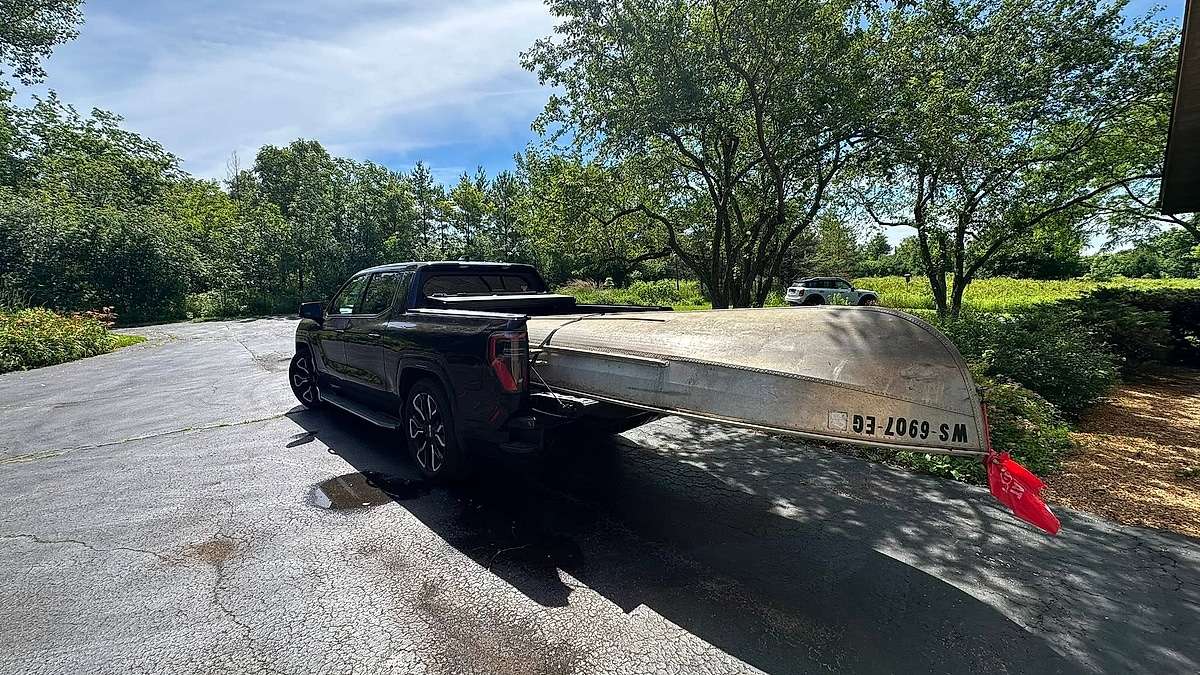

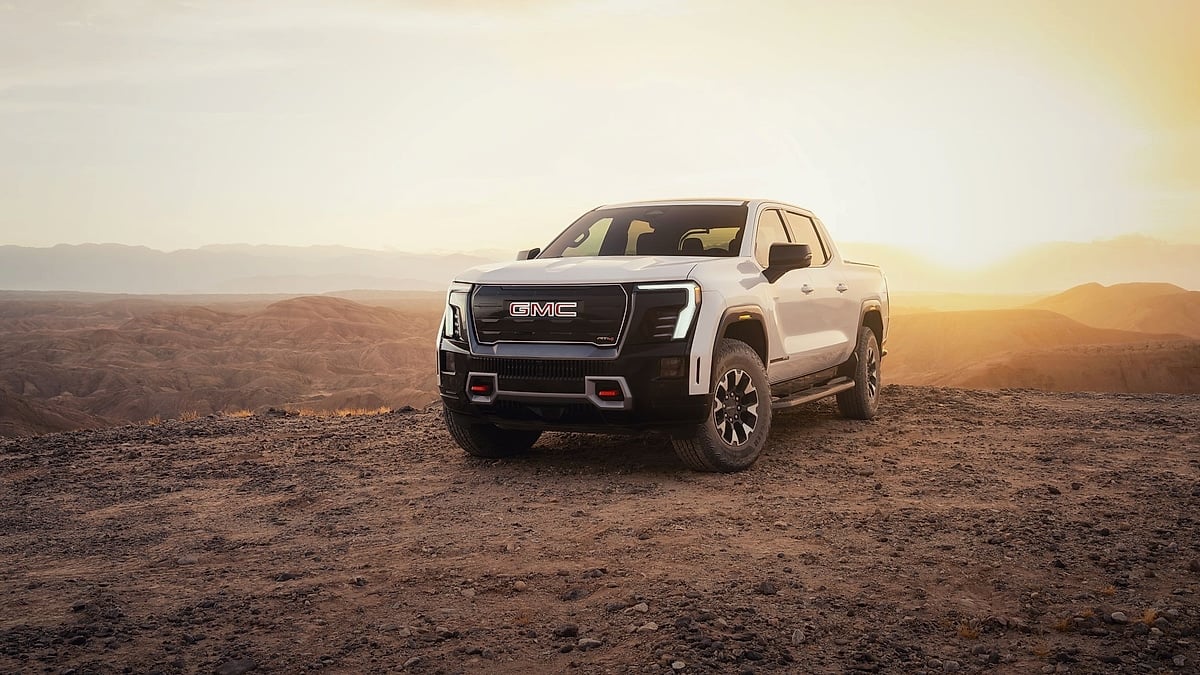
Ryan London put a 12-foot aluminum rowboat upside down in the bed of his GMC Sierra EV, lowered the tailgate, strapped the hull into place, and recorded the best efficiency he had seen in nearly four months of ownership on Facebook.
The screen showed 45.5 miles at 2.5 miles per kWh.
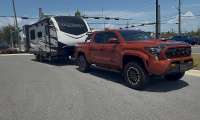
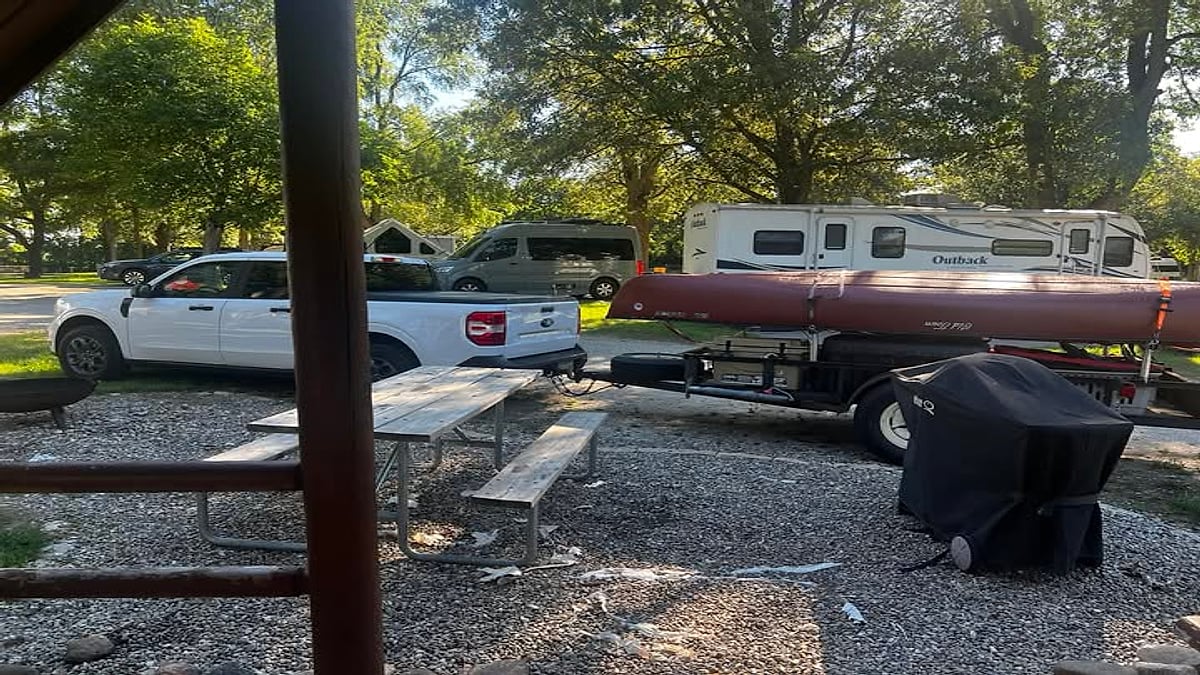
Around the same time, Arlene Kalmbach hitched a trailer carrying a canoe, two kayaks, clothing bins, and coolers to her 2026 Ford Maverick Hybrid. Her usual 34 mpg fell to 22 mpg on the highway.
- Speed matters more than most drivers expect: dropping from highway speeds to the low-40 mph range can dramatically reduce aerodynamic drag and improve efficiency, especially for EVs
- Carrying cargo inside the vehicle’s existing airflow (like in a truck bed) can be far more efficient than towing, even if the total weight is similar.
- Trailer shape and load arrangement often matter more than weight alone; tall, exposed gear can slash efficiency far more than a heavier but more streamlined setup.
The giant electric pickup appeared to enjoy its boat. The compact hybrid lost 12 mpg hauling lighter recreational gear.
The explanation begins with the view from the rear.
The Sierra’s Clock Gives Away Part Of The Secret
London’s Sierra EV covered 45.5 miles in one hour and five minutes. That works out to an average speed of exactly 42 mph.
At 2.5 miles per kWh, the truck consumed about 18.2 kWh over the trip, or 400 Wh per mile. That is an excellent result for a full-size electric pickup wearing enormous wheels and carrying a boat several feet beyond its open tailgate.
The pace deserves equal billing.
Forty-two mph is friendly territory for an electric truck. Aerodynamic demand remains far lower than it would at 65 or 70 mph, while the electric drivetrain avoids the idling and low-load inefficiency that punish a gasoline truck on slower roads. Stops and descents can return energy through regeneration.
London’s boat may have helped the airflow, though the photograph alone cannot prove it.
The hull sits upside down with its wider transom near the cab and its pointed bow extending behind the truck. From the side, it resembles the tapered rear fairings engineers call boat tails. The name is wonderfully literal in this case.
GM aerodynamic researchers have tested tapered extensions around the rear of a pickup bed and found measurable drag reductions in simulation. Those devices reduce the low-pressure wake behind the truck by allowing the air to close more gradually.
The aluminum hull in London’s bed was never designed as automotive aero equipment. Its position, gaps, angle, straps, and exposed structure differ from a developed fairing. Still, the basic shape points in the right direction.
One popular explanation from the comments deserves skepticism. Lowering the tailgate by itself usually does not improve pickup aerodynamics. Earlier SAE testing found that a lowered or removed tailgate slightly increased drag and rear lift. The air circulating inside an open bed can create a stable bubble that helps flow pass over the truck. Dropping the gate disturbs that pattern.
London normally drives with a hard folding tonneau closed, already a relatively tidy configuration. The surprising number could come from the slower trip, favorable wind, terrain, the boat’s taper, or some combination of all four.
A repeat over the same route would settle the argument. Same speed. Same weather. Tonneau closed and tailgate up on one run. Boat loaded exactly as shown on the next.
Until then, the clock is stronger evidence than the hull.
The Maverick Was Pulling A Second Vehicle Through The Air
Kalmbach’s Maverick faced a completely different job.
Her trailer may have been lightly loaded, but the truck still had to pull another axle, tires, bearings, fenders, frame, hitch, canoe, kayaks, bins, straps, and every disturbed pocket of air around them.
Weight demands energy while accelerating and climbing.
Drag sends the bill continuously.
The Maverick owner’s drop from 34 to 22 mpg represents a 35 percent fuel-economy loss. With the truck’s 13.8-gallon tank, the mathematical range falls from about 469 miles at 34 mpg to 304 miles at 22 mpg before any reserve is considered.
The 4K Tow Package gives the hybrid the hardware required for heavier duty: a trailer-brake controller, upgraded cooling fan, hitch equipment, and an auxiliary transmission-oil cooler. Those parts protect the vehicle and improve control. None can quiet the air behind a poorly streamlined load.
Ford places a 40-square-foot trailer frontal-area limit on Mavericks equipped with the package. That specification deserves more attention than it receives. Automakers know that a trailer’s aerodynamic footprint can become the limiting factor even when its scale weight appears modest.
A canoe and two kayaks can be light enough for two people to move by hand and still create an ugly highway wake. Curved hulls work beautifully in water. Mounted sideways, stacked above a trailer, or surrounded by racks and loose gear, they can become remarkably effective air brakes.
Kalmbach said the trip was highway and interstate driving. That pushes the Maverick into the environment where its hybrid advantage narrows.
Around town, the electric motor assists acceleration, regenerative braking recovers energy, and the gasoline engine can shut down frequently. On the interstate with a trailer attached, the engine works almost continuously. Tow mode changes powertrain behavior to manage load, response, cooling, and braking. The small hybrid battery cannot absorb a sustained aerodynamic demand and make it disappear.
Other Maverick owners in the discussion reported the same pattern. One saw about 29 mpg towing a 1,600-pound pop-up at 60 mph, then around 20 mpg at 70. Another reported more than 30 mpg with an open trailer and roughly 20 to 22 with an enclosed cargo trailer.
The trailers were different.
The wind understood each one immediately.
These Numbers Do Not Crown A Winner
The Sierra’s 2.5 mi/kWh and the Maverick’s 22 mpg do not belong on a single scoreboard.
The routes differed. Average speeds differed. Weather may have differed. One vehicle carried its load inside and behind the existing body wake. The other pulled a separate wheeled structure on the interstate.
Their value comes from the contrast.
London added a boat to a large truck without creating a second rolling chassis. The rowboat’s mass rode on the Sierra’s suspension, while its tapered hull extended rearward from the bed. At an average of 42 mph, the truck returned an unusually strong efficiency number.
Kalmbach’s load sat on a trailer. Even if the gear weighed far less than the Sierra’s payload capacity, the rig created additional rolling resistance and a new aerodynamic wake at highway speed.
This is why towing and hauling reports need more than weight.
A 1,500-pound open trailer carrying low machinery can use less energy than a 1,000-pound box trailer. A compact pop-up may outperform a lighter rack stacked with upright kayaks. A heavy Airstream can behave better at speed than a lighter camper with a flat front wall.
The scale tells the truck what it must accelerate and stop.
The shape tells the engine or battery what it must fight every second.
Owners Can Test This Without A Wind Tunnel
London already has the perfect experiment sitting in his driveway.
He should reset the trip meter and drive the same 45-mile route at the same average speed with the tonneau closed. Then repeat it with the boat positioned and secured exactly as shown. Wind direction, temperature, traffic, and elevation should be recorded.
A consistent improvement would make the accidental boat-tail theory much harder to dismiss.
Kalmbach can learn more by testing speed. Run the same highway segment at 60 mph and again at 70, with the trailer loaded identically. Check trailer-tire pressure and wheel-bearing condition beforehand. Keep the gear low and tightly secured. Follow Ford’s towing guidance and use the appropriate drive mode rather than chasing a better dashboard number at the expense of cooling or control.
The results may show that ten fewer mph recover several mpg.
That is often the cheapest modification available.
The Sierra owner found 2.5 miles per kWh with a rowboat protruding from the bed. The Maverick owner watched a trailer full of paddling gear drag 34 mpg down to 22.
The boat in the Sierra traveled inside the truck’s wake and may even have narrowed it.
The Maverick’s trailer built a second wake of its own.
The air kept the books.
Share The Load, Speed, And Real Number
Owners who have tested the same truck on the same route loaded and unloaded should post the cargo shape, average speed, wind, distance, and energy or fuel use in the comments below.
One image by Arlene Kalmbach
One image by Ryan London
About The Author
Noah Washington is an automotive journalist based in Atlanta, Georgia, covering sports cars, luxury vehicles, and performance culture. His reporting focuses on explaining the engineering, design philosophy, and real-world ownership experience behind modern vehicles.
Noah has been immersed in the automotive world since his early teens, attending industry events and following the enthusiast communities that shape how cars are built and driven today. His work blends industry insight with enthusiastic storytelling, helping readers understand not just what a car is, but why it matters.
Noah is also a member of the Southeast Automotive Media Association (SAMA), a professional organization for automotive journalists and industry media in the Southeast.
His coverage regularly explores sports cars, luxury vehicles, and performance-driven segments of the automotive industry, including the evolving culture surrounding Formula Drift and enthusiast builds.
Read more of Noah's work on his author profile page.
You can also follow Noah here:
Set Torque News as Preferred Source on Google
Follow us today...