
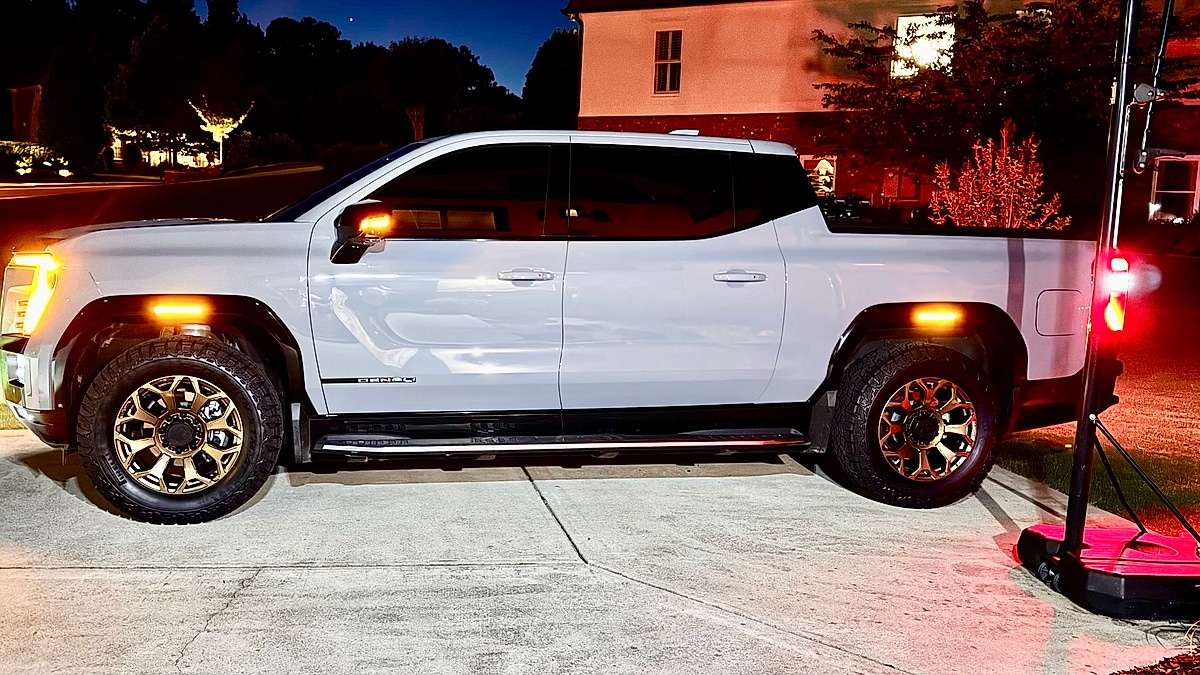

Moon Jeong’s GMC Sierra EV wheel swap started with the kind of sentence that makes electric truck owners lean closer to the screen.
“I don’t believe what I see.”
That came after he replaced the Sierra EV’s factory 24-inch wheel setup with 20x9 Almax AM-804 bronze wheels and Pirelli Scorpion ATR 285/65R20 tires. The wheels were a clearance deal from Tire Rack at $129.77 each, which is absurdly cheap for a 20x9 wheel going under a six-figure electric truck. Total wheel cost before tires, mounting, and everything else: $519.08. That number alone explains half the interest in his post.
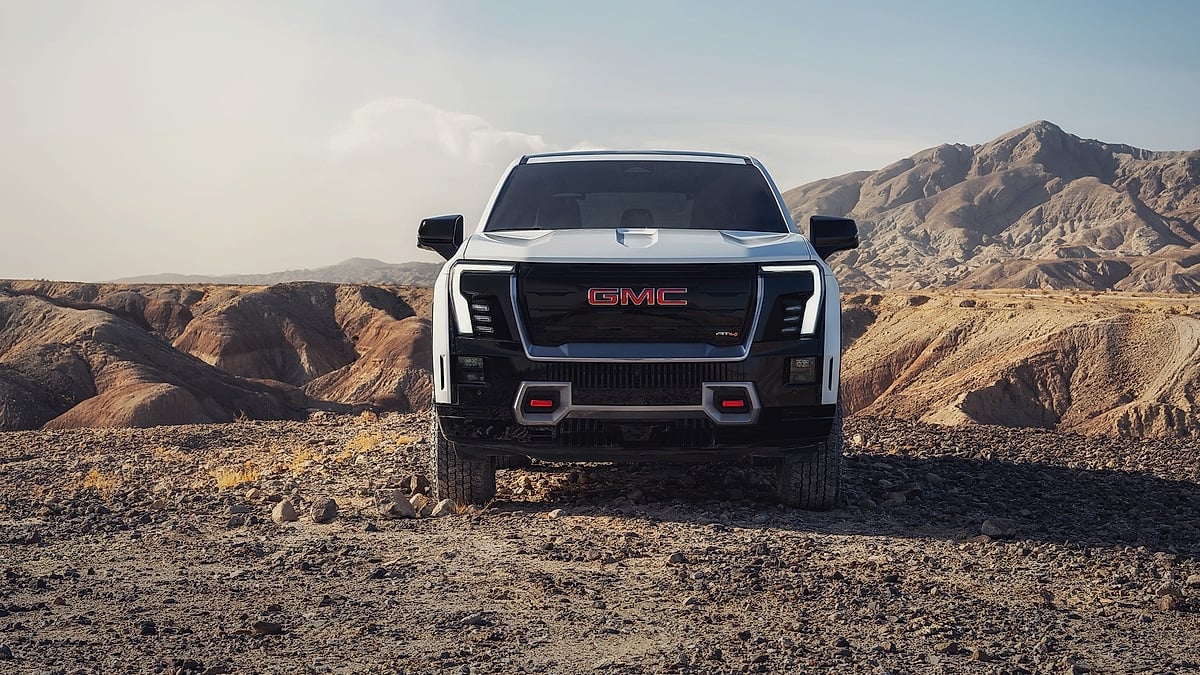
The rest came from the early driving report. Jeong said the new setup felt only marginally softer than the OEM 24s, kept the steering almost equally sharp, made more road noise, stuck out about an inch and a half farther than stock, and produced efficiency readings that did not match his expectations. On one 30-mile commute route where he usually sees around 2.6 mi/kWh in traffic, he saw 3.6 mi/kWh. Then on a later 35.5-mile run, he saw 2.4 mi/kWh, about 0.2 better than normal for that route.
That is where the story gets interesting.
Because the obvious prediction would have gone the other way.
The Setup Looks Like An Off-Road Downgrade Until The Details Start Fighting Back
The factory Sierra EV Denali wheel package is part of the truck’s whole personality. Big 24-inch wheels. Big visual mass. Big Denali drama. GM leans into that because the Sierra EV is a luxury electric pickup with serious range, huge torque, and a body that already looks expensive from a block away.
Dropping to a 20-inch wheel changes the flavor immediately.
A 285/65R20 tire has real sidewall. It gives the truck a more functional stance. It also makes the tire look like it belongs under an electric pickup that might actually leave pavement instead of spending its life reflecting valet lights. The Pirelli Scorpion ATR adds an all-terrain pattern, but this version is important: the owner says he bought the EV-focused version, and Tire Rack lists the 285/65R20 Scorpion ATR T0 Cybertruck-spec as an ELECT and PNCS tire.
This is not the same decision as throwing a heavy mud-terrain tire on a big EV truck and acting surprised when the range drops. The Pirelli has an aggressive enough look to change the truck’s attitude, but it is still built with EV use in mind. Tire Rack lists it at 45 pounds, with a 34.6-inch diameter, 10/32-inch tread depth, and a 116H XL service description.
The wheel is doing work too.
Jeong says the total wheel-and-tire package is about 10 pounds lighter per corner than the factory setup. Forty pounds of rotating unsprung mass is a real change. On a nearly 9,000-pound electric pickup, 40 pounds will not turn the Sierra EV into a Miata. But rotating mass matters most where stop-and-go driving lives, and his best early number came from a traffic-heavy commute.
That is the first clue.
The Tire Diameter Is Almost Perfect
The best part of this swap may be the least dramatic part.
A 275/50R24 tire works out to roughly 34.8 inches in diameter. A 285/65R20 comes in around 34.6 inches depending on the exact model and published spec. Tire Rack lists this Pirelli at 34.6 inches overall.
That means the new setup stays very close to the factory rolling diameter.
This is exactly what you want when changing wheel size on a modern EV. Too much diameter change can distort speedometer readings, range estimates, odometer calculations, driver-assistance assumptions, and the truck’s own energy math. Jeong’s swap keeps the basic tire height in the same neighborhood while trading wheel diameter for sidewall. That is the clean way to do it.
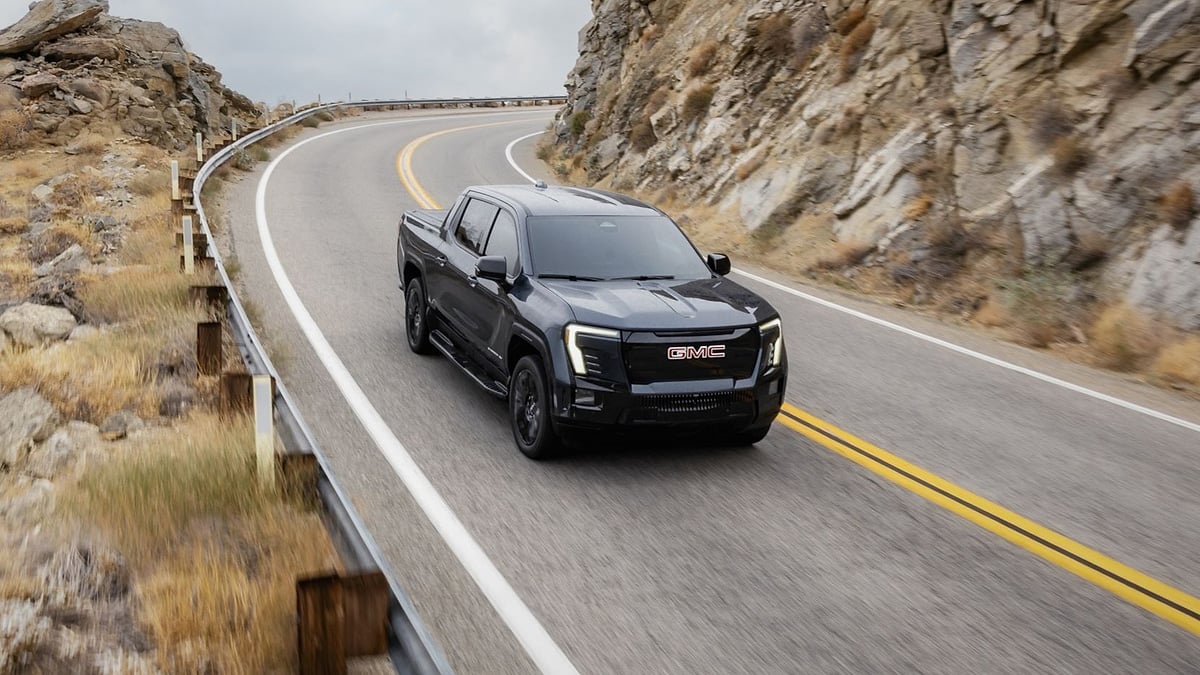
A smaller wheel with a taller sidewall can improve impact compliance, protect the rim, and give the truck a more useful tire package. The risk is that the new tire can weigh more, squirm more, hum more, or lose efficiency. In this case, the owner reports only a slight improvement in softness and no big loss of steering precision. That tells me the Pirelli’s sidewall is doing exactly what he suspected: staying stiff.
Some owners want plush. Some want sharp. This setup sounds like it moved the Sierra EV toward a tougher visual and practical package without turning the steering into pudding.
What The Numbers Tell Us
- The owner paid $129.77 per Almax wheel, or $519.08 for the set of four before the rest of the installation cost.
- The Pirelli 285/65R20 is listed at 34.6 inches overall diameter, very close to the factory 24-inch tire height.
- The owner says the new wheel-and-tire package is roughly 10 pounds lighter per corner than the OEM setup.
The Noise Report Sounds Completely Believable
Jeong rated the factory setup as a 10 for quietness and the new Pirellis as a 7.
That sounds right.
A Pirelli Scorpion ATR may be civilized for an all-terrain tire, but the Sierra EV’s factory 24-inch setup is playing a different game. Big luxury EVs are brutally honest about tire noise. Without an engine covering everything, the cabin starts reporting tread pattern, pavement texture, air turbulence, and tire construction directly to the driver’s ears.
Jeong also made a sharp observation: the extra noise may not come only from the tread pattern. The new setup sticks out about an inch and a half farther than the factory wheels. That means more tire face in the air, more turbulence around the wheel openings, and possibly more road spray, dust, and debris along the side of the truck.
That is a real cost.
Offset changes can make a truck look stronger, but they can also make it louder and dirtier. They can change scrub radius, bearing loads, steering feel, and how much junk the tires throw down the side of the body. On a gas truck, some of that gets lost in the mechanical background. On an EV Denali, every new sound gets a microphone.
A 7-out-of-10 quietness score is livable. It is also the number I would expect to matter more on a 600-mile highway day than on a short commute.
The Efficiency Claims Need More Miles Before Anyone Celebrates
The first 30-mile report of 3.6 mi/kWh is fascinating.
It is also too good to trust yet.
Jeong was clear about that. He said traffic was heavier than usual, and he had never seen that commute go above 3 mi/kWh before. His later 35.5-mile reading of 2.4 mi/kWh feels more useful because he compared it with a normal result around 2.2 on that same route. A 0.2-mi/kWh improvement on a heavy electric truck is still meaningful, but it is believable. The 3.6 number belongs in the “interesting, investigate later” drawer.
Short EV efficiency readings are messy.
Traffic can help if it keeps speed down. Wind can dominate the result. Temperature is a factor. Tire pressure matters. Climate load is always something to watch for. Elevation changes will also obviously affect the vehicle... A few miles of slower-than-usual driving can make a truck look magically efficient. A slight tailwind can turn a social media post into a science project. A new tire with full tread can also change over its first few hundred miles as mold release wears away and the casing settles into normal use.
The Sierra EV is especially tricky because it carries so much battery. A small percentage swing can represent a lot of energy. The truck may show a beautiful efficiency number over 11 miles or 30 miles, but the better test is a repeated route over several hundred miles, with similar weather, same tire pressures, same speed range, and the same driver behavior.
For now, I would treat the 2.4 mi/kWh reading as the one to watch.
If the truck normally gets 2.2 on that route and the Pirelli setup keeps returning 2.4, that is roughly a 9 percent improvement. That would be a real result.
If the next few hundred miles settle back to 2.1 or 2.2, the early numbers were traffic and conditions playing tricks.
Why A More Aggressive Tire Might Still Help In This Specific Case
The idea that an all-terrain-looking tire could improve efficiency sounds backwards until you look at the whole package.
The new setup may be lighter. The rolling diameter is close to stock. The tire is EV-focused. The sidewall is stiff enough that steering did not go lazy. The owner’s commute appears to include enough traffic that lower rotating mass and lower average speed may matter more than high-speed aerodynamics.
That is the exact situation where a wheel-and-tire swap can surprise people.
At 75 mph, I would expect the wider stance, exposed tire, and tread pattern to hurt. On a 40-mph average-speed commute with traffic, the equation changes. The truck spends more time accelerating, coasting, regenerating, and rolling through lower-speed air. Jeong even said that with regen turned off, the Sierra EV seemed to coast more than before.
That is subjective, but owners notice coasting.
A tire with lower rolling resistance can make an EV feel freer when the driver lifts. A lighter wheel package can make acceleration feel slightly easier. A tall sidewall can smooth tiny impacts. None of this guarantees better efficiency, but it gives the early readings a plausible path.
The aero penalty may simply not be showing up yet.
Take the same setup onto an interstate at 75 mph with crosswinds and the answer may change quickly.
Load Rating Is The Check I Would Do Before Towing
This is the part I would not skip.
The Pirelli 285/65R20 116H XL is listed at 2,760 pounds max load per tire. Four tires add up to 11,040 pounds of tire capacity on paper. That may sound like plenty, but the Sierra EV is a very heavy truck, and the factory tire fitment commonly listed for the Denali is an LT275/50R24/E 121S-type tire. A 121 load index carries more capacity than a 116.
That difference matters for a truck that may tow, haul, or carry heavy tongue weight.
I am not saying Jeong’s setup is unsafe. I do not have his door-jamb tire placard, axle ratings, loaded weight, final inflation settings, or towing plans. I am saying this is the first adult question after the cool photos.
Does the replacement tire meet or exceed what the truck’s placard requires for load, speed rating, pressure, and use case?
If the Sierra EV is mostly commuting, running empty, and using these wheels for style and ride, the answer may be different than if it is towing near the limit or hauling heavy payload. Tire load is not an aesthetic category. The sidewall has to match the truck’s actual job.
Before towing with this setup, I would compare the Pirelli’s load rating against the OEM tire rating, the door placard, the axle ratings, and the intended trailer tongue weight. Then I would set pressures based on tire manufacturer guidance and actual load rather than guessing.
A wheel deal is only a deal if the tire is rated for the work.
The Offset Gives The Truck Presence And Adds Consequences
The Almax wheel spec matters: 20x9, ET20.
That offset likely pushes the wheel farther outward than the stock setup, which matches Jeong’s comment that the tires stick out roughly an inch and a half more. Visually, that can be great. A huge EV truck on slightly poked 20s with bronze wheels and 35-ish-inch all-terrain rubber has the right stance. It makes the Sierra EV look less like a tech-luxury pickup and more like something that can take a dirt road without asking for permission.
The consequences arrive quietly.
More poke can increase spray and rock chips. It can add tire noise. It can affect steering feedback. It may change how the suspension feels over sharp impacts. It can increase the chance of rubbing under compression or steering lock, depending on ride height and alignment. It may also matter if the truck uses sensors, drive modes, air suspension calibrations, or clearance assumptions built around the factory package.
Jeong’s first 100 miles sounded positive. No dramatic ride penalty. Steering still sharp. Noise livable.
That is a good start.
The real test will come after rain, highway miles, full-lock parking maneuvers, loaded driving, and a few rough roads.
The Sierra EV Makes Wheel Choices More Important Than A Gas Truck Does
A gas Sierra can hide a lot with engine noise, transmission shifts, and old pickup expectations.
The Sierra EV does not give owners that cover. It is heavy, quiet, powerful, and expensive. A wheel-and-tire change can alter the entire personality of the truck. Noise becomes more obvious. Efficiency changes become visible on the energy screen. Regeneration and coasting feel different. The truck’s massive battery makes small percentage differences look tempting. The cabin is quiet enough that tread hum becomes part of the ownership experience.
That is why Jeong’s post drew attention.
Sierra EV owners are still learning what works. This is a new platform, and the aftermarket is still catching up. The factory 24s look premium, but not every owner wants that much wheel. Some want a tougher tire. Some want cheaper replacement options. Some want sidewall protection. Some want range. Some just want the truck to stop looking like it is wearing jewelry.
A 20-inch package gives owners room to experiment.
The challenge is finding the combination that does not punish the truck.
I Would Give This Setup 500 Miles Before Drawing Conclusions
The early signs are promising enough to follow.
The wheel price was excellent. The diameter match is clean. The EV-rated Pirelli tire is a smarter choice than a random heavy all-terrain. The owner reports only a slight ride improvement, sharp steering, acceptable noise, and possibly better efficiency in mixed traffic. That is a good first chapter.
The next chapter needs data.
Same commute. Same pressure. Same approximate weather. Same drive mode. Same regen setting. Similar traffic. Several hundred miles. Then a highway run. Then a rain run. Then a loaded run if the owner uses the truck as a truck. I would also want to know whether the truck’s range estimate recalibrates after more miles, whether the efficiency remains better above 60 mph, and whether the tire noise becomes tiring on coarse pavement.
The 3.6 mi/kWh number is the flashy part.
The 2.4 mi/kWh result may be the truth trying to introduce itself.
The Best Part Of This Swap Is That It Makes The Sierra EV Look Less Fragile
The Sierra EV is a strange thing in the best way: a giant electric luxury pickup with 800V fast charging, huge range, four-wheel steering, serious towing ability, and a cabin that wants to be treated gently. The factory 24s fit the Denali image, but they also make the truck look like it belongs more at a hotel entrance than a trailhead.
The 20-inch Almax and Pirelli setup changes that.
It gives the truck more sidewall, more tire, and a stance that suits the size of the vehicle. Bronze wheels on a Sierra EV could have gone wrong. Here, the idea makes sense because the tire fills the wheelwell without creating a cartoon build.
If the load rating checks out for the owner’s use, and if the efficiency does not collapse over longer testing, this could become a very interesting alternative for Sierra EV owners who want out of the 24-inch wheel world.
The noise penalty is real. The load-rating question needs attention. The efficiency claims need more miles.
The idea itself is strong.
A big electric truck deserves a tire package that looks ready for work, not only for valet lighting. Jeong may have found one that keeps the diameter close, trims weight, improves the stance, and avoids the worst range hit people fear from all-terrain rubber.
Now he needs the boring part.
Data.
What Wheel And Tire Setup Works Best On The Sierra EV?
If you own a GMC Sierra EV or Chevrolet Silverado EV and have changed wheels or tires, what size did you choose, what did the package weigh, how much did efficiency change, and did the noise or ride improve after the first 500 miles?
Thanks for reading guys. Come back tomorrow, or check our Torque News Home Page for more interesting automotive news articles.
One image by Moon Jeong
About The Author
Noah Washington is an automotive journalist based in Atlanta, Georgia, covering sports cars, luxury vehicles, and performance culture. His reporting focuses on explaining the engineering, design philosophy, and real-world ownership experience behind modern vehicles.
Noah has been immersed in the automotive world since his early teens, attending industry events and following the enthusiast communities that shape how cars are built and driven today. His work blends industry insight with enthusiastic storytelling, helping readers understand not just what a car is, but why it matters.
Noah is also a member of the Southeast Automotive Media Association (SAMA), a professional organization for automotive journalists and industry media in the Southeast.
His coverage regularly explores sports cars, luxury vehicles, and performance-driven segments of the automotive industry, including the evolving culture surrounding Formula Drift and enthusiast builds.
Read more of Noah's work on his author profile page.
You can also follow Noah here:
Set Torque News as Preferred Source on Google
Follow us today...



Comments
Noah did an awesome job…
Permalink
Noah did an awesome job writing this article! He looked at all the angles and also made sure that he didn't give an opinion one way or the other on this issue. There still are unbiased journalists after all, who knew???
Appreciate that. The goal is…
Permalink
In reply to Noah did an awesome job… by John (not verified)
Appreciate that. The goal is always to let the numbers do the talking. Readers are smart enough to draw their own conclusions.
Just can't fix a total waste…
Permalink
Just can't fix a total waste of time and money on a vehicle, much less the mind- numbing minutia of this article. Good grief
This is no surprise to EV…
Permalink
This is no surprise to EV enthusiasts. It's been know for a long time that larger wheels are less efficient. If you compare the efficiency of models that have optionally larger wheels, the EPA rating always goes down.
Exactly right. The EPA data…
Permalink
In reply to This is no surprise to EV… by Kevin H (not verified)
Exactly right. The EPA data backs that up every time. Bigger wheels look good on a spec sheet and hurt you on a long drive. Not complicated, just physics.
It makes sense to me that if…
Permalink
It makes sense to me that if you go to smaller tires that the speedometer and odometer wouldn’t give the correct readings. They would think you went faster and further.
The car is calibrated around…
Permalink
In reply to It makes sense to me that if… by Max (not verified)
The car is calibrated around the factory tire diameter, so swapping to a smaller size throws off both readings. Worth factoring in if you're chasing accurate efficiency data.
This article sounds like it…
Permalink
This article sounds like it was written by ai with slight human oversight...
What is the difference in…
Permalink
What is the difference in overall range on a full charge to needing a new one, empty and loaded? Those are the only numbers that really matter.
I will look into it and get…
Permalink
In reply to What is the difference in… by Scott (not verified)
I will look into it and get back to you.
Nice analysis on my review :…
Permalink
Nice analysis on my review :) I've updated with efficiency figures after 1k miles. it's an interesting read and its at the GMC Sierra EV Group in Facebook titled Update on Pirelli XTM AT 285/65/20.
Cheers!
The only Pirelli EV rated…
Permalink
The only Pirelli EV rated P285-65R20 on TireRack delivered to my zip code is a little over $500 each. Not $127. And how do they handle 65-70 psi?
the wheels were $127 each on…
Permalink
In reply to The only Pirelli EV rated… by Thomas McColl (not verified)
the wheels were $127 each on clearance. 65/70 they feel as compliant as the factory 24" on street tires.
I did something similar…
Permalink
I did something similar. Swapped my OEM 24" Denali wheels to 20" Mayhem 20" offset rims and LT275/65R-20 Toyo Open Country A/T III EV tires (which are 3 peak snow rated). While I noticed increased road noise, the ride quality has improved and the range / efficiency.. remained the same, which is a win in my book now that my tires have some real side wall and winter handling.