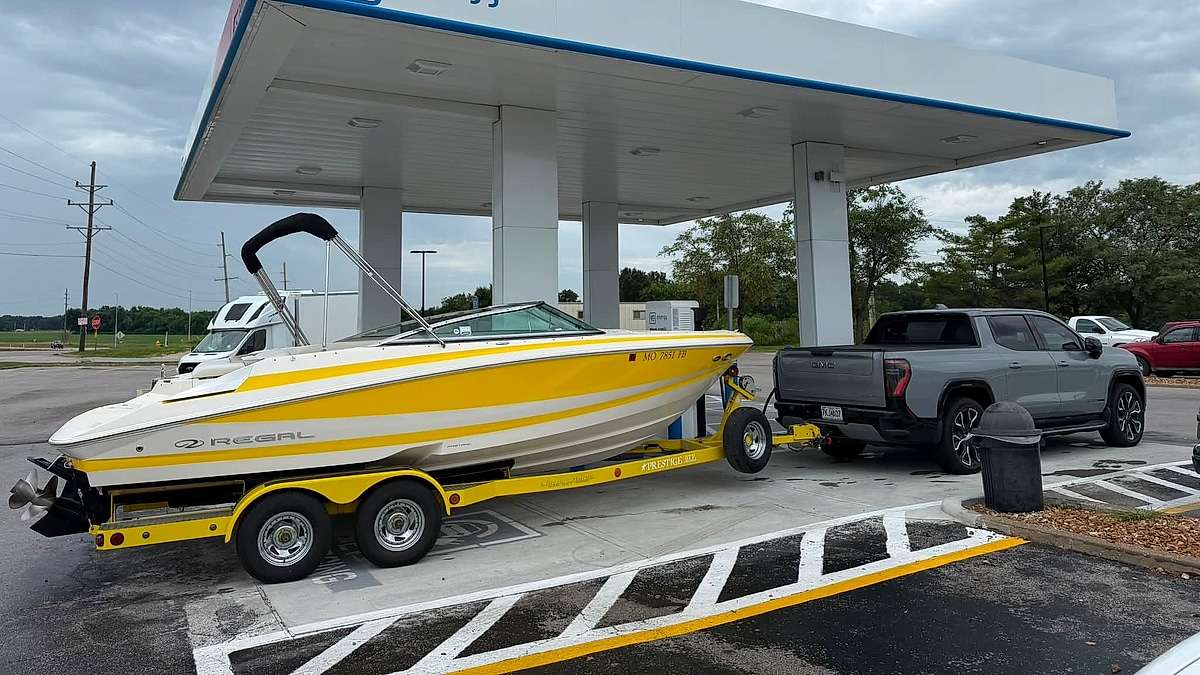

Tim Johnson's first tow with a 2025 GMC Sierra EV Denali Max Range involved roughly 5,500 to 6,000 pounds of boat and trailer, an indicated 1.1 mi/kWh, and a covered Pilot charger that accommodated the rig while it remained hitched. The truck made the load feel easy. A weight alert and repeated trailer-light warnings kept the trip from becoming a clean victory lap.
The photograph looks more useful than another electric-truck drag race.
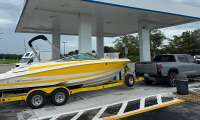
A gray GMC Sierra EV sits under a GM Energy canopy with a bright yellow Regal boat still attached. Rain hangs over the travel center. The combination has room, and the driver has cover. This is the ordinary-looking scene electric towing has spent years trying to reach.
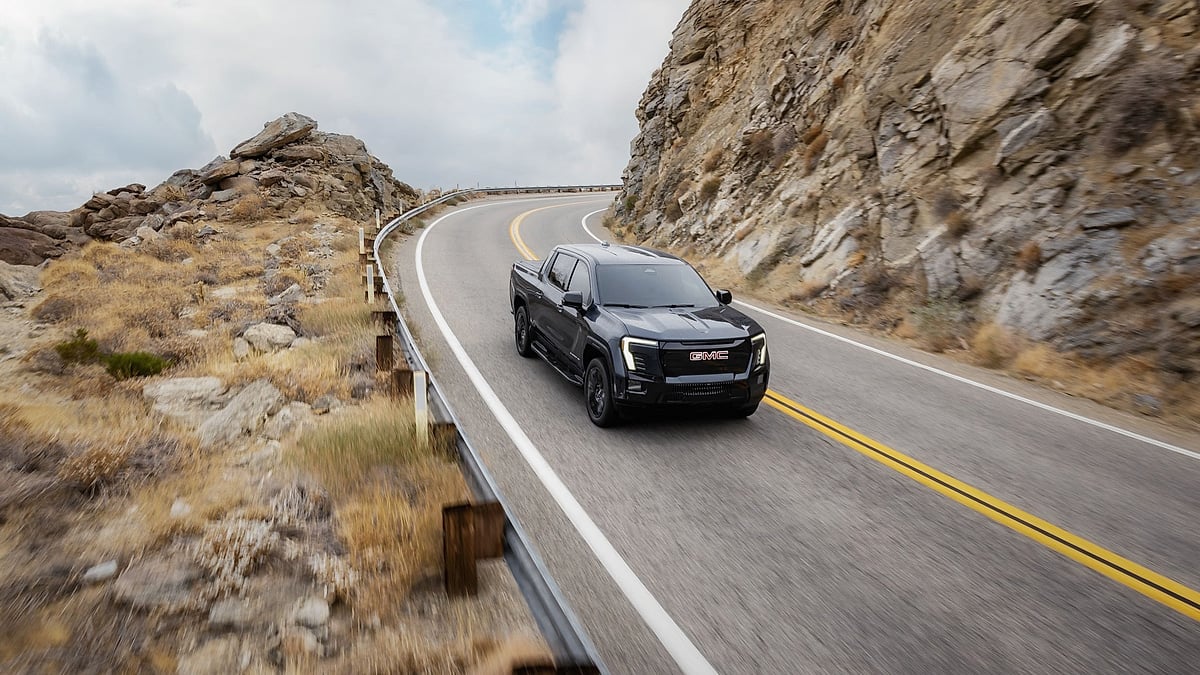
Johnson kept the truck below 65 mph over a route split about evenly between two-lane roads and interstate.
The truck was the easy part. Johnson called it the “smoothest tow ever” and said he barely felt the trailer most of the time in his Facebook post.
Then the Sierra gave him two reasons to keep paying attention. He reported a weight warning during the final 40 miles and repeated trailer-light alerts even though the lamps appeared to work when he checked them.
Those warnings deserve more attention than the effortless acceleration.
- At 1.1 mi/kWh, the truck uses about 90.9 kWh to cover 100 miles. The posted charging tariff, weather, speed, and route decide whether that energy stop feels cheap or painful.
- The boat sits below the five-figure maximum towing capacity GMC publishes for the 2025 Sierra EV Denali. The truck's loaded weight, combined weight, tongue load, rear-axle load, and vehicle-specific labels still govern the trip.
- Johnson's EVgo credits made this charging session free. A future trip paid at the normal public rate will have different economics even if the efficiency stays identical.
The Pilot Stop Solved the Awkward Part
Electric motors are exceptionally good at moving a heavy load away from a stop. They make torque immediately. The Sierra EV carries its enormous battery low in the chassis, and the Denali's adaptive air suspension controls the truck's attitude. GMC advertises up to 760 horsepower and 785 lb-ft of torque in Max Power mode for the 2025 model. A 6,000-pound boat should feel tame behind that hardware.
That calm matches another Sierra EV owner's comparison with a modified Sierra 2500. In that case, the electric GMC felt more planted with a large wake boat, while its shorter towing range complicated the day.
The energy stop is where an EV tow rig usually starts asking for favors.
A conventional charging stall often points the vehicle toward a curb with the charger at its nose or rear quarter. A boat trailer turns that parking maneuver into a geometry problem. The driver may block an aisle, occupy several spaces, stretch a cable, or find a separate place to drop the trailer in the rain.
Johnson's photograph shows the alternative. The Pilot location gave a combination of usable trailer access and a canopy. He also had EVgo credits, so the stop cost him nothing that day.
That experience matches the stated purpose of the Pilot, GM, and EVgo buildout. GM says many locations include overhead canopies and pull-through stalls designed to accommodate larger vehicles and trailers. The companies have described the sites as 24-hour travel stops with chargers capable of delivering up to 350 kW, although the rate any truck sees depends on the charger, battery temperature, state of charge, and charging curve.
The canopy is more than decoration when a driver is handling a wet cable beside a long boat. The trailer access saves time and removes an entire unhitching cycle. A good charging stop makes the electric tow vehicle behave more like a normal tow vehicle.
That may be the strongest result from the trip.
The 1.1 mi/kWh Figure Needs a Full Trip Record
Johnson supplied an energy average, a rough load, a speed ceiling, and a basic road mix. That is enough to make the number useful. It is still short of a controlled range test.
At 1.1 mi/kWh, every 100 miles requires about 90.9 kWh from the battery according to the truck's displayed consumption. A 150-mile leg would require roughly 136 kWh at the same average. Headwind, rain, elevation, launch-ramp detours, and higher speeds can move that number quickly.
Boat trailers have a different aerodynamic problem from travel trailers. The Regal's bow is lower and more tapered than the wall of a camper, and the bimini is folded in the photograph. The hull, windshield, trailer, exposed running gear, and open cockpit still disturb a large amount of air. On the interstate, air becomes the expensive cargo.
Keeping the combination below 65 mph likely helped. Aerodynamic drag rises sharply with speed, so the difference between 62 and 72 mph can consume more energy than the extra ten miles per hour suggests.
GMC advertises up to 460 miles of EPA-estimated range for the 2025 Sierra EV Denali Max Range when driven without this boat under the test conditions behind that rating. Johnson's 1.1 mi/kWh result points toward a substantial towing penalty, though a trustworthy full-charge towing range requires the truck's usable energy, starting and ending state of charge, and actual distance.
The next record should include all three. Add the kWh delivered by the charger and the receipt, and the same trip becomes a cost test.
The Weight Warning Is Still Unresolved
Johnson described the message as a gross vehicle weight warning. The precise wording matters.
Gross vehicle weight covers the loaded truck itself. That includes the vehicle, occupants, cargo, accessories, hitch hardware, and the portion of the trailer's weight carried on the hitch. Gross combined weight covers the loaded truck and trailer together.
GMC's trailering materials describe an available Gross Combined Weight Alert inside the ProGrade Trailering System. GMC also directs owners to the vehicle-specific trailering label on the pillar between the driver's and rear passenger's doors. The company's Trailering App support page says that the label may list curb weight, GVWR, GCWR, maximum payload, maximum tongue weight, and rear GAWR, depending on equipment.
The supplied material does not show which alert Johnson received. His post also lacks the truck's labels, a loaded scale ticket, tongue weight, passenger and cargo count, or trailer-profile inputs. The warning could reflect a genuine limit, a profile or estimated-weight issue, or another condition. Each possibility calls for a different action.
The next step is simple and boring, which is exactly what a weight question needs:
1. Photograph the alert and the truck's trailer labels.
2. Confirm the boat-and-trailer weight with the rig loaded as it travels.
3. Weigh the truck alone and the full combination on a certified scale.
4. Compare steer, drive, trailer, truck-total, and combined readings with the labels.
The five-figure tow rating answers how much trailer the properly configured truck can pull under specified conditions. It does not provide a blank check for tongue weight or truck payload.
The same distinction surfaced in a recent Tundra CAT Scale case: the trailer fit beneath the headline tow rating while the loaded truck appeared close to or above its own GVWR. The door label and scale decided the useful answer there, too.
The Added Underglow Is the First Place to Inspect
Johnson also received repeated trailer-light warnings. He checked the lights and saw them operating. The trailer carries home-wired underglow added by a previous owner, which Johnson already suspects.
That is a sensible diagnostic lead. It remains a hypothesis.
GMC says its trailer system monitors trailer lighting circuits, alerts the driver when it detects a problem, and can run a light test. A lamp can illuminate, while a splice, an added LED circuit, a weak ground, corrosion, an intermittent connection, or an unexpected current signature can bother the monitoring system.
I would start with the modification because it is the known variable. Document the warnings, run the in-vehicle light test, inspect the seven-pin connector and grounds, and temporarily isolate the added underglow. If the alerts disappear with the aftermarket circuit disconnected, the owner has a narrow wiring problem. If they continue, the diagnosis moves back toward the trailer connector, factory circuits, profile, or truck.
Repeated warnings deserve a real fix. A driver who grows accustomed to false alarms may dismiss the one alert that arrives when a brake or turn-signal circuit actually fails.
Eighteen Years Changed the Tow Vehicle
Johnson once owned nearly the same Regal and pulled it with a 2007 Chevrolet Avalanche 2WD powered by a 5.3-liter V8. His summary of the Sierra EV comparison was brief: “WOW, what a difference!”
Of course, it feels different. The trucks sit 18 model years apart. The Sierra EV brings immediate motor torque, a massive low-mounted battery, sophisticated chassis control, four-wheel steering, integrated trailering software, and far more power. The Avalanche came from an era when a tow vehicle communicated the work through revs, shifts, noise, and movement.
The old Chevrolet also carried one freedom the electric GMC still has to earn on every route: it could refuel almost anywhere that sold gasoline.
This trip found a charger shaped around the job. That is a meaningful win. It also produced a weight alert and trailer-light warnings that need to be understood before the next launch ramp.
The truck has already proved it can pull the boat. The next trip should prove the weights, wiring, range, and paid charging cost with the same confidence.
One image by Tim Johnson
About The Author
Noah Washington is an automotive journalist based in Atlanta, Georgia, covering sports cars, luxury vehicles, and performance culture. His reporting focuses on explaining the engineering, design philosophy, and real-world ownership experience behind modern vehicles.
Noah has been immersed in the automotive world since his early teens, attending industry events and following the enthusiast communities that shape how cars are built and driven today. His work blends industry insight with enthusiastic storytelling, helping readers understand not just what a car is, but why it matters.
Noah is also a member of the Southeast Automotive Media Association (SAMA), a professional organization for automotive journalists and industry media in the Southeast.
His coverage regularly explores sports cars, luxury vehicles, and performance-driven segments of the automotive industry, including the evolving culture surrounding Formula Drift and enthusiast builds.
Read more of Noah's work on his author profile page.
You can also follow Noah here:
Set Torque News as Preferred Source on Google
Follow us today...