
Richard del Rosario did not say his diesel Sierra 2500 lacked power.
He said the electric Sierra EV towed nicer.
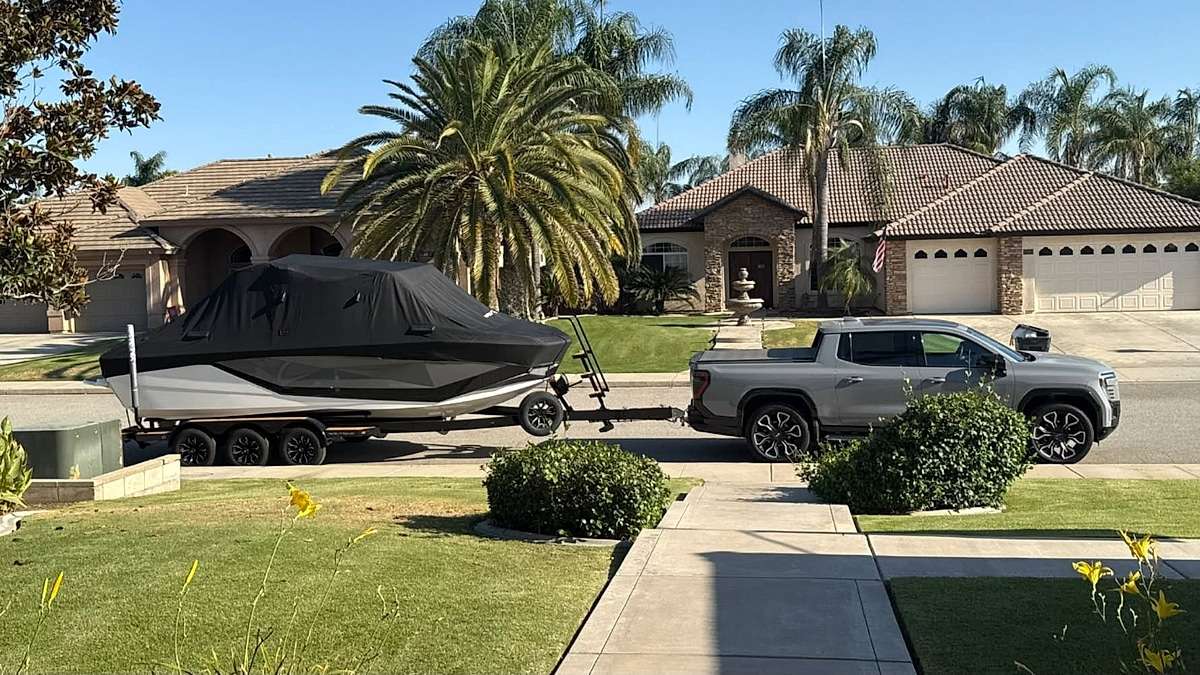
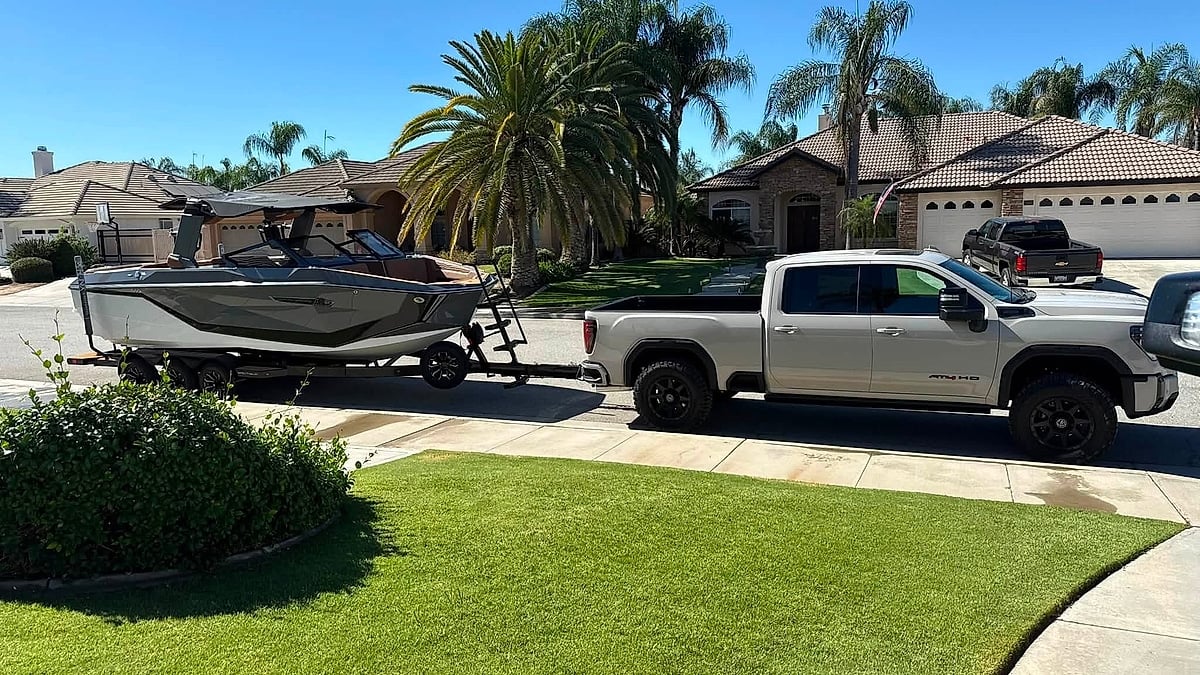
The photograph is no little weekend exaggeration. A Nautique G23 on a triple-axle trailer sits behind the truck like a floating condo with a wakeboard tower. The boat is wide, tall, heavy, expensive, and absolutely capable of exposing a tow vehicle that looks strong in a driveway and gets loose on a real road.
- The Sierra EV’s low center of gravity and instant torque delivery can significantly improve towing stability compared to traditional diesel trucks, especially with tall, heavy trailers like wake boats.
- Real-world towing range drops sharply with heavy loads, making route planning and charger availability just as important as the truck’s raw capability.
- Trailer-friendly charging infrastructure remains a major gap, particularly at lakes and marinas where EV owners actually need to recharge.
Del Rosario towed the G23 with a 2024 GMC Sierra EV Denali Edition 1 and compared it with his Sierra 2500 running 37-inch tires. His verdict was that the EV felt more planted, more comfortable, accelerated better, and stayed level the whole time, according to his Facebook post.
His energy estimate suggested only 180 to 200 miles of range on a full charge.
It can feel better than the heavy-duty diesel with the trailer attached, but then it loses the argument once the lake sits too far from a charger.
The EV’s Advantage Starts Under The Floor
The Sierra EV has a towing feel that a diesel HD truck cannot copy easily.
The battery sits low and wide. The motors deliver torque instantly. There is no gear hunting, no turbo lag, no transmission deciding whether it wants one more ratio on a grade. Air Ride Adaptive Suspension keeps the truck level. Four-wheel steering helps maneuver a long rig in awkward places. GMC also built the Edition 1 with 754 hp and 785 lb-ft in Max Power mode.
That package gives the driver a strange sensation while towing: less noise, less drama, more mass planted under the cab.
I am not surprised the owner preferred the feel.
A modern three-quarter-ton diesel is built to work. It can pull hard all day and shrug at loads that would humble a half-ton. A modified HD on 37-inch tires brings its own complications, though. Taller, heavier tires change gearing, steering response, braking feel, ride, sidewall behavior, and the way the truck communicates trailer movement. That does not make the build wrong. It makes this comparison less clean than stock EV versus stock diesel.
Still, the owner’s reaction makes sense.
The Sierra EV weighs enough to feel anchored, carries its mass low, and uses suspension and torque delivery that flatter a heavy trailer. A diesel HD truck may be rated to do more, but the driver can still prefer the electric truck’s calm.
The G23 Is Close Enough To The Limit To Demand Paper
Nautique lists the Super Air Nautique G23 at 6,300 pounds dry, with a 65.6-gallon fuel tank and major ballast capacity. Dry weight does not include the trailer. It does not include fuel. It does not include gear, batteries, tools, coolers, boards, ropes, trailer hardware, or anything else that appears when a boat becomes a lake day.
Del Rosario said his current Supra SA setup weighs about 7,700 pounds with boat, trailer, 500 pounds of ballast bags, full fuel, gear, and ice chest. He estimated the G23 at a little over 9,000 pounds with trailer, fuel, gear, and 500 pounds of ballast bags.
That puts the G23 comfortably below GMC’s 10,000-pound Edition 1 max towing estimate, but not by much.
I would not tow that combination on vibes.
The owner needs the actual loaded trailer weight, tongue weight, and the Sierra EV’s door-jamb payload figure. GMC listed the Edition 1 at 1,450 pounds of max payload, but the number printed on the truck decides the trip. Options, passengers, tools, coolers, hitch equipment, and tongue weight all eat into it.
Boat trailers often carry a lower tongue-weight percentage than travel trailers, but a 9,000-pound rig still puts a meaningful load on the hitch. The only acceptable answer comes from a scale.
That paper would either confirm the setup or force a harder conversation.
The Range Number Changes The Whole Trip
A 180-to-200-mile full-charge estimate sounds tolerable until the owner says the diesel Sierra 2500 could run around 300 miles on a full tank while towing.
The diesel’s advantage is where the next energy stop happens.
Diesel fuel exists almost everywhere. A boat owner can pull into a normal station, refuel, and keep moving. The trailer may create parking drama, but the pump is rarely the scarce resource. With the EV, the charger must exist in the right place, accept the truck, allow trailer access, and ideally deliver enough power to make the stop worth the detour.
The owner also said the EV could not make it to the lake and back. That is the line that turns a great towing impression into a planning problem.
A 180-to-200-mile full-charge towing estimate leaves a practical working range closer to 145 to 160 miles if the driver wants a 20 percent reserve. Run it down to 10 percent, and the number stretches, but the stress rises. Add heat, wind, hills, speed, launch-ramp detours, or an occupied charger, and the cushion thins quickly.
A diesel 2500 can feel rougher and still win the day by reaching home.
That is the cruel part.
The Sierra EV may be the better tow vehicle for the first 100 miles. The diesel may be the better lake truck for the full Saturday.
Lake Charging Is The Missing Link
One commenter asked the obvious question: Can the truck charge while the owner is on the water?
Del Rosario said there was nowhere to plug in. Some California lakes have chargers, but only Level 2.
Level 2 can help across a full day or weekend. It cannot fix every boat trip. A Sierra EV pulling a G23 may use a large amount of energy to reach the lake. If the truck sits for six hours on a 48-amp Level 2 charger, it can recover meaningful range. If the site only offers a lower-power connection, the gain may be too small for a comfortable return.
This is where lake infrastructure becomes more important than highway infrastructure.
Boat owners do not simply need chargers near interstates. They need trailer-friendly chargers at marinas, launch ramps, hotels, storage yards, lake restaurants, and parking lots designed for long combinations. The perfect EV tow vehicle still struggles if the destination treats charging as an afterthought.
A Level 2 charger at a lake is better than nothing.
A row of pull-through DC chargers near the launch area would change the use case.
The Sierra EV does not need 350 kW every time it tows. It needs predictable power where the boat actually goes.
The Extended-Range Question Is A Trap
Another commenter brought up the newer Sierra EV extended-range variants and higher tow ratings.
That helps, but only after the buyer checks the exact truck.
GMC’s 2024 Edition 1 launched with 10,000 pounds of max towing. Later Sierra EV trims and battery configurations can change the towing and range equation. A buyer with a 9,000-pound boat and a family full of gear should not shop by a single headline number from a forum comment.
The trim, battery, payload label, hitch rating, wheel and tire package, passengers, and actual trailer weight all decide the safe answer.
A buyer towing a G23, Tige 25ZX, Centurion Ri230, Yamaha 252, or similar high-end boat should do the math backward.
Start with the loaded boat and trailer. Add fuel, gear, ballast bags, boards, spare parts, ice, passengers, and tongue weight. Check the truck’s specific door label. Then map the lake route with a realistic towing efficiency estimate and a reserve.
If the route requires charging, inspect the charger layout before trusting it. A charger that a truck cannot physically use with a trailer attached is a decoration.
The Verdict: Better Towing Feel, Tougher Real-World Limits
The owner’s comparison is more credible because he did not pretend that the Sierra EV solved everything.
He praised the way it towed, then admitted the range problem.
That is the honest EV truck conversation.
The Sierra EV’s strengths are obvious in this use case: stability, comfort, acceleration, level ride, quiet operation, and confident control with a large boat. The diesel Sierra 2500 still holds the trip-planning advantage when the lake has no charging, and the route pushes beyond the EV’s practical tow range.
I would happily tow with the Sierra EV on routes with known charging, a reasonable reserve, and trailer-friendly access.
I would take the diesel if the lake trip required a no-charge round trip beyond 160 miles with a 9,000-pound boat.
That is not a knock on the electric truck.
It is the boundary of the current infrastructure.
The Sierra EV proved it can make the G23 feel easier behind the wheel. Now the charging map has to catch up with the truck.
Boat Owners, What Is Your Real EV Tow Range?
If you tow a wake boat with a Sierra EV, Silverado EV, Hummer EV, Cybertruck, R1T, or Lightning, share the loaded boat-and-trailer weight, average speed, range estimate, actual miles driven, battery used, and whether you could charge at the lake.
Comment below with your thoughts.
Two images by Richard del Rosario
About The Author
Noah Washington is an automotive journalist based in Atlanta, Georgia, covering sports cars, luxury vehicles, and performance culture. His reporting focuses on explaining the engineering, design philosophy, and real-world ownership experience behind modern vehicles.
Noah has been immersed in the automotive world since his early teens, attending industry events and following the enthusiast communities that shape how cars are built and driven today. His work blends industry insight with enthusiastic storytelling, helping readers understand not just what a car is, but why it matters.
Noah is also a member of the Southeast Automotive Media Association (SAMA), a professional organization for automotive journalists and industry media in the Southeast.
His coverage regularly explores sports cars, luxury vehicles, and performance-driven segments of the automotive industry, including the evolving culture surrounding Formula Drift and enthusiast builds.
Read more of Noah's work on his author profile page.
You can also follow Noah here:
Set Torque News as Preferred Source on Google
Follow us today...