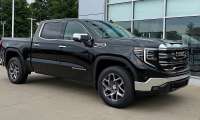

Logan Collins did the mountain tow that electric-truck skeptics usually describe as a trap.
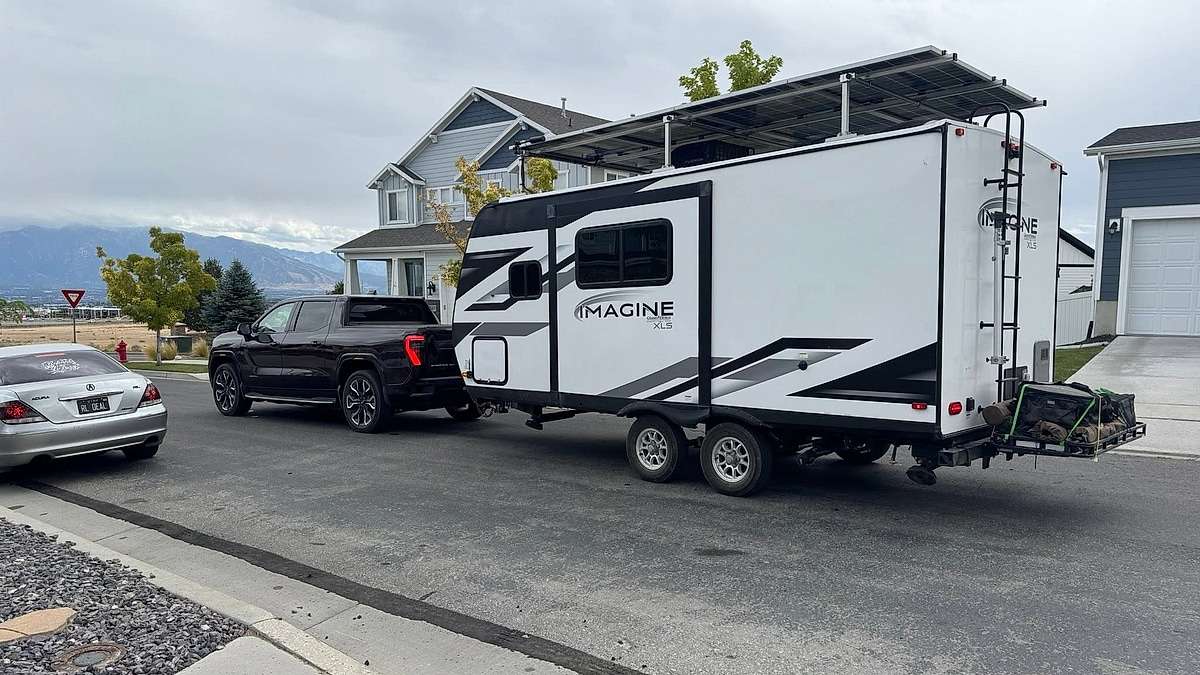
A camper behind the truck. Elevation rising from 4,300 feet to 9,000 feet. A return trip down the same grade. A 2025 GMC Sierra EV Extended Range doing the work. A 21-foot trailer weighing about 4,700 pounds dry and roughly 5,500 pounds loaded. Solar panels raised above the roofline, looking like they should punish efficiency the moment the air gets busy.
He came back pleasantly surprised.
The route was about 100 miles each way. According to Facebook, Collins started at 100 percent, stopped once in the middle, and added 15 percent for insurance, then arrived home with 21 percent remaining. His reported efficiency for the full there-and-back run landed around 1.2 to 1.3 miles per kWh. He kept freeway speed below 55 mph and used one-pedal driving.
- 200-mile round trip with a single mid-route charge, starting at 100% and returning home with 21% battery remaining
- Maintained efficiency of 1.2 to 1.3 mi/kWh while towing a 5,500-pound camper through significant elevation gain
- Kept speeds under 55 mph and relied on one-pedal driving to maximize control and energy recovery
His conclusion was practical: this specific camper gives him about a 200-mile maximum towing range, and he will plan future charging around 150-mile gaps.
That is exactly the kind of EV towing report owners need.
Just speed, elevation, trailer weight, energy use, and a planning number.
The 150-Mile Rule Is The Useful Part
Collins’ trip covers the difference between the theoretical range and the towing range.
The 2025 Sierra EV Extended Range is listed at around 390 miles under GM’s published range context. Hook up a 5,500-pound travel trailer, climb toward 9,000 feet, keep speed under 55, and the owner’s practical maximum becomes about 200 miles.
That is a major reduction. It is also usable.
A 150-mile planning leg gives him around 50 miles of buffer against wind, cold, charger detours, traffic, campsite access roads, or a station that refuses to cooperate. That margin is what turns EV towing from gambling into a procedure.
The battery estimate can impress in the showroom. The route plan needs a reserve.
Collins did not try to wring every mile out of the truck. He stopped mid-route and added 15 percent even though the truck ultimately came home with 21 percent. That stop may look unnecessary after the fact. On the road, towing uphill with family plans and a camper behind you, it was the adult choice.
Arriving with too much battery is mildly inefficient.
Arriving late makes memories nobody wants.
Speed Protected The Battery
The owner never exceeded 55 mph on the freeway.
That restraint likely did more for range than any other single choice.
A camper this size creates a large frontal area problem. Weight matters when climbing and accelerating. Air dominates on the highway. Raise the speed, and the power needed to push the trailer through the air climbs brutally. A truck that seems calm at 55 can start eating battery with both hands at 65.
The Sierra EV has the torque to hide that effort. The driver would not hear a gas engine straining, would not feel a downshift, and would not get the old mechanical warnings that a trailer is costing money.
The kWh screen tells the truth later.
Collins kept the pace conservative and got a 1.2-to-1.3 mi/kWh average across a mountain route. That means every 10 kWh bought roughly 12 to 13 miles. A 150-mile towing leg would require about 115 to 125 kWh before reserve, which is a serious draw but well inside the Sierra EV’s large-pack logic.
A faster trip could have turned the same route into a much shorter leash.
Slow was not timid.
Slow was the range.
The Raised Solar Panels Did Less Damage Than Expected
The trailer’s roof is the visual hook.
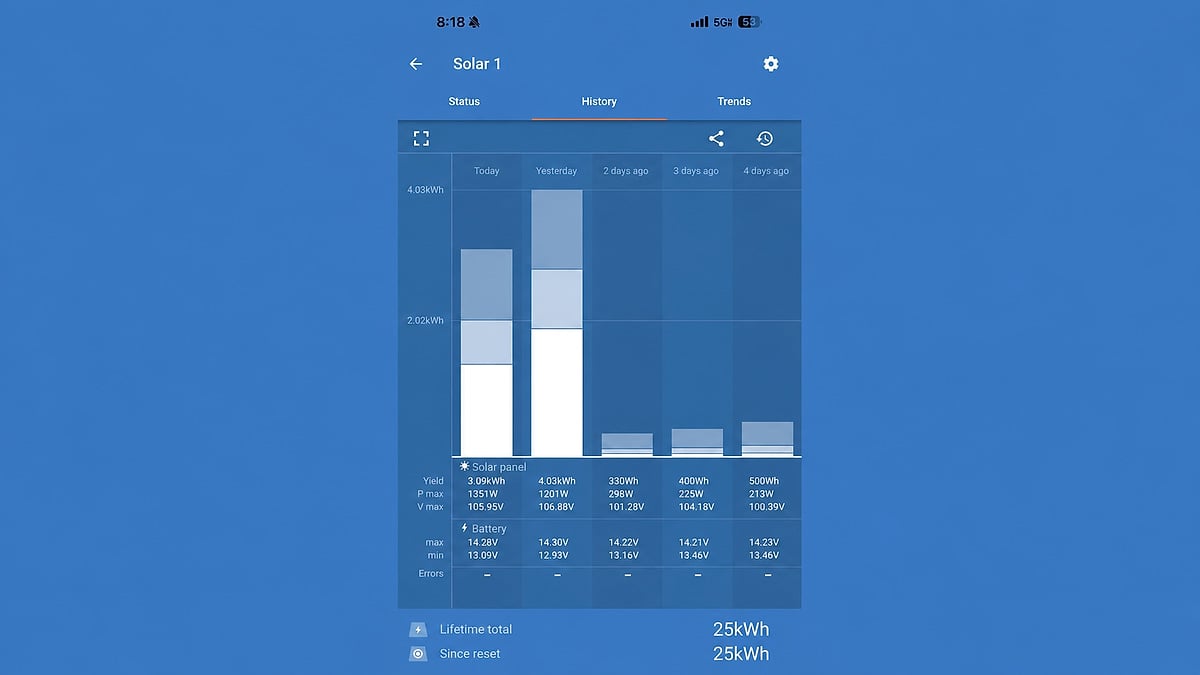
Collins has a raised solar setup with multiple panels sitting above the camper roofline. In the comments, he said the system is rated at 2,320 watts and that the bifacial array hit 2,680 watts that day. He also noted that one screenshot showed only one MPPT side, meaning the system details deserve their own proper breakdown.
The towing result says the raised array did not ruin the trip.
That does not mean the panels are aerodynamically free. A raised structure on top of a travel trailer can create drag, turbulence, and crosswind sensitivity. The effect depends on panel height, leading edge, mounting angle, gaps, roof equipment, trailer shape, and speed.
Again, the 55-mph limit matters.
A raised panel system may be barely noticeable at lower highway speeds and more painful at 70. Collins’ data suggests the solar array and camper shape remained manageable at his chosen pace.
The upside at camp is obvious. A 2-kW-plus solar setup can support off-grid RV life in a way a small trickle panel never will. Batteries, fridge loads, lighting, Starlink, fans, outlets, and camping gear begin to look different when the trailer can harvest serious wattage while parked.
The roof may cost a range on the road.
At camp, it pays rent.
One-Pedal Driving Changes Mountain Towing
Collins used one-pedal driving during the trip.
That is a major advantage in mountain towing. The Sierra EV can recover energy on descents and reduce reliance on service brakes when conditions allow. The drive downhill from 9,000 feet will not repay the full cost of climbing. Air drag, rolling resistance, heat, and conversion losses take their cut.
It still helps.
More importantly, regen changes how the truck feels. A heavy trailer pushing down a grade can make a gas or diesel driver start thinking about brake heat, gear selection, and engine braking. An EV gives the driver a strong deceleration tool that can feel calmer and smoother.
Trailer brakes still need correct adjustment. The driver still needs to watch speed, grade, brake temperature, and how the trailer behaves. Regeneration is powerful, but it does not excuse poor trailer setup or bad judgment.
On this route, Collins’ report was positive. The Sierra handled the job, the range remained within his plan, and the mountain did not turn the trip into an experiment gone wrong.
That matters because mountain towing is one of the places EV trucks have to prove they can be more than suburban toys.
The Camper Weight Was Only Half The Question
The trailer weighs about 5,500 pounds loaded.
That sits comfortably below the Sierra EV Extended Range’s published towing capacity. The truck has power for far more. Yet the range plan still shrank to about 150-mile charger spacing.
That is the reminder.
Towing capacity tells the owner whether the truck is rated to handle the load. Energy consumption tells the owner how the trip will unfold.
A 5,500-pound camper is not the same problem as a 5,500-pound flatbed loaded with low machinery. The camper is tall and blunt. It drags a box of air behind the truck. A lower, cleaner trailer could tow farther at the same weight. A taller or wider trailer could do worse.
Owners shopping for electric tow vehicles should ask for three numbers before judging any report:
loaded trailer weight
average speed
miles per kWh
Without those, the towing range is just noise.
Collins gave all three, plus elevation.
The Sierra EV Did What It Was Bought To Do
This trip did not prove that an electric truck is the best answer for every camper owner.
Long-distance towing across sparse charging corridors still favors diesel. Heavy trailers, high speeds, cold weather, and poor charger layouts can make EV towing slower and more stressful than the brochure suggests.
Collins’ run proves something more specific.
A Sierra EV Extended Range can tow a mid-size camper through a mountain route, average 1.2 to 1.3 mi/kWh, keep a 150-mile planning buffer, and come home without drama if the driver manages speed and charging conservatively.
That is a strong use case.
It fits weekend campers, regional trips, mountain cabins, state parks, and owners who can charge at home before leaving. It also fits RV owners who value quiet towing, one-pedal control, and the ability to power gear from a large battery.
The truck did not make towing range irrelevant.
It made the range predictable enough to plan around.
Sierra EV Owners, What Is Your Camper Number?
If you tow with a Sierra EV, Silverado EV, or Hummer EV, share the trailer length, loaded weight, average speed, elevation change, mi/kWh, charger spacing, and whether roof gear or solar panels changed the result.
Comment below with your results.
One image by Logan Collins
About The Author
Noah Washington is an automotive journalist based in Atlanta, Georgia, covering sports cars, luxury vehicles, and performance culture. His reporting focuses on explaining the engineering, design philosophy, and real-world ownership experience behind modern vehicles.
Noah has been immersed in the automotive world since his early teens, attending industry events and following the enthusiast communities that shape how cars are built and driven today. His work blends industry insight with enthusiastic storytelling, helping readers understand not just what a car is, but why it matters.
Noah is also a member of the Southeast Automotive Media Association (SAMA), a professional organization for automotive journalists and industry media in the Southeast.
His coverage regularly explores sports cars, luxury vehicles, and performance-driven segments of the automotive industry, including the evolving culture surrounding Formula Drift and enthusiast builds.
Read more of Noah's work on his author profile page.
You can also follow Noah here:
Set Torque News as Preferred Source on Google
Follow us today...