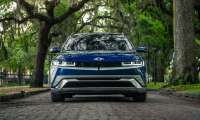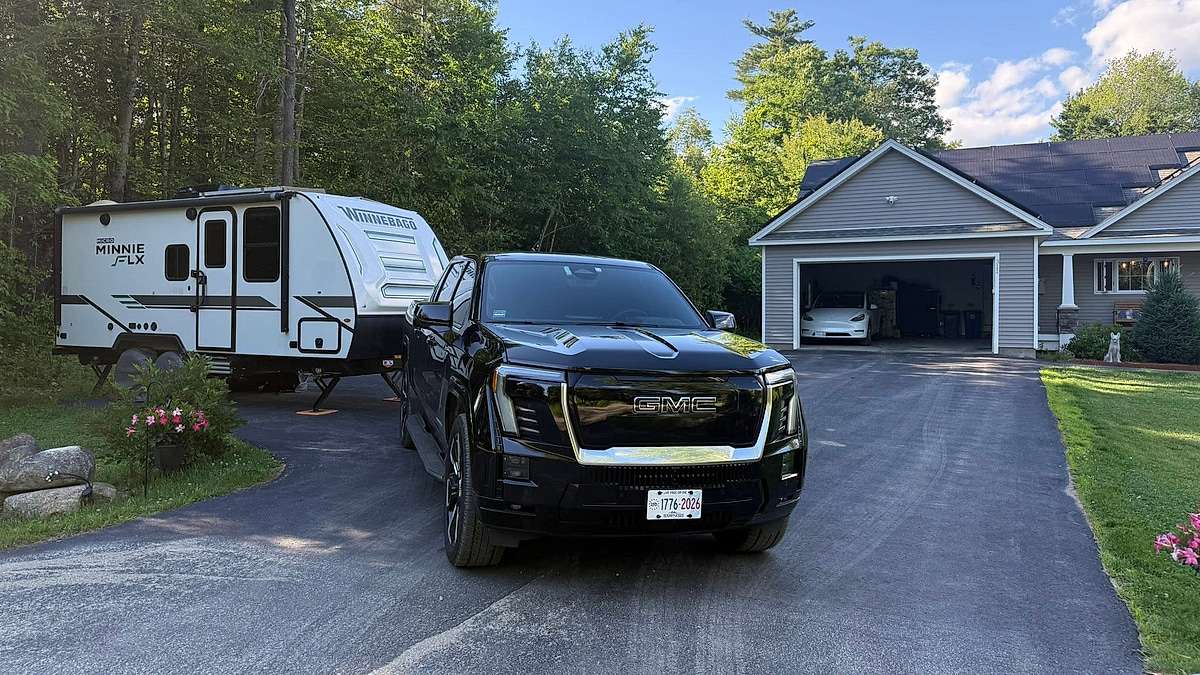

The easiest way to understand how quickly electric tow vehicles have evolved is to look at Brian Andrew’s driveway. Over the past several years, he has dragged the same basic camping dream through three distinct eras of EV ownership, starting with a Tesla Model X, moving into a Ford F-150 Lightning, and now hitching up a GMC Sierra EV with one of the largest batteries ever fitted to a pickup.
Towing With The GMC Sierra EV:
- The GMC Sierra EV Denali Max Range is rated for up to 478 miles of EPA-estimated range, giving it one of the largest energy reserves currently available in a production pickup truck.
- GMC's 800-volt electrical architecture allows DC fast charging at up to 350 kW, with the ability to add approximately 120 miles of range in about 10 minutes under ideal conditions.
- Available features such as four-wheel steering, adaptive air suspension, and up to 10.2 kW of off-board power make the Sierra EV uniquely suited to towing, campground maneuvering, and powering equipment away from the grid.
Three EVs, One Trailer, And A Decade Of Progress
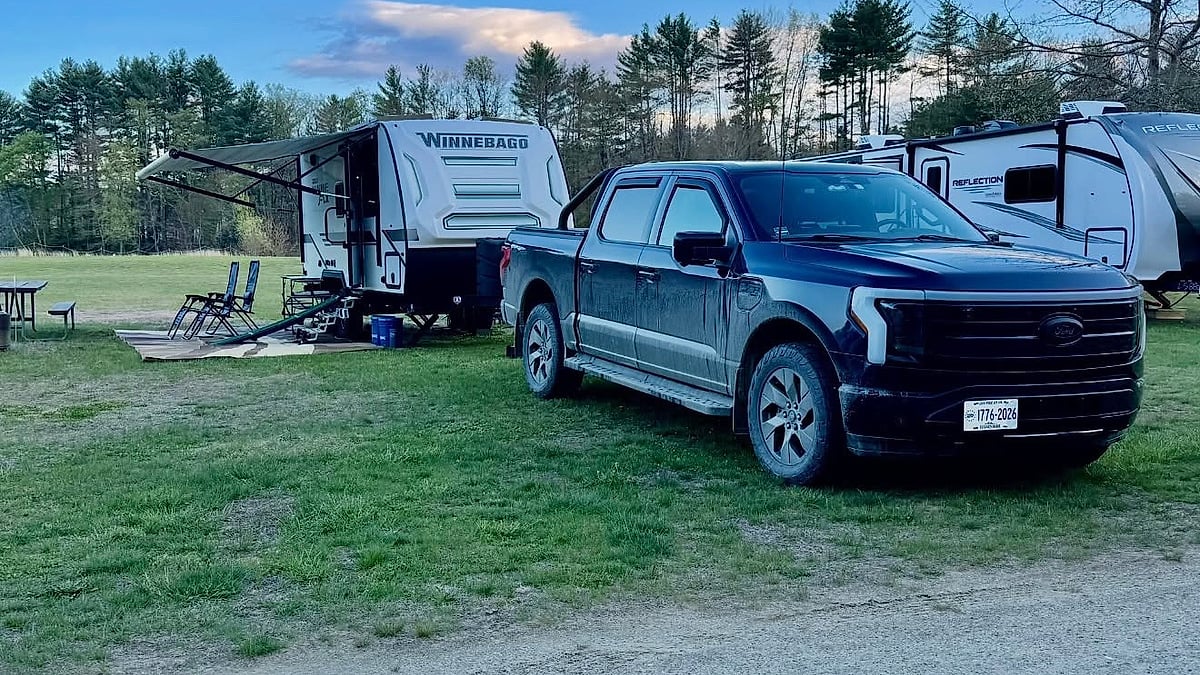
He says the experiment began in 2019 with a Tesla Model X. In January 2023, he moved to a Ford F-150 Lightning Extended Range. Last week, after more than 10,000 towing miles and visits to hundreds of campgrounds, he added a GMC Sierra EV Denali Max Range.
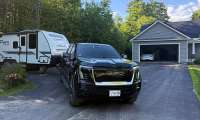
A black Sierra EV sits beside a Winnebago Micro Minnie FLX. Solar panels cover part of the house behind them. The picture is almost a diagram of the family’s operating plan: collect energy at home, pull a small traveling house into the woods, find electricity where the trip allows, and repeat.
This is more useful than another one-day tow test.
Andrew has lived through three generations of electric tow vehicle, each one exposing a different weakness. The Model X proved an EV could do the job. The Lightning gave the trailer a proper pickup. The Sierra EV arrives with enough battery to attack the problem through brute force.
The new truck still has to earn its place.
The Model X Chapter Required Nerve And A Calculator
A prior Winnebago account of the family’s electric camping history documented a Model X towing a Micro Minnie 2106DS. The Tesla carried a 5,000-pound tow rating and a 500-pound tongue-weight ceiling. The camper weighed 3,780 pounds dry, leaving a narrow margin for water, propane, batteries, food, clothing, tools, and everything that appears after an RV owner swears the trailer is fully packed.
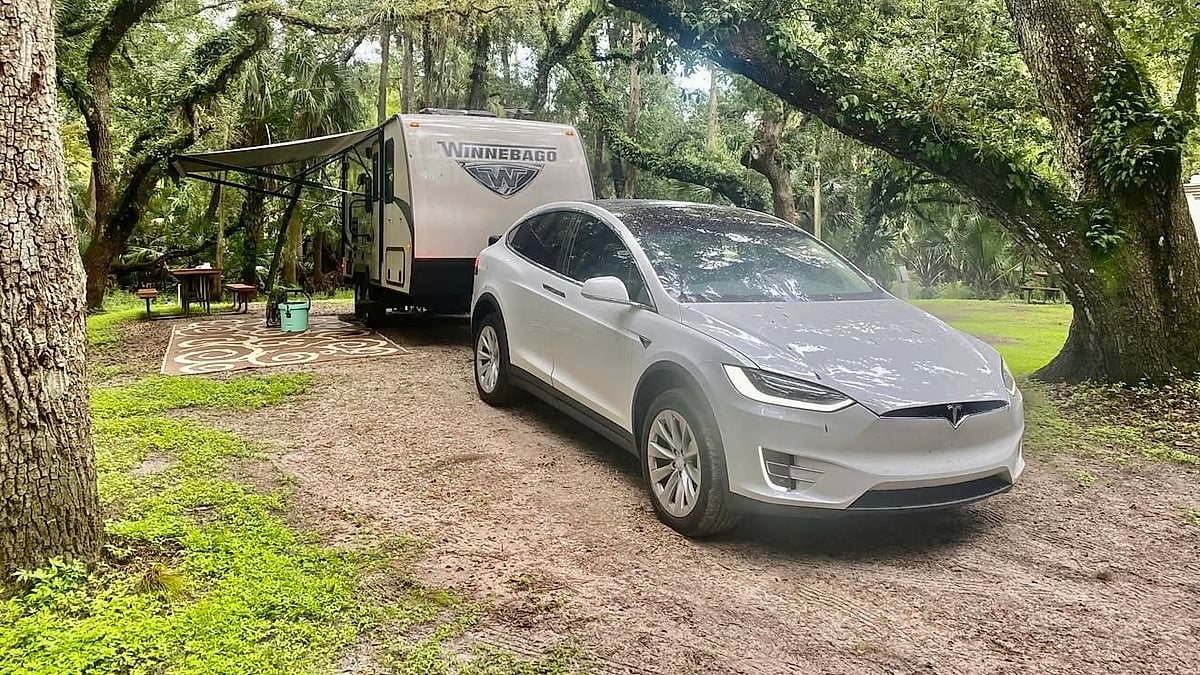
Towing cut the Model X’s range by roughly half. Route planning depended on A Better Routeplanner, Tesla navigation, charger availability, and a willingness to stop often. Some stations required dropping the trailer because early charging sites were built around cars arriving alone.
The Model X brought instant torque, regenerative braking, quiet operation, and Tesla’s charging network. It also made the driver part of the energy-management system. Every grade, headwind, charger gap, and parking-lot layout entered the plan.
I respect that chapter because the family learned EV towing before the industry had learned how to serve them.
The Lightning Gave The Trailer A Proper Truck
The camper changed with the tow vehicle.
The Ford chapter paired a Lightning Lariat Extended Range with Max Trailer Tow and a 2023 Micro Minnie FLX 2108DS. Winnebago lists that trailer at 4,291 pounds dry and 5,500 pounds GVWR. Ford rated the equipped Lightning at up to 10,000 pounds.
The numbers finally had breathing room.
The Lightning supplied pickup geometry, a 131-kWh usable battery, a bed, a large front trunk, integrated trailer features, and the stability of a vehicle designed around truck work. Its electric motors delivered 775 lb-ft without waiting for a downshift. Long descents turned some of the trailer’s momentum back into battery energy.
The trailer’s frontal area remained undefeated.
The Micro Minnie is seven feet wide, a useful advantage, yet it still stands more than ten feet tall and drags a wake through the air. At highway speed, that shape controls consumption more aggressively than a few hundred pounds of cargo. A Lightning capable of towing 10,000 pounds can still need short energy legs when a travel trailer pushes efficiency toward one mile per kWh.
The pickup solved capacity. The trip remained a charging exercise.
The Sierra Attacks The Right Problem
GMC’s Max Range truck brings a different weapon: battery reserve.
The 2025 Sierra EV Denali Max Range carried a 460-mile estimate. GMC now advertises as much as 478 miles for the 2026 Denali Max Range, plus 800V fast charging that can add up to 120 miles in about ten minutes under favorable conditions.
Those unloaded range claims will collapse with a camper attached. The useful part is the larger starting reservoir. A travel trailer can punish efficiency by the same percentage and still leave the driver with a longer practical leg.
Four-wheel steering may help in the places nobody photographs: charging lots, campground loops, and tight spaces laid out before an electric pickup arrived with a 22-foot trailer. Air suspension can help with hitch setup and ride control, though the scale ticket and trailering label still outrank any suspension mode.
Available 10.2-kW off-board power fits the camping mission too. A properly configured Sierra can run tools or campsite equipment without waking a generator.
The answer is expensive and heavy. Public charging a battery this large can produce a serious receipt. Tires, curb weight, and six-figure pricing keep the Sierra far from an every-family solution.
Still, the engineering direction makes sense. The owner already proved he will tolerate planning. The new truck buys back time.
Campground Electricity May Be The Best Upgrade
The family’s long towing history reveals a quieter advantage most EV truck comparisons miss.
A campground can become the final charging stop.
In their earlier Winnebago account, the owners described asking campgrounds about EV charging during the reservation process. They could arrive with a depleted tow vehicle, spend the weekend connected to suitable power, and leave with a full battery. Home solar handled another large share of their ordinary energy use.
That can erase a public charging stop the next morning.
Campground charging requires permission and electrical discipline. A pedestal was designed around RV loads, and owners should never assume they can charge the truck while running every high-draw appliance inside the camper. Circuit capacity, connector type, continuous load, billing, and cable safety need clear answers.
When those pieces line up, the campsite performs useful work while the family sleeps.
The Sierra Is Beginning An Audition
One week of ownership cannot settle the comparison.
The current photo shows promise. The Sierra now has to produce the figures that count: loaded trailer weight, tongue weight, highway efficiency at 55, 60, and 65 mph, first-leg range, 10-to-80-percent charging time, charging taper, campground energy use, and the number of stops where the trailer can remain connected.
I would also watch how accurately GMC’s route planner learns the trailer. A large battery can hide a poor forecast for longer, then expose it near the bottom of the pack. The best tow vehicle gives the driver honest information early enough to change the plan.
Andrew’s garage has already recorded the broad history.
The Model X era asked whether electric towing was possible. The Lightning era proved a battery pickup could become a real tow vehicle. The Sierra era will answer whether a giant pack and faster charging can make the trip feel ordinary.
That test begins after the hitch is loaded and the highway opens up.
EV Campers, What Changed With Your Second Tow Vehicle?
Owners who moved from a Model X, R1S, Lightning, or another early EV tow rig into a Sierra EV, Silverado EV, or newer long-range truck should share the trailer, speed, efficiency, charging time, and miles between stops in the comment section below.
Images by Brian Andrew
About The Author
Noah Washington is an automotive journalist based in Atlanta, Georgia, covering sports cars, luxury vehicles, and performance culture. His reporting focuses on explaining the engineering, design philosophy, and real-world ownership experience behind modern vehicles.
Noah has been immersed in the automotive world since his early teens, attending industry events and following the enthusiast communities that shape how cars are built and driven today. His work blends industry insight with enthusiastic storytelling, helping readers understand not just what a car is, but why it matters.
Noah is also a member of the Southeast Automotive Media Association (SAMA), a professional organization for automotive journalists and industry media in the Southeast.
His coverage regularly explores sports cars, luxury vehicles, and performance-driven segments of the automotive industry, including the evolving culture surrounding Formula Drift and enthusiast builds.
Read more of Noah's work on his author profile page.
You can also follow Noah here:
Set Torque News as Preferred Source on Google
Follow us today...