
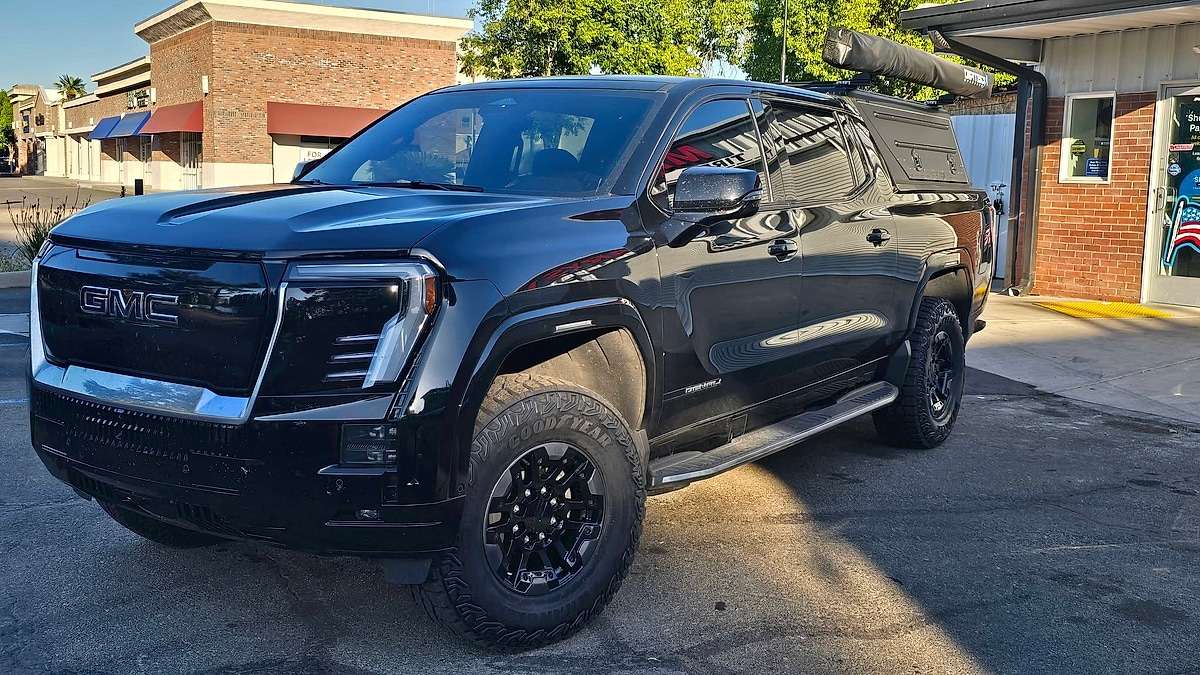

Scroll through enough GMC Sierra EV owner groups, and you'll notice a pattern. The truck's range numbers impress people. The technology impresses people. The giant battery impresses people. Then someone posts a photo of one sitting on smaller wheels with real sidewall and aggressive tires, and suddenly the conversation shifts from kilowatt-hours to desire.
That's what happened when Gregg McCambley shared photos of his Sierra EV wearing Hummer EV wheels and Goodyear Wrangler Territory MT LT305/70R18 tires. The transformation is immediate. The truck looks tougher, more purposeful, and far less concerned with preserving every last mile of EPA range. McCambley says he's happy with the change. The ride remains smooth. The downside appeared just as quickly: the new tires are noticeably louder than stock.
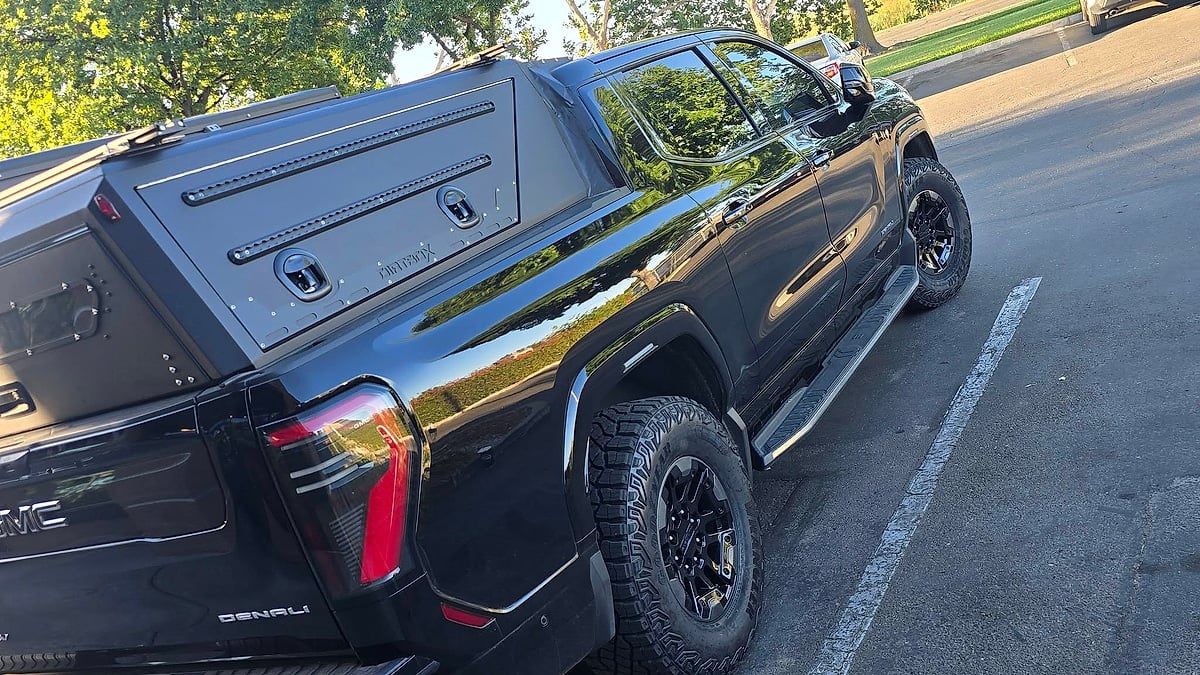
The photos only fueled the reaction. In one image, he raised the air suspension to show the truck at full height, and the combination of the lifted stance, chunky sidewalls, and aggressive tread makes the Sierra EV look much closer to the truck many buyers imagined when they first heard GMC was building an electric pickup.
Naturally, the discussion didn't stay focused on appearance for long.
One owner jumped straight to the question every EV truck owner eventually asks after a tire swap: how much range is this going to cost?
That is the right place to focus.
This swap makes the Sierra EV look better to a certain kind of truck owner. It may also make it less efficient in exactly the way big EV pickups hate most: rolling resistance, rotating mass, tread noise, and high-speed drag.
The interesting part is that the tire height is almost a wash.
The range penalty will come from everything else.
The Diameter Is The Clean Part Of This Swap
The Goodyear Wrangler Territory MT in LT305/70R18 is roughly a 35-inch tire. The Sierra EV Denali factory setup also uses 35-inch tires on 24-inch wheels.
That matters because the new package should stay close to the factory rolling diameter.
A 305/70R18 calculates to about 34.8 inches tall. A 275/50R24 also lands around 34.8 to 34.9 inches depending on the exact tire. That means the speedometer, odometer, driver-assistance assumptions, ride-height relationship, and basic gearing feel should not be thrown dramatically out of range by tire height alone.
That is the smart part.
Many wheel-and-tire swaps create problems by changing diameter too much. This one trades wheel diameter for sidewall while keeping the overall tire height in the same neighborhood. The owner gets more sidewall, more off-road tire character, and a tougher visual stance without turning the truck into a speedometer math problem.
The Sierra EV is already a massive, heavy, high-torque pickup. It does not need a tire-size calibration headache on top of everything else.
This setup appears to avoid that.
The Width And Tread Are Where The Battery Starts Paying
The stock-style Sierra EV tire is commonly listed at LT275/50R24. McCambley’s new Goodyear is a 305. That is 30 mm wider per tire.
Across the truck, the contact patches and exposed tread shoulders become meaningfully larger. Add the mud-terrain pattern and the battery now has to push more rubber, more void, more block movement, and more aero disturbance through the same road. The tire may be close in height, but it is not close in personality.
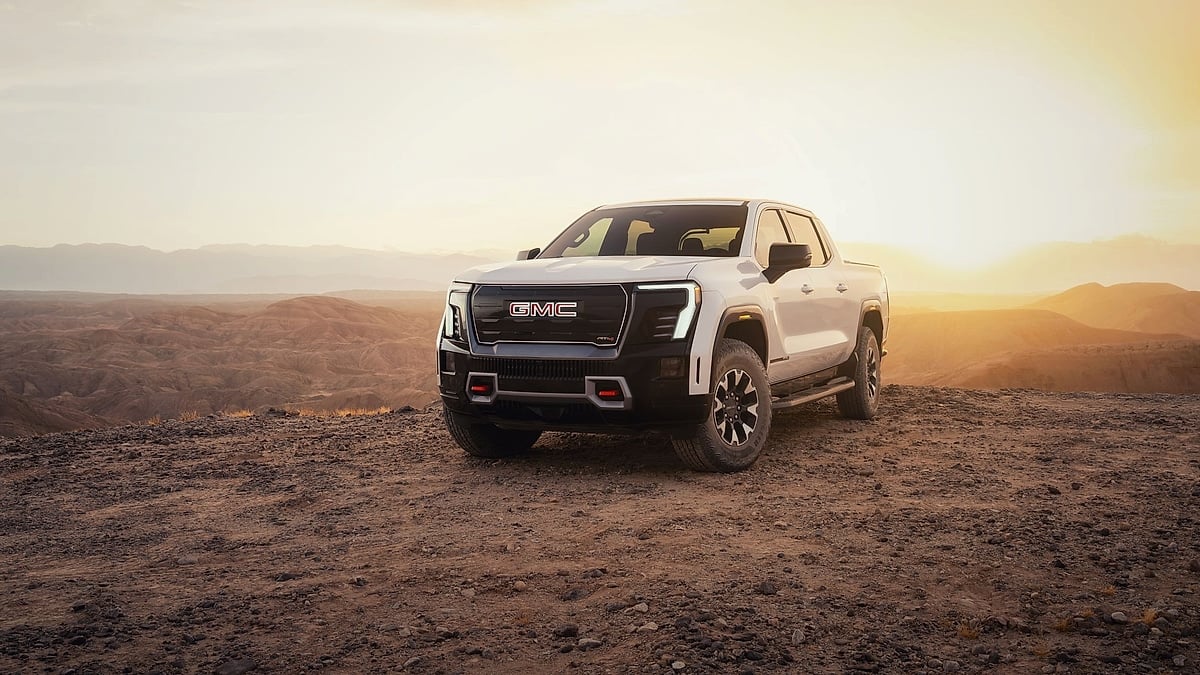
The Wrangler Territory MT is an aggressive tire. Deep tread. Open voids. Big shoulder blocks. Load Range E construction. Hummer EV heritage. It looks right under a huge EV truck because it was born for that kind of visual and physical job.
A street-focused 24-inch tire is doing a different job. It is there for low noise, range, ride, wet-road behavior, and refined highway manners.
That is the trade.
The Goodyears make the Sierra EV look ready for a trailhead.
The factory tires make the range number possible.
My Efficiency Loss Estimate: 10% to 18% for Most Owners
Without McCambley’s measured before-and-after data, the honest answer has to be an estimate.
For this specific swap, I would expect an efficiency loss around 10% to 18% in mixed real-world driving.
At lower speeds around town, the loss may stay closer to 8% to 12%, especially if the lighter 18-inch wheel package offsets some of the heavier tire weight. At highway speed, the loss could easily move into the 12% to 20% range because wider mud-terrain tread and additional turbulence punish efficiency harder as speed climbs. In cold weather, rain, headwinds, or 75-mph interstate driving, I would not be shocked to see a 20% or greater hit.
That is the realistic window.
If a Sierra EV normally averages 2.2 mi/kWh on a route, the Goodyear MT setup may pull it down around 1.8 to 2.0 mi/kWh. If the truck normally gets 2.0 mi/kWh, the new tires may put it around 1.65 to 1.8 mi/kWh in highway-heavy use. A very gentle local route could do better. A fast interstate route could do worse.
For a 460-mile Max Range Sierra EV, a 10% loss turns that into roughly 414 miles. A 15% loss lands around 391 miles. A 20% loss drops it around 368 miles.
That is still a lot of range.
It is also a very expensive way to lose 50 to 90 miles.
The Noise Report Is The First Proof The Tread Is Working Against Efficiency
McCambley says the ride is smooth, but the tires are definitely louder.
That makes sense.
Noise is energy you can hear. It is not a perfect measurement of rolling resistance, but it is a clue. A mud-terrain tread blocks and releases air differently than a highway tire. Big tread lugs strike the pavement. Voids pump sound. The sidewalls and carcass transmit different vibrations into the suspension. The cabin of an EV makes all of this more obvious because there is no gasoline engine covering the tire soundtrack.
A Sierra EV is a quiet truck on factory tires.
Put mud-terrain Goodyears underneath it, and the tire becomes part of the cabin experience. Some owners will love that because the truck finally sounds and looks more like a truck. Others will miss the near-silent highway glide that made the big GMC feel expensive.
The smooth ride is a good sign. The smaller wheel and taller sidewall likely help impact comfort. But smoothness and efficiency do not always travel together. A tire can ride nicely and still waste energy through tread deformation, weight, and drag.
The ear already knows the tire changed.
The energy screen will eventually put a number on it.
Three Numbers That Explain The Swap
- The new Goodyear LT305/70R18 is about 34.8 inches tall, very close to the factory Sierra EV 35-inch tire height.
- The Goodyear is 305 mm wide, roughly 30 mm wider than the common LT275/50R24 factory-size tire.
- A 10% to 18% efficiency hit is a reasonable early estimate, with highway driving likely landing at the higher end.
The 18-Inch Wheel Helps More Than People Think
The smaller wheel is the best defense this setup has.
A 24-inch wheel looks dramatic, but it leaves less sidewall and can be heavy. An 18-inch wheel gives the tire room to do truck work. More sidewall can improve compliance, reduce impact harshness, and make the truck feel more relaxed over bad pavement. That likely explains why McCambley can report a smooth ride even after installing a more aggressive tire.
The wheel may also help offset tire weight.
The Goodyear LT305/70R18 is a heavy tire, listed around 65 pounds. A factory LT275/50R24 tire can also be heavy, though usually less aggressive. The 18-inch Hummer EV wheel may be lighter or heavier than the GMC’s 24-inch wheel depending on the exact wheel construction, but the overall package could be closer than the tire-only comparison suggests.
That uncertainty matters.
If the full 18-inch wheel-and-tire package is not much heavier than the factory 24-inch setup, the efficiency loss will come mostly from tread design and width. If it is significantly heavier, the truck will pay during acceleration, braking, stop-and-go driving, and suspension movement too.
Owners need complete wheel-and-tire weights, not guesses.
A bathroom scale under each mounted assembly would be more useful than another beauty shot.
The Sierra EV Can Absorb The Range Loss Better Than Most Trucks
The Sierra EV has one luxury most EV pickups do not have: an enormous battery and a huge factory range number.
That changes the emotional math.
A 15% efficiency loss on a 250-mile EV is painful. A 15% loss on a Sierra EV Max Range still leaves a truck that can cover serious distance. That is why owners will be tempted to make swaps like this. The Sierra EV has enough battery to make inefficient tires survivable.
Survivable does not mean invisible.
If the truck is used locally, the owner may barely care. Home charging erases a lot of sins. A daily commute, school run, jobsite trip, or weekend errand will not expose the loss if the truck still comes home with plenty of battery.
Road trips will expose it.
Towing will expose it faster.
Cold weather will expose it harder.
The Sierra EV can carry the penalty, but the driver will notice when the route planner starts adding charging time.
The Factory 24s Were Built For The Range Number
The factory street tire setup is easy to criticize because it looks less rugged than a lot of owners want.
It exists for a reason.
GMC wanted a truck that could advertise enormous range, stay quiet at highway speed, ride like a luxury product, and make the Sierra EV feel worthy of its price. A large street-oriented tire on a 24-inch wheel helps create that polished Denali personality. It is not the tire an off-road purist wants. It is the tire that helps the truck deliver the brochure.
The Goodyear Wrangler Territory MT changes the mission.
It says appearance, sidewall, toughness, and off-road attitude matter more than peak efficiency. That is a legitimate choice. It just needs to be owned honestly.
The factory setup is the range setup.
The Hummer EV setup is the attitude setup.
Both make sense for different owners.
Why The Loss May Be Smaller Around Town
At city speeds, aerodynamics matter less than at highway speed. Rolling resistance and mass still matter, but the Sierra EV’s regenerative braking can recover some energy during stop-and-go driving. If the new wheel package is not dramatically heavier than stock, local efficiency may not collapse.
That is why the owner’s first report should separate driving types.
A short city loop may show a modest drop. A 70-mph highway loop may show a much larger drop. A mixed commute may land in the middle. A mountain route may be skewed by elevation and regen. A cold morning may punish the truck through tire stiffness and cabin heat. A wet road may make the mud-terrain lugs churn more energy away.
The number everyone wants is not one number.
It is a table.
Same route, same speed, same weather if possible, same tire pressures, same ride height, same drive mode. Factory wheels for one run, Goodyears for another. That is the only clean way to separate tire effect from normal EV variability.
Most owners will not do that.
So we estimate.
Why The Loss May Be Larger On The Highway
Highway driving is where this swap will likely hurt.
Wider tires disturb more air. Mud-terrain tread blocks create more noise and more rolling drag. The Sierra EV is already a large frontal-area truck, so the tires are not the only aero problem, but they sit in exactly the wrong place: exposed to dirty air around the wheel openings, spinning at speed, throwing turbulence down the side of the vehicle.
Raise the air suspension and the penalty can grow.
McCambley lifted the truck for the second photo to show the stance. That looks excellent. Driving around at higher ride heights usually hurts aero. The truck exposes more underbody and creates more drag. If the owner combines lifted ride height, mud-terrain tires, and highway speeds, the battery will notice.
The visual payoff is obvious.
The range cost arrives quietly, mile by mile.
Towing Will Magnify The Tire Decision
The Sierra EV is not a small lifestyle EV. GMC rates it for serious trailering. Owners will tow boats, campers, equipment, enclosed trailers, side-by-sides, and utility loads.
This tire swap changes that conversation.
For low-speed boat ramps, muddy campsites, wet grass, gravel lots, and uneven access roads, the Goodyear MTs may be a genuine upgrade. More sidewall and more aggressive tread can make the truck feel less delicate. The factory 24s look vulnerable in places where a truck tire should not look vulnerable.
For long-distance towing, the range penalty becomes painful.
A trailer already cuts EV range dramatically, especially if it is tall or blunt. Add mud-terrain tires and the battery is fighting two inefficiencies at once. The Sierra EV may still tow well because it has torque, mass, brakes, and battery capacity. The charging plan may need more time and more stops.
Owners who tow locally may love the swap.
Owners who tow hundreds of highway miles should measure before celebrating.
Load Rating Looks Strong, But Fitment Still Needs Care
The LT305/70R18 126/123R E tire has a serious load rating. That is appropriate for a truck as heavy as the Sierra EV. The tire is not the weak-looking part of the setup.
Fitment still matters.
A 305-width tire on an 18-inch wheel under a Sierra EV needs clearance at full lock, compression, normal ride height, raised ride height, loaded conditions, and uneven surfaces. Air suspension can hide or reveal clearance issues depending on mode. Four-wheel steering may add another dimension to clearance checks. Owners should inspect inner liners, control arms, splash shields, brake clearance, and any rub marks after a few days of driving.
The second photo in lifted mode may look perfect.
The real question is what happens in normal height, full lock, backing into a driveway, with people and cargo in the truck.
If there is no rubbing, the swap becomes much more convincing.
The Hummer EV Connection Makes The Setup Feel OEM-Adjacent
Using Hummer EV wheels and tires gives the build a factory-family logic.
The Hummer EV and Sierra EV share GM’s big Ultium truck universe, even though the vehicles have different missions. Seeing Hummer-style 18s under a Sierra EV does not feel random. It feels like GMC’s luxury electric pickup borrowed a pair of boots from its louder cousin.
That is why the look works.
A huge EV pickup with 24-inch street wheels can look expensive and slightly fragile. A huge EV pickup with 18-inch wheels and 35-inch mud terrains looks like it expects a messy weekend. The Sierra EV’s smooth body, midgate, air suspension, four-wheel steering, and luxury interior make the contrast even better.
The truck looks less polished.
For many owners, that is the whole point.
What I Would Tell Ed Woz About The Efficiency Loss
Woz asked for the efficiency loss versus 24-inch street tires.
My estimate: expect around 10% to 18% loss overall, with a cleaner local-driving number near 8% to 12% and a highway number closer to 12% to 20%.
If the truck previously averaged 2.2 mi/kWh, I would expect the new setup to settle somewhere around 1.8 to 2.0 mi/kWh in mixed use. On the highway, especially at 70 to 75 mph, I would prepare for 1.6 to 1.8 mi/kWh depending on wind, temperature, ride height, and pressure. If the owner drives gently at moderate speeds, the result could beat that. If he uses lifted height, fast highways, cold weather, or towing, it could be worse.
The first 500 miles should be treated as break-in and observation.
New tires can feel different once the surface wears in. The truck’s range estimate may need time to adjust. The driver may also enjoy the new look and drive differently. After that, the numbers should settle.
How McCambley Should Test It
The best test is boring.
Set the tires to a consistent pressure when cold. Pick a repeatable route. Drive it at 55 mph, 65 mph, and 75 mph if safe and legal. Use the same ride height each time. Avoid unusual wind if possible. Record temperature, state of charge, average speed, distance, and mi/kWh. Repeat after a few hundred miles.
Then compare the result with whatever factory-wheel data he already has.
A single commute number can mislead. A short drive after a tire swap can look better or worse than reality. A route with traffic can flatter efficiency. A headwind can ruin it. A lifted photo tells us nothing about the normal driving number unless the truck actually drives that way.
Owners need repeatable data because EV tire swaps can become mythology fast.
Someone will swear the mud tires cost nothing.
Someone else will swear they cut range by a quarter.
The truth usually lives in the route, speed, pressure, and weather.
The Best Takeaway
McCambley’s Sierra EV looks fantastic on Hummer EV wheels and Goodyear Wrangler Territory MTs.
That part is settled.
The ride being smooth is good news. The louder tire noise is expected. The efficiency loss is almost certainly coming, even though the tire diameter is nearly perfect. My estimate is a 10% to 18% hit for most real-world use, with highway driving and towing pushing higher.
The Sierra EV has enough battery to survive the penalty.
That does not make the penalty small.
This is the kind of swap that makes emotional sense before it makes mathematical sense. The truck gains sidewall, toughness, stance, and a more credible off-road look. It gives back quietness and range. For some owners, that is an easy trade. For others, the factory 24s will remain the better answer because the Sierra EV’s magic is how far it can go in comfort.
McCambley now has the version that looks ready to leave pavement.
The next update should tell us how much battery that look costs.
Would You Trade Range For 18-Inch Hummer EV Wheels On A Sierra EV?
If you own a GMC Sierra EV or Chevy Silverado EV and changed from factory 24-inch street tires to 18-inch all-terrains or mud-terrains, what did your efficiency do? Include tire size, wheel weight, tire pressure, ride height, average speed, towing use, and your before-and-after mi/kWh.
Please, return tomorrow, or check our Torque News Home Page for more interesting automotive news articles.
Two images by Gregg McCambley from Facebook.
About The Author
Noah Washington is an automotive journalist based in Atlanta, Georgia, covering sports cars, luxury vehicles, and performance culture. His reporting focuses on explaining the engineering, design philosophy, and real-world ownership experience behind modern vehicles.
Noah has been immersed in the automotive world since his early teens, attending industry events and following the enthusiast communities that shape how cars are built and driven today. His work blends industry insight with enthusiastic storytelling, helping readers understand not just what a car is, but why it matters.
Noah is also a member of the Southeast Automotive Media Association (SAMA), a professional organization for automotive journalists and industry media in the Southeast.
His coverage regularly explores sports cars, luxury vehicles, and performance-driven segments of the automotive industry, including the evolving culture surrounding Formula Drift and enthusiast builds.
Read more of Noah's work on his author profile page.
You can also follow Noah here:
Set Torque News as Preferred Source on Google
Follow us today...


Comments
I expected to see AI…
Permalink
I expected to see AI credited with the article. I use AI quite a bit myself and the wording, sentence structure, format, and sometimes overly detailed rants start to jump out. Even the length of the article is a bit unnecessarily long. I've got no problem with AI but this doesn't even look like there was much of an attempt to edit.