
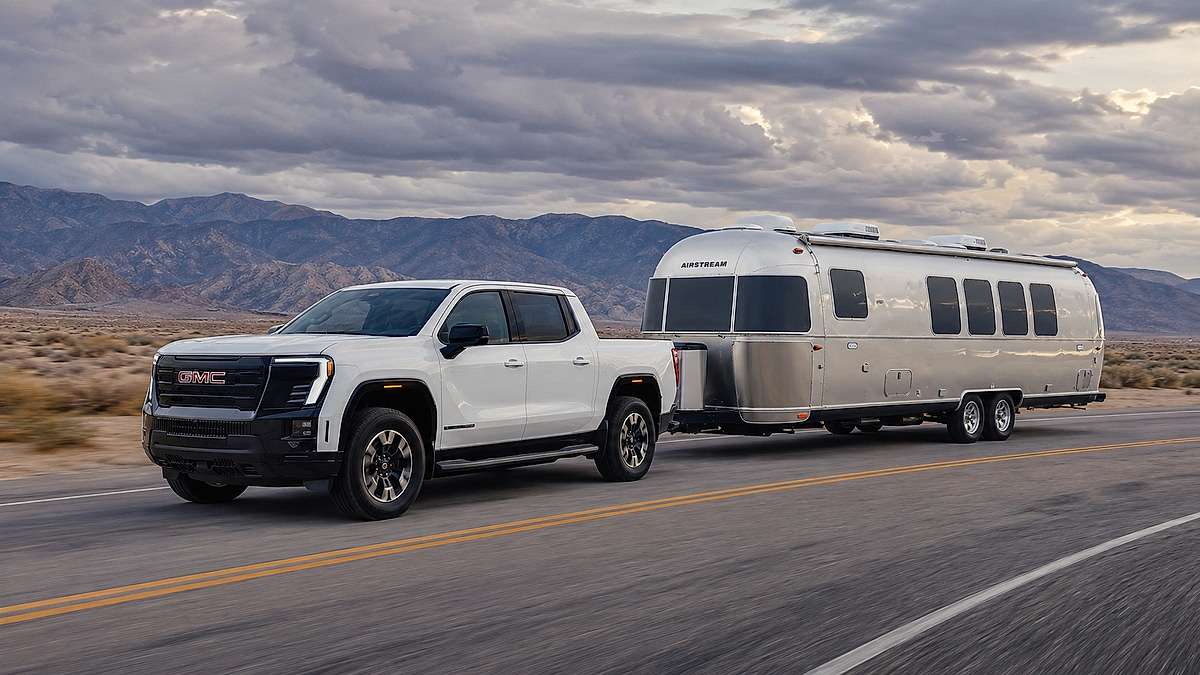

Timothy Rowe’s photo is the kind of EV towing evidence that cuts through a lot of parking-lot arguments.
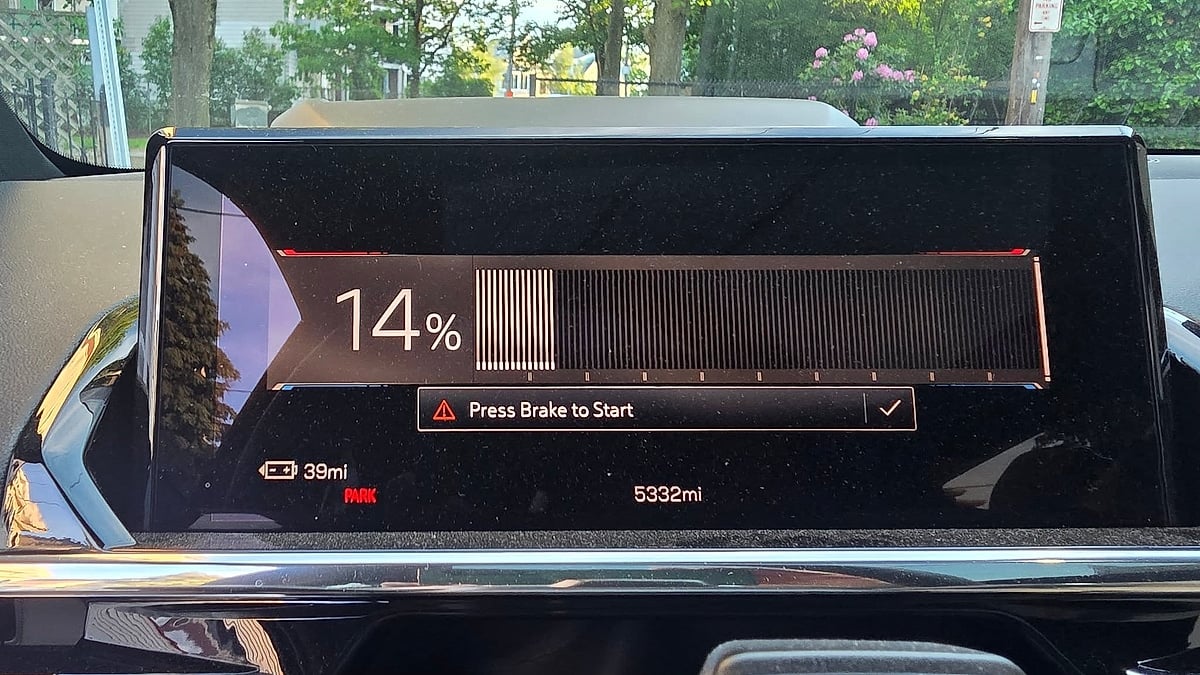
The GMC Sierra EV is sitting in Park with 14 percent battery remaining, 39 miles showing on the range estimate, and 5,332 miles on the odometer. Rowe says he charged to 100 percent in Brooklyn, New York, then drove to Somerville, Massachusetts, with a couple of small side stops. He later reconstructed the route at 224 miles.
The trailer behind him was the part that got my attention: a 28-foot dual-axle modern Airstream.
He did the trip without stopping to charge.
I have read enough electric-truck towing threads to know how fast they usually sour. Someone drags a square camper down an interstate at 74 mph, watches the range fall through a trap door, and declares the entire category dead. Rowe’s Facebook trip is more useful because the details are ordinary enough to study. Brooklyn to Somerville. Traffic near New York.
Open highway for much of the trip. Typical speed around 60 to 65 mph. Modest elevation change. A big trailer, but an aerodynamic one. That last part deserves a pen circle.
Airstreams are heavy enough to make a tow vehicle work, but their shape helps at speed. A comparable 28-foot Airstream is roughly 28 feet 2 inches long, often around 5,900 to 6,000 pounds before cargo, and can carry a GVWR around 7,600 pounds depending on floorplan. That is a real trailer. It is also a far cleaner aero problem than a tall, flat-front travel trailer with the wind manners of a garden shed.
The Sierra EV still had to earn this number.
Rowe used 86 percent of the battery to cover 224 miles. Simple math puts the full-pack towing range at about 260 miles. The truck’s remaining-range display lines up with that result too. Fourteen percent times Rowe’s observed usage works out to roughly 36.5 miles left. The dash showed 39.
For once, the truck and the back-of-the-napkin math appear to be speaking the same language.
The useful number is 260 miles, not 224
The internet will grab the 224-mile figure because it sounds clean. The more useful number is Rowe’s implied 260-mile maximum towing range.
2026 GMC Sierra EV Specs That Help Explain This Result
- The 2026 GMC Sierra EV offers EPA-estimated ranges of up to 478 miles with the Max Range battery pack, depending on trim and configuration.
- Available 800-volt DC fast charging can add up to 120 miles of range in about 10 minutes under ideal conditions.
- The Sierra EV is designed as a full-size work truck with a maximum towing capacity of up to 10,500 pounds when properly equipped.
That does not mean every Sierra EV owner will tow 260 miles with a camper. Change the trailer, weather, speed, tires, traffic, elevation, or payload, and the answer moves. A boxier 28-footer at 70 mph into a headwind could punish the truck. A slower run in warmer weather with more traffic could stretch the number. Towing range is not a fixed spec. It is a negotiation with drag.
Still, 260 miles with a 28-foot Airstream is a serious result.
If Rowe’s truck is a Max Range Sierra EV, that towing figure lands around the mid-50-percent range-retention mark compared with the 2025 Denali Max Range’s 460-mile rating, or a little over half of GMC’s 2026 478-mile Max Range estimate. That sounds brutal until you remember what towing does to every EV pickup.
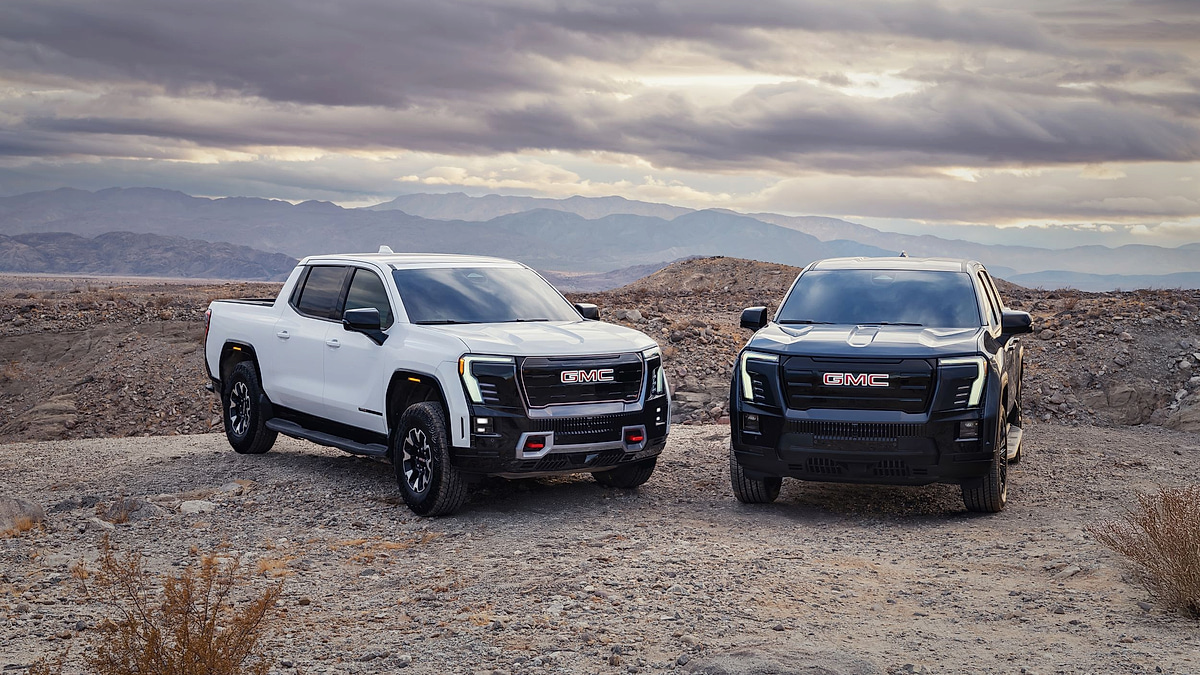
The truck is not losing range because electricity has failed some moral test. It is spending a huge battery against a huge aerodynamic job. A gas truck does the same thing. The pump just hides the drama better.
Speed probably helped more than people think
Rowe’s reported 60 to 65 mph cruising speed matters more than the trailer weight in this case.
Once you are rolling on the highway, aero load starts bullying the rest of the equation. Pushing a trailer through air at 65 mph takes far less energy than doing the same at 75. That difference can turn a good EV towing trip into a charger-hunting exercise.
Traffic near New York may have helped too. Stop-and-go driving is annoying, but it keeps highway drag down and gives the truck chances to recover some energy through regenerative braking. Nobody enjoys crawling out of Brooklyn with a camper attached. The battery may have appreciated the slower average speed.
I would not overplay the owner’s elevation estimate. He says an AI tool guessed 1,500 to 2,000 feet of cumulative gain and loss. Fine as rough color. I would want the actual route data before treating that as gospel. The important point is that this was not a western mountain pull with long grades and thin recovery margins.
It was a Northeast corridor tow. Messy traffic, real miles, normal highway pace.
That is exactly why it is interesting.
The Model X comparison says more about battery size than brand loyalty
Rowe says he used to get 100 to 120 miles towing a much smaller 16-foot Airstream with his Tesla Model X. Now he is seeing a 260-mile implied tow range with a larger trailer behind the Sierra EV.
That comparison will tempt people into a lazy brand-war take. Skip it.
The Sierra EV’s advantage starts with brute battery capacity and truck packaging. The Model X was never built to be an electric tow rig in the same way. It could tow, yes, but it had a smaller pack, a different cooling package, different vehicle geometry, and a very different use case. The Sierra EV was born in the era when GM could stuff a massive battery under a pickup floor and sell the result to people who expect truck behavior.
That does not make Rowe’s result less impressive. It makes the result easier to understand.
Big batteries change towing.
They do not erase the physics, but they give the driver enough buffer to use the truck like a truck. That is the part early EV pickups struggled to deliver. Many could tow the weight. Fewer could tow the weight far enough to make the trip feel normal.
Rowe’s Brooklyn-to-Somerville run crosses that psychological line.
The dash photo matters more than any range estimate
The dash shot helps because it shows the end state, not the boast.
Fourteen percent battery. Thirty-nine miles. Park. No triumphant press-office language. No perfect weather chart. No lab cycle. Just a truck that made it home with enough battery left to avoid the stomach clench.
That 39-mile reserve matters. Arriving at 1 or 2 percent makes for a better social media story and a worse travel habit. Fourteen percent leaves room for a missed driveway, a blocked charger, a detour, cold weather, or one of those little family delays that never appear in route planners.
I would still want more data. Starting and ending odometer photos. Trailer weight as loaded. Tire pressures. Outside temperature. Wind. Average speed. Trip energy consumption. Whether Tow/Haul was active. Whether Super Cruise was used while towing. State of charge at departure and arrival captured in the app.
That list sounds fussy until you have tried to compare EV towing reports. The difference between a useful data point and a campfire story is usually five missing numbers.
Rowe gave enough to make the result worth discussing.
A 260-mile towing range makes EV truck towing feel more normal
The big Sierra EV battery creates a different kind of towing experience. I have always thought range anxiety gets described too broadly. Most experienced EV drivers do not fear running out in the abstract. They fear a bad decision tree: one charger skipped, one station down, one stiff headwind, one trailer dragging range below the plan.
A 260-mile towing envelope changes that tree.
Brooklyn to Somerville without a charging stop means the driver does not have to unhitch at a public charger, block stalls, hunt for pull-through access, or explain to passengers why a 20-minute stop became an hour. That is where electric-truck towing either becomes livable or collapses into planning fatigue.
The Sierra EV still pays for that ability. It is expensive. It is heavy. Depending on model year and configuration, the big-pack Denali lives near six figures. No one should pretend this is an every-buyer solution.
Yet the result is hard to dismiss.
A 28-foot Airstream, 224 real miles, 14 percent left, no charge stop. That is the sentence GMC should care about.
What Sierra EV owners can learn
A Sierra EV owner towing an aerodynamic camper at 60 to 65 mph can cover a meaningful Northeast leg without charging. That is the practical takeaway.
Do not copy Rowe’s result blindly. Use it as a planning ceiling with context. If your trailer is boxier, heavier, taller, or running into wind, build in a wider charging margin. If you tow at 70 to 75 mph, expect the battery to make you pay. If your route has mountains, cold weather, rain, or poor charging access, plan like the truck will deliver less.
The best EV towing rule remains boring because it works: slow down before you panic.
A Sierra EV with the right trailer at the right speed can make numbers that would have sounded silly a few years ago. The truck’s size and battery capacity are doing real work here. So is the Airstream’s shape. So is Rowe’s speed.
That combination produced a result worth saving.
The Missing Details Would Make This Towing Report Even Stronger
The missing details are the same ones that always separate a good towing report from a great one. We do not know the trailer’s loaded weight, the exact Sierra EV trim and battery pack, wind conditions, outside temperature, tire pressures, or the truck’s measured energy consumption. Those factors can move towing range significantly, especially once speeds climb, or weather turns against you.
Even with those gaps, Rowe’s report holds together better than most owner anecdotes because the numbers are internally consistent. A 224-mile trip that consumes 86 percent of the battery points to roughly 260 miles of total towing range, and the truck’s displayed 39 miles remaining at 14 percent state of charge lands very close to that calculation. The photo does not prove what every Sierra EV will do with every trailer, but it does provide a realistic data point for a large electric pickup towing a substantial travel trailer at moderate highway speeds.
EV towing discussions often swing between extremes. Some owners report disappointing results while towing tall, boxy campers at interstate speeds. Others post best-case numbers without enough context to be useful. Rowe’s trip lands somewhere in the middle: a real-world route, a recognizable trailer, a reasonable cruising speed, and enough battery left at the end to avoid turning the drive into a charging gamble.
Owner question
If you tow with a Sierra EV, Silverado EV, Hummer EV, F-150 Lightning, Rivian R1T, Cybertruck, or Model X, what is your real towing range with trailer length, trailer weight, speed, and weather included? The trailer shape may be the missing number in half these debates.
One image by Timothy Rowe from Facebook.
About The Author
Noah Washington is an automotive journalist based in Atlanta, Georgia, covering sports cars, luxury vehicles, and performance culture. His reporting focuses on explaining the engineering, design philosophy, and real-world ownership experience behind modern vehicles.
Noah has been immersed in the automotive world since his early teens, attending industry events and following the enthusiast communities that shape how cars are built and driven today. His work blends industry insight with enthusiastic storytelling, helping readers understand not just what a car is, but why it matters.
Noah is also a member of the Southeast Automotive Media Association (SAMA), a professional organization for automotive journalists and industry media in the Southeast.
His coverage regularly explores sports cars, luxury vehicles, and performance-driven segments of the automotive industry, including the evolving culture surrounding Formula Drift and enthusiast builds.
Read more of Noah's work on his author profile page.
You can also follow Noah here:
Set Torque News as Preferred Source on Google
Follow us today...




Comments
Noah, imagine my surprise…
Permalink
Noah, imagine my surprise when my own Facebook post showed up in my Google alerts for Sierra EV news. Glad it warranted an article! To fill in your blanks, this is a 2026 Sierra EV Denali Max battery truck. I was on Supercruise for most of the trip, which probably helped the numbers as it drives very evenly (note to readers: I believe GM's Supercruise is the only autonomous driving system capable of working while you are towing). The tires were at factory-recommended pressure as of a week or so ago, so no news there. It was a clear day with on and off light rain but no major winds. Temps were in the 60s. As for the loaded weight, the trailer started the day with a full fresh water tank and black and grey probably around half as the place I was staying didn't have sewer connections. I'd guess that put its weight close to its rated GVWR of 7,600lbs. We use an Andersen hitch, in case anyone cares, to distribute weight and dampen any sway (we've not seen any sway at all with this rig). We still own the Model X and it is my wife's favorite car. FSD is in a different league than Supercruise. FSD can drive you from door to door, and is super aware of what is going on. Supercruise is more of an advanced highway lane-keeping & adaptive cruise control system, similar to the old Tesla Autopilot. But its support for towing is a game-changer, as is its accessoey real trailer camera which integrates right into the truck's systems and gives you backup lines when you reverse the trailer, just like a car. Do I prefer Tesla FSD? Sure. But Supercruise actually works in this scenario and FSD doesn't so I'll take the tradeoff.
This added context makes the…
Permalink
In reply to Noah, imagine my surprise… by Tim Rowe (not verified)
This added context makes the Sierra EV result even stronger. A 28-foot Airstream near its loaded GVWR, a real Northeast trip, light rain, moderate temperatures, Super Cruise engaged, and 14 percent left at arrival is a serious data point.
I love it.