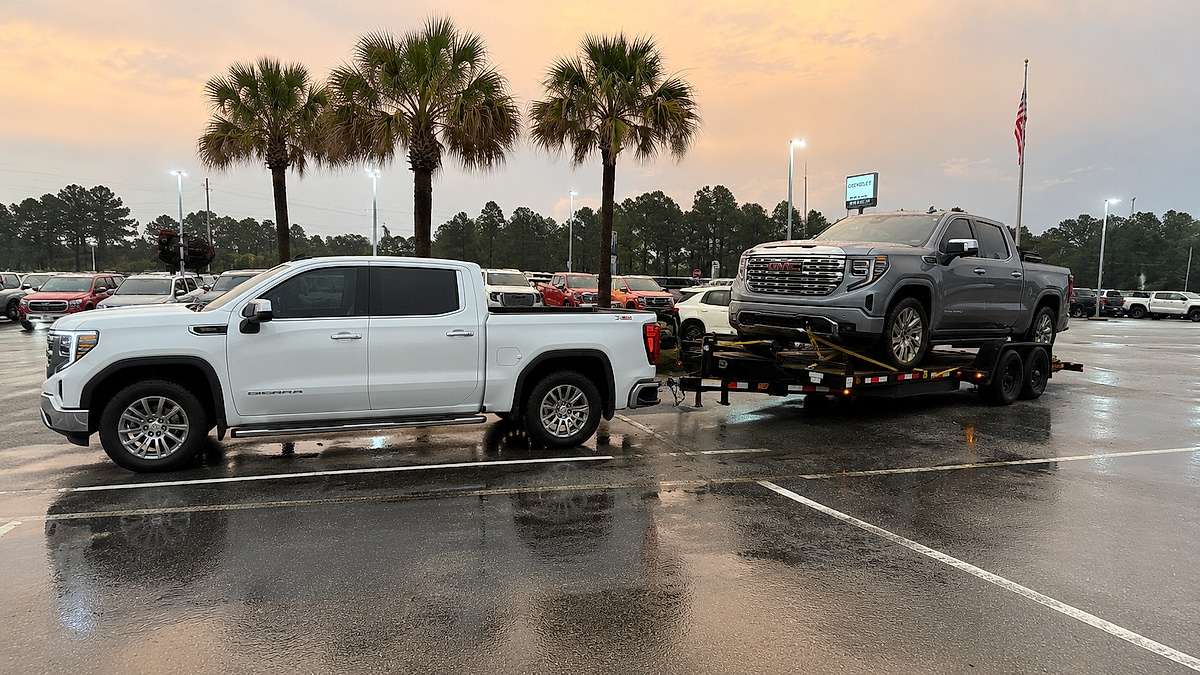

Charles O’Conner has reached the point where the joke is doing the work of a flare gun.
“Looking for a buyer,” he wrote in a Duramax 3.0 owners group. “$50k. It must go.”
That is a man trying to laugh before he says something worse.
O’Conner is in Vidalia, Georgia, and the truck is a 2025 GMC with the 3.0L Duramax. According to his post, the odometer is around 12,000 miles. The first engine failed at about 5,000. At 6,000, he says it ran hot and used two quarts of oil. Then came check-engine lights, water-in-fuel warnings, emissions issues, and finally a running problem that felt like fuel starvation.
He took the Sierra to the dealer.
The first answer was bad fuel, accompanied by a $1,100 bill.
- A first engine failure at 5,000 miles followed by overheating, oil consumption, and fuel-related warnings suggests either a cascading mechanical issue or a misdiagnosis early in the repair chain, both of which demand deeper factory-level involvement, not repeated dealer guesswork.
- “Water in fuel” alerts and fuel-starvation symptoms can originate from sensor faults, wiring issues, or fuel system pressure problems.
- With the truck already approaching 12,000 miles and multiple unresolved issues, every day it remains out of service strengthens the owner’s position under the Georgia Lemon Law.
O’Conner did not buy it. He towed the truck back to his own shop, pulled the filter and tank, changed the filter, and said he found no bad fuel. The truck still would not run. Back to the dealer it went.
Now, he says, it has been there for two weeks, and they still have not solved it.
Bad Fuel Is A Serious Diagnosis, Not A Guess
Modern diesels are extremely sensitive to fuel quality. Water, gasoline contamination, debris, DEF in the fuel system, and improper handling can create expensive failures. GM’s own service information treats contamination as a real diagnostic path because contaminated diesel can damage high-pressure fuel-system components and create no-start, rough-run, warning-light, and emissions symptoms.
So the dealer was not wrong to consider fuel.
The problem is what happens next.
“Bad fuel” is not a casual phrase. It can move the repair from warranty territory into customer-pay territory. It can put the owner on the defensive. It can turn a defective truck into an accused truck.
That means the evidence has to be clean.
Fuel sample. Photos. Water content. Debris. Odor. Color. Filter condition. Tank findings. Diagnostic trouble codes. Lab test if needed. Written notes on why the dealer believes the problem was fuel-related.
If the owner pulls the tank and filter and finds no contamination, the dealer’s diagnosis now has to stand on more than suspicion.
That does not prove O’Conner is right. It does mean the dealership should be able to explain, in writing, what it found and how it reached the conclusion.
A diesel owner should never accept “bad fuel”.
This Is Bigger Than One Warning Light
The sequence is what bothers me.
First engine at 5,000 miles. Heat and oil use around 6,000. Water-in-fuel warning. Emissions issues. Fuel-starvation symptoms. The dealer says bad fuel. The owner disputes it. The truck still will not run. The dealer has it again for two weeks.
Those events may not share one cause. A replaced engine can introduce new variables. A cooling concern may be separate from a fuel concern. An emissions warning may be a downstream result rather than the original fault. A no-start can come from several places on a modern diesel.
Still, a 12,000-mile GMC should not read like a shop foreman’s bad month.
The 3.0L Duramax has plenty of loyal owners. It is smooth, efficient, strong for its size, and one of the more interesting engines GM sells in a half-ton truck. A lot of people bought these trucks because the diesel made the Sierra feel like a long-distance tool rather than another thirsty full-size pickup.
That reputation does not erase O’Conner’s case.
A good engine family can still produce a terrible individual truck. A strong design can still be undone by a bad part, a bad replacement, a missed diagnosis, a fuel-system issue, an emissions fault, a wiring problem, or a service process that loses the thread.
At this stage, the owner does not need another round of guesses.
He needs the file built like a case.
The Truck Is Still Inside The Important Mileage Window
O’Conner says the truck is a 2025 and has about 12,000 miles.
That number matters in Georgia.
Georgia’s Lemon Law rights period generally covers the first 24 months after delivery or the first 24,000 miles of operation, whichever comes first. The state’s consumer guidance also points owners toward repair-attempt and out-of-service standards, including a 30-day cumulative out-of-service threshold under certain conditions.
This is not legal advice. It is a warning about time.
Owners lose leverage when they let a service mess drift without dates, repair orders, mileage, and written notices. A truck sitting at a dealer for two weeks may feel like a personal frustration. In a legal or warranty process, it becomes a calendar entry. Those entries have to be preserved.
O’Conner should not rely on Facebook comments, dealer counter talk, or anyone’s memory.
He needs every repair order from the first engine failure, the overheating and oil-use visit, the water-in-fuel warning, the emissions repairs, the $1,100 bad-fuel diagnosis, the tank/filter inspection he performed, the tow receipts, the current dealer stay, and every communication with GM.
If the truck is not running, each day out of service should be counted.
If the dealer says fuel contamination, he should ask for the proof.
If the dealer cannot diagnose it after two weeks, he should ask whether GM Technical Assistance has been engaged and whether a field service engineer is involved.
That is not being difficult.
That is behaving like the owner of a nearly new truck that has already had one engine.
The Dealer Needs To Answer The Basic Questions
A good repair path starts with simple written questions.
- What failed in the first engine at 5,000 miles?
- Was the replacement engine complete, partial, new, remanufactured, or rebuilt?
- What caused the overheating at 6,000 miles?
- How was the two-quart oil consumption documented?
- Which codes appeared with the water-in-fuel warning?
- Which emissions components were diagnosed or replaced?
- What fuel sample proved to be bad fuel?
- Who retained that sample?
- What test showed contamination?
- What are the current diagnostic trouble codes?
- Does the engine have fuel pressure on the low and high side?
- Have the lift pump, filter housing, pressure sensor, fuel rail, injectors, wiring, grounds, ECM commands, exhaust aftertreatment status, and related modules been checked?
- Has GM TAC been contacted?
The answer may still be ugly. The fuel system may have a fault. The replacement engine may have an issue. An emissions problem may be pulling the truck into limp logic. A sensor or harness may be lying. A module may be making the whole truck act possessed.
The owner can live with a hard truth better than he can live with drift.
“Bad Fuel” And “Water In Fuel” Are Not The Same Story Every Time
The comments under O’Conner’s post went where diesel posts always go.
Bad DEF. Water in fuel. Emissions sensors. Lemon law. Lawyer. Another dealer. Open a GM case. Trade it. Buy a Ram. Buy a gas truck. Modern diesels are trouble. My truck has 100,000 miles without a hiccup.
All of those comments can be true for somebody.
No one diagnosed this GMC.
A water-in-fuel warning can point toward actual water, a sensor problem, wiring, filter issues, or previous contamination history. Poor DEF can set a different chain of emissions warnings and speed limitations. A fuel-starvation feel can come from restriction, air intrusion, pump failure, rail-pressure control, injector trouble, electrical faults, or software response to a different problem.
Modern diesels are layered machines.
That is why the repair order matters more than the comment section. The same dashboard warning can lead to different root causes. The same symptom can live in fuel, air, emissions, cooling, wiring, or control logic.
The Next Step Should Be Formal
A dealer can be polite and still fail to solve the problem.
At two weeks, the escalation should move above the service lane.
O’Conner should open or update a formal case with GMC Customer Assistance using the VIN, mileage, dealer name, dates, repair order numbers, and a short timeline. He should ask for a case number and keep every email or message. If he has already opened one, he should ask for escalation to a supervisor and request written confirmation that GM Technical Assistance is involved.
He should also consider speaking with a Georgia lemon-law attorney or the Georgia Attorney General’s Consumer Protection Division about the process, deadlines, and required notices. Again, the point is not to threaten first. The point is to avoid missing a window while the truck sits.
If the dealer ultimately proves contaminated fuel, then the dispute becomes evidence and responsibility.
If the dealer cannot prove it, then the earlier bad-fuel bill deserves a hard look.
If the truck remains down long enough, the out-of-service days become their own problem.
If the same or related defect keeps coming back, the repeated repair history becomes the center of the file.
The Damaging Part Is The Trust Loss
O’Conner wants out because the truck has stopped being transportation and started being a wager.
That is the real damage.
People can forgive a bad sensor. They can forgive a single defective part. They can forgive a truck needing warranty work if the repair is clean, the explanation is clear, and the machine returns to service with confidence.
A first engine at 5,000 miles changes the owner’s hearing. Every sound after that gets louder. Every warning light carries history. Every dealer's answer has to climb over what happened before.
By 12,000 miles, after heat, oil use, water-in-fuel alerts, emissions issues, a disputed bad-fuel diagnosis, and two weeks of no answer, the owner is no longer just waiting for repair.
He is waiting to see whether the truck deserves another chance.
The 3.0L Duramax may still be a fine engine in thousands of other driveways. That does not help the man in Vidalia whose GMC is back at the dealer with one engine already gone and the next answer still pending.
A vehicle can be covered by warranty and still cost the owner time, work, towing, sleep, and trust.
O’Conner does not need to be told he bought the wrong truck. He needs a clean diagnosis, a documented repair path, and a manufacturer-level decision before the clock and odometer eat his leverage.
The truck is nearly new.
The paper trail should look like it.
GMC 3.0 Duramax Owners, What Fixed Yours?
If your 3.0L Duramax had a no-start, water-in-fuel warning, emissions fault, oil-use issue, overheating, or engine replacement, share the model year, mileage, codes, dealer diagnosis, final repair, and whether GM Customer Assistance became involved.
Let us know by commenting below.
About The Author
Noah Washington is an automotive journalist based in Atlanta, Georgia, covering sports cars, luxury vehicles, and performance culture. His reporting focuses on explaining the engineering, design philosophy, and real-world ownership experience behind modern vehicles.
Noah has been immersed in the automotive world since his early teens, attending industry events and following the enthusiast communities that shape how cars are built and driven today. His work blends industry insight with enthusiastic storytelling, helping readers understand not just what a car is, but why it matters.
Noah is also a member of the Southeast Automotive Media Association (SAMA), a professional organization for automotive journalists and industry media in the Southeast.
His coverage regularly explores sports cars, luxury vehicles, and performance-driven segments of the automotive industry, including the evolving culture surrounding Formula Drift and enthusiast builds.
Read more of Noah's work on his author profile page.
You can also follow Noah here:
Set Torque News as Preferred Source on Google
Follow us today...