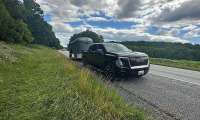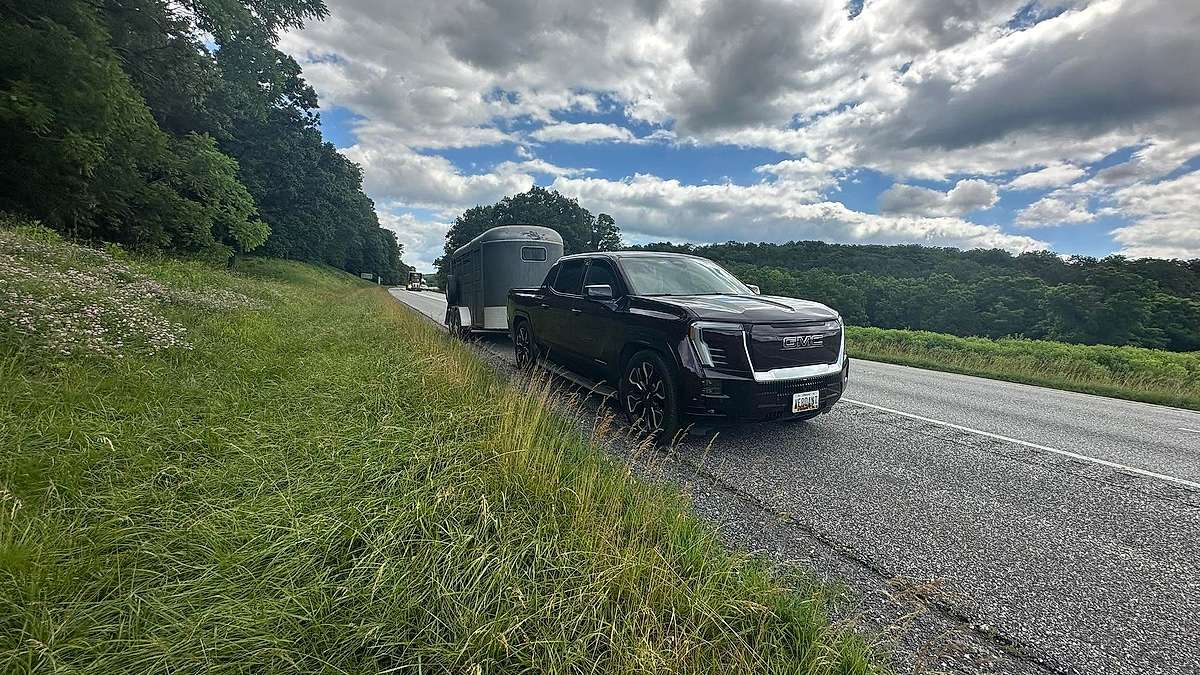

The truck quit with a charger 15 miles away.
That is the kind of sentence that turns an EV towing debate from theory into roadside geography. Trevor William Ashley posted in a GMC Sierra EV group that his 2025 GMC Sierra EV Denali Max Range was towing a trailer on I-81 just north of Harrisonburg, Virginia, when the range estimate collapsed. He had been showing 10 percent battery. Then the truck went to zero, entered reduced-power turtle mode for a mile or two, and shut down after he reached the shoulder.
The dash photo is ugly in the way only a dead EV dash can be ugly.
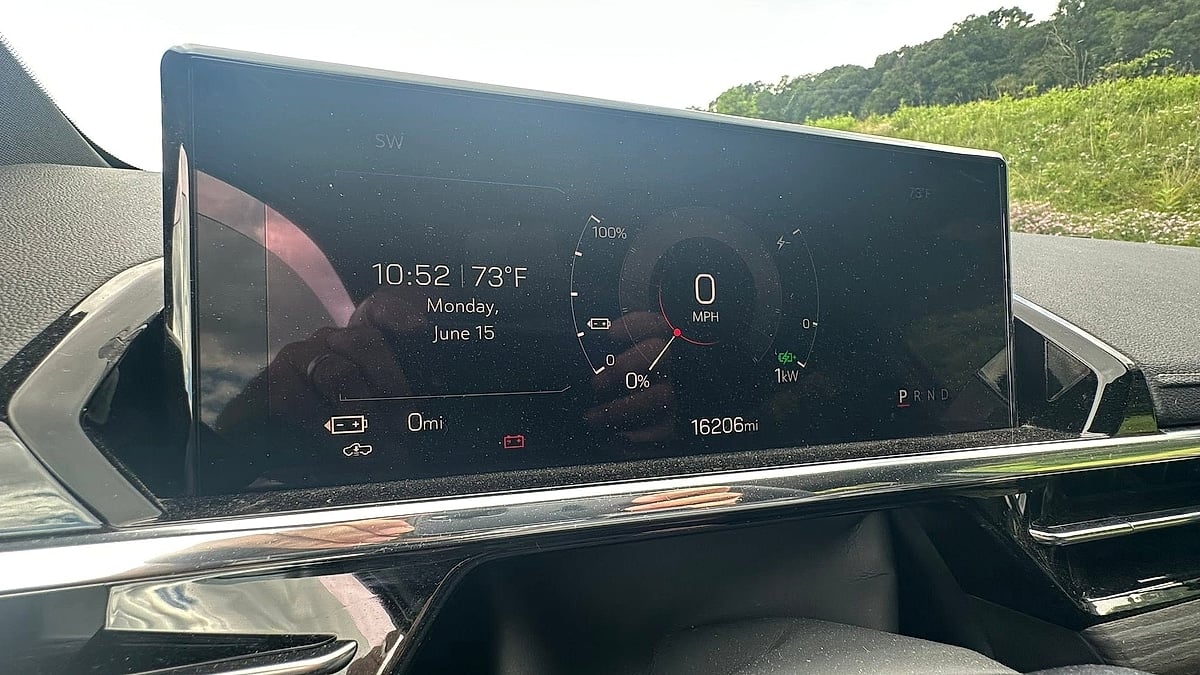
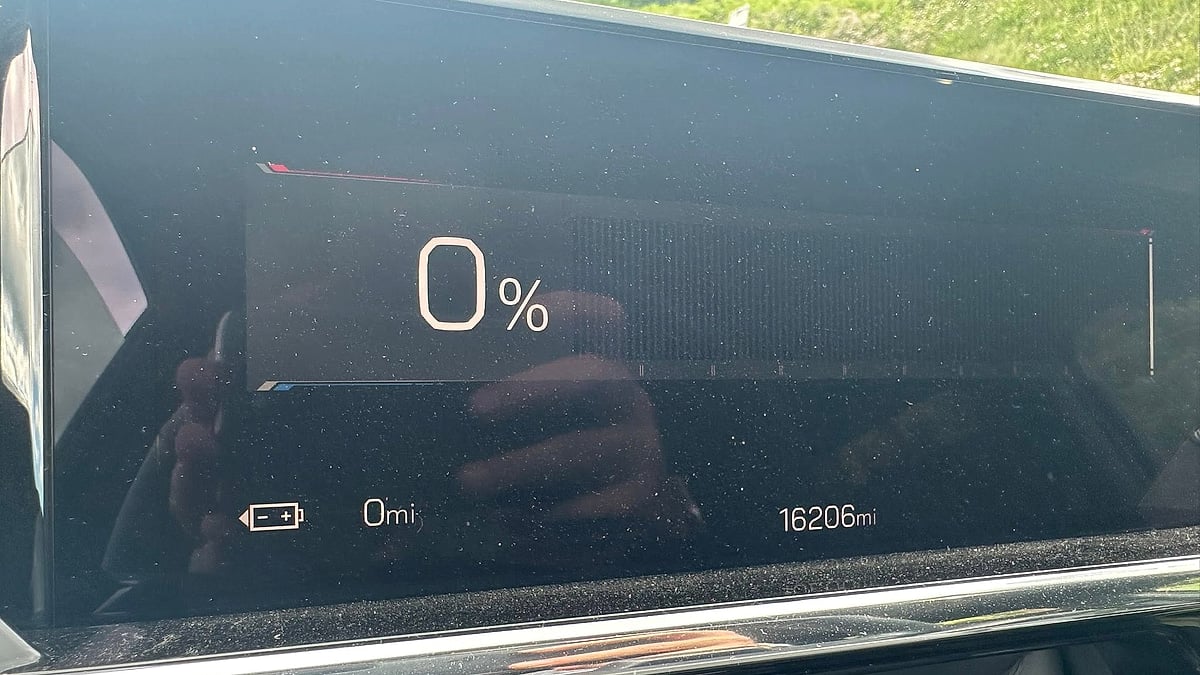
Zero percent. Zero miles. Park. Red battery icon. A lonely 1 kW showing on the right side of the display. Odometer at 16,206 miles. Outside temperature 73 degrees. No blizzard. No desert heat. No obvious weather villain. Just a big electric truck, an empty horse trailer, Appalachian grades, and a battery estimate that stopped behaving like a promise.
Ashley says he had enough remaining low-voltage power to enable transport mode, then waited for a tow.
That is the entire fear of EV towing in one frame.
The mistake was not buying the truck
The easy crowd will jump straight to “this is why EV trucks are useless.”
That crowd can sit down.
The Sierra EV Denali Max Range is one of the most capable electric pickups on sale. GMC rates the 2025 Denali Max Range at up to 460 miles, with 760 horsepower and 785 lb-ft of torque in Max Power mode. It has a giant battery, strong DC fast-charging capability, four-wheel steering, serious comfort, and enough torque to make towing feel deceptively easy.
That last word is the trap.
Deceptively.
Ashley was towing an empty horse trailer on a 660-mile trip. He later said he was in Appalachia, driving about 75 mph because the speed limit on I-81 is 70 mph. He wanted to avoid a third charging stop. That is the kind of decision every road-tripper understands. Nobody wants another stop. Nobody wants to unhitch. Nobody wants to sit at a charger with a trailer attached while the clock eats the day.
So he pushed.
Most of us have done some version of that in a gas vehicle. The difference is that a gas truck running low usually gives you a fairly familiar kind of anxiety. Needle low. Light on. Maybe 25 miles left. Maybe 12 if you are unlucky. You know the ritual.
An EV towing at highway speed near the bottom of the pack follows a harsher set of rules.
Low state of charge is not a fuel gauge with nicer graphics
Battery percentage feels like a fuel gauge because automakers train us to read it that way.
It is not that simple under load.
A lithium-ion pack at low state of charge has less voltage headroom. Add a trailer, interstate speed, rolling grades, and a heavy right foot, and the pack has to deliver serious current. Under that load, voltage sag can make the usable portion of the battery disappear faster than the percentage display prepared the driver to believe. The battery management system will protect the pack before it protects your schedule.
That is what turtle mode is trying to do.
The truck reduces power because the system no longer believes it can deliver normal propulsion safely. In a towing situation, that reduced power can arrive at the worst possible moment: uphill, in traffic, with a trailer behind you and a charging station just close enough to make the failure feel personal.
Kyle Conner commented on the post that GM is particularly weak at high load and low state of charge in towing tests, and that GM EV truck owners should treat 10 percent as zero when towing. That advice sounds harsh. Ashley’s photo makes it look practical.
I would go further for mountain or interstate towing: treat 20 percent as the decision point and 10 percent as emergency territory.
A big EV pickup should never ask the driver to learn that lesson on the shoulder.
Speed punished him harder than the air conditioning
One commenter suggested turning off the AC to save 10 percent.
That sounds like gas-station folklore wearing an EV hat.
Yes, HVAC uses energy. In a marginal situation, every kilowatt helps. Ashley said he tried shutting it off as soon as the AC suddenly dropped. By then, he was already in the danger zone.
At 75 mph with a horse trailer in Appalachia, aerodynamic drag and grade load dominate the story. A trailer may be empty and still act like a parachute with wheels. The air does not care whether the trailer has horses inside. It cares about frontal area, turbulence, speed, and shape.
Dropping from 75 mph to 65 mph would likely have saved more useful range than sweating in the cabin. Dropping to 60 before the final stretch might have done more still. That is the unpleasant EV towing rule: speed is the big lever, and it feels insulting because slowing down makes the trip longer before it makes the math better.
Ashley knew he was pushing it. He said as much. He usually avoids going below 20 percent in his EVs. This time, the long trip and the desire to avoid another stop tempted him past his own rule.
That is how these stories happen.
Not through stupidity. Through one more exit. One more hill. One more optimistic estimate. One more charger you think you can reach.
GM needs a towing reserve display, not just a range number
This is where the Sierra EV can improve.
The truck should know when it is towing. It should know speed, grade, recent consumption, battery temperature, voltage behavior, trailer mode, and the next charging stop. It should not present the bottom 10 percent with the same emotional confidence it gives a commuter running empty on level ground.
A towing reserve should be calculated differently.
If the battery is at 18 percent while towing at 75 mph through hills, the truck should say something closer to: “Current load leaves limited usable reserve. Reduce speed or charge now.” If voltage sag is trending badly, the warning should come early. If the vehicle expects power reduction before the next charger, the driver needs that information while choices still exist.
A normal range estimate tells you how far the truck thinks it can go.
A tow reserve should tell you how hard the truck can keep working.
EV trucks need load-aware reserve logic. A 460-mile battery does not remove the need for better information at the bottom of the pack. It makes better information more urgent because the drivers using these trucks will take them farther, tow heavier, and trust the big number until the dashboard betrays them.
The trailer plug trick is a warning sign, not a strategy
One commenter said disconnecting the trailer plug can pull the truck out of tow mode and give more range or power. Another owner said dropping the trailer caused the percentage to recover enough to reach help.
Those stories are useful. They are also emergency improvisation.
If removing the trailer load or trailer logic changes the truck’s available power enough to save a few miles, that proves the original problem: the energy estimate under tow was too optimistic for the actual load. Disconnecting a trailer plug on the shoulder of an interstate should never become part of the normal EV towing playbook.
Dropping the trailer may be the right emergency move if you can do it safely and legally, especially near a charger. But that is not a plan. That is a roadside confession.
A better plan starts 50 miles earlier.
Charge sooner. Slow down sooner. Do not chase a skipped stop below 20 percent while towing. If the route is mountainous, windy, cold, wet, or fast, build a larger reserve. If the truck predicts arrival under 15 percent with a trailer attached, assume that number is decorative until proven otherwise.
The Sierra EV still has a towing case
This incident does not erase the Sierra EV’s strengths.
A gas 2500 or 3500 still rules the long-haul towing world because diesel energy density remains brutally convenient. No electric pickup changes that yet. But the Sierra EV Max Range has enough battery to make many towing routes workable if the owner respects the bottom of the pack. It has huge power, strong charging, and a real truck bed. It can tow. It can road-trip. It can also strand an owner who treats the final 10 percent like normal driving reserve.
That is the grown-up reading.
The truck did not fail because electric towing has no future. The trip failed because high-speed towing at low state of charge exposed a weakness in the way useful reserve gets displayed and trusted.
I do blame GM for one part: the driver should get a clearer warning before the truck falls off the cliff. A premium electric truck with a six-figure window sticker should be better at telling its owner when 10 percent is already gone in practical terms.
Ashley gave everyone else a painful gift.
He found the cliff.
What Sierra EV owners should do now
If you tow with a Sierra EV, Silverado EV, Hummer EV, or Escalade IQ, change your mental reserve immediately.
For normal unloaded driving, your comfort zone may be 10 percent. For towing, use 20 percent as the floor unless you know the route, the charger, the weather, and the trailer behavior. In hills or at interstate speeds, build more margin.
If the truck drops below 15 percent with a trailer attached, slow down before the warning lights appear. Drop from 75 to 65. If range still looks tight, go to 60 and take the next viable charging option. Turn off heavy HVAC if needed, but do not pretend cabin comfort is the main energy lever with a trailer at highway speed.
Watch the truck’s behavior, not just the percentage. Reduced power, falling predicted range, weak regen, AC changes, or sudden estimate movement should push you into conservation mode immediately. If the truck enters turtle mode, get to a safe shoulder. Do not gamble with traffic while towing.
For GM, the fix should be software-based. Add a tow reserve model. Make the warning earlier. Use load and voltage behavior to warn the driver.
Sierra EV owners, where is your real tow reserve?
If you tow with a Sierra EV, Silverado EV, Hummer EV, or Escalade IQ, what battery percentage do you treat as your personal zero when towing? Share trailer type, speed, terrain, state of charge when you arrived, and whether the truck ever reduced power near the bottom of the pack.
Images by Trevor William Ashley
About The Author
Noah Washington is an automotive journalist based in Atlanta, Georgia, covering sports cars, luxury vehicles, and performance culture. His reporting focuses on explaining the engineering, design philosophy, and real-world ownership experience behind modern vehicles.
Noah has been immersed in the automotive world since his early teens, attending industry events and following the enthusiast communities that shape how cars are built and driven today. His work blends industry insight with enthusiastic storytelling, helping readers understand not just what a car is, but why it matters.
Noah is also a member of the Southeast Automotive Media Association (SAMA), a professional organization for automotive journalists and industry media in the Southeast.
His coverage regularly explores sports cars, luxury vehicles, and performance-driven segments of the automotive industry, including the evolving culture surrounding Formula Drift and enthusiast builds.
Read more of Noah's work on his author profile page.
You can also follow Noah here:
Set Torque News as Preferred Source on Google
Follow us today...