

A cross-country drive is where marketing claims usually go to die. Range estimates meet headwinds, driver-assist systems meet construction zones, and charging curves meet reality.
That is why one GMC Sierra EV owner’s account of a 5,300-mile coast-to-coast round trip stands out. Not because it was flawless, but because it worked, repeatedly, over thousands of miles, at speed, and without turning the trip into an endurance experiment.
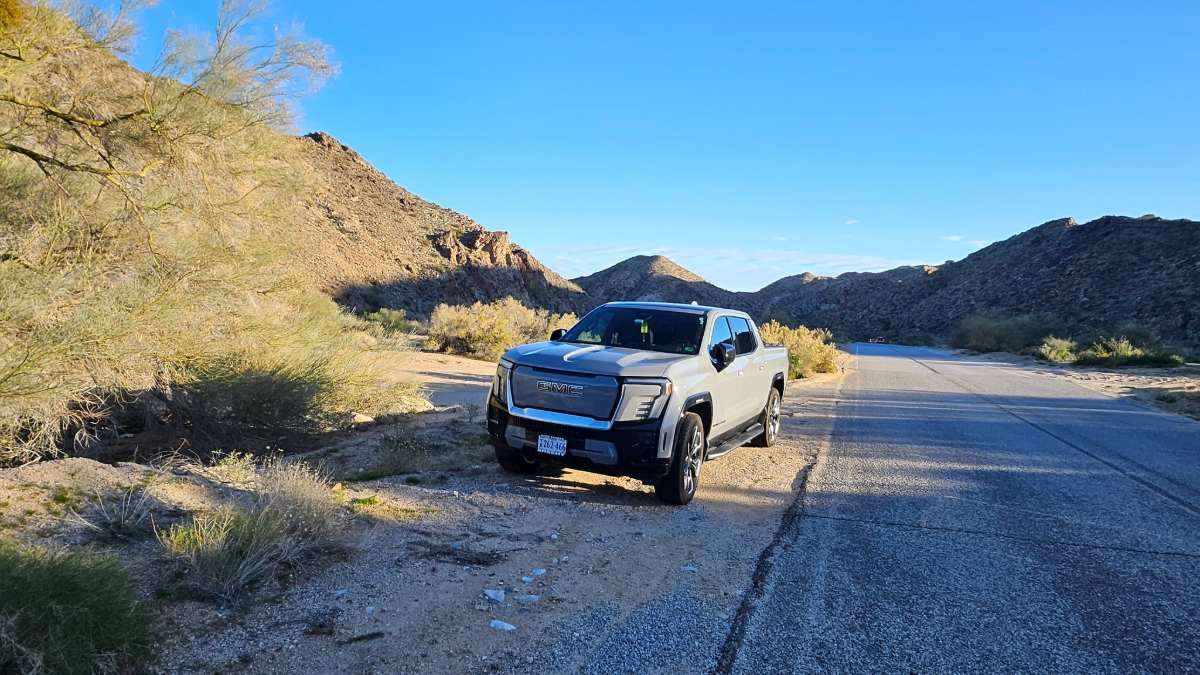
The truck was a 2024 Sierra EV Edition 1, nicknamed “Thundertank,” driven from Northern Virginia to Torrance, California, and back, with roughly 8,000 miles added in just two weeks. The original reason for the journey was practical: picking up a custom truck topper in Phoenix.
The execution quickly became something more ambitious. Instead of breaking the trip into short hops and hotel charging stops, the owner committed to running the truck hard across interstates, hauling camping gear, and seeing whether an electric full-size pickup could genuinely replace the long-haul role traditionally owned by diesel and gas trucks.
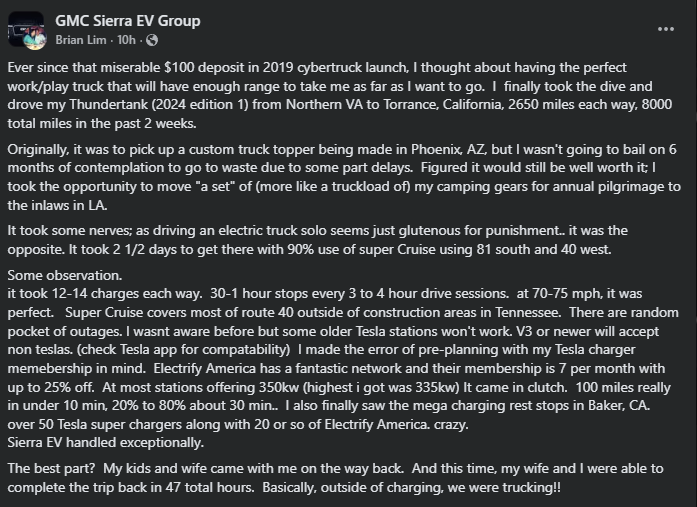
“Ever since that miserable $100 deposit in the 2019 Cybertruck launch, I thought about having the perfect work/play truck that will have enough range to take me as far as I want to go. I finally took the dive and drove my Thundertank (2024 edition 1) from Northern VA to Torrance, California, 2650 miles each way, 8000 total miles in the past 2 weeks.
Originally, it was to pick up a custom truck topper being made in Phoenix, AZ, but I wasn't going to bail on 6 months of contemplation to go to waste due to some part delays. Figured it would still be well worth it; I took the opportunity to move "a set" of (more like a truckload of) my camping gear for the annual pilgrimage to the in-laws in LA.
It took some nerves; as driving an electric truck solo seems just gluttonous for punishment, it was the opposite. It took 2 1/2 days to get there with 90% use of Super Cruise using 81 south and 40 west.
Some observation.
Advertising
It took 12-14 charges each way. 30-1 hour stops every 3 to 4 hour drive sessions. At 70-75 mph, it was perfect. Super Cruise covers most of Route 40 outside of construction areas in Tennessee. There are random pockets of outages. I wasnt aware before, but some older Tesla stations won't work. V3 or newer will accept non-Teslas. (check Tesla app for compatibility) I made the error of pre-planning with my Tesla charger membership in mind. Electrify America has a fantastic network, and their membership is 7 per month with up to 25% off. At most stations offering 350kw (the highest I got was 335kw) It came in clutch. 100 miles really in under 10 min, 20% to 80% about 30 min. I also finally saw the mega charging rest stops in Baker, CA. over 50 Tesla super chargers along with 20 or so of Electrify America. Crazy.
Sierra EV handled exceptionally.
The best part? My kids and wife came with me on the way back. And this time, my wife and I were able to complete the trip back in 47 total hours. Basically, outside of charging, we were trucking!”
What surprised him most was not the range but the workload taken off his shoulders. SuperCruise handled roughly 90 percent of the driving, particularly across I-81 and I-40, only disengaging in construction zones and a few coverage gaps. For hours at a time, the truck managed lane keeping and speed with minimal intervention, turning what could have been a fatiguing solo drive into something closer to structured downtime. By the time the return leg included his wife and kids, the benefit became even clearer. They completed the return trip in about 47 total hours, charging stops included, effectively spending nearly all non-charging time moving.
GMC Sierra EV: Full-Size Electric Pickup
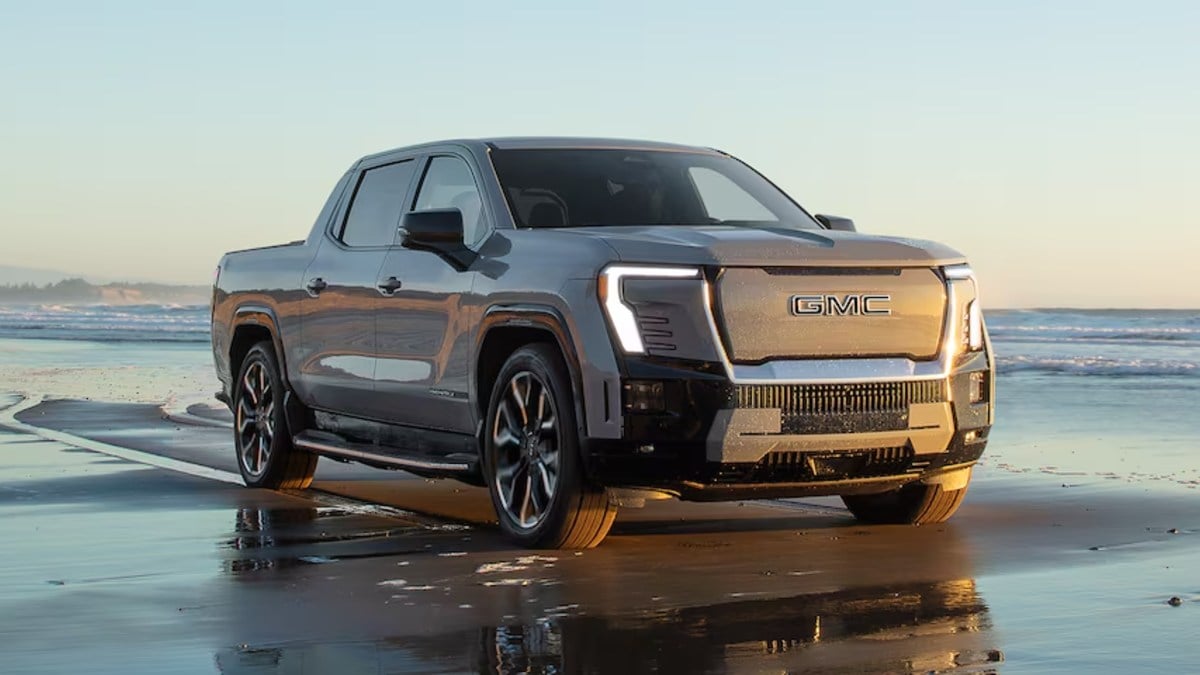
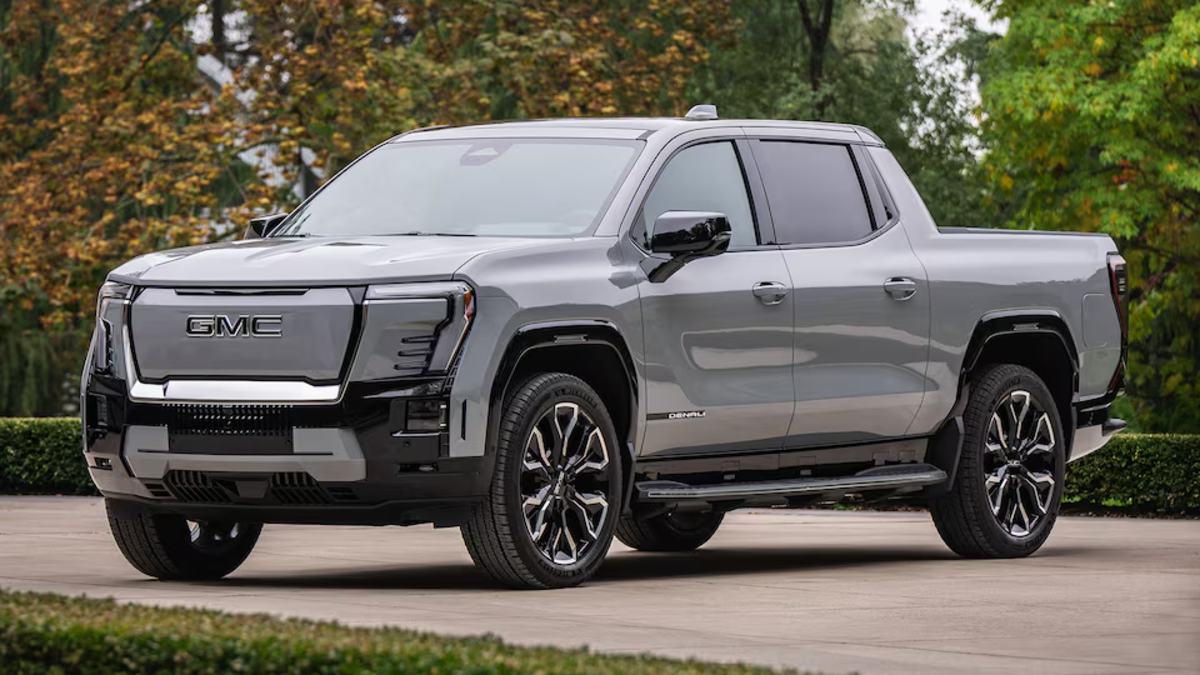
- The GMC Sierra EV is a full-size electric pickup built on GM’s Ultium platform, sharing core technology with other GM electric trucks and SUVs.
- It features a four-wheel steering system that helps reduce turning radius, making the large truck easier to maneuver in parking lots and urban areas.
- The Sierra EV includes a front trunk, often called a frunk, which provides additional secure storage that traditional gas trucks do not offer.
- Its MultiPro tailgate and fold-flat rear seating allow the truck to carry long items inside the cabin, expanding cargo flexibility beyond the bed.
Charging, predictably, was the make-or-break variable, and Electrify America carried most of the load. The trip required roughly 12 to 14 DC fast-charge sessions each way, typically every three to four hours. Stops lasted between 30 minutes and an hour, depending on how deep into the battery the owner chose to charge. At 350-kW stations, peak speeds reached as high as 335 kW. In practical terms, that translated to roughly 100 miles of range added in under 10 minutes, and a 20 to 80 percent charge in about half an hour when conditions lined up.
The charging strategy was deliberate. Rather than chasing full charges, the owner stayed in the fat part of the charging curve, topping up just enough to reach the next stop with a buffer. Above 60 percent, charging speeds tapered quickly, dropping into the low 100-kW range by around 70 percent. With chargers located right off highway exits, it made more sense to stop more often and leave sooner. The breaks also aligned well with human limits. Three to four hours of driving followed by a short stop kept fatigue in check, especially on the solo outbound leg.
There were lessons learned along the way. Some older Tesla Superchargers remain incompatible with non-Tesla vehicles like the Sierra EV, even with a membership, and pre-planning around that assumption caused unnecessary detours. Electrify America’s network proved more reliable for this trip, and the owner recommends the monthly membership for its discounted rates. He also encountered one of the large-scale charging hubs in Baker, California, with dozens of Tesla stalls alongside a substantial Electrify America presence, a glimpse of what high-traffic EV corridors are starting to look like.
Speed discipline mattered. Cruising at 70 to 75 mph struck the balance between progress and efficiency, keeping consumption predictable and charging stops consistent. With the Sierra EV’s large battery, skipping chargers was often possible, but only when the next stop was confidently within reach. Google Maps’ charge-at-arrival estimates were used as a baseline, with a self-imposed buffer added before committing to longer legs.
The owner admits he was nervous going in, conditioned by years of online horror stories about EV road trips, charging queues, and range anxiety. What he found instead was a system that, while imperfect, functioned well enough to make the trip not just feasible, but enjoyable. The truck was stable, quiet, and comfortable over long distances, and SuperCruise turned hours of highway into something closer to managed time than constant vigilance.
That perspective resonated with other owners. Several commenters noted how refreshing it was to read a detailed, positive long-distance report rather than another post focused solely on edge cases and failures. One Silverado EV owner pointed out that with hotel charging and fewer DC fast-charge stops, even longer daily distances are achievable, reinforcing the idea that strategy matters as much as hardware.
This trip does not prove that electric trucks like the Sierra EV are for everyone, or that charging infrastructure is finished. What it does show is that the core pieces are now in place.
High-power charging, reliable driver assistance, and realistic range management have reached a point where a coast-to-coast drive in a full-size electric pickup is no longer a stunt. It is simply a long drive, planned with intent, executed with patience, and supported by a network that finally feels like it belongs on the same map as the interstate system it shadows.
Image Sources: GMC Media Center
Noah Washington is an automotive journalist based in Atlanta, Georgia. He enjoys covering the latest news in the automotive industry and conducting reviews on the latest cars. He has been in the automotive industry since 15 years old and has been featured in prominent automotive news sites. You can reach him on X and LinkedIn for tips and to follow his automotive coverage.
Set Torque News as Preferred Source on Google
Follow us today...



Comments
Until EVs recharge as fast…
Permalink
Until EVs recharge as fast as I can fill a gas tank no one will really want them.
Get up in the morning, you…
Permalink
In reply to Until EVs recharge as fast… by Devil (not verified)
Get up in the morning, you drive 3 to 4 hours, you charge while you eat lunch, you drive another three or four hours, you dine while you charge, drive anther three or four charge while you sleep, repeat. What’s the inconvenient part? Also, when operating around home, you charge at home, much cheaper than gas. All good — unless you enjoy oil/transmission/ coolant changes, belt or timing chain replacement, air and oil filter replacements, valve train adjustments, and killing the planet.
I love the smell of gas, oil…
Permalink
In reply to Get up in the morning, you… by SteveInMN (not verified)
I love the smell of gas, oil, transmission fluid, and coolant. Why would I want to give that up?
This trial trip to see how…
Permalink
In reply to Get up in the morning, you… by SteveInMN (not verified)
This trial trip to see how well it will do on a cross-country is ridiculous. Not everyone has a week to get across the country m, time to waste taking long stops, or money to spend on stopping for hotels. I've been coast to coast several times, driving with other drivers. We only stopped for gas and took turns driving around the clock, the trip took 4-5 days.... that would never happen with this vehicle
Well I guess my digestive…
Permalink
In reply to Get up in the morning, you… by SteveInMN (not verified)
Well I guess my digestive system is much different from yours, I cant eat every 3-4hrs
Easy that is not long…
Permalink
In reply to Get up in the morning, you… by SteveInMN (not verified)
Easy that is not long distance driving. Each year we drive from ND to Indianapolis and with minimal stops it still takes about eleven hours to get there but with the OPs schedule we would end up taking an additional 2+ hours of stop time thats not needed. The point of a lomg distance drive is to get from point A to point B as fast as possible to either maximize the time at your destination or just not waste time.
30 hours of charging is…
Permalink
In reply to Until EVs recharge as fast… by Devil (not verified)
30 hours of charging is ridiculous. The key tale away is Supercruise with a 3.0 Duramax diesel is the perfect roadtrip vehicle. 600 miles+ to each fill up and fill up take less than 5 minutes.
I bought a used 2023 volt…
Permalink
In reply to Until EVs recharge as fast… by Devil (not verified)
I bought a used 2023 volt euv. Best car I ever owned. I plug it in at home and charges in a few hours. My driving habits work well with this setup. So don’t say no one will want one, it just may not work for you. EVs are the future.
It will take a long time for…
Permalink
In reply to I bought a used 2023 volt… by Mick (not verified)
It will take a long time for EVs to match ICE vehicles for long distance driving and towing. The best option if these companies reqlly wanted to would be to develope a diesel electric drivetrain which would in principle provide the best of both worlds.
No one? Even the people that…
Permalink
In reply to Until EVs recharge as fast… by Devil (not verified)
No one?
Even the people that already have one? Or the people considering buying one? Or the people that want one but can't afford one?
You're a fool. The number…
Permalink
In reply to Until EVs recharge as fast… by Devil (not verified)
You're a fool. The number one selling car in the US is a EV Tesla model y to be exact. So your stupid comment makes zero sense. If you're not taking 20 to 30 mins rest in between driving your probably the jackass falling asleep and causing accidents
Try Tesla FSD. You will…
Permalink
Try Tesla FSD. You will actually be shocked
Wow my camry adds 650 miles…
Permalink
Wow my camry adds 650 miles of range in less than 10 minutes so....
I'd love to have seen a…
Permalink
I'd love to have seen a breakdown of the costs . The varied charging rates would have been important information.
Sounds miserable. You have…
Permalink
Sounds miserable. You have to search for places to charge; which I suspect are NOT on the route you wish to take. You have to stop to charge 4-5 times rather than 1 (one) time to fill the tank with gas. Of course it takes 5 minutes or less to fill your tank with gas; rather than HOURS of charging a vehicle with limited range. Electric vehicles are substantially heavier; so they go through tires twice as fast as internal combustion vehicles. The EV's cost substantially more to purchase and also insure. Then when the vehicle dies, you have to find a junkyard that will take the vehicle; which limited junkyards will do after you pay the hazardous materials disposal fee.
I have a 2022 Chevy Colorado…
Permalink
I have a 2022 Chevy Colorado
Been trying for over two years now to have transmission and back up camera problems corrected
Made at least a dozen visits to 2 different Gm dealers without resolution
GM or the dealers do not care how many visits it takes to resolve the issues with this vehicle
It is not their time getting wasted it is mine
Avoid GM if possible
The article mentions both a…
Permalink
The article mentions both a 5300 mile round trip as well as 8000 miles in 2 weeks. It doesn't add up.
Otherwise, the Supercruise feature is something that I really wish I checked the box on when I got my Silverado High Country. I've made cross country trips several times and really enjoyed it, but the Supercruise I'm sure would have made the trip so much better.
I'm curious what the…
Permalink
I'm curious what the charging costs were and if there was a difference between going east or west.