
Electric trucks have become an easy scapegoat for rising utility bills, especially in winter, when kilowatt-hours disappear faster, and explanations feel harder to pin down. That reflex was on full display in a recent GMC Sierra EV Group post, where an owner initially blamed his new electric pickup for a power bill running more than 50 percent higher than usual. The reality, as it turned out, had far less to do with the truck and everything to do with a heating system that never knew when to quit.
The warning sign arrived via an automated alert from the local electric co-op. The message was blunt. Energy usage was trending at least 50 percent higher than the same time last year and higher than the most recent billing cycle. Halfway through the month, the household had already burned through 2,615 kWh in just 14 days. If that pace continued, the projected total would land at a staggering 5,604 kWh for the month. For context, that is more than some entire households use in a quarter.
“Does anyone have any input? I drive my truck 2-3 days a week, and when parked, I leave it charging. Help!! This is nuts. Quick update! It gets around 30 to 40° down here, normal average cold levels, and we have been opening up our windows and setting the heat to 66, so apparently, the heat has never been cutting off and running all night. I believe that’s where our energy should be coming from. I looked at my GMC app, and it’s barely pulling 57 kW on a single day charge at most.”
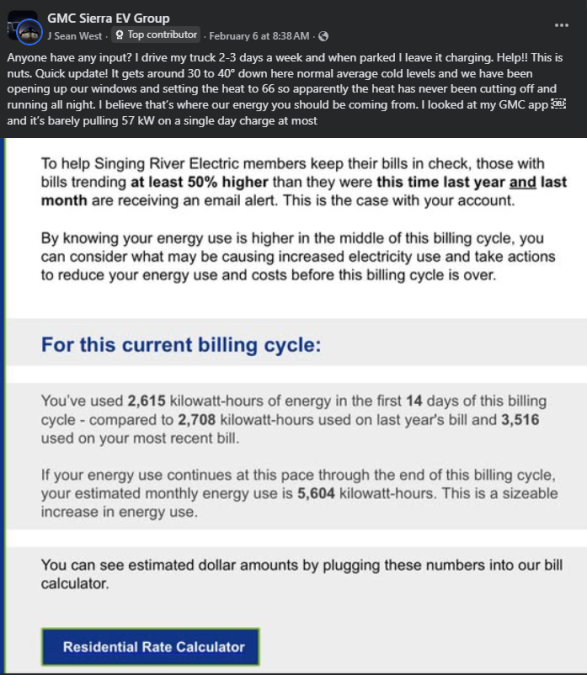
The owner’s first instinct was understandable. He drives his GMC Sierra EV two to three days a week and typically leaves it plugged in when parked. With a new truck, a new charger, and a suddenly eye-watering electric bill, the dots seemed easy to connect. Panic set in quickly. Something had to be wrong. The truck must be pulling power constantly. The charger must not stop. Surely this was not normal.
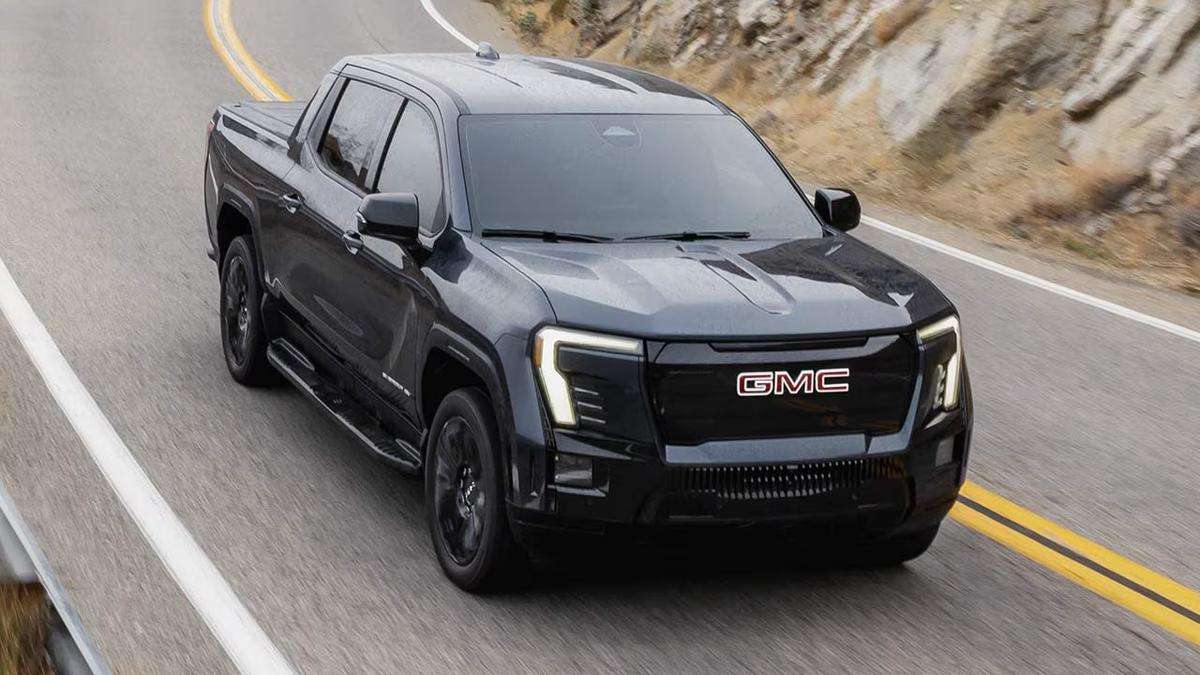
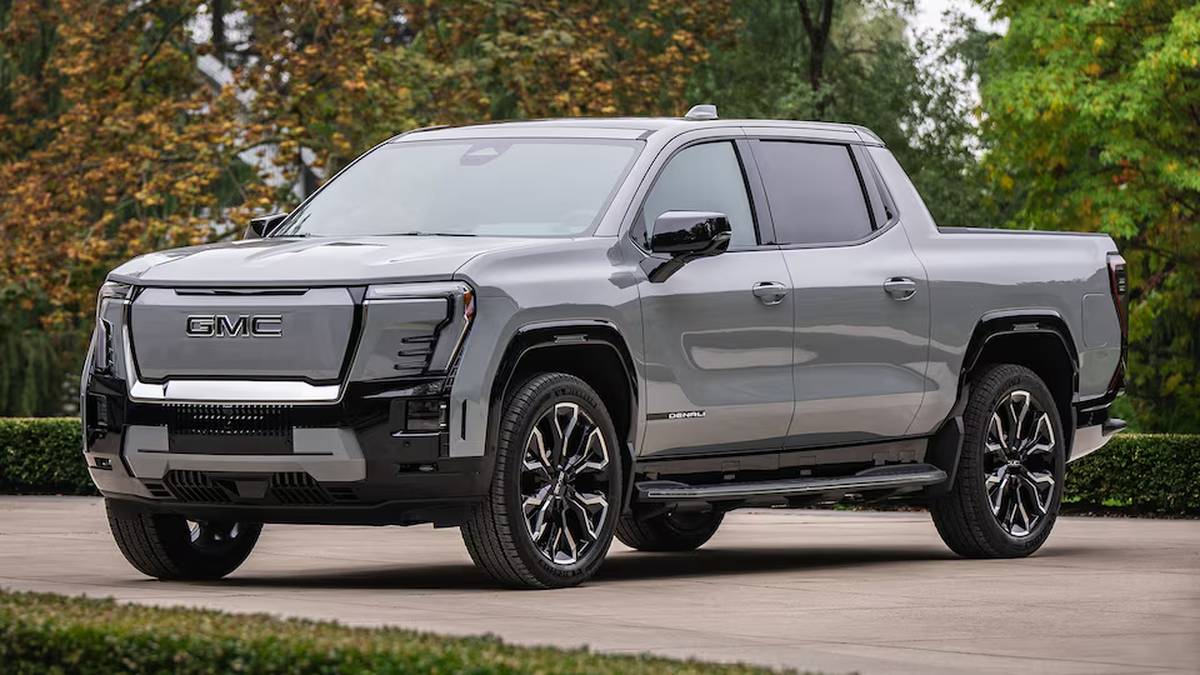
GMC Sierra EV: Body-On-Frame Construction
- The Sierra EV replaces traditional body-on-frame construction with a dedicated electric platform, improving ride smoothness and interior packaging while changing how the truck feels under load.
- Its large battery enables long driving ranges and strong towing capability, but the added mass is noticeable during braking and in tight urban environments.
- The bed design integrates features like a multi-function tailgate and available pass-through storage, expanding hauling flexibility beyond a conventional pickup layout.
- Interior presentation leans premium, with expansive screens and quiet operation, positioning the Sierra EV closer to a luxury vehicle than a work-first truck.
Commenters did what online communities often do best and started with basic math. Leaving an EV plugged in does not consume meaningful power once charging stops, no more than a phone left on a charger overnight. Energy usage scales with miles driven. At roughly two miles per kWh, even a heavy electric truck driven 2,000 miles a month would consume around 1,100 kWh, including losses. That is nothing, but it also does not explain a household on pace for more than 5,600 kWh.
The breakthrough came with a simple observation about the weather and the house, not the truck. Temperatures were hovering in the 30 to 40 degree range. To keep things comfortable, the household had been opening windows and setting the thermostat to 66 degrees. The unintended consequence was brutal. The heating system never shut off. It ran continuously, all night, fighting outdoor air with indoor heat and quietly devouring electricity in the background.
Once that realization clicked, the truck’s role shrank dramatically. Checking the GMC app revealed that the Sierra EV was pulling at most about 57 kWh on a typical charging day. That is entirely consistent with modest weekly driving and nowhere near enough to explain the spike. The villain was not the electric pickup quietly sipping electrons in the garage. It was the HVAC system sprinting a marathon it was never meant to run.
This episode shows a recurring theme in the EV transition for truck owners. Electric vehicles are new, visible, and easy to blame. Home energy systems are old, familiar, and often overlooked. When something goes wrong, attention goes to the shiny new machine rather than the furnace, water heater, or heat pump quietly operating out of sight. In this case, the utility’s alert did its job, but it took some detective work to interpret what the numbers were actually saying.
It also underscores how misleading raw kilowatt-hour totals can be without context. A projected 5,604 kWh per month sounds like an EV problem until you break it down. Spread across 30 days, that is nearly 187 kWh per day. No light-duty electric vehicle driven a few days a week comes close to that. Heating systems absolutely can, especially when forced to run continuously against open windows in cold weather.
The comments ultimately converged on the same conclusion. The truck was doing exactly what it was supposed to do. The charger was not secretly draining power. The spike was real, but the source was mundane and human. Comfort settings, weather, and an always-on heater combined into a perfect storm of consumption.
If there is a lesson here, it is not that electric trucks are innocent in all cases. It is that energy accounting matters. Before blaming the newest device in the driveway, it pays to look at the fundamentals. How many miles are driven? How many kWh that realistically require? What else in the house runs when temperatures drop? In this case, the Sierra EV was an easy suspect, but the evidence pointed elsewhere.
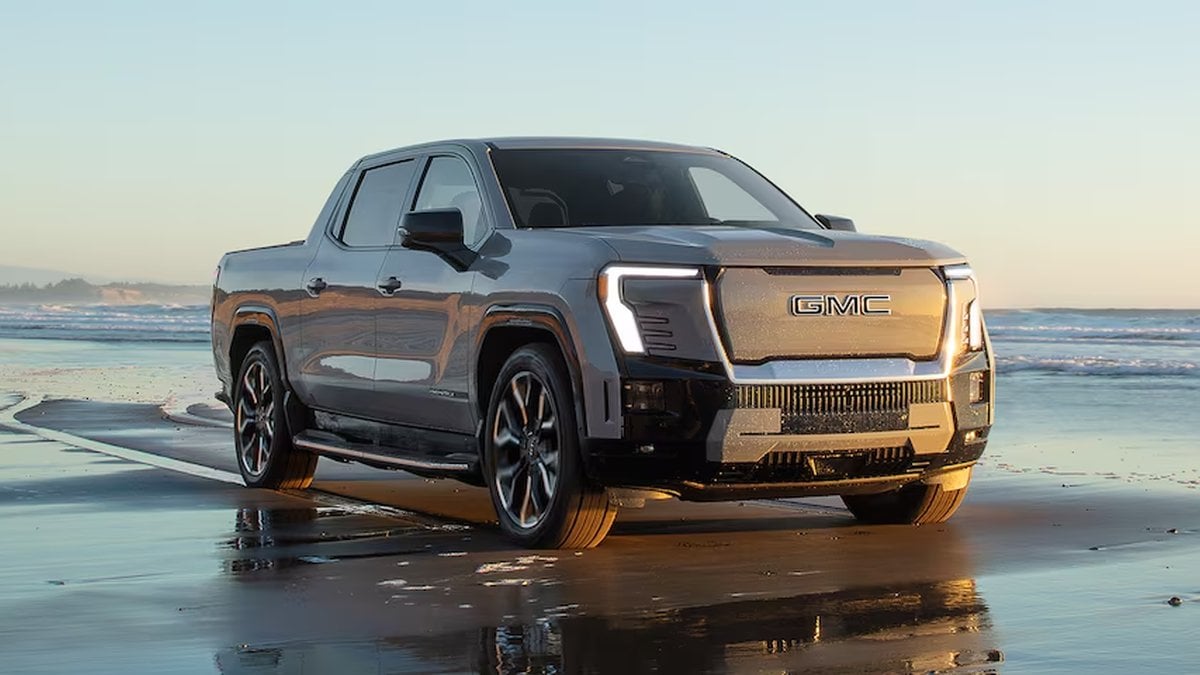
While home energy confusion represents one facet of the Sierra EV ownership experience, the truck itself has been navigating a more complex market reality. The 2026 GMC Sierra EV significantly expanded its lineup in March 2025 with the addition of more affordable Elevation and off-road AT4 trims, dropping the base price by around $28,000 to $64,495, including destination, while retaining Ultium platform strengths like 754 hp in Max Range configs, bidirectional charging, and Super Cruise hands-free driving.
As homes and vehicles become more electrified, understanding where power actually goes becomes essential. Sometimes the biggest drain is not the futuristic machine you can see, but the familiar system you stopped thinking about years ago.
Are you excited for the direction GMC is heading? Let us know in the comment section below!
Image Sources: GMC Media Center
Noah Washington is an automotive journalist based in Atlanta, Georgia. He enjoys covering the latest news in the automotive industry and conducting reviews on the latest cars. He has been in the automotive industry since 15 years old and has been featured in prominent automotive news sites. You can reach him on X and LinkedIn for tips and to follow his automotive coverage.
Set Torque News as Preferred Source on Google
Follow us today...