

Public charging arguments tend to flare up around etiquette, but every so often a photo comes along that forces people to confront something more fundamental: math. In this case, a Hummer EV sitting at a ChargePoint station for nearly 24 hours looked, at first glance, like another example of an inconsiderate driver squatting on a charger.
The reality, as the comments quickly demonstrated, is far less scandalous and far more revealing about what happens when enormous batteries meet modest charging hardware.
The image shows the Hummer EV charging at roughly 6.2 kW, a rate that feels almost comically small when paired with one of the largest battery packs ever put into a consumer vehicle. That number alone explains most of the mystery.
The Hummer EV’s usable battery capacity is about 212 kWh, with total capacity closer to 246 kWh depending on how you count buffers. At 6.2 kW, even a best-case scenario involves long hours plugged in. From zero to full, you are staring at roughly 34 hours before losses. Even a more realistic 10 to 90 percent session still pushes close to 28 hours.
“There is available charging, this hummer all ev has been plugged in for 24 hours. same Hummer EV that sometimes parks there and doesn’t charge for hours upon hours.”
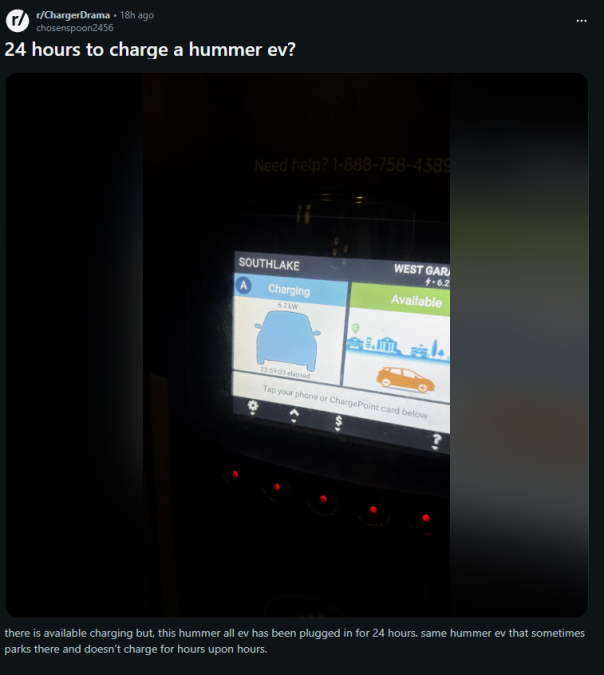
This is not a failure of the charger or the vehicle. It is simply physics and electrical infrastructure colliding. Many commercial Level 2 stations run on 208 volts rather than the 240 volts most people associate with home charging. That lower voltage, combined with typical 30-amp limits, lands you right in the 6 to 6.2 kW range. If the station happens to be a shared-power unit, where two plugs divide available current, charging times stretch even further if another car is plugged in at any point during the session.
GMC Hummer EV: Cost of Everyday Efficiency
- The Hummer EV prioritizes extreme off-road capability and visual impact, resulting in a curb weight that affects efficiency, braking feel, and urban usability.
- Features like CrabWalk enhance low-speed maneuvering off-road, though they add complexity with limited benefit in everyday driving scenarios.
- The suspension delivers impressive wheel articulation, but ride comfort varies depending on terrain and wheel configuration.
- Interior packaging emphasizes width and headroom, while the tall beltline and broad pillars reduce outward visibility in traffic.
The frustration seen in the original post likely comes from expectation rather than misuse. To someone glancing at the screen, a vehicle occupying a charger for an entire day looks antisocial. To someone doing the math, it looks inevitable. The Hummer EV is a rolling contradiction in this space. It is marketed as an electric vehicle, but its energy consumption and storage are closer to light industrial equipment than a typical passenger car. Plugging it into low-power public chargers was never going to be quick or polite by accident.

Several commenters helpfully laid out the numbers, turning outrage into education. One noted that even at 170 kWh added, a common mid-range charging session, you are still talking about well over a day at that rate. Another pointed out the difference between total and usable battery capacity, which sparked a side discussion about how wild it is that the Hummer carries more unusable energy than the entire battery pack of early Teslas.
What this episode really highlights is a mismatch between vehicle design and charging norms. Level 2 public chargers were built around cars with 60 to 80 kWh batteries, vehicles that could reasonably top up overnight or during a workday. Drop a 9,000-pound electric truck with a 200-plus-kWh pack into that ecosystem, and the system does not break, but it does become uncomfortable. The charger works. The truck charges. Everyone else waits.

There is also an etiquette lesson buried in the numbers. A Hummer EV owner using a Level 2 public charger is not necessarily doing anything wrong, but they are effectively committing to monopolizing that resource for a very long time. That may be unavoidable in some areas, but it does change how these vehicles fit into shared infrastructure. Fast DC charging exists for a reason, and vehicles of this scale are clearly better matched to it.
Battery size, charging rate, voltage, and current all matter, and when they are mismatched, the result looks like bad behavior even when it is just arithmetic. The Hummer EV sitting there for 24 hours is not hogging the charger out of spite. It is simply doing exactly what a 212 kWh battery does when you feed it 6.2 kW at a time.
Image Sources: GMC Media Center
Noah Washington is an automotive journalist based in Atlanta, Georgia. He enjoys covering the latest news in the automotive industry and conducting reviews on the latest cars. He has been in the automotive industry since 15 years old and has been featured in prominent automotive news sites. You can reach him on X and LinkedIn for tips and to follow his automotive coverage.
Set Torque News as Preferred Source on Google
Follow us today...