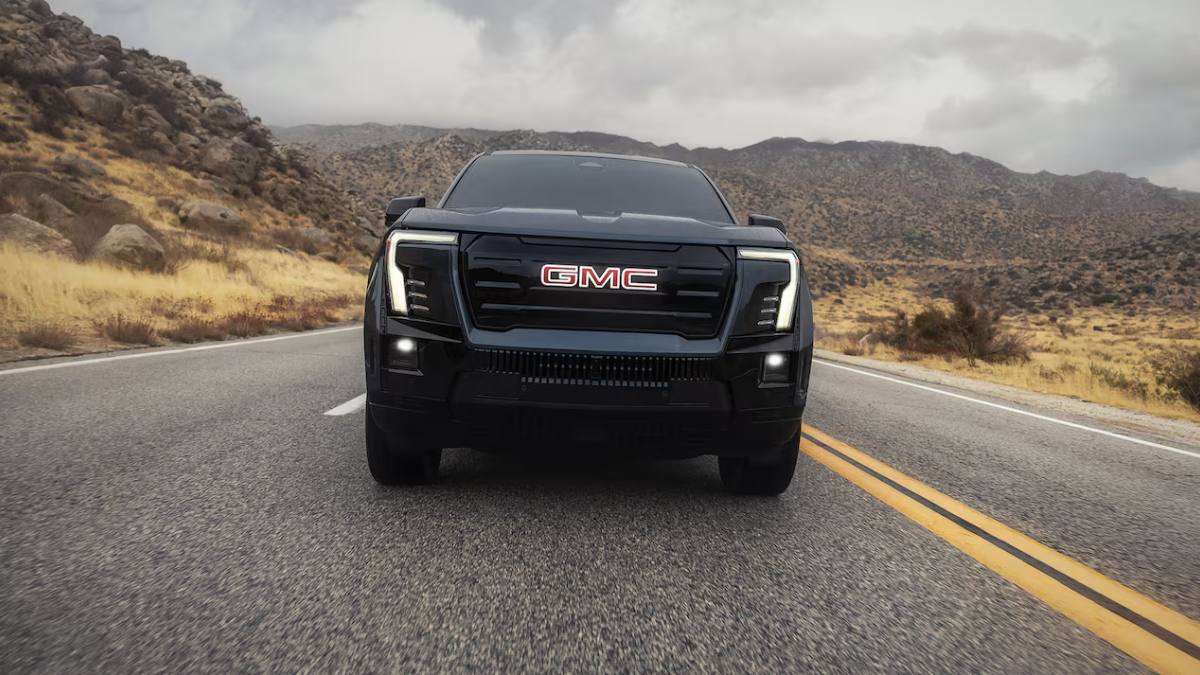

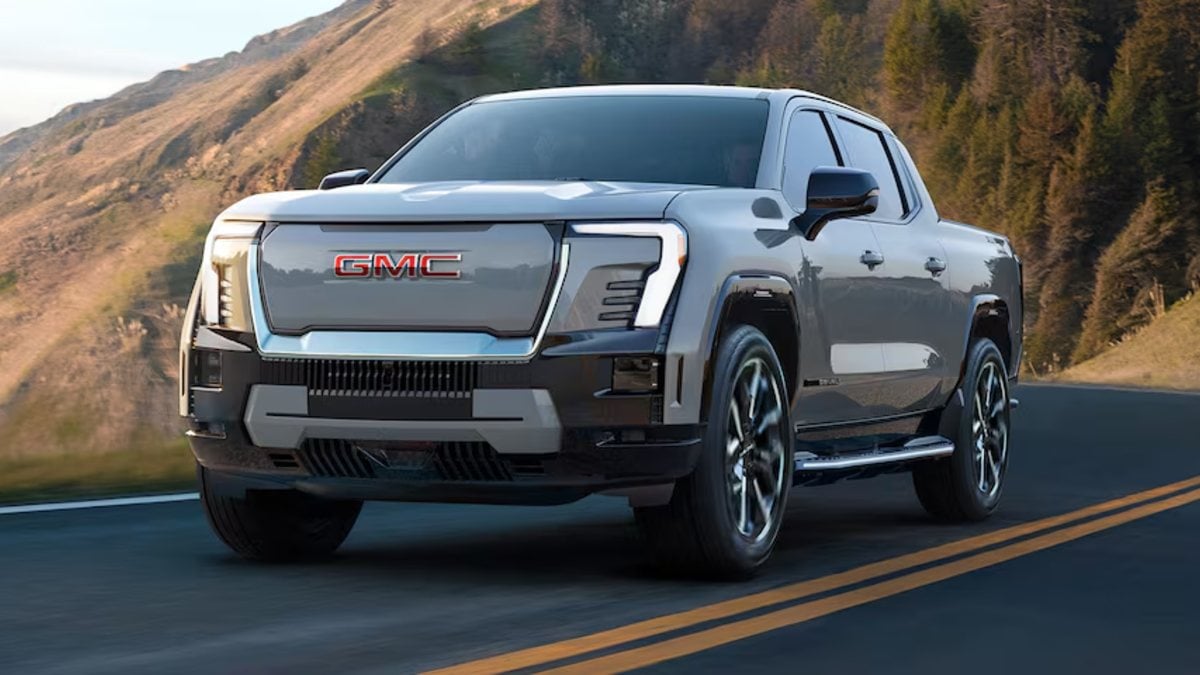
The new era of the electric truck promised us silent power, instant torque, and a seamless digital experience. It promised a future where the mechanical headaches of the past were replaced by the elegant simplicity of software. Yet, as Chris Konicek’s ordeal with his $102,000, 2025 GMC Sierra Denali EV proves, the future is still deeply flawed, and sometimes the biggest breakdown isn't the engine, it's the screen that runs the whole show.
This is a drama of the digital age, a high-stakes comedy of errors where a six-figure machine is brought to its knees not by a snapped belt or a blown gasket, but by a stubborn, unresponsive slab of glass. Chris’s story is a cautionary tale about the perils of buying a first-year model in an era where the vehicle is less a machine and more a mobile supercomputer.
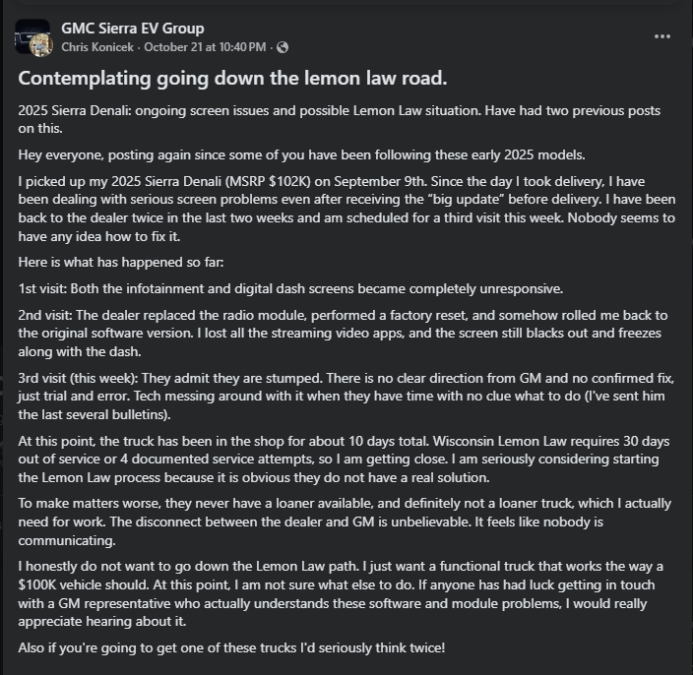
“2025 Sierra Denali: ongoing screen issues and possible Lemon Law situation. Have had two previous posts on this.
Hey everyone, posting again since some of you have been following these early 2025 models.
I picked up my 2025 Sierra Denali (MSRP $102K) on September 9th. Since the day I took delivery, I have been dealing with serious screen problems even after receiving the “big update” before delivery. I have been back to the dealer twice in the last two weeks and am scheduled for a third visit this week. Nobody seems to have any idea how to fix it.
Here is what has happened so far:
1st visit: Both the infotainment and digital dash screens became completely unresponsive.
2nd visit: The dealer replaced the radio module, performed a factory reset, and somehow rolled me back to the original software version. I lost all the streaming video apps, and the screen still blacks out and freezes along with the dash.
3rd visit (this week): They admit they are stumped. There is no clear direction from GM and no confirmed fix, just trial and error. Tech messing around with it when they have time with no clue what to do (I've sent him the last several bulletins).
Advertising
At this point, the truck has been in the shop for about 10 days total. Wisconsin Lemon Law requires 30 days out of service or 4 documented service attempts, so I am getting close. I am seriously considering starting the Lemon Law process because it is obvious they do not have a real solution.
To make matters worse, they never have a loaner available, and definitely not a loaner truck, which I actually need for work. The disconnect between the dealer and GM is unbelievable. It feels like nobody is communicating.
I honestly do not want to go down the Lemon Law path. I just want a functional truck that works the way a $100K vehicle should. At this point, I am not sure what else to do. If anyone has had luck getting in touch with a GM representative who actually understands these software and module problems, I would really appreciate hearing about it.
Also if you're going to get one of these trucks I'd seriously think twice!”
The irony is thick enough to spread on toast. You pay a king’s ransom for a truck that represents the pinnacle of American engineering, only to find the most basic function, the ability to see your speed or change the radio station, is held hostage by a software glitch. Chris’s truck has been in the shop for ten days total, rapidly approaching the Wisconsin Lemon Law threshold, and the dealer’s response is the most frustrating part of the whole affair: they are "stumped."
The dealer’s attempts at a fix read like a desperate, almost comical, sequence of events: a radio module replacement, a factory reset that somehow rolled the software backward, and the loss of streaming apps. It’s a technological regression that turns a cutting-edge truck into something less capable than a decade-old sedan. The worst part is the feeling of being a beta tester for a product you paid a premium for. As Chris notes, the disconnect between the dealer and GM is "unbelievable." It’s a classic corporate shrug, leaving the customer stranded in a bureaucratic no-man's-land.
This is the new reality of the high-tech truck: when the software fails, the entire vehicle fails. The screens are not just for entertainment; they are the central nervous system. When they black out, you lose navigation, climate control, and often, the ability to monitor critical driving information. This transforms a minor annoyance into a serious safety and utility issue.
The Anatomy of the Digital Breakdown:
- Nerve Center: Infotainment and dash screens freezing, turning the driver into a helpless passenger.
- Multiple visits, part replacements, and software rollbacks that only compound the original problem.
- The frustrating lack of a clear fix or communication from the manufacturer, leaving the dealer to "mess around" with a six-figure vehicle.
- The inability to get a functional loaner truck highlighting the disconnect between the customer's real-world need and the dealer's capacity.
Chris is not alone in this digital wilderness. Luke Watkins echoes the sentiment perfectly: I have had an intermittent dead screen since the first day I bought it and they do not have an answer. It takes the truck from my most loved and favorite truck I’ve had to the most hated all in one vehicle. That single sentence captures the emotional whiplash of owning a beautiful, powerful machine that is fundamentally unreliable due to a software flaw.
Brutus Junius, another owner, tells an even more dramatic tale of a truck that was "flawless for 5k miles" until an over-the-air update turned it into a nightmare. His truck threw a "service high voltage message," refused to charge, and required a tow home: a total nightmare compounded by a multi-layered tow service that failed to show up for hours. His experience with the dealer, who he suspects just disconnected the battery and charged it up, is the ultimate betrayal of trust.
This is where the rubber meets the road, or rather, where the code meets the road. The problems are not just a nuisance; they are costing owners like Junius and Konicek days of work and forcing them to contemplate the dreaded Lemon Law. As one owner notes, the GM EV concierge is often just "someone to giggle and say oh that’s terrible."
The ultimate irony is that this software chaos is pushing loyal customers away. Junius, a 20-year Chevy fan, states that if GM can't handle this "changing environment," he's getting a Cybertruck. This is the new battleground for automotive loyalty: not horsepower or towing capacity, but the reliability of the user interface and the competence of the service network.
The Lemon Law, a necessary evil, is the last resort for an owner who just wants a working truck. It’s a legal process that should never have to be invoked on a brand-new, six-figure vehicle. The fact that it is even on the table for these early electric truck. It's a sign that the industry is still struggling to marry cutting-edge hardware with reliable software. The GMC Sierra EV is a magnificent piece of engineering, but until the software is as robust as the frame, it remains a promise unfulfilled. The drama of the dead screen and the looming threat of the Lemon Law are the new, high-tech hazards of the American road. The GMC Sierra EV's charging behavior is another example of the complex power management these trucks handle. The infotainment system's lack of CarPlay was already a point of contention. The Lemon Law is a critical protection for owners facing these issues, though there are loopholes to be aware of.
Have you experienced a software-induced breakdown in your high-tech vehicle? What is your breaking point before you consider the Lemon Law process? Share your stories of dealer frustration and digital drama in the comments below.
Image Sources: GMC Media Center
Noah Washington is an automotive journalist based in Atlanta, Georgia. He enjoys covering the latest news in the automotive industry and conducting reviews on the latest cars. He has been in the automotive industry since 15 years old and has been featured in prominent automotive news sites. You can reach him on X and LinkedIn for tips and to follow his automotive coverage.
Set Torque News as Preferred Source on Google
Follow us today...