
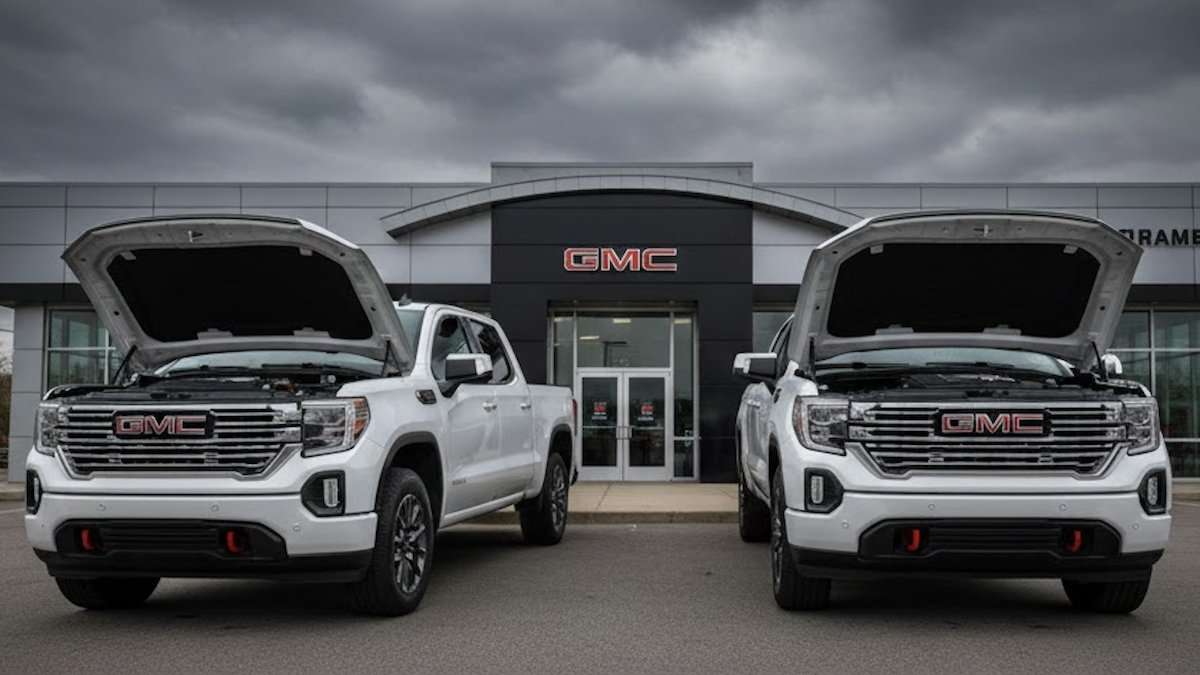

After his second brand-new GMC Sierra engine seized at just 6,961 miles, this 30-year loyalist was left stranded without a loaner and handed a denial letter that exposes a terrifying reality for every 3.0L Duramax owner.
Key Takeaways:
- Repeat Failures: A loyal GM owner reports two consecutive GMC Sierra 3.0L diesel engine failures—one at 31,000 miles and another at just 6,961 miles.
- Official Confirmation: The failures align with GMC Technical Service Bulletin 25-NA-307, yet the owner reports being denied a buyback and left without a loaner vehicle.
When you spend tens of thousands of dollars on not just one, but two premium pickup trucks, you expect more than a breakdown. You expect reliability. What David Lotze, a member of the GMC Sierra Facebook community, describes is a scenario that every truck buyer fears: a brand-new vehicle that becomes a yard ornament.
David is discussing a situation that is becoming alarmingly familiar to those of us tracking the 3.0L Duramax engine. After purchasing two Sierras with the highly touted diesel engine, both suffered catastrophic failures. His story is a warning about mechanical flaws and, perhaps more concerning, the lack of support that followed.
"Two Catastrophic Failures"
David Lotze’s story is harrowing because it involves a level of loyalty that was met with failure. He writes:
“I’m sharing my experience because GMC continues to sell the 3.0L diesel engine despite ongoing catastrophic failures, failures that GMC acknowledges in their own Technical Service Bulletin (TSB 25-NA-307). After purchasing two brand-new GMC Sierras, both trucks suffered major engine failures. I strongly advise anyone considering buying from them to reconsider.”
For a buyer to pay cash for two vehicles and lose both to the same mechanical defect is a statistical anomaly that strongly points to a manufacturing defect rather than user error.
“I paid cash for both trucks, a 2023 Sierra and a 2025 Sierra. The first engine failed at 31,000 miles. The second failed at just 6,961 miles, shortly after its first oil change. Both vehicles were serviced exclusively at GM dealerships and used for normal driving. These failures align exactly with the issues outlined in GMC’s own TSB.”
The mileage here is critical. A failure at 31,000 miles is premature; a failure at 6,961 miles is unacceptable. This second failure occurred during what engineers consider the "infant mortality" phase of component life, often caused by assembly errors or defective parts, in this case, likely the thrust bearings mentioned in the TSB.
Related Story: Escaping GM's 6.2L Nightmare: Is the 3.0L Duramax a Safe Haven or an Oil-Thirsty Trap?
The TSB That Validates the Nightmare
David’s experience is not an isolated incident of bad luck; it appears to be a systemic issue that General Motors is aware of but is struggling to manage. He references TSB 25-NA-307, a Technical Service Bulletin that I have seen referenced in multiple service departments.
This bulletin specifically addresses issues with the crankshaft end play and thrust bearing wear in the LZ0 3.0L Duramax engines found in 2025 and some 2026 models. When these bearings fail, the crankshaft can move axially, essentially "walking" back and forth inside the block, which destroys the engine internals.
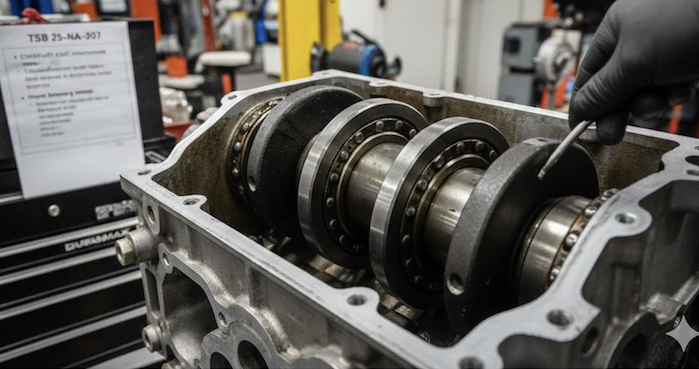
Other users in the same Facebook thread are echoing similar concerns, validating David's frustration. One user noted that their truck has been sitting at the dealership for weeks waiting for parts that are on backorder, a common theme we see with these specific engine replacements.
When a manufacturer issues a TSB like 25-NA-307, it acknowledges a defect exists, yet as David points out, the customer support mechanism seems entirely unprepared to handle the fallout. The refusal of a loaner vehicle for a warranty repair of this magnitude is particularly egregious.
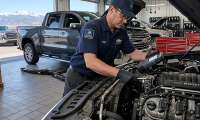
ENGINE IMAGE
The "Reasonable Time" Trap
The most frustrating aspect of David’s report is not just the mechanical failure, but the administrative wall he hit. When GMC customer service told him he must give them "reasonable time to repair," they utilized a legal gray area often used to delay Lemon Law claims.
David explains the fallout:
“What has followed has been even worse than the mechanical failures themselves: A complete lack of assistance in securing a proper loaner vehicle... Out-of-pocket towing costs... The selling dealership is refusing to take responsibility... GMC customer service is dragging its feet and delaying escalation.”
In my analysis of GM’s warranty disputes, "reasonable time" is subjective. However, a truck sitting in a shop for over a month with no ETA for a replacement engine, as David notes, pushes the boundaries of that definition. The supply chain for the LZ0 engine seems strained, likely because the factory is diverting units to the assembly line to build new trucks rather than sending them to dealers to fix broken ones.
Another member in the thread noted his issues were identical, stating that his dealership admitted they had "three other trucks out back" waiting for the same engine. This suggests that David is part of a larger cohort of owners stuck in service limbo.
The Buyback Denial and Lost Confidence
The sting of betrayal is sharpest when a loyal customer is turned away. David has been a GM customer for decades, yet that loyalty bought him no goodwill during this crisis.
He says, “And now, GMC’s official denial of a buyback, even after two catastrophic engine failures, claiming the first engine failure has no bearing on the second... After 30+ years of loyalty to GM, GMC’s unwillingness to stand behind their product... has left me with zero confidence in this engine or in the company.”
Denying the buyback by treating the two failures as isolated events is a strict interpretation of corporate policy that ignores the customer relationship. While legally they may be separate transactions, the loss of faith is cumulative.
Related Story: Silverado and Sierra 6.2L Nightmare: Why Owners Call the Recall Fix a "Cheap Band-Aid" on a $75,000 Truck
Is the 3.0L Duramax Still Viable?
The situation David faces raises a serious question for potential buyers: Is the 3.0L Duramax still a smart buy? The engine itself is a marvel of engineering when it works. I have driven the LZ0 extensively, and its torque delivery and efficiency are impressive. However, the prevalence of these thrust bearing failures in the 2025 models indicates a batch quality control issue or a supplier defect that GM has not fully contained.
The TSB 25-NA-307 confirms that the crankshaft is moving out of spec. When that happens, it can trigger oil pressure codes (like P06DD) and eventually lead to the engine seizing. For an owner like David, who uses his truck for "normal driving," there is no preventative maintenance that can stop a thrust bearing from failing if it was manufactured incorrectly.
David ends with, “If you are considering a GMC 3.0L diesel, please take this as a warning. These engines are failing, and when they do, you may face the same lack of support I’m experiencing now.”
This warning is poignant. It highlights that the risk isn't just the breakdown, it is the potential for financial loss and stranded time. We are seeing a pattern where dealership service departments are overwhelmed, loaner fleets are empty, and parts are months away.
Related Story: I Traded My Wimpy Chevy Silverado 2WD 2.7L For a Muscled Up Trail Boss 3.0L
A System Under Stress
David Lotze’s experience serves as a case study in how not to handle a defect. Mechanical things break; that is an accepted reality of automotive ownership. But the measure of a company is how it responds when things go wrong. By failing to provide a loaner, refusing a buyback after two failures, and hiding behind vague definitions of "reasonable time," GMC risks alienating the very core of its customer base.
For now, if you are in the market for a 2025 Sierra with the 3.0L Duramax, I recommend asking your dealer explicitly about TSB 25-NA-307 and ensuring you have a written agreement regarding loaner availability should the worst happen. As David’s story proves, loyalty alone is not enough to keep you on the road.
It’s Your Turn: Click the red link below to write your comment and join the community in sharing experiences.
Next Up: If you are tired of modern engine tech failing, check out my report on a 2026 Sierra owner who bypassed all the luxury tech to special order a "Unicorn" truck. It’s a single cab, short bed workhorse that you won't find on any dealer lot.
With over 30 years of industry experience, Denis Flierl brings an insider’s perspective to Torque News, where he has been a Senior Reporter since 2012. Before picking up the pen, Denis consulted for the automotive industry's biggest brands and honed his skills as a test driver. He cuts through the noise to deliver the latest auto news, compelling owner stories, and the expert analysis necessary to navigate today's changing automotive market.
Have a tip or question? Follow me on X @DenisFlierl and @WorldsCoolestRides, or connect with me on Facebook, Instagram, and LinkedIn.
Photo credit: Denis Flierl
Set Torque News as Preferred Source on Google
Follow us today...



Comments
I had my 2025 GMC Sierra…
Permalink
I had my 2025 GMC Sierra Denali ultimate with a 3.0 Duramax for six months. The engine failed at 5614 miles. They told me that everything is on backorder and they do not have a clue when it will be repaired. Luckily I was able to secure a courtesy vehicle I have requested a buyback but from what I’ve read in this article the chances of that happening Slim to none I guess. As soon as I can offload this thing I’m gonna get rid of it. I regret buying a GMC every day.
Friend buy a 2005 bow tie…
Permalink
Friend buy a 2005 bow tie that will last over 200.000 miles or more. Even toyota makes junk.
2025 GMC AT4X LZ0 Engine…
Permalink
2025 GMC AT4X LZ0 Engine
Assembled Aug 25
Purchased Oct 25
Engine failed Dec 25
- 6,365 miles / 140 Engine hours
Zero codes given, I heard a not normal diesel noise and got the reduced accel warning enroute to the dealership. Never tossed an engine light.
I bought a new 2025 GMC…
Permalink
I bought a new 2025 GMC Sierra 1500 Denali with the LZ0 3.0L Duramax, paid for it and took delivery on 7/31/25. I had it for 83 days when it went a instrument panel message appeared "Reduced Acceleration Drive safely". I drove it directly to the dealership on 10/22/25, where I purchased it. The odometer read a total number of miles of 1,673 miles. It was later determined that it needed a new engine, transmission and turbocharger. I received a message on 12/31/25 that the truck had been repaired with a new engine, transmission and turbocharger. What they did not know is that I had done my research and via an email to the General Manager at the purchasing dealership had already initiated the GM Buyback process. Additionally, I obtained the GM Customer Support phone number and via their representative I received a case number as well as a specifically named GM Advisor. This advisor has called me every week, as she said she would. I have not picked up my repaired truck as i am awaiting GM's Buyback response. My real concern is that GM has not really fixed their problem with the thrust bearing issue. Thus I await a response from GM.