
Something is fascinating about discovering your truck has been secretly feeding itself in the darkness while you sleep, consuming electricity with the persistence of a digital vampire that refuses to acknowledge dawn.
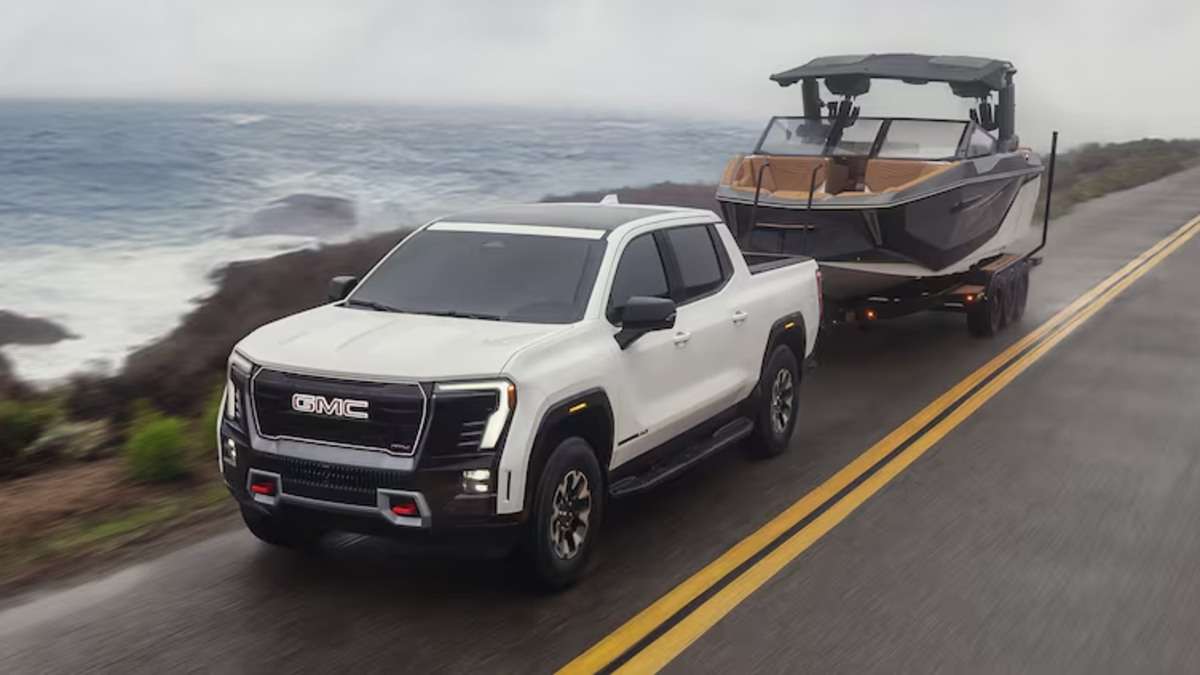
Mike Roland's recent encounter with his GMC Sierra EV's nocturnal energy habits reveals one of the more intriguing aspects of electric vehicle ownership: the realization that these machines never truly rest, maintaining a constant dialogue with the electrical grid that would make insomniacs envious of their dedication to staying connected.
The setup reads like a modern mystery:
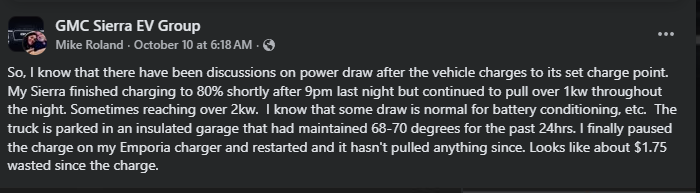
“So, I know that there have been discussions on power draw after the vehicle charges to its set charge point. My Sierra finished charging to 80% shortly after 9 pm last night, but continued to pull over 1kw throughout the night. Sometimes reaching over 2kW. I know that some draw is normal for battery conditioning, etc. The truck is parked in an insulated garage that has maintained 68-70 degrees for the past 24 hours. I finally paused the charge on my Emporia charger and restarted, and it hasn't pulled anything since. Looks like about $1.75 wasted since the charge.”
The casual mention of "discussions" suggests this phenomenon has achieved the status of community folklore, where owners share tales of mysterious power consumption with the resigned acceptance of people who have discovered their pets have been raiding the refrigerator. The specificity of the power draw figures reveals the kind of obsessive monitoring that electric vehicle ownership encourages, where success requires constant surveillance of systems that operate according to their own mysterious logic.
The environmental conditions eliminate the obvious suspects that typically explain unusual behavior in complex machines.
The truck is parked in an insulated garage that has maintained 68-70 degrees for the past 24 hours. This detail demonstrates the methodical troubleshooting approach that electric vehicle ownership cultivates, where owners learn to consider variables that would never occur to drivers of conventional vehicles. Temperature stability should theoretically eliminate battery conditioning as an explanation, yet the power consumption continues with mechanical indifference to human expectations.
The discovery that manual intervention could halt this nocturnal feast provides the kind of immediate relief that comes with regaining control over systems that had appeared to operate beyond human influence. I finally paused the charge on my Emporia charger and restarted, and it hasn't pulled anything since.

Looks like about $1.75 was wasted since the charge. The modest financial impact barely justifies the concern, yet the principle of the matter looms larger than the actual cost, representing the fundamental question of who controls the charging process.
Meni Hen's response introduces the concept that transforms this apparent malfunction into a feature, revealing how electric vehicle behavior often defies conventional expectations about completion and precision.
Advertising
"I set my limit to 85% and it always keeps charging, and I end up with 87-88% in the morning. So it's not wasted, but it just forgets to limit the charge, I guess."
The laughing emoji suggests acceptance of this behavior as charming eccentricity rather than serious malfunction, demonstrating the psychological adaptation that successful electric vehicle ownership requires.
This casual acceptance of imprecision in a digital system reveals something profound about our relationship with automotive technology in the 21st century. We've become accustomed to expecting mathematical precision from electronic systems, yet these vehicles operate with the kind of approximate behavior that characterized mechanical systems from earlier eras. The truck doesn't "forget" to limit the charge so much as it operates according to algorithms that prioritize battery health and longevity over rigid adherence to user-specified limits.
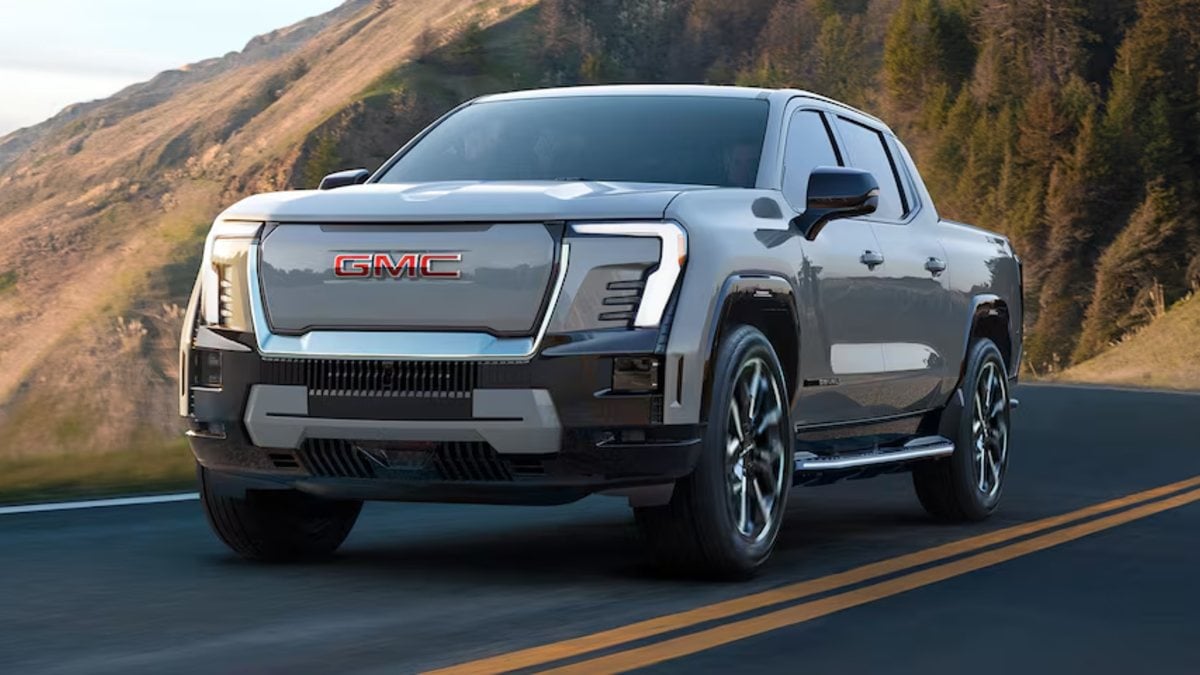
Roland's follow-up confirms the pattern while revealing his growing understanding of the system's actual priorities: Mine ended up being at 88% when I left this morning, despite the app telling me that the charge was complete at 80%. Glad to know it wasn't just wasting energy. The relief in discovering that energy consumption served a purpose illustrates how electric vehicle ownership requires constant recalibration of expectations about efficiency and waste.
Meni's enthusiastic endorsement of this behavior reveals the kind of evangelical fervor that characterizes satisfied electric vehicle owners, where apparent flaws become evidence of superior engineering. Yeah, these trucks are awesome! No energy wasted. You can leave it with 75% and go on a month-long vacation, you'll come back to the same SOC(ask me how I know lol). They're super efficient. It's amazing! The parenthetical aside suggests personal experience with extended absence testing, demonstrating the experimental approach that early adopters bring to understanding their vehicles' capabilities.
The Physics of Electric Vehicle Sleep Patterns
- Continuous monitoring and adjustment of cell temperatures and voltages requires ongoing power consumption that operates independently of charging completion status.
- Regular diagnostic routines, software updates, and component calibration create power demands that occur according to internal schedules rather than user preferences.
- Battery management systems prioritize long-term health over short-term precision, leading to apparent "overcharging" that actually represents careful cell balancing and conditioning.
- Maintaining communication with charging networks, manufacturers, and mobile applications requires constant power consumption for cellular and WiFi connectivity.
Kenneth Burghardt Jr.'s practical solution reflects the engineering mindset that approaches problems through external control rather than internal understanding. That's simple to fix, set the timer/charger to turn off when charging has suspended, or know your charge time and set the end charge on the timer to 15 minutes after the truck shuts down.
This approach treats the symptom rather than addressing the underlying behavior, demonstrating how different personalities approach the same technological challenge.
Roland's response reveals the deeper curiosity that drives true understanding of complex systems, where solving the immediate problem matters less than comprehending the underlying logic. I could do that, but I'd really like to find out the reason why it does this. This distinction separates mere users from genuine enthusiasts, where the desire to understand system behavior transcends the need to simply control outcomes.
The revelation about actual charge completion provides the key insight that transforms apparent malfunction into sophisticated battery management. Also noticed that my end charge state was at 88% instead of 80 after I got in the truck to drive today. At least it wasn't just wasted energy, and it did end up charging more even though the app said it had completed at 80%. This discovery illustrates how user interfaces often simplify complex processes in ways that can mislead rather than inform.
Jason Snelgrove's observation introduces another variable that complicates the power consumption equation while revealing the integrated nature of modern vehicle systems. Odd, mine ramps up to 3 when climate control comes on in the mornings. This comment demonstrates how electric vehicle power management extends far beyond simple battery charging to encompass comprehensive vehicle preparation for operation.
The integration of climate control with charging systems represents a fundamental shift in automotive thinking, where vehicles anticipate user needs rather than simply responding to immediate commands. This proactive approach to comfort and convenience requires continuous power consumption that serves purposes beyond basic transportation, transforming vehicles into comprehensive lifestyle support systems.
Charles T Morgan's technical insight provides the scientific explanation that transforms mysterious behavior into logical engineering. Cell balancing is also a thing. Plus, the power for the truck to stay awake for the modules to function. This comment reveals the complexity of battery management systems that must maintain individual cell health within large battery packs while keeping vehicle systems operational for immediate response to user demands.
The concept of cell balancing illustrates how electric vehicle batteries require active management that continues long after charging appears complete. Individual cells within large battery packs can develop slight variations in charge level that must be corrected through careful redistribution of energy, a process that can take hours and requires ongoing power consumption that appears wasteful to casual observation.
The Psychology of Electric Vehicle Ownership Adaptation
- Learning to accept that electric vehicles operate according to algorithms that prioritize long-term performance over immediate user preferences.
- Understanding that apparent energy waste often represents investment in battery longevity and system reliability that provides greater long-term value.
- Acquiring habits of system observation and data analysis that become essential for successful electric vehicle ownership.
- Participating in shared learning experiences that help decode complex vehicle behaviors through collective wisdom and experimentation.
The broader implications of this charging behavior extend beyond individual inconvenience to reveal fundamental differences between electric and conventional vehicles in their relationship with energy infrastructure. Traditional vehicles consume fuel in discrete events separated by periods of complete dormancy, while electric vehicles maintain continuous relationships with the electrical grid that blur the boundaries between active use and passive storage.
This constant connectivity transforms vehicles from simple transportation tools into nodes in a larger energy management network, where individual charging decisions contribute to grid stability and efficiency optimization. The overnight power consumption that initially appeared wasteful may actually serve broader purposes related to grid load balancing and renewable energy utilization that extend far beyond individual vehicle needs.
The community response to Roland's experience demonstrates the collaborative approach to problem-solving that characterizes electric vehicle ownership, where shared experiences contribute to a collective understanding of complex systems. The willingness of owners to share detailed observations about charging behavior creates a knowledge base that supplements official documentation and helps newcomers navigate the learning curve associated with electric vehicle adoption.
The evolution from concern to acceptance in Roland's experience reflects the psychological journey that many electric vehicle owners undergo as they learn to trust systems that operate according to unfamiliar logic. The initial alarm at discovering unexpected power consumption gives way to appreciation for sophisticated battery management that prioritizes long-term performance over short-term precision.
The financial impact of this overnight consumption, while modest in absolute terms, represents a larger question about electric vehicle operating costs and the hidden expenses associated with advanced automotive technology. Understanding these costs requires recognition that electric vehicles consume energy for purposes beyond simple propulsion, including system maintenance, connectivity, and preparation for operation.
The success of Roland's manual intervention in stopping the power consumption demonstrates that users retain ultimate control over charging processes, even when vehicles operate according to their own internal logic. This balance between automated optimization and user override provides the flexibility necessary for diverse ownership situations while maintaining the sophisticated battery management that ensures long-term reliability.
The ongoing development of electric vehicle charging technology will likely address some of the confusion surrounding overnight power consumption through improved user interfaces and more transparent communication about system activities. However, the fundamental complexity of battery management will remain, making community knowledge sharing and owner education essential components of successful electric vehicle adoption.
Have you discovered unexpected behaviors in your electric vehicle that initially concerned you but later proved to serve important functions?
Share your experiences with electric vehicle ownership mysteries and the process of developing confidence in unfamiliar technology in the comments below.
Noah Washington is an automotive journalist based in Atlanta, Georgia. He enjoys covering the latest news in the automotive industry and conducting reviews on the latest cars. He has been in the automotive industry since 15 years old and has been featured in prominent automotive news sites. You can reach him on X and LinkedIn for tips and to follow his automotive coverage.
Set Torque News as Preferred Source on Google
Follow us today...