
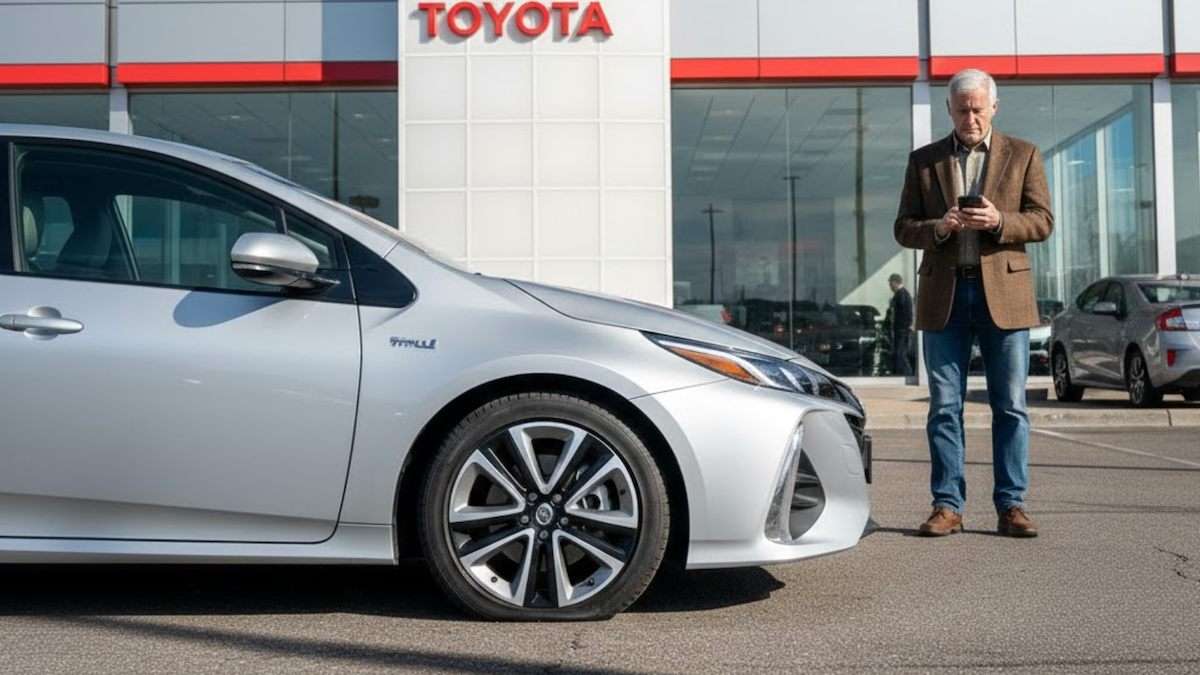

This legal expert just traded his retirement peace to expose the $1,200 "tire trap" hiding beneath the world’s most stylish hybrid.
Imagine that you’ve meticulously babied your sleek new Prius hybrid to maximize every MPG, only to find yourself stranded at the dealership facing a massive repair bill for "premium" rubber that couldn't even make it to 15,000 miles. Now, one retired attorney, tired of the excuses, is stepping out of the waiting room and into the legal arena to hold Toyota accountable for what he calls a systemic failure.
In my research on 5th Gen Prius issues, I found a recent post shared in a Facebook community of Toyota enthusiasts; Tim Wolfson highlighted growing concerns about the reliability of the 19-inch Toyo tires and the steep costs of staying on the road.
Tim says, “I am writing this as I sit in my Toyota dealership's service center while they once again attend to the tires on my car. Two of the 19" Toyo tires on my 2024 Prius Prime XSE have failed with less than 15K miles on the vehicle. I am a slow driver and avoid potholes and bumps. I keep the tires properly inflated. I see many other similar complaints about the Toyo tires in this group and elsewhere. I am a retired attorney. I have the time and motivation to raise a dispute with Toyota and Toyo. I am interested in compiling more information regarding the failure rate of the Toyo 19-inch tires on the Toyota Prius models.”
From My View: The Dealership Lounge Nightmare
I know the smell of that dealership coffee all too well. It’s the scent of a "free" morning wasted while a service advisor prepares to tell you that your nearly new car needs a thousand dollars in rubber because the factory equipment isn't up to the task. For 30 years, I’ve watched automakers push the envelope on design, but with the 5th Gen Prius, it feels like they’ve pushed owners right into a corner.
Verified automotive experts have noted that the Prius has an odd tire size and no spare tire, making rare situations like punctures more difficult to handle, a reality that complicates what should be a simple ownership experience.
In my recent deep dive into the 2024 Toyota Prius ownership experience, I explored how these mechanical choices impact the long-term journey, noting that reducing wheel weight reduces "unsprung mass," allowing the suspension to react more quickly to bumps.

Why This Failed for Us: The Engineering Compromise
The 19-inch wheels on the XSE and Limited trims are gorgeous, but they are functionally "hopeless" when they meet real-world infrastructure. To achieve those record-breaking fuel-economy numbers, Toyota opted for "thin" low-rolling-resistance tires that prioritize aerodynamic efficiency over durability.
Industry analysis from Car and Driver shows that the larger rollers contribute 0.4 inches of additional ride height and increase the rotating mass, which directly affects both efficiency and ride quality.
I’ve previously reported on the shock-and-awe of these repair costs, specifically how one owner's nightmare of six punctures in 17,000 miles reveals the shocking trade-off between the 2025 Toyota Prius's stunning looks and its real-world durability.
My Take: The Invisible Supply Chain Trap
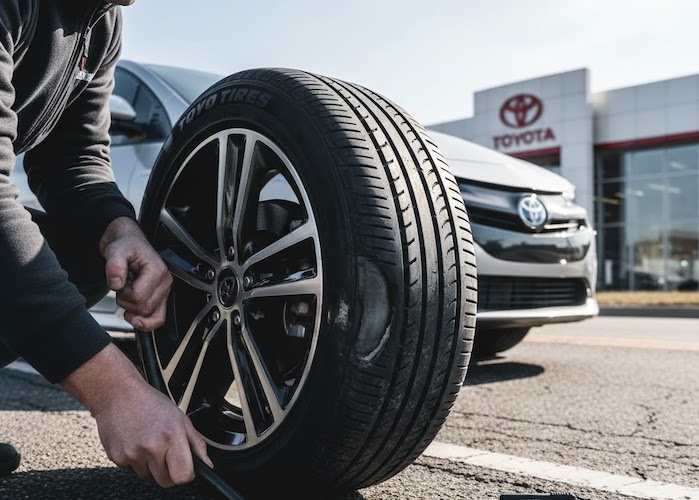
The real "industry secret" here isn't just that the tires are failing; it’s that you can’t find them when they do. The 195/50R19 is a "unicorn" size. If you get a flat on a Saturday night, you aren't going to a local tire shop for a quick fix. You are likely looking at a two-day wait and a $300-per-tire bill at the dealership. This creates an "Invisible Shortage" that turns a minor road hazard into a multi-day ordeal.
The Heavy Price of Low-Profile Performance
Why are these tires failing? As a senior reporter who has spent decades under car hoods, I can tell you it isn't just "bad luck." We are seeing a perfect storm of physics and marketing. The Prius Prime is a technical marvel, but it is also heavy. Because of its 13.6 kWh lithium-ion battery pack, the Prime carries roughly 450-500 pounds of extra "heft" compared to a standard gasoline-only compact. When you pair that weight with a 19-inch low-profile tire, you lose the "air cushion" that normally protects your wheels. Source: YouTube - Josh on Cars.
The "Pinch-Shock" Phenomenon: From my view, the core issue is the sidewall-to-rim ratio. On a standard 17-inch wheel, you have a tall rubber wall that acts as a secondary shock absorber. On the 19-inch Toyos, that wall is paper-thin. When you hit a pothole, the heavy battery pack drives the wheel downward with immense force. Because there isn’t enough rubber to compress, the tire gets "pinched" between the road and the metal rim. This "pinch-shock" can cause internal cords to snap instantly, leading to the dreaded sidewall bubbles or total blowouts that Tim and so many others are reporting. In practice, large wheels photograph well, but they require a lot of public roads that are rarely prepared to give it, especially when the vehicle's weight leaves zero room for error.
Load Rating vs. Real-World Stress: Every tire has a load rating, but these ratings are often tested under "ideal" conditions. In my experience, low-rolling-resistance (LRR) tires, which are standard on the Prius to keep those MPG numbers high, use thinner, lighter carcasses to reduce friction. While this is great for the planet, it’s a disaster for durability. You are essentially asking a lightweight, "economy-first" tire to support the curb weight of a mid-sized crossover.
The "Proprietary" Supply Trap: What makes this a true "Reliability Nightmare" is the scarcity of supply. The 195/50R19 is an odd-duck size. Most tire manufacturers haven't ramped up production for it because it’s so niche. This means when your tire fails at 10,000 miles, you can't just pop into a local shop for a $150 replacement. You are forced back to the dealer, often waiting days for a backordered OEM Toyo that, as we’ve seen, may just fail again.
What Prius Owners Are Saying
The community is not staying silent about these "rubber band" tires. One user on Reddit noted the severity of the situation, stating, "I wouldn't get the 19” wheels again. On Day 2 of owning my Prius, I ran over a medium-sized rock & it popped my tire. Ran me $300 to get it replaced," which you can read in the full discussion here.
Another owner highlighted the new design's vulnerability, saying, "I hold my breath every time I hit a pothole," illustrating the constant anxiety felt by drivers in this Reddit thread.
Key Takeaways for Prius Owners
- 19" Tires are High-Maintenance: The low-profile Toyo tires are optimized for MPG, not impact resistance.
- Scarcity is Real: Always check availability before you need a replacement; these sizes are rarely in stock.
- Downsizing is an Option: Many owners are switching to 17-inch or 16-inch wheels to gain more "sidewall cushion."
- Cost of Ownership: Budget at least $1,200 for a full set of replacement tires, well before the 40,000-mile mark.
The Total Cost Is Left Undisclosed
Toyota has built a masterpiece of design with the 5th Gen Prius, but they’ve saddled it with a tire setup that feels experimental at best and predatory at worst. When a retired attorney is sitting in a service center building a case, it’s a sign that the "Total Cost of Ownership" isn't what was promised on the window sticker.
How About You? Have you experienced premature tire failure or bubbles on your 19-inch Prius wheels? If your 2024 Prius is eating through rubber before its first anniversary, Tim Wolfson wants to hear from you, and so do we. Leave a comment in the red "Add new comment:" link below.
Next Up: 2024 Toyota Prius Owner Switched the 19-In OEM Rims For Smaller 16-In Wheels and Winter Tires. Discover how one owner fixed the Prius's biggest ride-quality flaw by ditching the factory 19s for a more comfortable, durable, and cost-effective 16-inch setup that transformed the car.
Denis Flierl is a Senior Reporter at Torque News with over 30 years of hands-on experience in the automotive industry. Having served as a professional test driver and industry consultant for major automakers such as Chevrolet, Ford, Toyota, Honda, and Tesla, Denis provides a "boots-on-the-ground" perspective that goes beyond standard reporting. Since joining Torque News in 2012, he has specialized in cutting through market noise to deliver data-backed analysis and real-world owner stories. His work focuses on navigating the transition to EVs and the shifting automotive market.
Have a tip or question for Denis? > Engage with him directly on LinkedIn for industry analysis, or follow his latest updates on X @DenisFlierl and @WorldsCoolestRides. You can also find his latest car features on Facebook and Instagram.
Photo credit: Denis Flierl via Toyota
Set Torque News as Preferred Source on Google
Follow us today...







Comments
First of all...19-inch…
Permalink
First of all...19-inch wheels on a Prius? Who does that, right?
First of all...19-inch…
Permalink
First of all...19-inch wheels on a Prius? Who does that, right?
The tires the car comes with…
Permalink
The tires the car comes with almost always suck and they won’t last as long as other options.
Did you have an alignment done for the sake of seeing if anything was off?
That's why I prefer base…
Permalink
That's why I prefer base model cars with smaller wheels and more sidewall. It comes with the territory of low profile tires
Mine blew as well
Permalink
Mine blew as well
I replaced all mine.
Permalink
I replaced all mine.
Yes. I have gone through 5…
Permalink
Yes. I have gone through 5 tires in one year. I drive a lot and there are potholes everywhere, debris on the road, and with the low profile you can’t see or react to these situations. I love the car otherwise. Thankfully, I paid for the tire and rim insurance when I purchased. I haven’t had to pay for any of the tires, but have had to pay for realignment every time, and call for a tow. I need to decide if I am moving on from the 19” toyo and if this will effect the insurance protection.
Today, about a week after a…
Permalink
In reply to Yes. I have gone through 5… by Joshua Levine (not verified)
Today, about a week after a dealer Tire Rotation …. I went to check tire pressure. Newly emerged - there was a huge sidewalk bubble on the front right tire (this at about 13,000 miles). No potholes hit at All… and especially in the last week post rotation (we’re not until season at all now). Then I looked and spotted the slightest beginning of a bulge on a second Toyo tire. Man - never health with this stuff before. Sad. For sure going to switch from Toyos - and very likely will downsize the rims. Didn’t want 19’s in first place - but waited 2.5 years with $500 deposit - to essentially get Whatever color/variant rolled in. Take it or leave it. Not happy with my experience. Actually bought a Base prime 2026 about 4 weeks ago with 17 inch tires. Actually much prefer those - more efficient…