
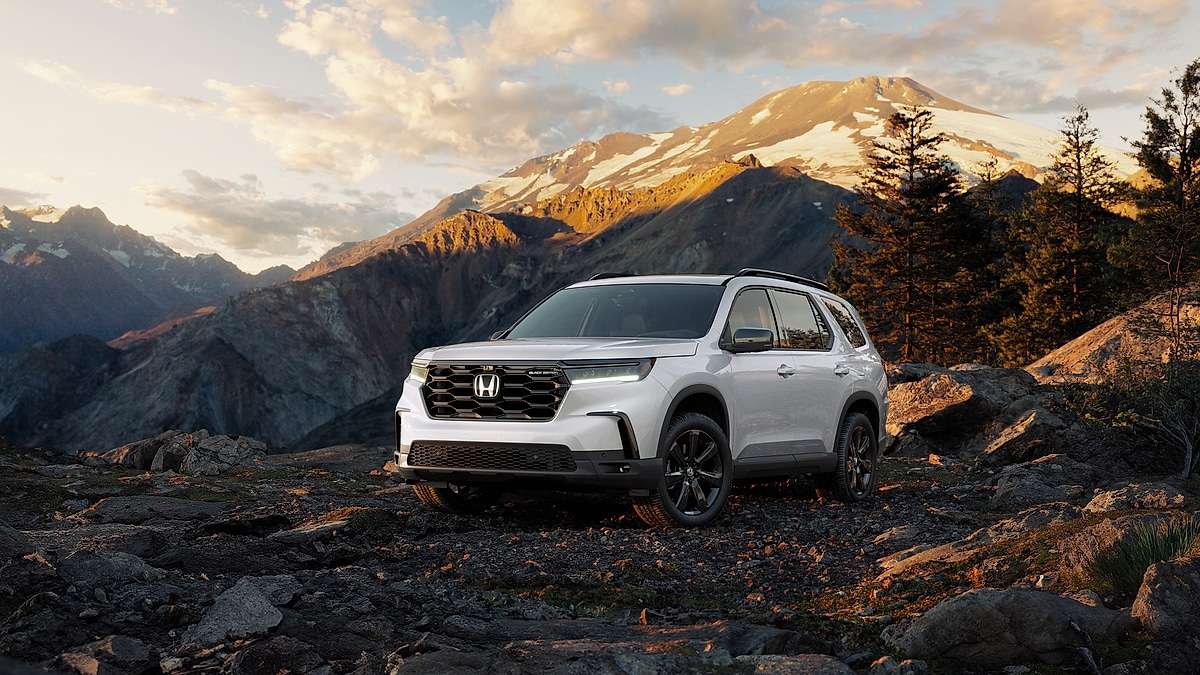

A new Honda Pilot Elite owner, after test-driving both the Toyota Grand Highlander and the Pilot, declared the Honda to be "butter smooth" and a "completely different experience" despite initial reservations about fuel economy. The owner, identified as Reddit user Prize-Leading-6653, found the Pilot offered superior materials, design, seats, and a significantly better driving feel compared to the Grand Highlander, which they described as having noisy engines and sloppy handling. This direct comparison, favoring the Pilot so strongly, challenges the common perception that Toyota's newest three-row SUV is the undisputed segment leader.
A single buyer's preference directly indicts Toyota's execution on a critical new model, particularly when Honda, a brand often seen as playing catch-up in some segments, delivers a more compelling package. When a vehicle's perceived advantages in areas like fuel economy and resale value pale beside fundamental driving dynamics and cabin experience, it signals a deeper problem for the manufacturer. Buyers are increasingly looking beyond spec sheets for the tangible experience, and Toyota's Grand Highlander appears to be missing the mark on that front.
The Grand Highlander, despite its hybrid powertrain and Toyota badge, is failing to deliver the precise, communicative chassis dynamics or the refined powertrain response that would justify its price against the Honda Pilot.
"So I drove a Grand Highlander (gas and regular hybrid) and thought they were OK. Engines were a little noisy, and seats were not great, plus handling felt a little sloppy. But I was fine with it and was ready to buy one.
Enough people in this sub said they expected to like the GH more but then found the Pilot to be way better and “butter smooth.” Almost wasn’t going to test drive one d/t fuel economy (wars and such), but figured I might as well. From the moment I sat in it, it felt WAY better. Better materials, design, and seats. Then I drove it and WHOA. Completely different experience.
Interestingly, I’d driven the previous-gen Pilot in 2018 when getting another car and hated it. Steering was too light and sloppy; just everything felt worse.
For those considering the two, I was looking at a GHH Limited b/c I wanted the bench seat. Hard to find.
For those considering these two, the GH is better in:
- Fuel economy
- 3rd row and trunk space
- Resale
- Colors (really did like the Storm)
- Better brake feel (Pilot very squishy)
- More cubby and storage space
Advertising
Beyond that, not a single thing to recommend it. Pilot is better in the following:
- Power and smoothness
- Features for price
- Infotainment (WAY better with Google Auto and no subscription required, tons of apps)
- Handling (still very soft for my tastes, but doable)
- Price - OTD $10k less for better features
- Sunglasses holder
And at least in my area (Raleigh-Durham, NC), dealership experience was night and day.
We don’t drive much, so hoping gas won’t be that big of a deal, and we have a second, more fuel-efficient car as a primary.
Thanks again to everyone here who shared their experiences. Made a big difference."
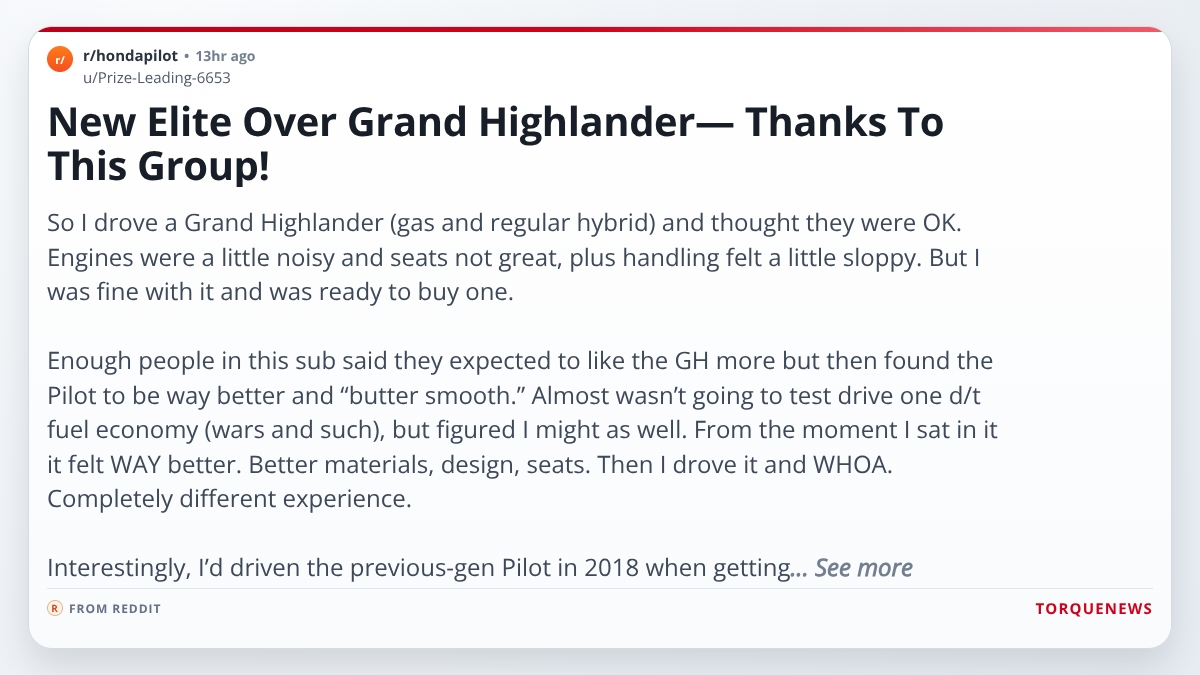
Prize-Leading-6653’s detailed comparison is particularly damning for Toyota because it comes from a buyer who was ready to purchase a Grand Highlander. The decision to even test-drive the Pilot was based on community feedback, not an initial inclination.
Honda Pilot: Elite Trim Delivers Unexpected Value
- The 2026 Honda Pilot Elite, as tested by the owner, offers a significant $10,000 out-the-door price advantage over a comparable Toyota Grand Highlander Limited, despite offering a more feature-rich and refined experience. This price discrepancy shows a strategic misstep by Toyota in its competitive positioning within the three-row SUV segment.
- The Pilot's infotainment system, featuring Google Auto integration and no subscription fees, stands in stark contrast to the Grand Highlander's offerings, which often come with additional costs or less intuitive interfaces. This focus on user-friendly, cost-free technology shows Honda's understanding of modern consumer expectations.
- While the Grand Highlander is often praised for its third-row and cargo space, real-world owner feedback suggests the Pilot's third-row headroom and shoulder room are perceived as more comfortable, with the added benefit of practical underfloor storage. This challenges the notion that the Grand Highlander holds an undisputed advantage in interior volume.
- The owner's description of the Pilot as "butter smooth" and the Grand Highlander as having "noisy engines" and "sloppy handling" points to a significant difference in powertrain refinement and chassis tuning. As of late February 2026, market data indicate a slight but noticeable dip in Toyota's customer satisfaction scores for new vehicle purchases, particularly in the three-row SUV segment, while Honda's scores have remained robust.
This shows a critical failure in Toyota's product planning: the Grand Highlander, designed to fill a perceived gap above the Highlander, appears to have missed the mark on the very attributes buyers prioritize in this segment. The notion that a previous-generation Pilot was "hated" by the same driver, only for the new one to be lauded as "butter smooth," shows Honda's engineering progress.
The specific criticisms leveled against the Grand Highlander, noisy engines, subpar seats, sloppy handling, and a lack of features for the price, are fundamental flaws that cannot be easily dismissed. These aren't minor quibbles; they are core elements of the driving and ownership experience. The fact that the Pilot offers "WAY better" infotainment with Google Auto and no subscription, while also being $10,000 less out the door for a comparable Elite trim, exposes a significant value proposition mismatch. Toyota's reliance on its brand reputation and perceived resale value is clearly not enough to overcome these experiential deficits.
Reddit user Dear_Significance_80 immediately jumped in to defend the Grand Highlander, stating, "Your list should carry an asterisk; the GH Hybrid Max has way more power than the Honda." This comment, while factually correct about the Hybrid Max's peak output, misses the point entirely. Prize-Leading-6653 specifically tested the regular gas and hybrid Grand Highlander models, not the Hybrid Max, which carries a significantly higher price tag and often limited availability. The discussion isn't about raw power figures at the top of the range; it's about the everyday driving experience and value proposition of the more common trims.
The immediate follow-up from Alternative-Park-841, "I'd hope so because you'll probably pay like $15k more for that," reveals the Hybrid Max's irrelevance to this particular comparison. Toyota's strategy of offering a high-performance, high-cost variant doesn't magically fix the issues of the standard models. If the base and regular hybrid Grand Highlanders are falling short on refinement and value, a more powerful, more expensive version does little to address the core problem. This reveals a common misconception among brand loyalists: that a halo trim can somehow compensate for deficiencies in the volume sellers.
Another comment, from AlienDelarge, who identified as a "Fourth Gen" Pilot owner, further corroborated Prize-Leading-6653's findings, particularly regarding the third-row seating and dealership experience. AlienDelarge noted, "I actually preferred the Pilot's 3rd row seats. The headroom and shoulder room in the GH are smaller, which made it feel cramped to me." This directly contradicts one of the Grand Highlander's supposed advantages, interior space. It also shows an often-overlooked practical detail: the Pilot's underfloor storage, which keeps valuables out of sight, a feature the Grand Highlander apparently lacks. This is a clear example of Honda's engineers understanding real-world family needs better than Toyota's.
The consistent feedback on the "vastly more pleasant" Honda dealership experience versus Toyota's indicates a pattern. For years, Toyota dealers have been criticized for aggressive sales tactics, inflated pricing, and a general lack of customer focus, particularly on popular models. When the entire buying process, from initial test drive to final paperwork, is a source of frustration, it erodes customer loyalty and can push buyers toward competitors, even if they initially favored the Toyota product. Toyota needs to address this systemic issue.
The narrative emerging from this owner's experience is clear: the Honda Pilot, particularly in its current generation, offers a more refined, value-packed, and superior ownership proposition than the Toyota Grand Highlander for a significant portion of the market. Toyota's reliance on its brand and hybrid powertrain, while strong, is not enough to overcome a driving experience that lacks polish and a price point that fails to deliver commensurate features. This comes as the Grand Highlander continues to face scrutiny over its value proposition and driving dynamics against competitors like the Honda Pilot.
Image Sources: Toyota Media Center
About The Author
Noah Washington is an automotive journalist based in Atlanta, Georgia, covering sports cars, luxury vehicles, and performance culture. His reporting focuses on explaining the engineering, design philosophy, and real-world ownership experience behind modern vehicles.
Noah has been immersed in the automotive world since his early teens, attending industry events and following the enthusiast communities that shape how cars are built and driven today. His work blends industry insight with enthusiastic storytelling, helping readers understand not just what a car is, but why it matters.
Noah is also a member of the Southeast Automotive Media Association (SAMA), a professional organization for automotive journalists and industry media in the Southeast.
His coverage regularly explores sports cars, luxury vehicles, and performance-driven segments of the automotive industry, including the evolving culture surrounding Formula Drift and enthusiast builds.
Read more of Noah's work on his author profile page.
You can also follow Noah here:
Set Torque News as Preferred Source on Google
Follow us today...



Comments
Toyota has the best record…
Permalink
Toyota has the best record. Now Honda looks likely they are beating the big guy by focusing on the customer.