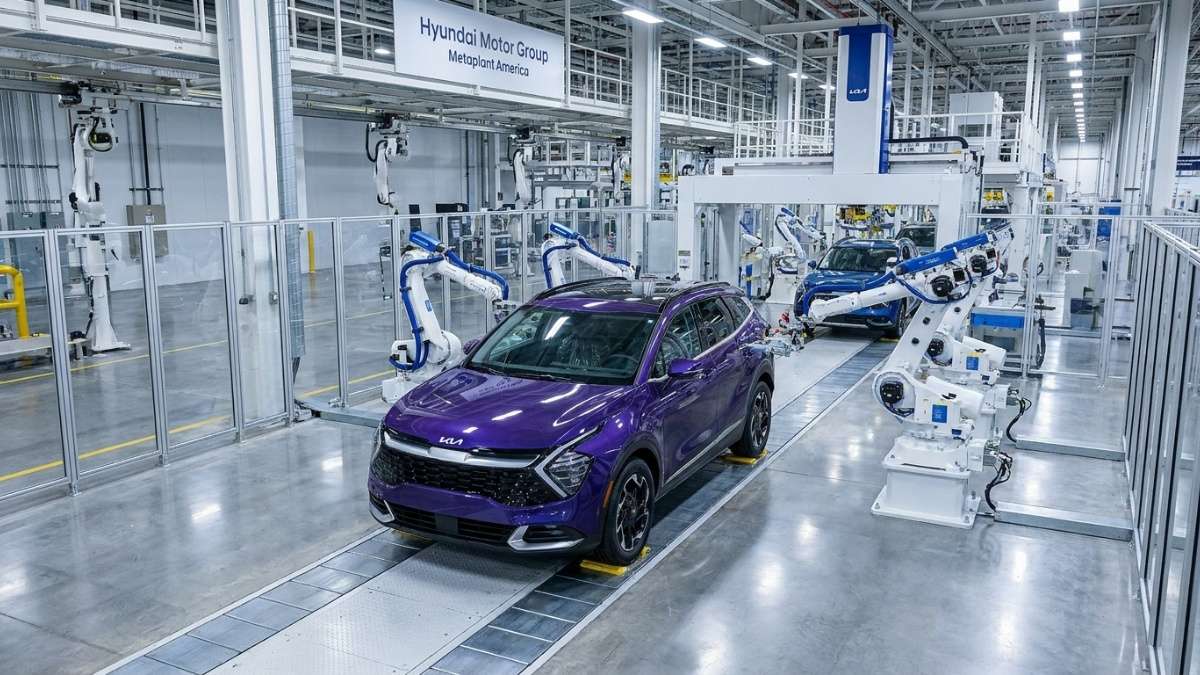

There is a profound difference between reading about modern automotive manufacturing and actually standing on the floor of a next-generation facility. Earlier this month, I attended the historic production launch at the Hyundai Motor Group Metaplant America (HMGMA) in Ellabell, Georgia. The event was a masterclass in modern industrial theater, highlighted by a 2027-designated Kia Sportage Hybrid rolling onto the stage atop an Autonomous Mobile Robot (AMR), carrying Georgia Governor Brian Kemp.
This moment wasn't just a photo op; it represented a massive strategic shift. As I discussed in my earlier column detailing the facility’s advanced robotics, Kia is leveraging an AI-driven factory operating system to build multiple powertrains on the same line. The Sportage is the third vehicle to roll off these lines—joining the all-electric Hyundai Ioniq 5 and Ioniq 9—but it is the facility's first hybrid and first Kia-branded model.
The strategic brilliance here is multifold. By moving Sportage Hybrid assembly from South Korea to Georgia, Kia effectively eliminates the 15% import duty that would otherwise impact their bottom line, insulating the brand against a projected $5 billion tariff exposure on future imports. But beyond the smart politics and economics, the star of the show remains the vehicle itself. The 2026 Kia Sportage is an impressive piece of engineering that demands a closer look, especially as buyers increasingly demand flexible powertrain options.
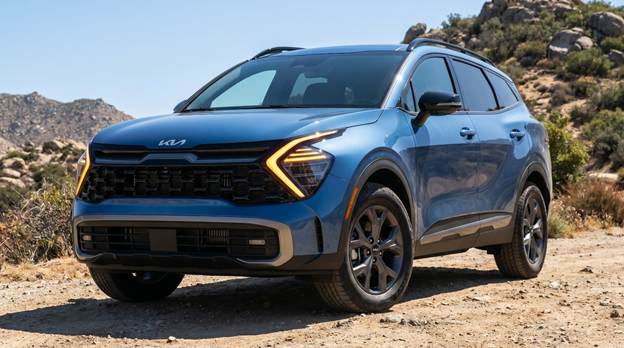
Kia’s design language has evolved aggressively over the last five years, moving from utilitarian to undeniably bold. The 2026 Sportage embraces the "Opposites United" design philosophy, presenting an exterior that is simultaneously rugged and sophisticated.
The front fascia is dominated by what Kia calls its "Star Map" lighting signature. These striking, boomerang-shaped amber LED daytime running lights bracket a wide, technical grille that gives the crossover a grounded, assertive stance. For 2026, Kia has introduced revised bumper designs and newly available cube-style projection LED headlights that look like they belong on a premium European SUV rather than a mainstream family hauler.
The profile is dynamic, characterized by crisp character lines and a contrasting black roof option that visually lowers the vehicle's center of gravity. For those inclined toward adventure, the X-Line and X-Pro Prestige trims add serious visual and functional hardware. We're talking 17-inch matte black wheels (note, unlike most manufacturer wheels which look underwhelming, most of the KIA wheels I saw at the event were really nice) wrapped in B.F. Goodrich all-terrain tires, ladder-type roof rails, and standard Terrain Mode systems. Kia isn't just building a grocery-getter; they are engineering a vehicle that confidently straddles the line between urban commuter and weekend off-roader.
A Cabin Aimed at Connectivity, Comfort, and Convenience
Stepping inside the 2026 Sportage reveals an interior that punches well above its weight class. Having recently evaluated the cabins of luxury EVs like my own 2022 Audi E-Tron GT, I am continually impressed by how rapidly mainstream brands are adopting premium interior architecture.
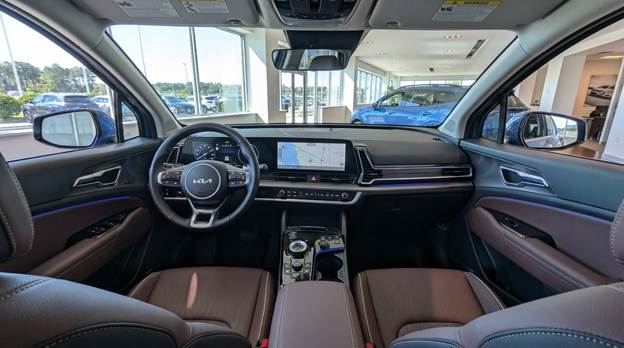
The centerpiece of the Sportage's cabin is the massive, curved panoramic display that seamlessly integrates a 12.3-inch digital instrument cluster with a 12.3-inch infotainment touchscreen. The system feels highly responsive, natively supporting wireless Apple CarPlay and Android Auto across the hybrid trims. For 2026, Kia has also added an available 10-inch Head-Up Display (HUD) that projects turn-by-turn navigation and safety alerts directly into the driver's line of sight, minimizing cognitive load a crucial safety feature as dashboard interfaces become increasingly complex.
Space is another major asset. Rear passengers are treated to a class-leading 41.3 inches of legroom, making the Sportage genuinely comfortable for four adults on long road trips. The dual-level cargo floor provides up to 39.6 cubic feet of space behind the second row (on ICE and HEV models), proving that you don't have to sacrifice utility for style. Kia has also introduced new accent trims on the center console and door panels specifically designed to reduce fingerprint smudges - a small but highly appreciated detail for anyone tired of constantly wiping down piano-black plastics.
Powertrain Choices: From EV Capability to ICE
The true genius of the Sportage lineup lies in its powertrain diversity. We are living through a transitional era in automotive technology, and automakers who force consumers into a single propulsion type are struggling. Kia understands this, offering the Sportage in Internal Combustion Engine (ICE), traditional Hybrid (HEV), and Plug-in Hybrid (PHEV) variants.
My wife and I recently ordered a 2027 Volvo EX60 (an EV) to replace our 2021 Volvo XC60 Recharge (PHEV) model, so I have a deep personal appreciation for the plug-in hybrid architecture. The Sportage PHEV offers a brilliant bridge for consumers who want the benefits of an EV for daily driving but aren't ready to commit to a fully electric lifestyle.
- The Plug-In Hybrid (PHEV): This is the crown jewel of the lineup. It pairs a 1.6-liter turbocharged gasoline direct injection (GDI) engine with a robust 72kW electric motor, delivering an impressive 268 combined horsepower and 271 lb-ft of torque. It provides substantial all-electric range, allowing owners to run local errands entirely on battery power—effectively operating as an EV—before the gasoline engine seamlessly kicks in for longer journeys.
- The Turbo Hybrid (HEV): Built locally at the Georgia Metaplant, the HEV utilizes the same 1.6-liter turbo but pairs it with a 44.7kW motor to produce 232 horsepower. This is the sweet spot for many buyers, offering excellent fuel efficiency (up to an EPA-estimated 42 MPG combined on FWD models) without the need to plug in.
- The Internal Combustion Engine (ICE): For traditionalists, the ICE model features a naturally aspirated 2.5-liter four-cylinder engine producing 187 horsepower. While it lacks the immediate low-end torque of its electrified siblings, it remains a reliable, cost-effective option and boasts the highest towing capacity in the lineup at 3,500 pounds.
Comparing Price, Performance, and the Competition
When evaluating the Sportage against its fierce competition - namely the Toyota RAV4 Hybrid and the Honda CR-V Hybrid - the differences in engineering philosophy become apparent.
The most significant differentiator is Kia's use of the Transmission-Mounted Electric Device (TMED) architecture. Toyota relies on a power-split device utilizing an electronic Continuously Variable Transmission (e-CVT). While efficient, e-CVTs often suffer from a frustrating "rubber-band" effect, where engine RPMs soar disproportionately to vehicle acceleration, creating a noisy, disconnected driving experience.
In contrast, Kia integrates its electric motor directly into a conventional six-speed automatic transmission. This means the Sportage HEV and PHEV shift gears like a traditional car, providing a far more engaging and linear driving dynamic. Having driven both setups, the TMED architecture simply feels more refined. The electric motor provides smooth, instant torque off the line, and the physical gear changes offer tactile feedback that driving enthusiasts appreciate.
From a pricing perspective, the Sportage remains aggressively competitive. The HEV models start around the $31,000 mark, significantly undercutting similarly equipped European crossovers while matching them in interior quality. While the PHEV commands a premium, the total cost of ownership can be heavily offset for buyers who charge at home and execute most of their daily driving in EV mode.
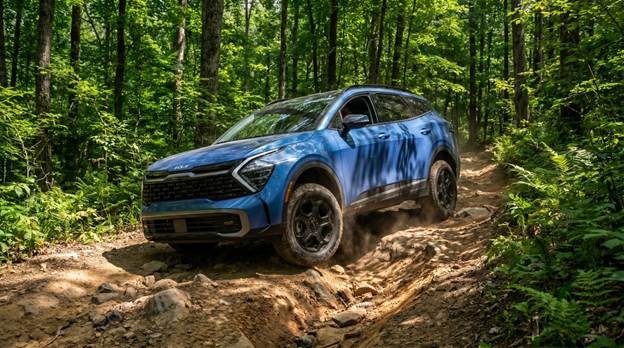
Furthermore, the HEV and PHEV models offer an Active All-Wheel Drive system that uses an electro-hydraulic coupling with a center-locking differential to actively distribute power. Combined with Downhill Brake Control and Hill-Assist Control, the Sportage isn't just playing dress-up; it has genuine all-weather and mild trail capability that outclasses the standard all-wheel-drive systems found in many competitors.
The Featured Star of the Metaplant Event
Returning to the event in Savannah, it was impossible to ignore the symbolism of the Sportage Hybrid taking center stage at a facility originally slated primarily for pure EVs.
Automotive manufacturing is transitioning from fixed-line production to highly adaptable environments. The HMGMA plant utilizes cell-based, mixed-model production. Unlike traditional factories where tooling is locked to a single vehicle architecture, the stations at the Metaplant operate as software-updatable nodes. This means Kia can dynamically scale production between the electric Ioniq models and the hybrid Sportage based on real-time market demand.
As I noted in my previous analysis, this flexibility is a massive competitive advantage. While other automakers are idling EV plants due to fluctuating demand, Kia can simply instruct its AI-driven factory operating system to shift resources to the highly demanded Sportage Hybrid. In the first quarter of 2026 alone, Kia’s U.S. hybrid sales surged 51% year-on-year. The market has spoken, and Kia’s manufacturing infrastructure is perfectly positioned to answer.
Watching Governor Kemp ride in the first U.S.-assembled Sportage Hybrid underscored the economic impact of this flexibility. The West Point and Savannah plants together employ over 5,000 workers, granting Kia an annual domestic production capacity of up to 550,000 vehicles. By localizing the production of their highest-volume hybrid model, Kia is securing its supply chain, optimizing logistics, and delivering vehicles to American consumers faster and more efficiently than ever.
Wrapping Up
The 2026 Kia Sportage is a masterclass in market adaptation. It offers a striking, modern design that refuses to blend into the crossover background, paired with an interior that democratizes luxury technology. But its true strength lies beneath the sheet metal.
By offering a spectrum of powertrains- from the heavy-hauling ICE to the ultra-efficient HEV and the EV-capable PHEV - Kia ensures there is a Sportage tailored for almost every demographic and use case. The decision to utilize a traditional stepped automatic transmission over a CVT proves that Kia still values the driving experience, prioritizing tactile engagement over theoretical efficiency gains.
Furthermore, the vehicle's new home at the Georgia Metaplant represents the pinnacle of modern manufacturing strategy. Avoiding heavy import tariffs while leveraging AI-driven flexible assembly lines ensures that the Sportage will remain both competitively priced and readily available.
Whether you are an urban commuter looking to maximize your electric range with a PHEV, or a weekend adventurer relying on the X-Pro's all-terrain capability, the 2026 Sportage demands serious consideration. It isn't just a great crossover; it is a testament to what happens when an automaker perfectly aligns its engineering, its manufacturing, and its understanding of the modern consumer.
Disclosure: Images rendered by Artlist.io
Rob Enderle is a technology analyst at Torque News who covers automotive technology and battery developments. You can learn more about Rob on Wikipedia and follow his articles on TechNewsWord, TGDaily, and TechSpective.
Set Torque News as Preferred Source on Google
Follow us today...