
To truly understand a massive shift in the automotive and technology sectors, you have to see it firsthand. The spreadsheets and press releases sent out by corporate PR departments rarely tell the whole story. So, earlier this week, I flew to Savannah, Georgia, to attend a landmark event: the start of production for the Kia Sportage Hybrid at the newly minted Hyundai Motor Group Metaplant America (HMGMA).
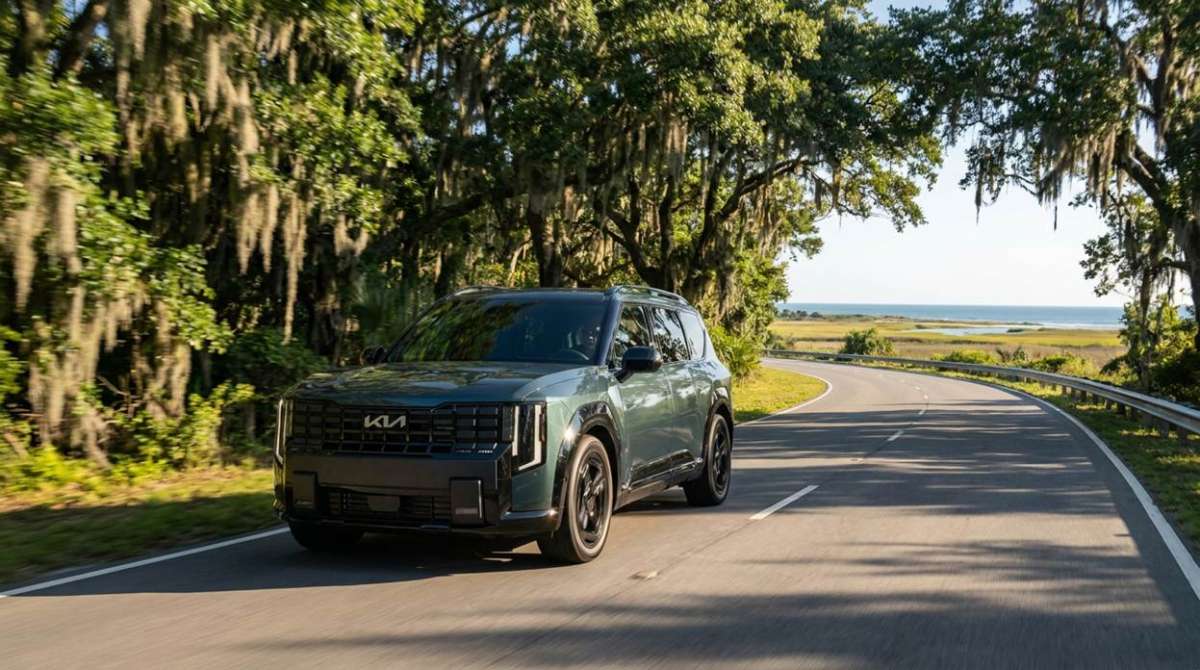
To get the full Kia experience, I arranged to drive a borrowed Kia Telluride to and from the Savannah event. Navigating the coastal Georgia highways in the Telluride offered a masterclass in how far this brand has evolved. The Telluride is arguably one of the most disruptive three-row SUVs on the market today, offering a level of refinement, quietness, and commanding road presence that aggressively challenges luxury brands costing tens of thousands of dollars more. The highway steering assist, the premium materials, and the sheer ergonomic comfort made the drive absolutely effortless. I will be doing a comprehensive, deep-dive review of the Telluride in a later column, but suffice it to say, arriving at a state-of-the-art factory in Kia’s flagship SUV perfectly set the stage for what I was about to witness on the manufacturing floor.
Inside the Metaplant Marvel and Flexible Manufacturing
Pulling into the massive HMGMA complex, the sheer scale of the investment becomes immediately apparent. This isn't just another car factory; it is the physical manifestation of the Electrifying Georgia program, a strategic state-level initiative designed to turn the American South into the epicenter of next-generation mobility.
The celebration itself marked three critical milestones for HMGMA: it was the first Kia model to roll off this specific line, the first hybrid electric vehicle (HEV) produced at the site, and the third vehicle overall to be integrated into the facility's complex assembly process. The Kia Sportage Hybrid now joins the award-winning Hyundai IONIQ 5 and the massive, all-electric IONIQ 9 on the floor.
What makes this genuinely fascinating from a technology analyst’s perspective is the concept of flexible manufacturing. Legacy automakers often build rigid plants. If they build an EV plant, it only builds EVs. If consumer demand shifts back toward hybrids—as we have seen happen dramatically over the past two years—those rigid plants sit idle, hemorrhaging capital. HMGMA’s original design threw that antiquated concept out the window. The factory was built from the ground up to allow the seamless integration of entirely different powertrains with minimal modifications. Watching the assembly line shift effortlessly from assembling the battery-heavy architecture of an IONIQ 5 to the hybrid-combustion system of the Sportage Hybrid is a marvel of modern software, logistics, and engineering flexibility. As Sean Yoon, president and CEO of Kia North America, pointed out during the event, this capability is a clear testament to Kia's confidence in the facility's future.
A Tale of Two Factories: The Antiquated Luxury Contrast
Seeing the HMGMA facility in operation immediately triggered a stark memory for me. A few years back, I took a guided tour of a Mercedes-Benz manufacturing plant. Given the storied reputation of German engineering and the premium price tag attached to the famous three-pointed star, I fully expected to walk into a pristine, sci-fi utopia of automotive creation.
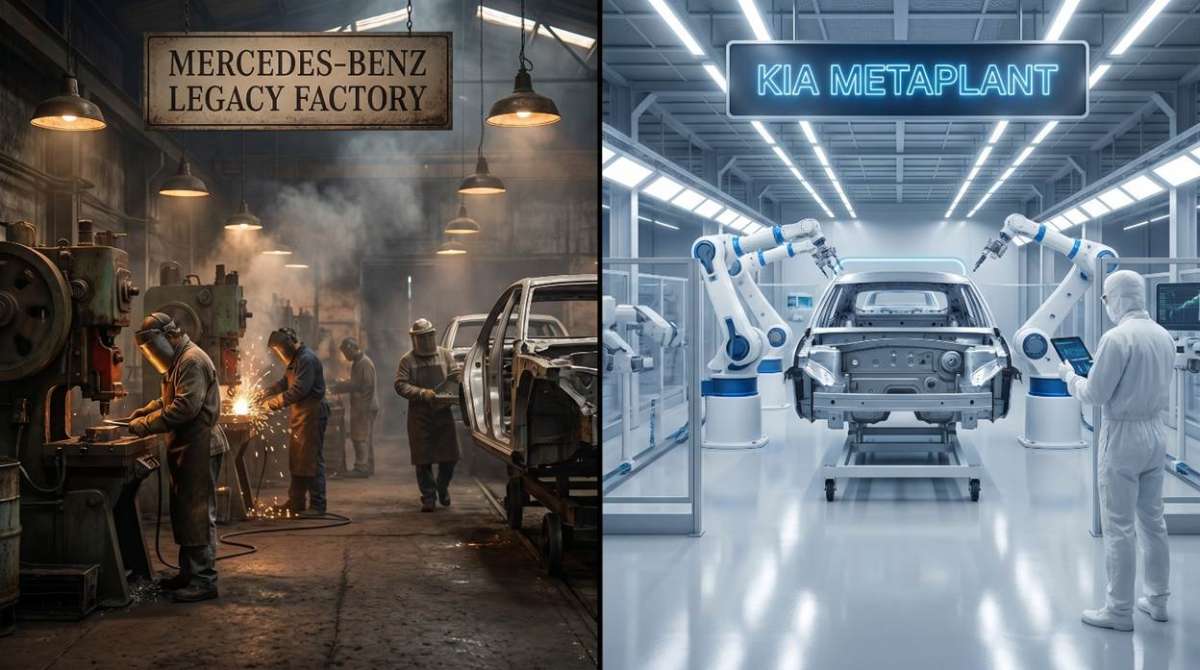
Instead, the Mercedes plant looked shockingly ancient. The technology felt thoroughly antiquated, resembling something built in the late 1990s rather than the bleeding edge of the 21st century. What stood out the most was the agonizingly heavy use of human labor to do things that computers and machinery should have taken over a decade ago. I watched line workers engaged in strenuous, repetitive, heavy lifting, wrestling with chassis components in a noisy, chaotic environment that felt deeply inefficient and ergonomically dangerous. The legacy overhead of old-school manufacturing was palpable. It was a factory anchored to the past, struggling to adapt to the present.
By sharp contrast, the Kia Metaplant tour felt like stepping through a portal into the year 2040. The facility was stunningly quiet, brightly lit, and incredibly clean. More importantly, humans were no longer being treated as heavy-lifting machines. Instead of sweating over heavy drive shafts, the human workers—whom HMGMA calls "Meta Pros"—were acting as highly skilled overseers, managing complex automated systems. Heavy lifting, precision welding, and repetitive torque applications were entirely handled by automated systems. The difference was night and day. Where Mercedes looked like an old-world blacksmith shop operating at scale, Kia’s Savannah plant is a high-tech laboratory that just happens to build cars.

A Showroom of Robots and the Humanoid Future
To call HMGMA a factory is almost a disservice; it is more accurately described as a showroom of robotics. Hyundai Motor Group’s acquisition of Boston Dynamics a few years ago wasn't just a PR stunt to get cool YouTube videos of dancing robots—it was a core manufacturing strategy, and that strategy is now fully operational in Georgia.
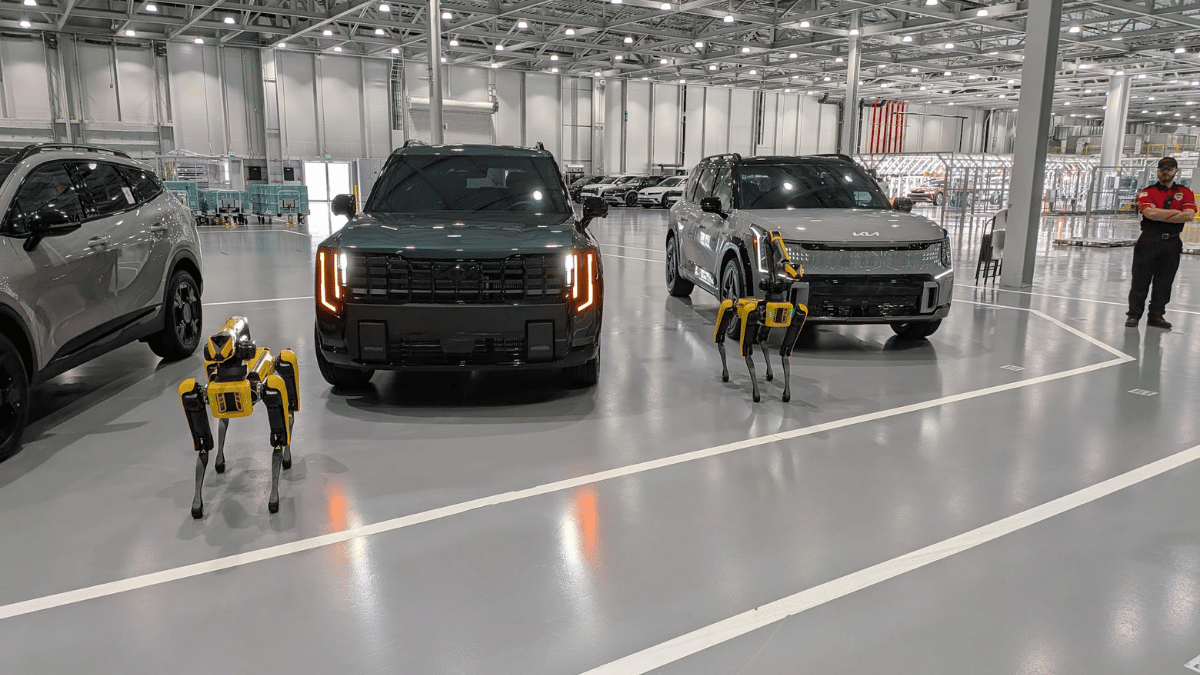
As I toured the floor, I was genuinely astounded to see Boston Dynamics "Spot" robot dogs actively patrolling the facility. These quadrupedal robots aren't there for show. Equipped with high-resolution thermal cameras, acoustic sensors, and advanced AI vision models, they are heavily utilized for quality control and autonomous facility inspection. They roam the floor looking for microscopic defects, thermal anomalies in the machinery, and safety hazards that a human eye would easily miss.
Furthermore, executives at the plant quietly confirmed that they are beginning to test and train bipedal humanoid robots for future integration. These humanoids are learning to perform the highly complex, dexterous tasks that currently require human hands but are ergonomically taxing over a standard shift. By training humanoid robots using advanced AI and reinforcement learning, Kia is future-proofing its workforce against labor shortages and drastically reducing workplace injuries.
The robotics integration was even central to the celebration ceremony itself. The very first Kia Sportage Hybrid didn't just drive onto the stage; it was delivered in a signature display of the plant’s advanced automation capabilities, traveling seamlessly to the podium atop an Autonomous Mobile Robot (AMR). Seeing an entire SUV silently glide across the floor on a robotic platform was a powerful visual metaphor for the technological leap this facility represents.
The Power of Political Partnership
None of this technological marvel happens in a vacuum. The successful deployment of capital at this scale requires a stable, forward-thinking political environment, and Georgia Governor Brian Kemp deserves a tremendous amount of credit for getting this factory built. Governor Kemp, who actually rode in the Sportage Hybrid as the AMR delivered it to the stage, has been instrumental in the "Electrifying Georgia" initiative.
The mutual success here is the direct result of a proven partnership approach between the state government and corporate leadership. Governor Kemp's administration aggressively cut red tape, provided vital infrastructure support, and heavily funded local technical colleges to ensure that HMGMA would have a pipeline of highly trained Georgian workers—the Meta Pros—ready to operate this advanced machinery.
The economic ripple effect is staggering. This event expands a nearly two-decade commitment by Kia to the state. Kia’s West Point, Georgia factory currently employs over 3,200 team members, assembling the Telluride, EV9, EV6, and ICE versions of the Sportage and Sorento. The Savannah Metaplant adds another 2,000 advanced manufacturing jobs to that roster, with a massive percentage of those roles filled by local Georgians. According to official Kia press materials, the combined capacity across the West Point and HMGMA facilities now sits at an astonishing 550,000 vehicles annually. That is a massive chunk of the U.S. automotive market being built entirely within the borders of a single Southern state. The political foresight to capture this manufacturing base will secure Georgia's economic foundation for generations to come.
Wrapping Up
The start of production for the Kia Sportage Hybrid at the Savannah Metaplant is far more than just another car rolling off a line; it is a clear warning shot across the bow of the entire legacy automotive industry.
By combining the unparalleled flexibility of modern assembly lines with the bleeding-edge robotics of Boston Dynamics, Kia has effectively insulated itself against the volatile shifts in consumer powertrain preferences. Whether the market demands EVs or Hybrids, the HMGMA facility can pivot instantly without losing a step. When you contrast this agile, highly automated, and remarkably quiet robotics showroom with the antiquated, labor-intensive factories of legacy luxury brands like Mercedes, it becomes clear who is actually leading the future of mobility. Supported by Governor Kemp’s pro-business Electrifying Georgia program, Kia isn't just building cars in Savannah—they are building the blueprint for the 22nd-century automotive industry. If this facility is any indicator of Kia's trajectory, the rest of the automotive world should be very, very worried.
Disclosure: Images rendered by Artlist.io
Rob Enderle is a technology analyst at Torque News who covers automotive technology and battery developments. You can learn more about Rob on Wikipedia and follow his articles on TechNewsWord, TGDaily, and TechSpective.
Set Torque News as Preferred Source on Google
Follow us today...