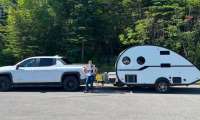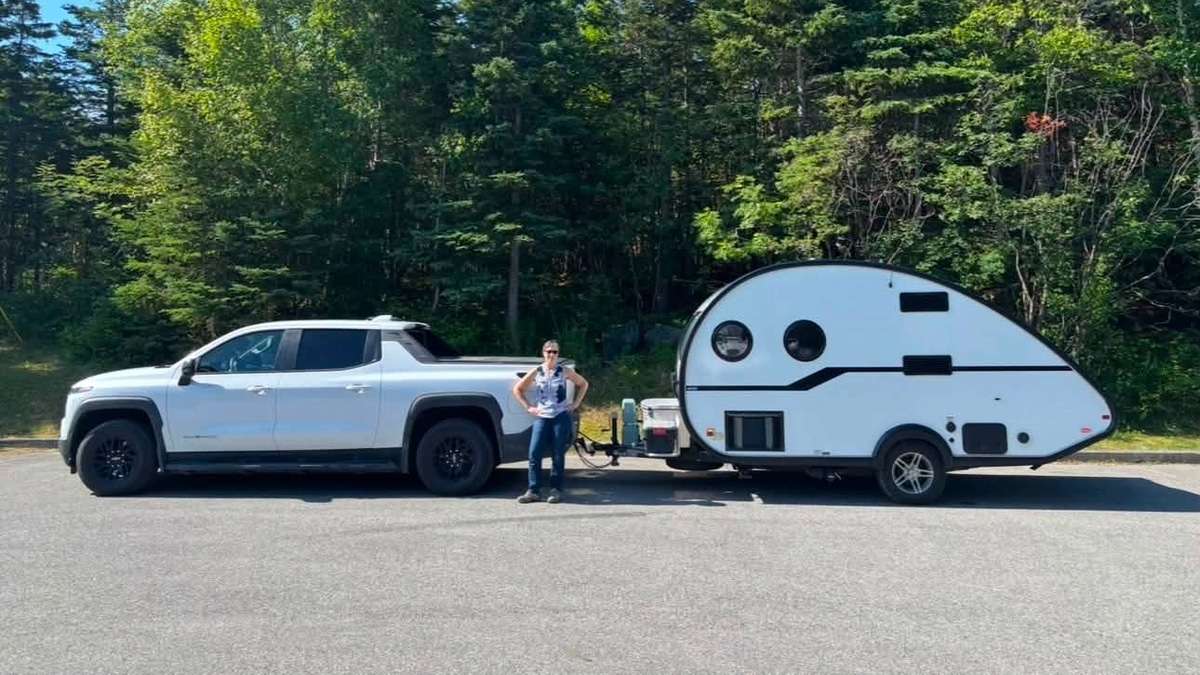

At 93°F in Nipigon, Ontario, the Chevrolet Silverado EV had finished towing for the day. Its battery was still working.
A couple traveling across Canada with a compact teardrop planned to spend the night at the local visitor center. The owner ran a power cord from the truck bed to the trailer and switched on the air conditioner.
There was no electrical pedestal beside their parking space and no generator idling beneath the trailer window. The Silverado EV carried the energy for the road and the room behind it.
The owner-group post appeared under the title “cold weather,” although John Bouwmeester was describing how the truck handled summer heat.
“One of the things we love about towing with an electric truck,” Bouwmeester wrote in the post.
“We just plug the trailer into the truck’s 120-volt receptacle and turn on the A/C. This has worked well for us across Canada in the summer.”
In the replies, Bouwmeester clarified that he actually uses the Silverado’s 240-volt, 30-amp outlet with a purpose-built adapter that supplies 120-volt power to the trailer. He prefers the locking plug because it is less likely to work loose.
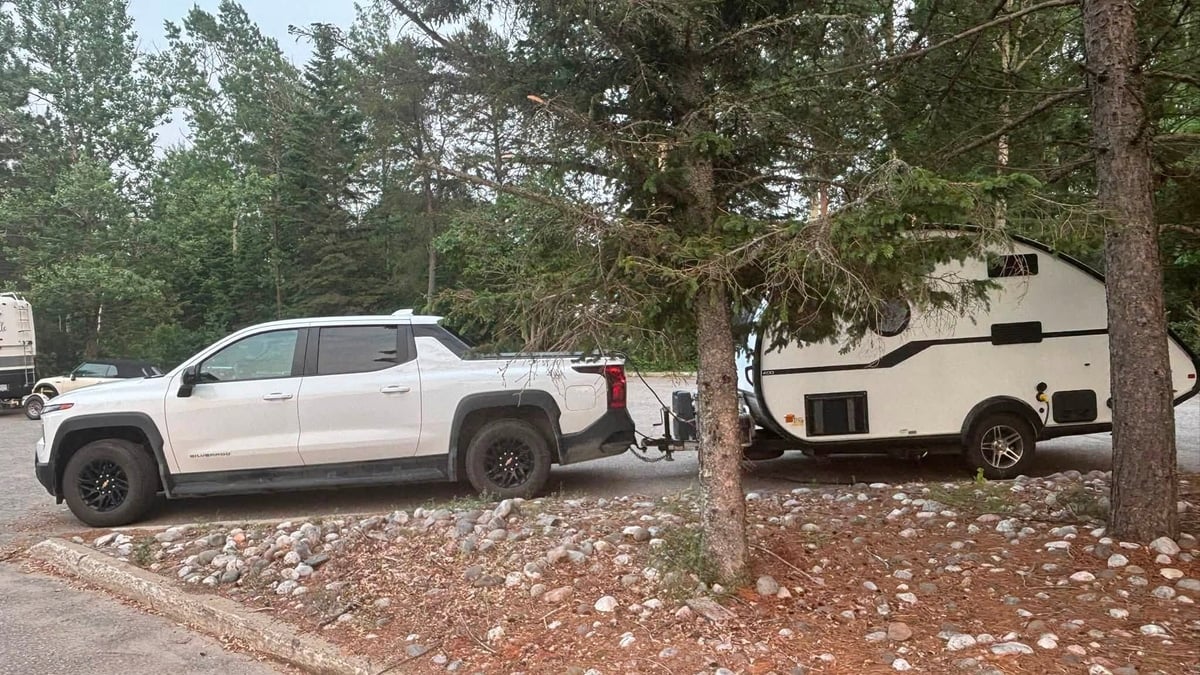
That is a useful ownership detail. The next one belongs on the truck’s energy screen.
The Silverado Became the Electrical Pedestal
Bouwmeester described his truck as having four 120-volt, 20-amp receptacles and one 240-volt, 30-amp receptacle, with outlets available in the bed, cabin, and front trunk. He said his trailer’s air conditioner only requires a 120-volt, 15-amp source.
We could not identify the Silverado EV’s model year, trim, battery size, or factory power package. Those omissions matter because Chevrolet has expanded and rearranged the truck’s available configurations. Chevrolet’s current Silverado EV page advertises up to 11 outlets and up to 10.2 kW of available offboard power. That current maximum should not be assigned backward to Bouwmeester’s unidentified truck.
His description is enough to establish what he used. The 240-volt, 30-amp receptacle can theoretically provide up to 7.2 kW at its circuit limit. The small trailer A/C asks for a fraction of that capacity. A 120-volt appliance drawing the full 15 amps would demand 1.8 kW.
The numbers also explain why the receptacle rating should not be confused with actual battery consumption. The truck does not continuously send 7.2 kW merely because the cord is connected. The appliance takes the power it needs, the compressor cycles, and the load changes with temperature, thermostat setting, fan speed, startup demand, and the trailer’s insulation.
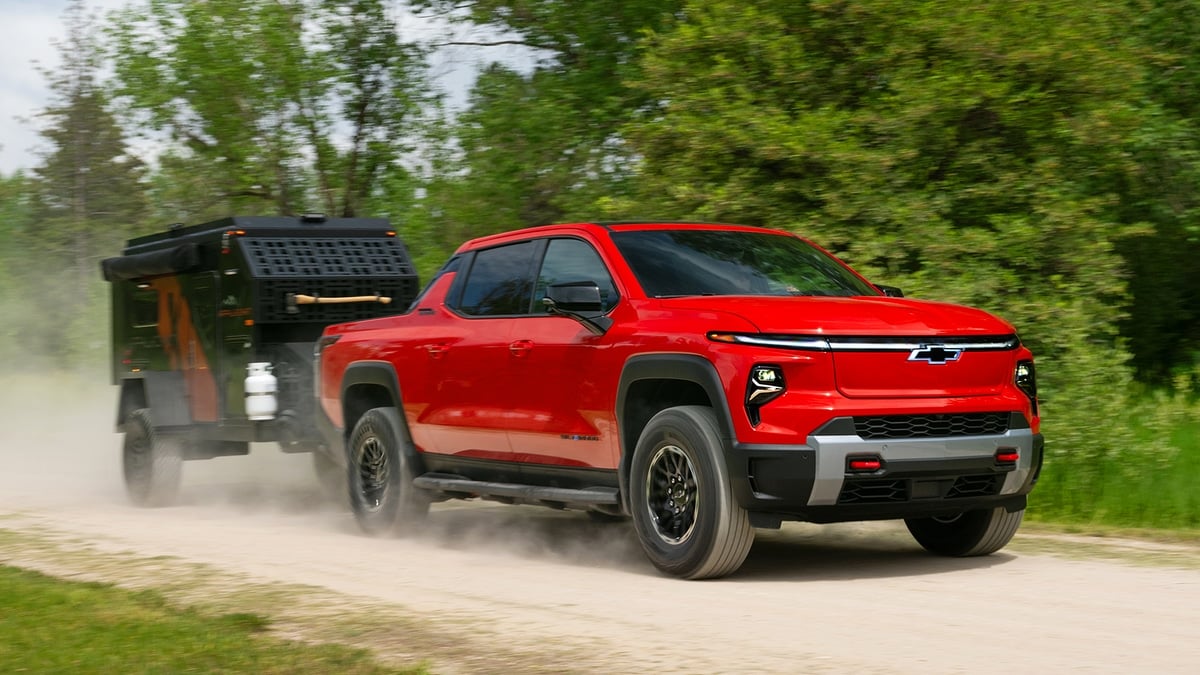
The adapter remains the part that deserves caution. A 240-volt receptacle cannot feed arbitrary 120-volt equipment through any convenient plug shape. A properly listed adapter must match the Silverado’s receptacle, provide the intended 120-volt leg, maintain the correct neutral and ground paths, and remain within every component’s rating. Bouwmeester’s post documents his arrangement; it is not a universal wiring instruction.
One Before-and-After Photograph Would Price the Night
The air conditioner worked. The post does not reveal what the night costs in battery energy.
Suppose the trailer averaged 1.5 kW for eight hours. It would consume approximately 12 kWh. That figure is an illustration, not Bouwmeester’s result. His A/C may cycle below that average, run harder in the early evening, or operate for a different number of hours.
A useful overnight record would contain seven entries:
- Battery percentage when the trailer was connected.
- Battery percentage the following morning.
- Energy reported by the truck’s offboard-power display, if available.
- Total hours connected.
- A/C make, model, and rated current.
- Interior thermostat setting.
- Outside temperature at connection and departure.
Those figures would tell another Silverado EV owner how much driving reserve to protect before choosing comfort for the night. The truck’s large battery makes this use practical, but the exact percentage depends on the battery fitted to Bouwmeester’s truck and the A/C’s measured consumption.
Chevrolet’s current Silverado EV materials describe a Range Reserve feature that lets drivers protect the energy needed for the next destination while using available offboard power. That is the correct mental model, even if Bouwmeester’s configuration predates the current feature set. The morning route belongs in the overnight power calculation.
Towing Had Already Taken Roughly Half the Range
The overnight load cannot be separated from the towing penalty that brought the truck to Nipigon.
Bouwmeester said the teardrop reduces range by roughly half, depending on conditions. He previously towed the same trailer with a Tesla Model Y and described the penalty as approximately the same.
That comparison carries useful experience and limited measurement. The post does not include the trailer’s loaded weight, height, width, average speed, wind, elevation, starting battery percentage, ending battery percentage, or energy consumption from either vehicle. It cannot establish that a Silverado EV and Model Y suffer identical penalties under controlled conditions.
It can guide trip planning. A compact teardrop still presents a second body to the air. Its rounded nose helps, but the trailer adds frontal area, rolling resistance, exposed tires, roof equipment, and turbulence between the truck and camper. At highway speed, the shape and wind can matter more to energy use than another suitcase in the bed.
Other GM electric-truck owners have reported the same split between effortless pulling and expensive air. A GMC Sierra EV Denali owner averaged 1.1 mi/kWh while towing a 6,000-pound boat. Another Sierra EV pulled a 5,500-pound camper to 9,000 feet and returned with 21 percent.
Those trips used different vehicles, trailers, roads, and weather. They should not be averaged together. They show why Bouwmeester’s morning battery reading matters. A few kilowatt-hours of overnight A/C may feel modest inside a large pack, but every unit has already become more valuable after towing cuts the road range.
This Is Where Offboard Power Earns Its Hardware
An electric truck’s battery usually appears in towing stories as a weight that must be carried and energy that must be replenished. Bouwmeester used it as a service the campsite would otherwise need to provide.
The arrangement removes a portable generator, fuel can, engine vibration, and exhaust from the immediate campsite. It also avoids generator noise during a night when other travelers may be sleeping nearby. Carbon monoxide remains a serious reason to keep combustion equipment away from occupied trailers. The Silverado’s outlets produce no tailpipe exhaust in the parking space.
The trade belongs on the dashboard. Climate control consumes traction energy, and an electric tow vehicle cannot treat destination power as free. A family waking beside a fast charger can spend more freely than one facing another long gap through Northern Ontario.
The location introduces a separate boundary. Bouwmeester said they were staying at the visitor center, but the supplied post does not say whether overnight parking was formally authorized. Readers should verify posted rules and local permission rather than treating one owner’s stop as a permanent camping policy.
The Next Trip Can Turn the Photograph Into a Benchmark
Bouwmeester already has the difficult experience. He has crossed Canada with the teardrop, towed it with two electric vehicles, and used the Silverado EV to run its air conditioner during hot weather.
His next post only needs a better receipt.
Photograph the battery percentage and offboard-power reading when the cord goes in. Take the same photographs before departure. Record the hours, thermostat, outside temperature, trailer dimensions, towing speed, and the distance to the next charger.
That log would answer the question hidden inside the photograph. Silverado EV shoppers can already see that the truck will run a small trailer’s A/C. They want to know whether it can cool the trailer through a 93°F stop and still preserve a comfortable margin for the next towing leg.
Bouwmeester proved the comfort. Two dashboard photographs could measure its cost.
If you have powered a camper from an electric truck overnight, share the A/C size, hours used, and starting and ending battery percentages in the comments. Your numbers could help another traveler stay cool without sacrificing the next day’s range.
Two photos by John Bouwmeester.
About The Author
Noah Washington is an automotive journalist based in Atlanta, Georgia, covering sports cars, luxury vehicles, and performance culture. His reporting focuses on explaining the engineering, design philosophy, and real-world ownership experience behind modern vehicles.
Noah has been immersed in the automotive world since his early teens, attending industry events and following the enthusiast communities that shape how cars are built and driven today. His work blends industry insight with enthusiastic storytelling, helping readers understand not just what a car is, but why it matters.
Noah is also a member of the Southeast Automotive Media Association (SAMA), a professional organization for automotive journalists and industry media in the Southeast.
His coverage regularly explores sports cars, luxury vehicles, and performance-driven segments of the automotive industry, including the evolving culture surrounding Formula Drift and enthusiast builds.
Read more of Noah's work on his author profile page.
You can also follow Noah here:
Set Torque News as Preferred Source on Google
Follow us today...