
A Kia EV9 owner's first camping trip with a 2024 Kia EV9 GT-Line stayed calm because he treated 119 estimated towing miles as a planning limit.
Mike Bell left home in Washington at 99% state of charge with a travel trailer attached. The EV9 displayed 119 miles of estimated range. He held about 60 mph on a relatively flat stretch of Interstate 5 and averaged 1.3 mi/kWh. After roughly 80 miles, he stopped at a Walmart near the campsite for a quick top-off and, as he put it, an opportunity to buy more camping gear.
Bell still had a useful range. The location made sense.
- At 1.3 mi/kWh, the 80-mile leg required roughly 61.5 kWh. Simple pack math leaves a meaningful reserve, although the missing arrival state of charge prevents a full audit.
- Holding 60 mph likely protected the EV9’s range. Trailer drag rises quickly with speed, so another 5 or 10 mph could consume substantially more energy while saving little time.
- The 5,000-pound tow rating is only one limit. Passengers, gear, hitch hardware, and tongue weight must also fit within roughly 1,213 to 1,299 pounds of vehicle capacity.
That gives the trip more value than a dramatic arrival at 2%. Bell knew the range penalty was coming, selected a manageable first leg, and used an available charger before the remaining margin became important. His summary in the Kia EV9 Owners USA group was equally undramatic: “No issue and enjoying the journey.”
The numbers support his confidence.
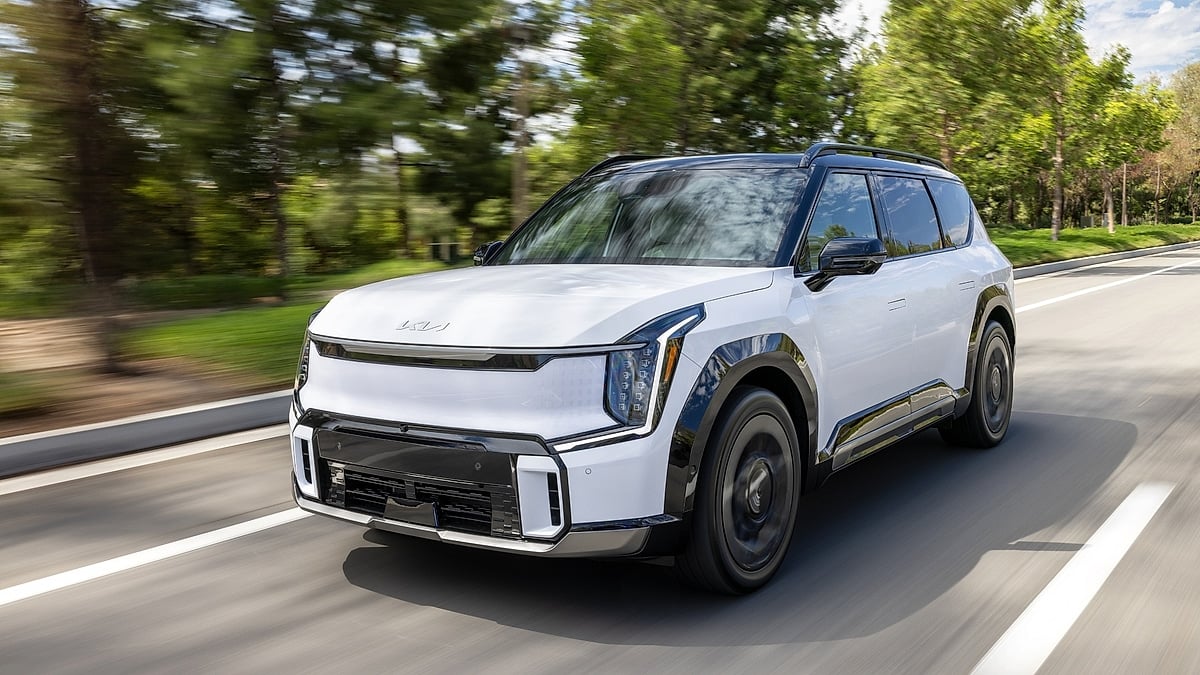
Kia equips the 2024 EV9 GT-Line with a 99.8-kWh battery and rates the trim for 270 miles of normal EPA range. Bell's 1.3 mi/kWh average equals about 76.9 kWh per 100 miles. Multiply 1.3 by the battery's rated energy, and the rough full-pack pace approaches 130 miles before accounting for the difference between rated and usable energy, reserve, temperature, and battery-management limits.
A more practical 90% window produces about 117 miles. The EV9 showed 119 at 99%.
That two-mile difference is close enough to show a range estimate behaving sensibly on this trip.
The First 80 Miles Used Roughly 62 kWh
At Bell's reported 1.3 mi/kWh, an 80-mile leg requires about 61.5 kWh. That leaves meaningful energy in a 99.8-kWh pack on simple paper math, though the missing arrival state of charge prevents a direct audit.
The display, battery, and route were all pointing toward the same basic answer. This combination wanted a charging opportunity somewhere around 100 to 120 miles if Bell planned to preserve a healthy reserve. He chose one at 80 because the store sat near the campsite.
That is conservative routing, and it scales better than waiting for the dashboard to begin negotiating.
Speed helped. Bell held 60 mph on the relatively flat I-5. A travel trailer presents a broad frontal area and turbulent wake, so aerodynamic demand rises quickly as speed climbs. Another five or ten mph can consume a disproportionate amount of the battery while saving little time over a short leg.
Bell's 1.3 mi/kWh also matches the headline average from a Rivian R1T towing a 19-foot Airstream for 1,000 miles. The two rigs differ in trailer shape, loaded weight, speed, weather, elevation, tires, battery size, and measurement distance. Their shared number places 1.3 mi/kWh in credible territory for a large EV towing a compact travel trailer under cooperative conditions.
The Trailer Weight Still Needs a Scale
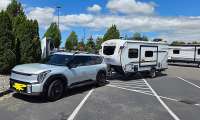
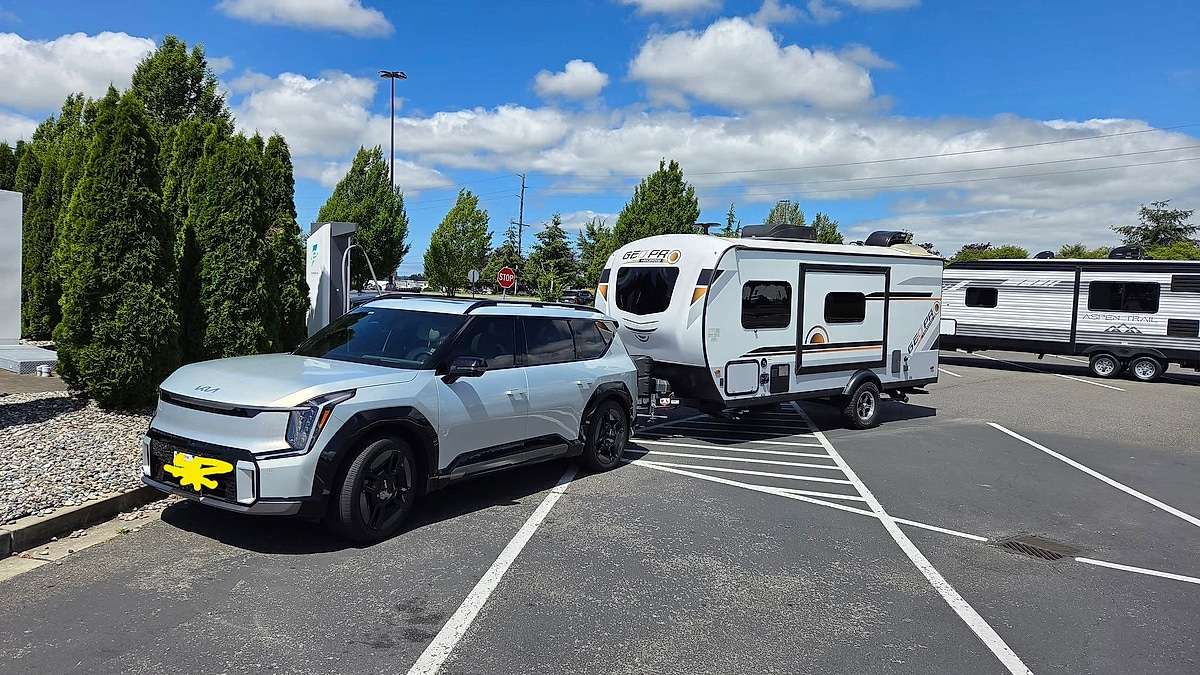
Bell identified the trailer as a 2020 Geo Pro G19FBS. The photograph shows a compact single-axle travel trailer sitting level behind the EV9. The post does not supply its loaded weight, tongue weight, water load, battery and propane configuration, or cargo.
Kia rates the 2024 EV9 GT-Line to tow up to 5,000 pounds with trailer brakes when properly equipped. A model name and a dry brochure number cannot establish Bell's actual load. Camping trailers gain weight through water, propane, batteries, food, tools, chairs, cookware, bedding, and everything purchased during that Walmart stop.
The EV9 has a second limit that receives less attention. Kia lists the GT-Line at 5,800 to 5,886 pounds of curb weight and 7,099 pounds of GVWR. Simple subtraction leaves roughly 1,213 to 1,299 pounds between those figures before accounting for the exact truck's certification label.
Passengers, luggage, hitch equipment, and trailer tongue weight all occupy that allowance. A 5,000-pound tow rating does not guarantee enough remaining vehicle capacity for a family, camping gear, and a heavily loaded hitch.
The driver's door label and a scale settle the weight question. Bell's first trip tells us how the combination felt from the driver's seat.
The Charging Stop Worked Because the Lot Had Room
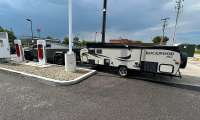
Bell's photograph shows the EV9 and Geo Pro still connected near a charger. The combination stretches across the geometry of a conventional parking lot, with the SUV near the curb and the trailer occupying space behind it.
The lot was open enough for the maneuver. A crowded weekend could make the same arrangement harder.
This remains one of the dividing lines between electric towing that feels easy and electric towing that becomes a parking exercise. A charger can be available, functional, and fast while offering no clean path for a vehicle with another 20 feet behind it. Drivers then depend on empty adjacent spaces, a perimeter charger, a wide aisle, or a place to unhitch.
Bell's stop appears to have worked without separating the trailer. The photograph does not show the full stall markings, traffic level, cable connection, or whether any restricted access area was involved. It documents tight geometry and cannot support a judgment about where Bell parked.
Kia says the GT-Line can accept up to 210 kW under suitable conditions and lists a 10-to-80% time of 24 minutes on a sufficiently powerful DC charger. Bell described a quick top-off but supplied no charger power, kWh added, session duration, arrival state of charge, or price. Those figures would show whether the stop was fast enough to disappear into a shopping break.
The Sierra EV boat-towing case showed the more deliberate solution: a covered Pilot location designed with trailer access. Bell's Walmart stop shows the current middle ground, where the trip succeeds because the driver finds a workable corner of an ordinary lot.
V2L Can Replace a Generator and Spend Tomorrow's Range
Another EV9 owner, Brian Pletcher, added a compelling campsite advantage in the discussion. He said a soft-start device allows him to run his trailer's air conditioner and the rest of the trailer from the EV9's Vehicle-to-Load system, eliminating his need for electrical hookups or a generator.
That is Pletcher's separate experience. Bell did not say he used V2L on this trip.
Kia equips the EV9 with V2L functionality and a cargo-area outlet, and says the feature can be used down to a 20% battery state of charge with the required equipment and normal limitations. For a camper, that turns the tow vehicle into a quiet energy source for lights, small appliances, charging, and compatible loads.
Every kilowatt-hour used at camp also leaves the battery before the next towing leg. At Bell's observed 1.3 mi/kWh, 1 kWh consumed by the trailer corresponds to about 1.3 miles of towing pace. Ten kWh spent on overnight loads represents roughly 13 miles at the same road efficiency.
V2L replaces fuel cans, engine noise, exhaust, and generator maintenance with one more line in the departure calculation. Owners who plan to run air conditioning should measure the actual draw, set a state-of-charge floor, and reserve enough battery to reach the next charger with the trailer attached.
The EV9 can power the campsite. The route planner still gets the final say on how much energy is available to spend.
Bell Refused to Turn Range Into a Dare
The usual electric-towing argument obsesses over the largest possible distance between stops. Bell's first trip points toward a calmer operating pattern.
He started nearly full. He accepted the reduced range before leaving. He held 60 mph. He chose a relatively flat route. He stopped after 80 miles at a charger near the destination. He arrived with the trip still behaving according to plan.
The missing data would make the case stronger: loaded scale weights, start and arrival odometer, arrival state of charge, remaining range, kWh added, charging time, price, return-trip efficiency, and any V2L consumption. Those numbers would separate the EV9's displayed estimate from actual battery energy and show how the same rig performs in the opposite wind direction.
Bell's account establishes a credible baseline for this EV9, this trailer, and this stretch of I-5. Mountains, winter weather, a strong headwind, higher speed, or a heavier trailer can produce a very different trip.
At 1.3 mi/kWh, the EV9's towing range was finite and predictable. Bell gave up some distance, kept the margin, and reached the campsite without manufacturing a crisis for the sake of a bigger number.
EV9 owners who tow can make the next comparison useful by sharing the trailer's loaded weight, tongue weight, highway speed, route, temperature, start and finish state of charge, mi/kWh, kWh added, and whether the charging stall worked while hitched.
Comment below with your thoughts.
One image by Mike Bell.
About The Author
Noah Washington is an automotive journalist based in Atlanta, Georgia, covering sports cars, luxury vehicles, and performance culture. His reporting focuses on explaining the engineering, design philosophy, and real-world ownership experience behind modern vehicles.
Noah has been immersed in the automotive world since his early teens, attending industry events and following the enthusiast communities that shape how cars are built and driven today. His work blends industry insight with enthusiastic storytelling, helping readers understand not just what a car is, but why it matters.
Noah is also a member of the Southeast Automotive Media Association (SAMA), a professional organization for automotive journalists and industry media in the Southeast.
His coverage regularly explores sports cars, luxury vehicles, and performance-driven segments of the automotive industry, including the evolving culture surrounding Formula Drift and enthusiast builds.
Read more of Noah's work on his author profile page.
You can also follow Noah here:
Set Torque News as Preferred Source on Google
Follow us today...