
A glance at raw battery data can be more unsettling than reassuring, especially when the numbers do not line up with expectations set by marketing brochures and spec sheets. That is the situation facing a 2024 Kia EV9 Wind owner who recently noticed that his SUV reports just 87,608 Wh of “remaining energy” at a displayed 100 percent state of charge, despite a battery state of health reading of 98.2 percent and an advertised usable capacity that many assume should exceed 95,000 Wh.
On its face, the discrepancy feels alarming. A near-new three-row electric SUV showing what appears to be a double-digit shortfall in usable energy naturally raises fears of premature degradation or a problematic used purchase. The owner, posting in Kia EV9 Owners USA, was particularly concerned because his other EV, a 2023 Genesis GV60, still reports more than 71,000 Wh remaining out of a roughly 74,000 Wh usable pack. By comparison, the EV9’s numbers looked like an 8 to 9 percent loss before the vehicle had even settled into ownership.
“My 2024 KIA EV9 Wind is showing 87,608 remaining energy. Isn't it supposed to be over 95,000? SOH says 98.2%.”
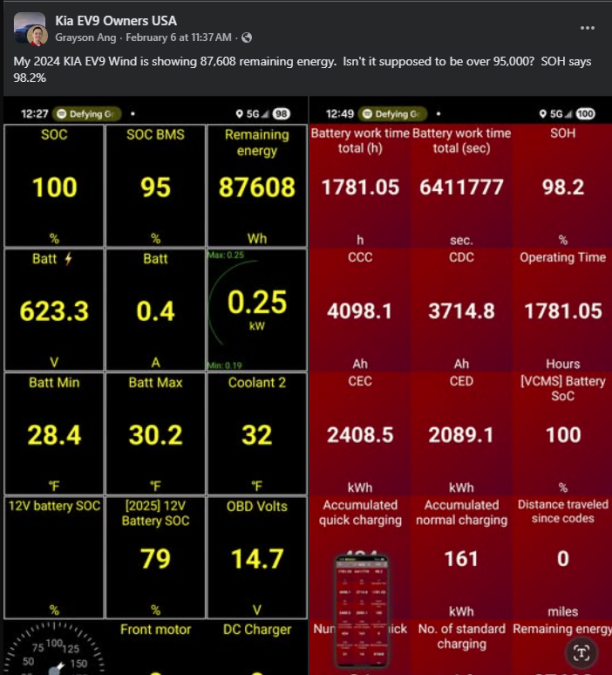
The responses from other EV9 owners, however, paint a more nuanced picture. Several reports of nearly identical readings, with remaining energy values clustering in the mid to high 80 kWh range and BMS state of charge rarely exceeding the mid-90 percent range internally, even when the dash reads 100 percent. One owner noted that his EV9 shows about 85 to 87 kWh remaining at full charge and that this behavior appeared after a major software update in September, despite no measurable cell imbalance before or after.
Kia EV9: Suspension Tuning & Ergonomics
- The EV9’s boxy proportions prioritize interior volume and third-row accessibility, giving it a more traditional SUV feel than many rounded electric crossovers.
- Suspension tuning favors comfort and stability, helping manage the vehicle’s size on highways while limiting agility in tighter driving situations.
- Interior layout emphasizes flexibility, with flat floors and configurable seating that support family use over driver-focused ergonomics.
- Real-world efficiency is influenced by its upright shape and weight, making the range more sensitive to speed and wheel choice than smaller Kia EVs.
This points to a critical but often misunderstood distinction: displayed state of charge, BMS state of charge, and usable energy are not the same thing.
Kia and Hyundai typically advertise battery capacity from the top of the user-accessible range down to a point well below zero percent display, including hidden buffers at both the top and bottom. The “remaining energy” figure many diagnostic apps show usually represents energy available between 100 percent display and zero percent display, not the pack’s full physical capacity.
In other words, the EV9 may still have a large battery and healthy cells, but the software-defined usable window can shift. That window is influenced by buffers designed to protect longevity, accommodate temperature extremes, and manage long-term degradation. If Kia adjusts those buffers through software, the reported remaining energy can change overnight without a single electron being lost to actual wear.
The state of health figures further complicates matters. As one commenter pointed out, SOH calculations on Hyundai and Kia EVs have long been opaque. On the EV6, for example, SOH begins dropping once usable energy dips below a certain threshold, even if real-world range and performance remain unchanged. A displayed SOH of 98.2 percent may correspond to a different internal baseline than owners assume, making direct comparisons across models or even software versions unreliable.
What unsettled some owners most was the timing. Multiple reports suggest that remaining energy and SOH values shifted after major software updates, not after dramatic changes in driving habits, charging behavior, or cell balance. That does not necessarily indicate a problem, but it does underscore how much modern EV ownership depends on software interpretation rather than fixed mechanical limits. The battery did not suddenly shrink; the ruler changed.
For buyers of used EVs, this creates understandable anxiety. Numbers like “remaining energy” feel authoritative, yet they lack standardized definitions across manufacturers and even across updates from the same brand. Without a clear, factory-published reference for what a brand-new EV9 Wind should report in third-party apps, owners are left comparing screenshots and crowdsourcing reassurance.
The emerging consensus from EV9 owners is cautiously comforting. Seeing 85 to 88 kWh remaining at full charge appears common, not exceptional. No one reports meaningful range loss, drivability issues, or abnormal cell voltage differences. The vehicles behave normally. The math simply looks strange when viewed through diagnostic tools, never meant to replace official metrics.
The larger lesson is that EV transparency remains a work in progress. As manufacturers lean harder on software-defined vehicles, the data owners can see does not always align with intuitive expectations. A number that looks wrong is not always a sign of damage. Sometimes it is just a reminder that the battery you bought is managed, not measured, and that the truth lives somewhere between chemistry, code, and corporate caution.
Beyond the battery data debates, the EV9's broader market story has been one of steady momentum and refinement.
Kia's 2026 EV9 builds on 2025's momentum with U.S. production ramping at West Point, Georgia, NACS port standard across trims for Tesla Supercharger access, and Light Long Range RWD topping EPA at 304 miles, though real-world owners report 230 to 270 miles mixed driving amid July 2025 sales dips.
Lease incentives remain aggressive into early 2026, fueling Reddit buzz around the family haulers' appeal: quiet cabin, quick infotainment, ventilated seats, blind-spot dashboard cams, and room for three car seats.
Have you tested the Kia EV9? What were your thoughts, and did it meet expectations? Let us know in the comments below.
Image Sources: Kia Media Center
Noah Washington is an automotive journalist based in Atlanta, Georgia. He enjoys covering the latest news in the automotive industry and conducting reviews on the latest cars. He has been in the automotive industry since 15 years old and has been featured in prominent automotive news sites. You can reach him on X and LinkedIn for tips and to follow his automotive coverage.
Set Torque News as Preferred Source on Google
Follow us today...