
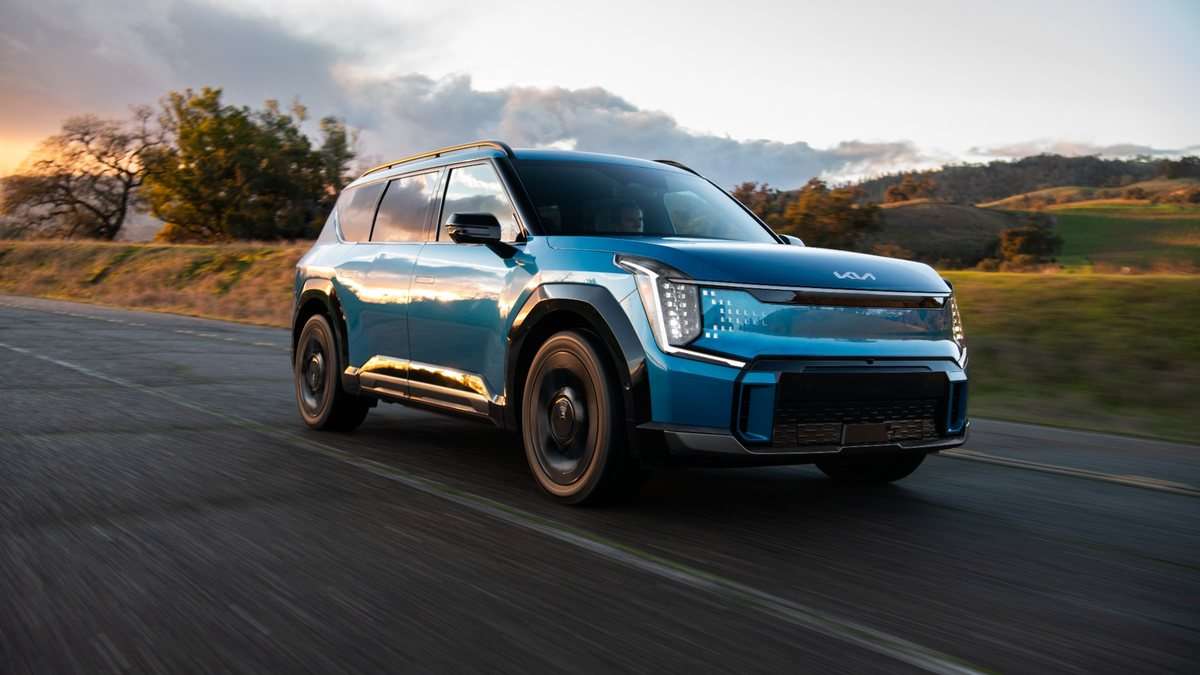

A Kia EV9 owner, approaching the one-year mark and 11,000 miles with their 2024 Land model, has brought to light an intriguing discrepancy in the vehicle's battery management system (BMS) data.
This observation, shared within the Kia EV9 Owners USA social media group, reveals a potential "hidden" capacity buffer that is common in modern electric vehicles but often not transparent to the consumer. The owner's detailed data pull, following a full charge from 18% to 100%, has initiated a crucial discussion among fellow EV owners about battery health, longevity, and manufacturer-implemented safeguards.
"Just did a full charge to 100% from 18% and pulled some data (see pics). What's interesting is the SOC BMS shows only 96.5% while SOH & SOC is 100%. Also, the 12v system is running at 13.7v. The 12V Battery has always been blank when I pull this data.
At the one-year mark with this 2024 Land with around 11k miles. Curious to compare with other EV9s out there."
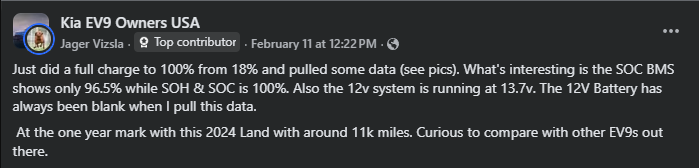
The core of the owner's discovery lies in the difference between the dashboard's reported 100% State of Charge (SOC) and the Battery Management System's (BMS) internal reading of 96.5%. This 3.5% variance immediately suggests an intentional buffer, a common engineering practice designed to protect the battery pack's long-term health. While some might view this as deceptive from Kia, it is, in fact, a sophisticated method to extend the usable life of the high-voltage battery, preventing both overcharging and excessive discharging, which are detrimental to lithium-ion chemistry.
Kia EV9: Understanding Its Battery Management System's Hidden Buffers
- The Kia EV9's battery management system (BMS) often reports a lower State of Charge (SOC) than the dashboard display, typically around 96.5% when the vehicle shows 100%. This discrepancy is an intentional design feature, not a defect, aimed at preserving battery health.
- These "hidden" buffers prevent the battery from being fully charged to its absolute maximum capacity, which can accelerate degradation of lithium-ion cells over time. They also protect against deep discharge, further extending the battery's lifespan.
- The 12V auxiliary battery system in the EV9, crucial for powering vehicle electronics, typically operates at 13.7V, indicating a healthy charging state. Owners sometimes report blank data for the 12V battery in diagnostic tools, which can be normal depending on the tool's capabilities.
- With 11,000 miles and a year of ownership, the reported 3.5% buffer is consistent with industry practices seen in other EVs like the Ford F-150 Lightning and Hyundai Ioniq 6. This suggests robust engineering for long-term battery durability.
One commenter, Andrew Schaltenbrand, quickly offered a straightforward interpretation, stating, "Your soc display is 100. That tells me that there is a buffer built in for some reason." This initial assessment points directly to the industry's standard practice. For any EV owner, understanding these underlying systems is paramount to managing expectations regarding range and battery longevity. The "reason" for this buffer isn't some corporate conspiracy; it's a fundamental principle of battery science applied for the consumer's benefit, even if it's not explicitly communicated on the dashboard.
Mike Magnet expanded on this, explaining, "Andrew Schaltenbrand, there absolutely is, and the reason is, of course, to prevent people from leaving the battery at 100% actual state of charge; it's basically an idiot proof buffer." This polarizing take, while perhaps blunt, accurately reflects the engineering philosophy. Automakers, in their quest to provide a reliable and durable product, must account for varying user behaviors. Leaving a lithium-ion battery at its absolute maximum charge for extended periods accelerates degradation, and these buffers are a silent guardian against such practices, ensuring the warranty and expected lifespan are met.
Schaltenbrand further corroborated this by drawing a parallel to another popular electric truck: "Mike Magnet My F-150 Lightning has a massive buffer built in. I'm not as familiar with the EV9 as it's new to our house with the battery architecture, but that's what I assumed." This comparison shows that such buffering is not unique to Kia but is an industry-wide strategy. The fact that an owner of a different brand immediately recognized the pattern speaks volumes about the universality of these battery management principles across various EV platforms.
Ronnie Glen provided a more technical perspective on the buffer's implications for battery health: "That's showing a healthy top buffer. If that number at full charge starts to go up, it's an indicator of the top buffer being reduced due to overall capacity loss." This comment offers critical insight into how owners can potentially monitor their battery's long-term degradation. A shrinking buffer, where the BMS SOC at a displayed 100% begins to creep closer to 100%, would indeed suggest that the battery's overall capacity is diminishing, a natural part of its lifecycle.
Magnet reiterated the technical reality, pointing to "The SOC BMS is the true number, and the battery is designed to always have a capacity buffer, which is why it will show 100% on your dashboard even though the battery is not actually at 100% full capacity. Same exact thing on my Ioniq 6." This reinforces the idea that the dashboard display is a user interface, not a direct diagnostic tool. Expecting a 1:1 correlation between the dashboard and the raw BMS data is a misunderstanding of how these complex systems are engineered for both user experience and component longevity.
Anthony Cruisen Jenkins added another data point from a related Kia EV model: "My ev6 says 96.5 at 100. After it drops a few, it's only 2% different." This concrete example from the EV6, sharing a similar battery architecture with the EV9, provides strong evidence that the 3.5% buffer observed is not an anomaly but a consistent design choice by Kia. This level of consistency across models suggests a deliberate and validated engineering decision, rather than a one-off software glitch or an individual vehicle's quirk.
The consensus among these experienced EV9 owners is clear: the observed discrepancy is not a fault but a feature. It is a testament to the sophisticated engineering that goes into protecting high-voltage battery packs, ensuring they deliver consistent performance and longevity over many years and thousands of miles. While the lack of explicit communication about these buffers can initially cause concern for new EV owners, the underlying intention is always to safeguard the vehicle's most expensive component.
This discussion reveals the ongoing need for greater transparency from manufacturers regarding battery management systems. While the technical reasons for these buffers are sound, better education for consumers could alleviate initial confusion and build greater trust. Owners like Jager Vizsla, who delve into the underlying data, are performing a valuable service by prompting these important conversations and helping to demystify EV ownership for the wider community.
Image Sources: Kia Media Center
Noah Washington is an automotive journalist based in Atlanta, Georgia. He enjoys covering the latest news in the automotive industry and conducting reviews on the latest cars. He has been in the automotive industry since 15 years old and has been featured in prominent automotive news sites. You can reach him on X and LinkedIn for tips and to follow his automotive coverage.
Set Torque News as Preferred Source on Google
Follow us today...







Comments
Thank you for the thorough…
Permalink
Thank you for the thorough explanation!!
If there was no buffer, not…
Permalink
If there was no buffer, not only would you harm the battery, but there's be no place for regeneration power to go. It wouldn't be able to function at 100% charge, so braking would feel totally different and that could cause an accident.