
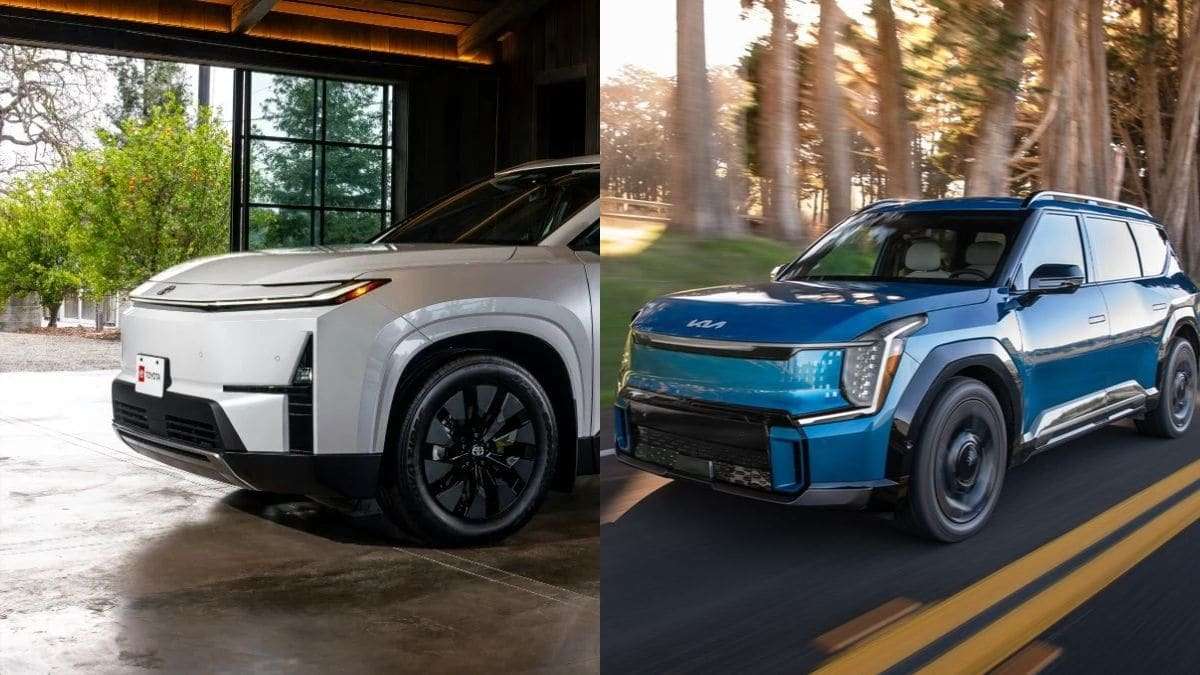

The three-row electric SUV segment is no longer a future promise, it’s happening now. Families searching for a 3-row EV with long range, strong towing, and real-world practicality are increasingly narrowing their choices to two names: the upcoming Toyota Highlander EV and the already-established Kia EV9.
Toyota is preparing to electrify one of its most recognized family SUVs, while Kia has already planted a flag with the EV9, a vehicle that has quickly become one of the most talked-about electric SUVs in America. So how do these two compare on paper? And more importantly, what do the numbers mean for buyers searching for the best electric SUV for families?
Let’s break it down.
Exterior Dimensions and Interior Space: How Big Are They Really?
If you’re Googling “Toyota Highlander EV size vs Kia EV9 dimensions,” here’s what matters:
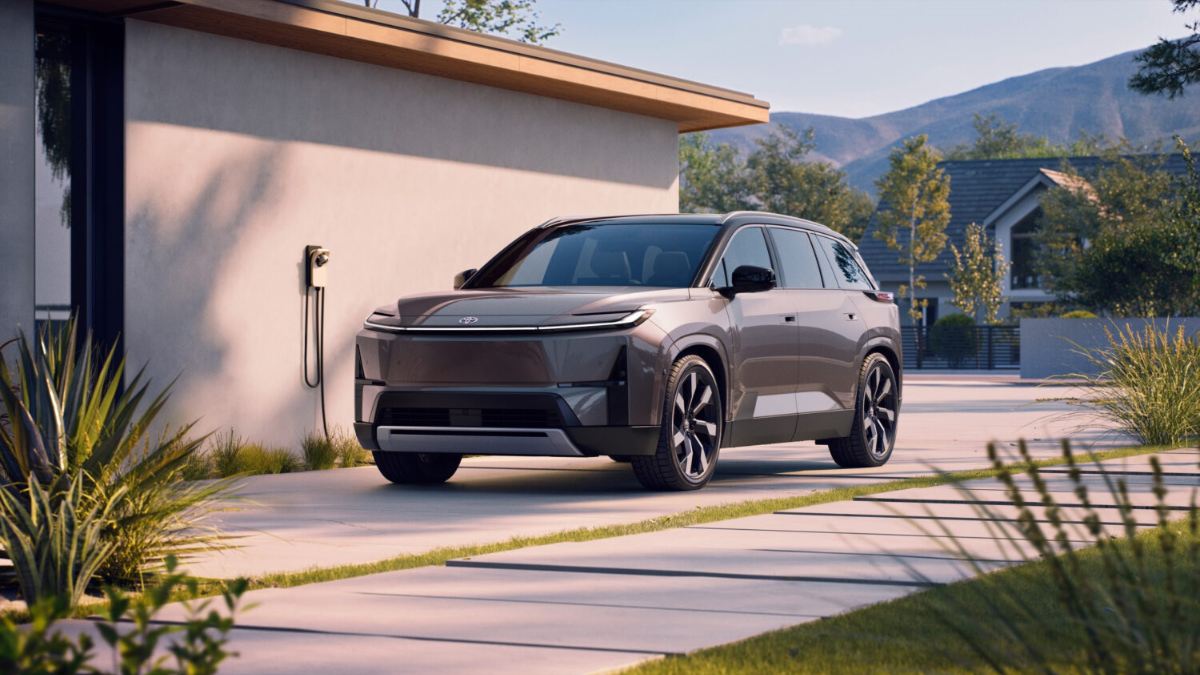
The 2027 Toyota Highlander EV measures roughly 5,050 mm in length with a 3,050 mm wheelbase. The 2026 Kia EV9 is slightly shorter overall at about 5,010 mm, but it rides on a longer 3,100 mm wheelbase.
Why does that matter?
Wheelbase directly affects interior packaging, especially second- and third-row legroom. On paper, the EV9’s longer wheelbase should translate to better cabin space distribution. It’s also slightly taller, which can improve third-row headroom and cargo stacking height.
In other words, both are true midsize three-row electric SUVs, but the EV9 appears optimized for maximum interior flexibility.
Cargo Space Comparison: Which Has More Room?
Search phrase: “Highlander EV cargo space vs Kia EV9 cargo capacity.”
Here’s how they compare:
Toyota Highlander EV
- 450 liters behind the third row
- 1,290 liters with third row folded
- No front trunk (frunk)
Kia EV9
- 573 liters behind the third row
- 1,233 liters with third row folded
- Frunk: 91 liters (RWD) or 51 liters (AWD)
This is an interesting split.
The EV9 offers more cargo space behind the third row - important for families carrying strollers, sports gear, or airport luggage with all seats up. However, the Highlander EV offers slightly more space once the third row is folded.
The EV9’s frunk is a meaningful advantage. Even if it’s mostly used for charging cables and small items, that extra compartment adds flexibility. Toyota’s decision to skip a frunk may disappoint some EV shoppers accustomed to Tesla-style front storage.
Towing Capacity: Which Electric SUV Tows More?
For buyers searching “best electric SUV for towing 5,000 lbs,” the numbers matter.
Toyota Highlander EV
- 2,600 lbs (77 kWh battery)
- 3,500 lbs (95.8 kWh battery)
Kia EV9
- 2,000 lbs (single-motor RWD)
- Up to 5,000 lbs (dual-motor AWD)
The EV9 clearly wins here in maximum towing capacity. If you need to tow a boat, camper, or heavier trailer, the dual-motor EV9 offers significantly more capability.
Toyota’s 3,500-lb rating is respectable and likely sufficient for small trailers or light recreational use. But if towing is high on your priority list, the EV9 has a clear edge.
Power and Performance: Horsepower and Torque Numbers
Search term: “Highlander EV horsepower vs Kia EV9 horsepower.”
Toyota Highlander EV
- Single-motor FWD: ~221 hp
- Dual-motor AWD: ~338 hp
Kia EV9
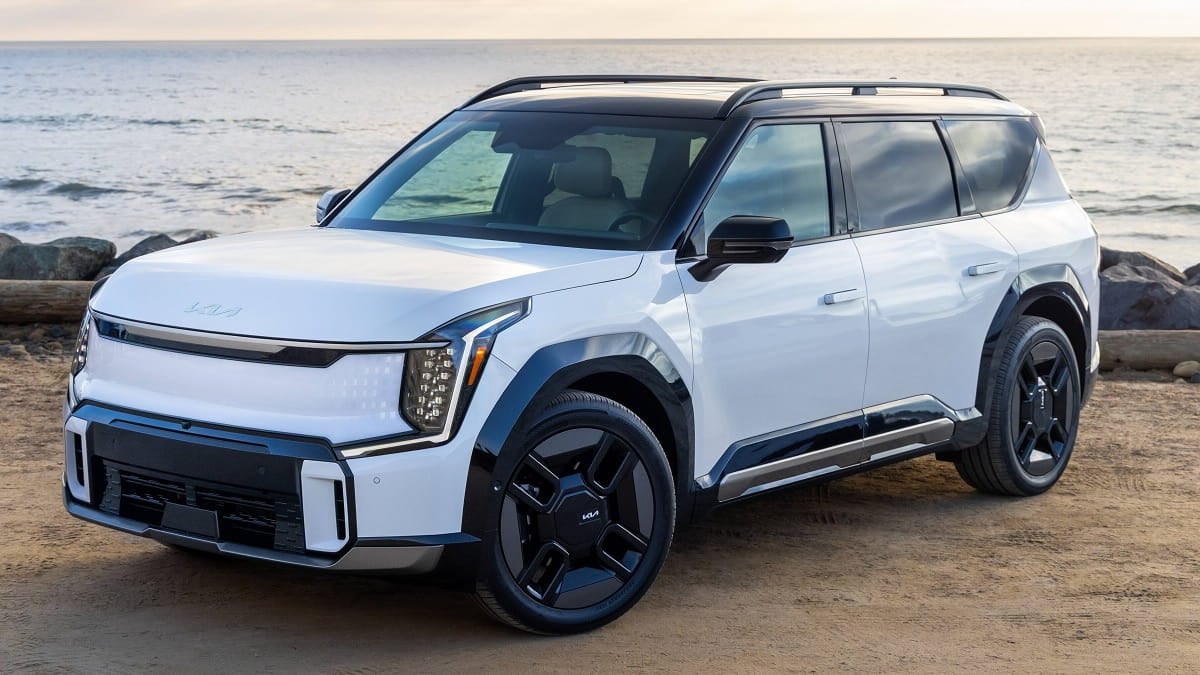
- RWD: 201–215 hp
- AWD: 379 hp
- GT: 501 hp
Toyota appears to be prioritizing balanced efficiency over outright performance. The Highlander EV’s 338 horsepower in AWD form should feel strong for daily driving.
But the EV9’s dual-motor AWD version offers more power, and the GT model enters performance SUV territory with 500+ horsepower.
If you’re searching “fastest 3-row electric SUV,” the EV9 GT likely dominates this comparison.
Electric Range: Which 3-Row EV Goes Farther?
Range anxiety remains one of the most searched EV topics. So let’s compare “Toyota Highlander EV range vs Kia EV9 range.”
Toyota Highlander EV
- 77 kWh FWD: ~458 km
- 77 kWh AWD: ~431 km
- 95.8 kWh AWD: up to ~511 km
Kia EV9
- 76.1 kWh RWD: ~370 km
- 99.8 kWh RWD: ~491 km
- 99.8 kWh AWD: ~451–455 km
- GT AWD: ~418 km
On paper, the Highlander EV with the larger battery appears to offer the longest maximum range. That could be significant for families who frequently road-trip or commute long distances.
However, real-world range will depend on weight, aerodynamics, wheel size, and driving style. The EV9’s larger dual-motor variants trade some range for power and towing capability.
For buyers searching “longest range 3-row electric SUV,” Toyota may have a headline advantage, assuming those estimates hold in EPA testing.
Charging Speed: 10% to 80% Fast Charging
Search term: “Highlander EV charging time vs Kia EV9 charging speed.”
Both vehicles use the NACS charging standard, giving them access to Tesla-compatible infrastructure: an increasingly important factor for EV buyers in North America.
Toyota Highlander EV
- Approximately 30 minutes from 10% to 80% (claimed)
Kia EV9
- Up to 210–235 kW peak DC fast charging
- Approximately 20–24 minutes from 10% to 80%
On paper, the EV9 charges faster under ideal conditions. Its high peak DC charging capability gives it an advantage for road-trip convenience.
Toyota’s 30-minute estimate is competitive, but if fast-charging speed is your top priority, the EV9 appears to have the edge.
Warranty Coverage: Long-Term Ownership
Search term: “Toyota Highlander EV warranty vs Kia EV9 warranty.”
Toyota
- 3-year basic warranty
- 8-year / 160,000 km battery warranty
Kia
- 5-year basic warranty
- 8-year EV component warranty
- 8-year / 160,000 km battery warranty
Kia offers a longer comprehensive vehicle warranty, which adds peace of mind, especially for first-time EV buyers.
Toyota’s reputation for reliability is strong, but warranty length still matters when comparing ownership costs.
Pricing: The Biggest Question Mark
The 2026 Kia EV9 starts around $60,000 USD and can reach the mid-$80,000 range depending on trim and configuration.
Toyota has not finalized pricing for the 2027 Highlander EV. This will ultimately determine how competitive it is.
If Toyota undercuts the EV9 while delivering longer range, it could shift the segment. If it prices similarly, buyers will likely weigh brand loyalty, dealer experience, and feature packaging.
Final Thoughts: Which 3-Row Electric SUV Should You Buy?
Here’s the straightforward takeaway.
If you want:
- Higher towing capacity
- Faster charging speeds
- A performance variant
- A longer comprehensive warranty
The Kia EV9 currently looks like the stronger all-around package.
If you want:
- Potentially longer maximum range
- Toyota brand familiarity
- A more conservative, efficiency-focused setup
The Toyota Highlander EV could be compelling, especially if priced aggressively.
This comparison matters because the three-row electric SUV category is becoming the new family benchmark. Buyers aren’t just asking, “Is it electric?” They’re asking:
- What is the real-world range?
- How fast does it charge?
- Can it tow my trailer?
- Is it worth the price?
The EV9 is already answering those questions in showrooms. The Highlander EV still has to prove itself when it arrives.
If Toyota executes well on pricing and real-world efficiency, this could become one of the most important EV matchups in the next two years. And for families transitioning from gas SUVs to electric vehicles, that competition is exactly what the market needs.
Now I’d like to hear from you: If you were choosing a three-row electric SUV today, would you prioritize longer range or higher towing capacity? And does Toyota’s reputation for reliability outweigh Kia’s faster charging and stronger performance in your decision? Drop your thoughts in the comments please, as your perspective helps other families navigate this big switch to electric.
Armen Hareyan is the founder and Editor-in-Chief of Torque News. He founded TorqueNews.com in 2010, which since then has been publishing expert news and analysis about the automotive industry. He can be reached at Torque News Twitter, Linkedin, and Youtube. He has more than a decade of expertise in the automotive industry with a special interest in Tesla and electric vehicles.
Reference: Le Guide De L'Auto.
Set Torque News as Preferred Source on Google
Follow us today...




Comments
Would not buy an electric…
Permalink
Would not buy an electric car.
I was looking the KIA EV9…
Permalink
I was looking the KIA EV9.
Really awesome car but after few years if you want trade you will lose a lot of money.
Toyota EV? Nope. Better plug in hybrid or just hybrid.
Join some ev9 groups…
Permalink
Join some ev9 groups. Nothing but problems.
Hyundai/kia battery tech is…
Permalink
Hyundai/kia battery tech is far superior than Toyota's.
In what way is the Hyundai…
Permalink
In reply to Hyundai/kia battery tech is… by Jene Markowski (not verified)
In what way is the Hyundai/Kia EV battery is superior to that of Toyota's?
Armen, they’ve had far…
Permalink
In reply to In what way is the Hyundai… by Armen Hareyan
Armen, they’ve had far longer to develop it, charging speeds, modularity, V2L, just selling flat out more EVs for a longer period of time, etc...
Toyota EV. Believe it or not…
Permalink
Toyota EV. Believe it or not, EV is still the future. North America is lagging behind and will eventually accept it. They are just better. Less moving parts, no motor noise, more torque. If electric vehicles were first in the market (1900’s) and companies were introducing gas engines today, the population would be belly laughing for days and days.
There's a problem with the…
Permalink
There's a problem with the ICCU on most EVs with that KIA model. Not an EV person but that's like literally the only problem with that Kia of course. It's going to have better tech safety interior. From what I understand that's the only drawback on those vehicles. But I wouldn't buy an EV so meh.