
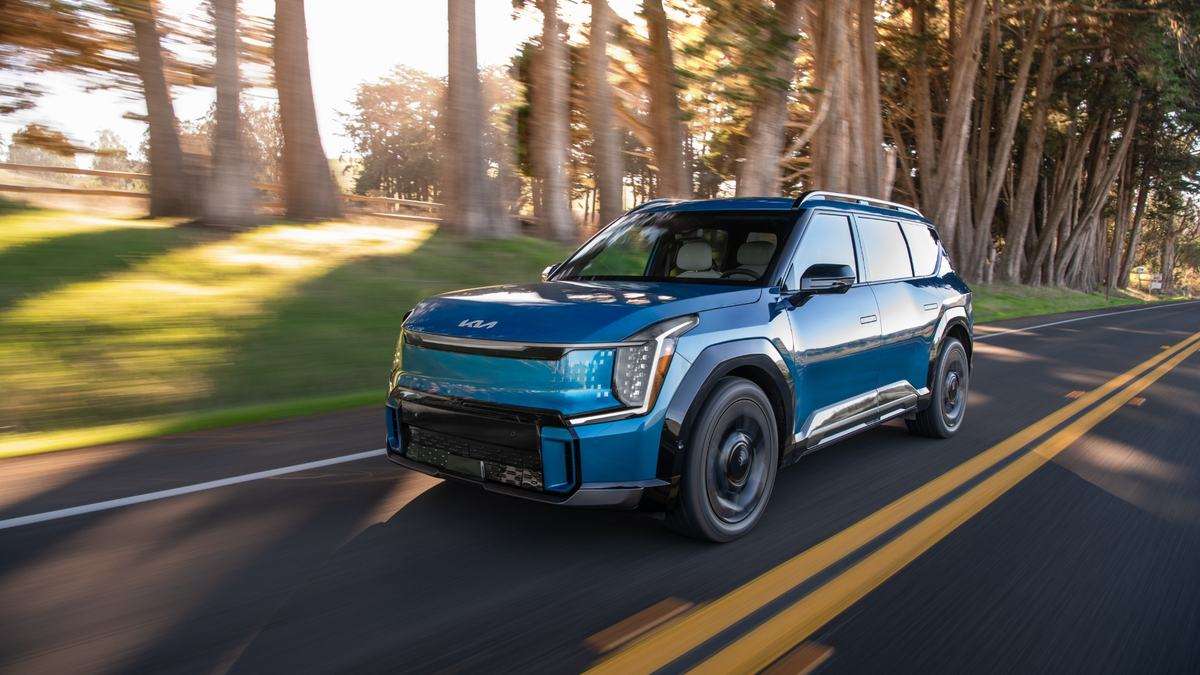

Modern automotive technology, designed to enhance safety and convenience, occasionally introduces unforeseen challenges. One such instance has emerged with Kia's advanced driver-assistance systems, where a feature intended to seamlessly integrate with posted speed limits is instead creating potentially hazardous situations. This issue, centered around the misinterpretation of specific road signs, raises critical questions about the robustness of these systems and the responsibility of both manufacturers and drivers.
A Kia EV6 GT-Line AWD owner recently shared a concerning experience on social media, detailing how their vehicle's adaptive cruise control system misinterpreted route signs for speed limits, leading to dangerous speed adjustments. The user, identified as sdague, posted the following account:
"Around here, there are a couple of roads that are labeled 9D and 9H (there is also a 9W, 9P, and 9G... welcome to the Hudson Valley of NY).
In my Kia EV9, I've now had it read these route signs as speed limits, and flag it as 90 or 95 mph (it happened last night coming down 9H). If I'm just driving, it's fine. However, in the EV6, there is the ability to have the adaptive cruise control adjust automatically based on speed limit, and at least on one occasion, I've had it decide it was time to get up to 90 mph.
I'm not even sure how to report a thing like this to Kia. Any thoughts?"
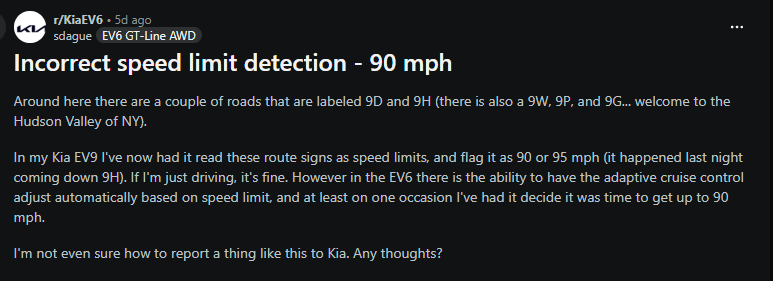
The core of the problem lies in the vehicle's inability to differentiate between route markers, such as "9D" or "9H" common in New York's Hudson Valley, and actual speed limit signs. When the adaptive cruise control is engaged with the automatic speed adjustment feature, this misidentification can prompt the EV6 to accelerate to an alarming 90 or 95 mph, far exceeding legal and safe speeds. This isn't merely a display error; it's a direct command to the vehicle's powertrain, posing a significant risk to the driver and other road users.
One commenter, humanthrope, expressed skepticism about manufacturer responsiveness while suggesting an alternative: "humanthrope • 4d ago • Edited 4d ago EV6 Wind AWD I think it’s doubtful that Kia would address anything like this in a timeframe that we humans live in.
But if you’re technically inclined, you might consider looking at a Comma running Sunnypilot. For these cars, it’s basically a much-improved lane-keeping assist that integrates with the smart cruise control to adjust the limit. It’s also open source, so potential problems like this can be addressed by the community. For me, the expense was very much worth it."
This sentiment, while perhaps cynical, reflects a common frustration among owners dealing with software-related vehicle issues. The suggestion to resort to aftermarket, open-source solutions like Comma.ai's Sunnypilot system shows a critical gap: if a manufacturer's advanced driver-assistance systems (ADAS) are unreliable, owners will seek their own fixes, even if those solutions operate outside the OEM's validated parameters.
Kia EV6: Understanding Advanced Driver-Assistance System Limitations
- The Kia EV6 GT-Line AWD is equipped with advanced driver-assistance systems (ADAS), including Highway Driving Assist 2 (HDA2) and Smart Cruise Control. These systems use cameras and radar to maintain speed, follow traffic, and interpret road signs.
- The reported issue specifically involves the system's ability to misinterpret route signs (e.g., "9H") as speed limit signs, leading to erroneous speed adjustments. This shows a critical flaw in the system's image recognition and contextual processing.
- While ADAS features aim to enhance safety and comfort, incidents like this reveal the necessity for drivers to remain fully engaged and prepared to override automated systems. No current ADAS is a substitute for an attentive human driver.
- Automakers are continuously updating these systems via over-the-air (OTA) software updates, but the detection and rapid deployment of fixes for safety-critical bugs remain a significant challenge. This incident demands a swift and effective software remedy.
This creates a regulatory gray area and shifts the burden of safety and reliability onto the consumer, a position no major automaker should condone. The idea that owners should have to modify their vehicle's core driving assistance systems to achieve basic functionality is an indictment of the OEM's software development and validation processes.
Another user, EV-Bug, offered a more direct, if somewhat dismissive, perspective on the driver's responsibility: "u/EV-Bug avatar EV-Bug • 4d ago EV6 Wind RWD Anyone allowing their car to adjust their speed based on the signs is just asking for trouble. I noticed the display showing a 15 mph speed limit in a school zone during off-hours and weekends. I appreciate reminders, but have a conscience to adjust my speed."
While driver vigilance is paramount, this comment misses a fundamental point about ADAS. These systems are marketed as aids, designed to reduce driver workload and enhance safety. To suggest that a driver is "asking for trouble" by trusting a system explicitly designed to automatically adjust speed based on detected limits undermines the entire premise of such technology. It's akin to blaming a pilot for trusting an autopilot system that suddenly attempts to dive. The expectation is that the system, once engaged, will perform its function reliably, not that it will require constant, minute-by-minute override for basic safety. The onus must be on the manufacturer to deliver a system that works as advertised, not on the driver to constantly second-guess its fundamental operations.
Further corroborating the issue, Mewtwo_EX confirmed experiencing the same "95mph bug": "mewtwo_EX • 4d ago EV6 GT-Line AWD It only auto adjusts to speeds 45mph and above. I've experienced the 95mph bug a couple of times. Otherwise, it's pretty nice to have it auto-switch from 45 to 55 and back when rolling through rural areas. I do end up overriding it anyway since it doesn't actually speed up or slow down in time. I might take your advice and disable it."
This confirmation from another owner, specifically noting the 45 mph threshold for auto-adjustment, solidifies the existence of a systemic flaw. The fact that this "bug" affects multiple vehicles and can trigger speeds up to 95 mph is deeply troubling. While the convenience of automatic speed adjustments in rural areas is acknowledged, the potential for a sudden, dangerous acceleration to nearly triple the legal limit on a misidentified road sign far outweighs any perceived benefit. This isn't merely an inconvenience; it's a safety defect that demands immediate attention and a robust software patch from Kia.
The casual acceptance of such a critical flaw, with users considering disabling the feature entirely, speaks volumes about the current state of ADAS reliability. Automakers are rushing to implement these technologies, but often overlook the real-world complexities that can turn a convenience feature into a liability. The "cars just trying to save you time" quip from ForwardBias, while humorous, reveals the inherent risk when technology oversteps its bounds without sufficient validation.
This incident is a stark reminder that advanced driver-assistance systems, despite their sophisticated algorithms and sensors, are only as reliable as their programming and the data they interpret. Kia, like all manufacturers deploying such features, has a responsibility to ensure that their systems are not just functional but demonstrably safe in every conceivable real-world scenario. A system that can misinterpret a route sign for a 90 mph speed limit is not just inconvenient; it's a ticking time bomb on public roads.
Image Sources: Kia Media Center
Noah Washington is an automotive journalist based in Atlanta, Georgia. He enjoys covering the latest news in the automotive industry and conducting reviews on the latest cars. He has been in the automotive industry since 15 years old and has been featured in prominent automotive news sites. You can reach him on X and LinkedIn for tips and to follow his automotive coverage.
Set Torque News as Preferred Source on Google
Follow us today...



Comments
I have one. You set the top…
Permalink
I have one. You set the top limit for how fast it can go, not the sign. Unless things are different in his model year than mine, this is simply not the way things work.
The easiest route might be…
Permalink
The easiest route might be to contact state highway department. Maybe a minor change in sign design or maybe Kia programed in some "delete" or "ignore" command if it also sees another sign, say an "x".