

A quiet software update is rarely supposed to feel like a loss. Yet that is exactly how one Kia EV9 owner described his experience after discovering that a recent update appeared to reduce the amount of usable battery capacity available at a full charge.
In a post that quickly gained attention within the Kia EV9 Owners USA group, the owner claimed that what the car now reports as “100 percent” no longer corresponds to the same usable energy it did before, effectively trimming real-world range without any warning.
The owner documented the change using an OBD scanner and a third-party app, both before and after the update. Prior to the update, a full charge showed a battery management system state of charge of roughly 97 percent.
Afterward, that same 100 percent dashboard reading corresponded to just 92 to 93 percent. The screenshots tell a compelling story, with nearly identical conditions but a noticeable reduction in usable watt-hours reported by the vehicle.
To the owner, this was not a rounding error. It was a meaningful chunk of capacity that simply vanished.
“KIA has changed what 100% state of charge means. I performed a battery health check prior to the over-the-air update and afterward. Now 100% state of charge on my car went from a state of charge (BSM) of 97% to 92%.”
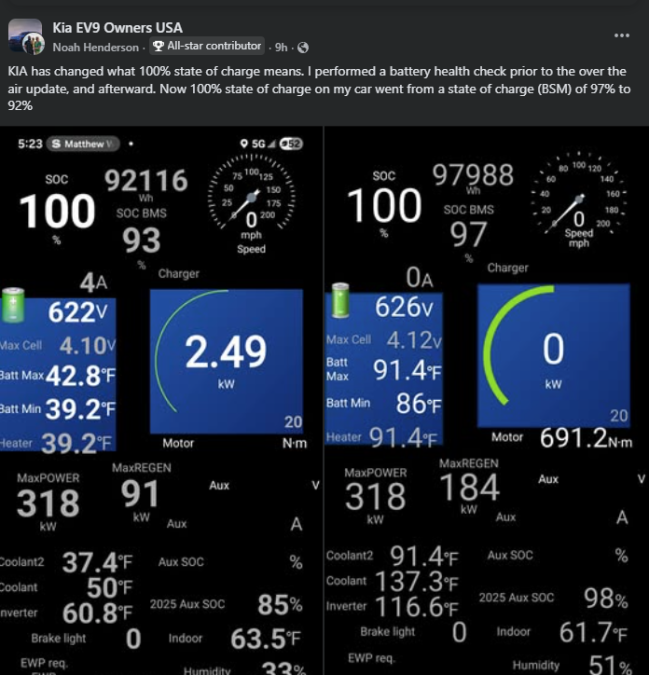
Naturally, the first question from other owners was battery health. Could degradation explain the difference? The answer, according to the data, was no. The vehicle’s state of health was still reported as 100 percent both before and after the update. With mileage around 24,000, the battery itself appeared unchanged. That shifted attention away from wear and toward software behavior, which is where modern EV ownership becomes complicated.
Kia EV9: Design, Dynamics, and Everyday Usability
- The EV9 adopts a boxy, upright design that maximizes interior volume, enabling three adult-usable rows within a footprint that remains manageable for urban driving.
- Electric power delivery emphasizes smoothness and low-speed control, supporting confident movement despite the vehicle’s size and weight.
- Interior layout balances digital interfaces with practical storage and seating flexibility, reflecting its role as a family-oriented electric SUV.
- Ride quality prioritizes stability and composure, particularly on highways, while firmer suspension tuning becomes more apparent over rough or uneven pavement.
Some commenters suggested temperature as a factor, noting that a warmer battery can unlock more usable buffer and that battery management systems dynamically adjust limits based on conditions. In this case, however, the owner pointed out that the update was applied during a dealer service visit and not as a typical over-the-air push the owner initiated. The timing, paired with the before-and-after data, made the explanation feel incomplete rather than reassuring.
What unsettles owners most is not the idea of buffers existing. Most EV drivers understand that manufacturers reserve a portion of the battery at the top and bottom to protect longevity. What raises concern is when those buffers appear to change without clear communication. When yesterday’s 97 percent becomes today’s 92 percent while still being labeled “100,” it feels less like protection and more like subtraction, even if the intent is benign.
This is not the first time an automaker has faced scrutiny over software-defined battery limits. Tesla owners have long debated similar shifts following updates, and the industry as a whole is still learning how to message these changes transparently. In theory, a slightly reduced usable window could improve long-term durability or thermal stability. In practice, owners experience it as a reduced range, especially when they plan trips or charging habits around previous behavior.
The EV9 is a large, family-oriented vehicle, and range expectations matter more in that context than they might in a small commuter car. Losing even a few percentage points at the top end can translate into several miles, which can be the difference between a comfortable arrival and a mid-trip charging stop. When that loss arrives silently, trust takes the hit before range does.
Other commenters noted inconsistency in Kia’s update rollout, with some owners receiving updates and others seeing none for months. That unevenness only adds to confusion. Without clear release notes or explanations, owners are left comparing screenshots and theories, trying to reverse-engineer decisions that directly affect how they use their vehicles.

To Kia’s credit, nothing in the data suggests battery damage or accelerated degradation. The car is still reporting a healthy pack. But that distinction may matter less to owners than the lived experience of plugging in, charging to “full,” and realizing that full no longer means what it used to. In a world where EVs are increasingly defined by software, expectations hinge on consistency and communication as much as hardware.
It may turn out to be a one-off calibration change tied to service procedures or temperature modeling. Or it may reflect a broader strategy to adjust usable capacity margins over time. Either way, it underscores a reality of modern EV ownership. The car you buy is not frozen in time. With every update, it can quietly become something slightly different.
Image Sources: Kia Media Center
Noah Washington is an automotive journalist based in Atlanta, Georgia. He enjoys covering the latest news in the automotive industry and conducting reviews on the latest cars. He has been in the automotive industry since 15 years old and has been featured in prominent automotive news sites. You can reach him on X and LinkedIn for tips and to follow his automotive coverage.
Set Torque News as Preferred Source on Google
Follow us today...