
Any perfect EV towing story makes me suspicious. This one had a 19-foot Airstream, a baby, five charging stops, two unhooking sessions, a Flying J in McCammon, Idaho, and a man willing to eat sushi from a travel center. That sounds like an actual trip.
According to the Reddit post, they pulled an Airstream Bambi with a first-generation Rivian R1T from central Utah to Yellowstone and back. The loop covered roughly 1,000 miles over two weeks. He averaged 1.3 miles per kWh while towing.
- Morning air is cooler, winds are usually calmer, and the battery starts from a better thermal place. That can be worth more than obsessing over a few pounds of camping cargo.
- Plugging into campground power sounds simple, but the truck, trailer, A/C, water heater, and other loads may be sharing the same pedestal. Owners should know what the circuit can safely provide before treating overnight charging as automatic.
- EV owners watch battery numbers, but trailer tire pressure, alignment, bearing condition, and brake drag can quietly steal range. A dragging trailer brake can look like “bad EV towing range” before anyone smells it.
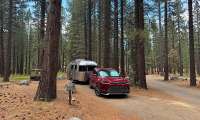
He charged five times during the trip and had to unhook twice. He said better charger selection could have avoided at least some of that. Overnight charging came from a mix of RV campsites and family homes.
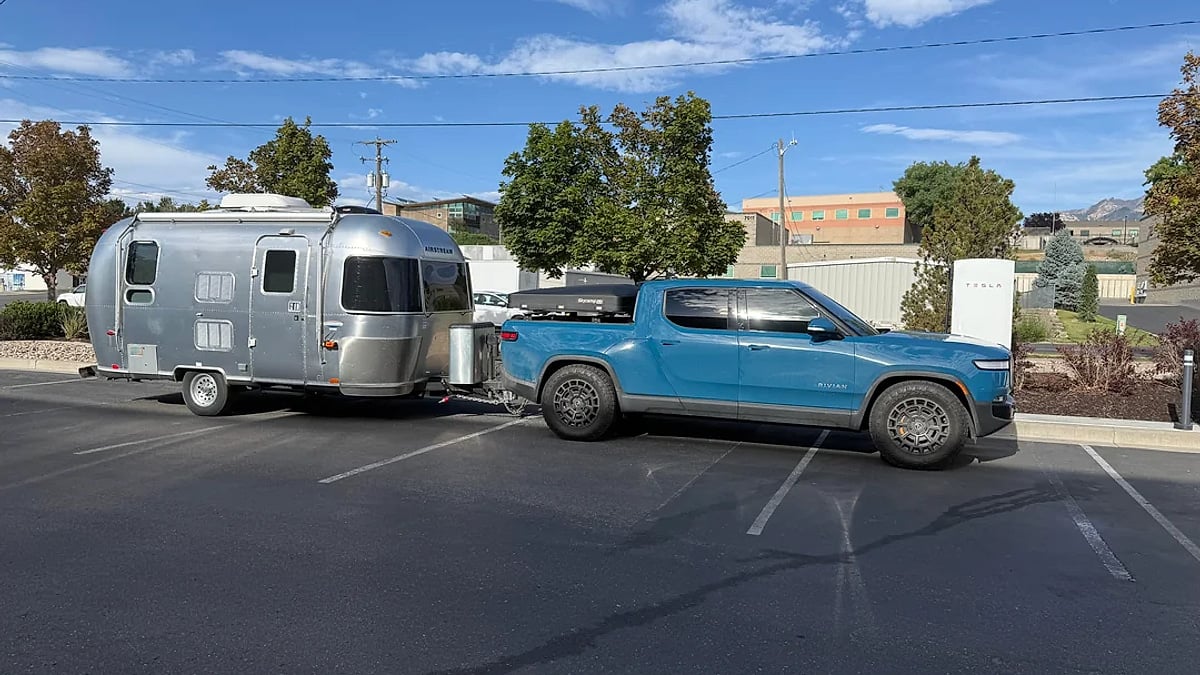
The best line was that charging stops gave the family time to feed their child and change her diaper. The truck was usually ready before she was. That is the EV towing experience people miss when they argue only from spreadsheets. A 30-minute charging stop feels different when the passengers need 30 minutes anyway.
The Number Was Good For An R1T And A Small Airstream
At 1.3 mi/kWh, the R1T used about 769 Wh per mile.
That is a solid result for an electric pickup towing a travel trailer across Utah, Idaho, Montana, and Wyoming terrain. It also fits the trailer. A 19-foot Airstream Bambi is compact by RV standards, and the rounded shell helps more than the weight sheet admits.
Airstream lists the 19CB-style Bambi at 5,000 pounds GVWR, 3,650 pounds base weight, and 525 pounds hitch weight. The exact trailer load on this trip was not posted, so I would not pretend to know the real tongue weight or camping weight. The R1T, as a Gen 1 truck, has plenty of tow-rating room if properly equipped and correctly loaded.
The planning math is easy.
At 1.3 mi/kWh:
- A 100-kWh usable driving window gives about 130 miles.
- An 85-kWh window gives about 110 miles.
- A 75-kWh window gives about 98 miles.
Those are the numbers I would use for route planning, not the R1T’s unloaded range.
The owner told a commenter he could get about 130 miles with the large pack. That lines up with the math and leaves enough room to avoid fantasy.
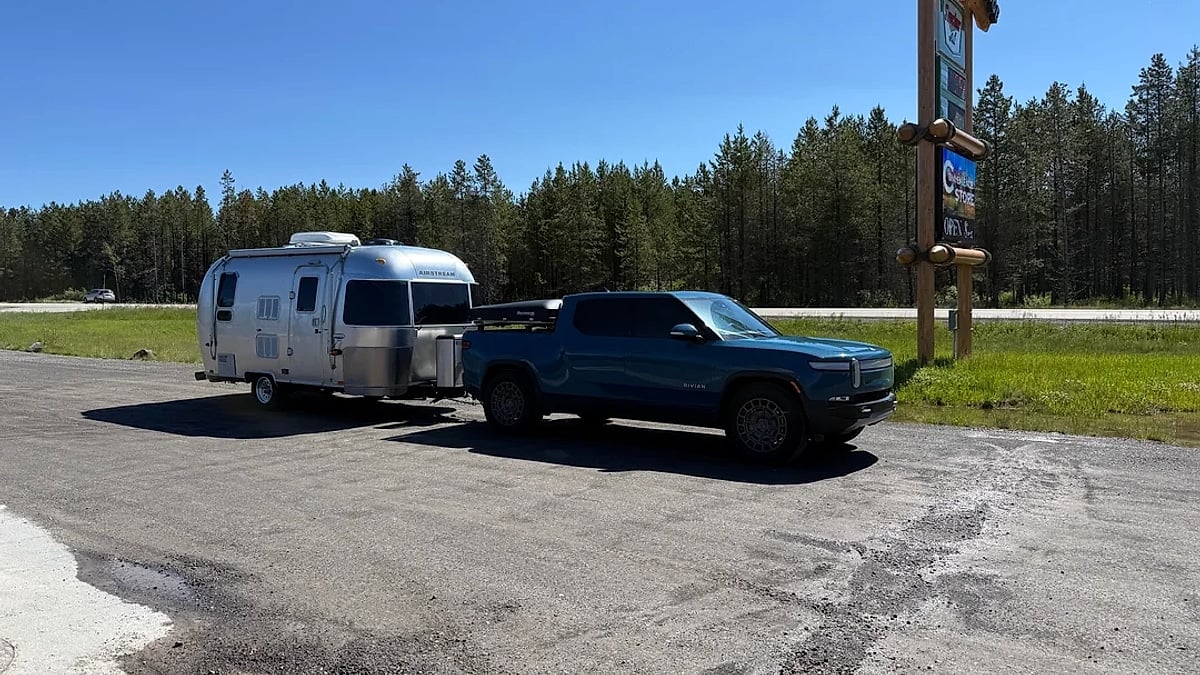
A Rivian towing a Bambi is not a 300-mile highway rig. It can be a 100-to-130-mile leg rig when the route has chargers, campgrounds, and overnight plugs in the right places.
That worked here.
The Airstream Helped More Than The Truck’s Tow Rating
Rivian’s 11,000-pound Gen 1 R1T tow rating makes for a nice brochure line.
This trip cared more about the trailer shape.
A Bambi does not push air like a tall rectangular camper. The rounded aluminum body, modest height, and shorter length keep energy use away from the worst EV towing numbers. The same truck pulling a 7,000-pound flat-front travel trailer through mountain grades can drop much closer to 0.9 or 1.0 mi/kWh.
One commenter said he tows a 29-foot Kodiak around 7,000 pounds with a newer R1T and often stops every 100 miles because mountain towing returns around 0.9 mi/kWh.
That is the same EV universe, different trailer physics.
The R1T can pull both. The battery feels them differently.
Weight decides whether the rig stays within ratings. Shape decides how often the owner hunts for a charger.
This is why Airstreams keep showing up behind electric trucks. Their old aluminum silhouette accidentally fits the EV age. What looked timeless in 1965 looks efficient in 2026.
Unhooking Twice Was A Planning Problem, Not A Truck Problem
The owner unhooked at two of five charging stops.
That is annoying. It is also believable.
Most charging stations were never designed for a pickup and travel trailer. Nose-in stalls, curbs, short cables, narrow lanes, and parked cars can turn a working charger into a small backing exam. The owner said he could have picked better chargers and likely avoided some unhitching.
He also met an R1S owner towing a much larger Airstream from Lake Tahoe to Glacier National Park with five kids on board. That driver reportedly covered more than 600 miles in a day and had unhooked only once in more than 2,000 towing miles.
The difference may have been route planning.
It may have been a backing skill.
It may have been tolerance for occupying awkward space while charging.
Probably all three.
PlugShare photos, recent check-ins, satellite view, and route planning are no longer optional for EV towing. They are part of the hitch setup. A charger with user photos showing a pull-through layout is worth more than a faster charger trapped between concrete islands.
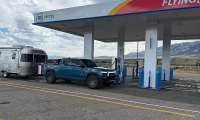
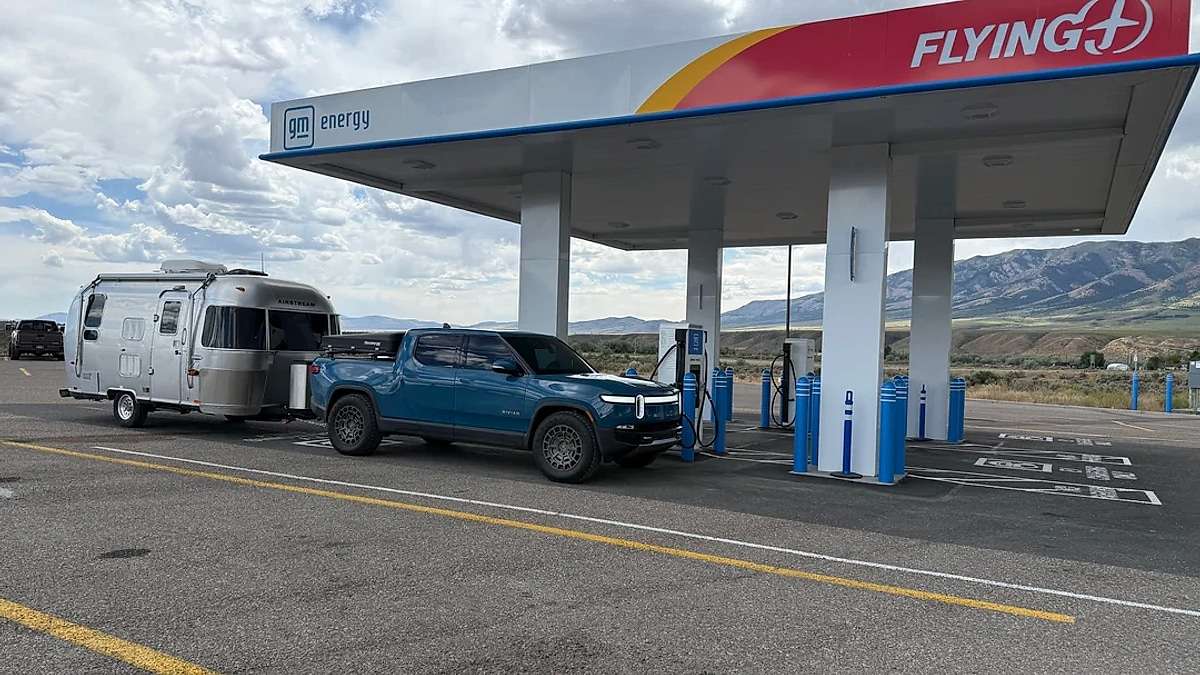
The owner’s favorite stop was the EVgo at Flying J in McCammon, Idaho. That site has four fast-charging stalls and sits at a travel center. He called the pull-through layout the future of EV truck charging.
He is right.
A travel-center charger with room for a trailer can erase the ugliest part of EV towing in one design decision.
The Baby Changed The Charging Math
The family’s six-month-old daughter may have been the perfect road-trip clock.
EV skeptics often imagine charging stops as pure dead time. Sometimes they are. A solo driver trying to cover 800 miles in one day will feel every minute.
A family traveling with a baby has a different rhythm.
Feeding takes time. Diaper changes take time. Stretching, snacks, dogs, bathrooms, and reorganizing the cabin all take time. If the truck can add enough energy during that same break, the charging stop stops feeling like a penalty.
The owner said the truck was always ready before the baby finished.
That turns the usual EV towing complaint upside down without pretending the charging disappeared. The stop remained. The family needed it.
I like that honesty.
This trip lasted two weeks, so nobody was trying to win Cannonball. The schedule gave the R1T room to behave like a camping tool rather than a fuel-cost experiment. Overnight charging at RV sites and family homes did more than save money. It changed departure psychology. Starting a travel day with a full or comfortable battery makes the first leg quiet.
That is how EV towing works best.
Drive. Camp. Charge while sleeping. Repeat.
The Comma 4 Detail Needs A Careful Footnote
The owner also said a Comma 4 was “a dream” while towing and stayed engaged for roughly 98 percent of the miles, with one construction zone requiring takeover.
That is a striking detail.
It also deserves a careful boundary.
Comma’s openpilot system is driver assistance, not autonomy. Comma says the system can provide adaptive cruise and automated lane centering, and it also says the driver must stay alert, watch the road, and remain ready to take control.
Towing raises the stakes. A small steering correction with a trailer attached can feel different than the same correction unhitched. Construction zones, lane shifts, wind, ruts, and poor markings can arrive quickly.
I understand why the owner liked it. Long towing days get tiring, and a good lane-centering system can reduce mental load. I would still treat aftermarket driver assistance while towing as a serious personal decision, not a casual accessory recommendation.
The safest praise here belongs to the driver, not the device.
He used it heavily and took over when conditions demanded it.
That is the only way these systems belong on a towing trip.
Gen 1 R1T Still Has A Case
The owner ended with a point I liked: his first-generation R1T still felt relevant and capable while attention shifted to R2, autonomy, and newer Rivian hardware.
That is fair.
A 1,000-mile tow with a 19-foot Airstream, five charging sessions, overnight charging, a baby, family stops, and a Yellowstone route is not a press-release fantasy. It is exactly the type of trip Rivian owners bought these trucks to attempt.
The R1T did the job.
The trailer choice helped. The route had enough charging. The family schedule fit the charging stops. The owner accepted some inconvenience and learned that pull-through chargers made life easier.
That is not a miracle.
It is a working system.
Rivian Owners, Post The Charging Layouts
If you tow with an R1T or R1S, share your trailer model, loaded weight, mi/kWh, longest leg, number of charging stops, how often you had to unhook, and which charger layout saved the trip.
The photos of charger entrances and stall angles may help other owners in the comments.
Images by SemiprivatePeruvian
About The Author
Noah Washington is an automotive journalist based in Atlanta, Georgia, covering sports cars, luxury vehicles, and performance culture. His reporting focuses on explaining the engineering, design philosophy, and real-world ownership experience behind modern vehicles.
Noah has been immersed in the automotive world since his early teens, attending industry events and following the enthusiast communities that shape how cars are built and driven today. His work blends industry insight with enthusiastic storytelling, helping readers understand not just what a car is, but why it matters.
Noah is also a member of the Southeast Automotive Media Association (SAMA), a professional organization for automotive journalists and industry media in the Southeast.
His coverage regularly explores sports cars, luxury vehicles, and performance-driven segments of the automotive industry, including the evolving culture surrounding Formula Drift and enthusiast builds.
Read more of Noah's work on his author profile page.
You can also follow Noah here:
Set Torque News as Preferred Source on Google
Follow us today...