
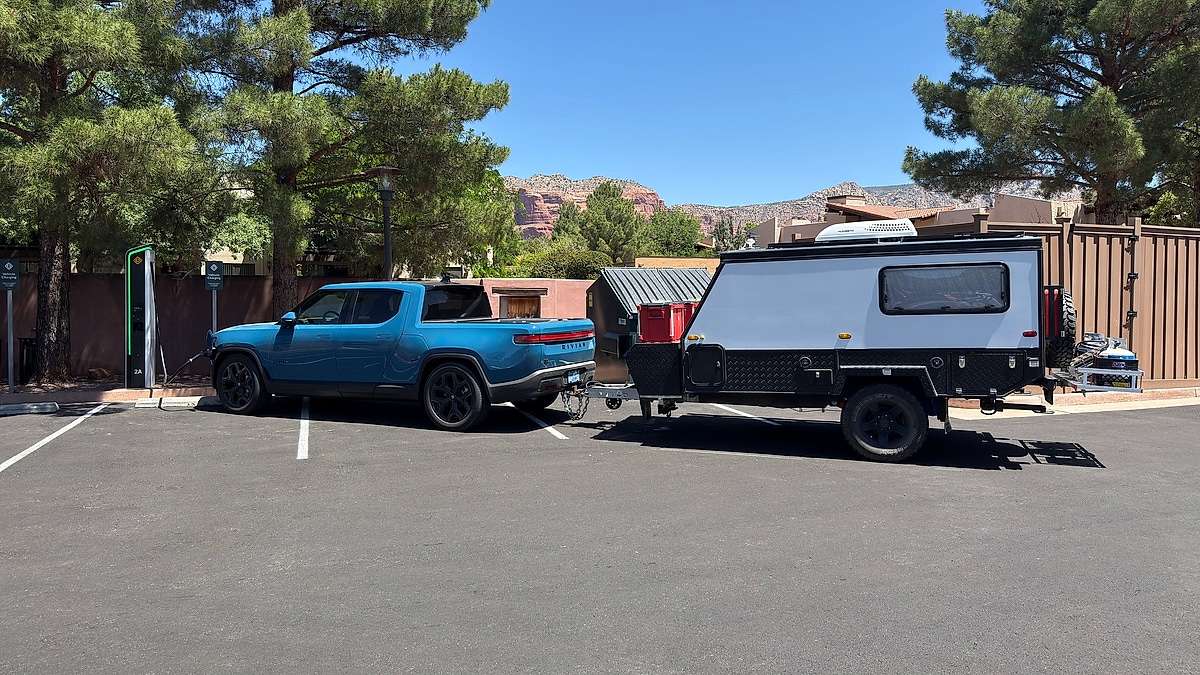

At Overland Expo West weekend in Flagstaff, a Rivian R1T Dual Performance Max made the Phoenix-area climb with a roughly 4,500-pound overland trailer and reported 1.10 mi/kWh on the way up, then 1.32 mi/kWh on the return. Torque News checked the owner’s reported efficiency against Rivian’s published specs, the Overland Expo West timing and location, the Phoenix-to-Flagstaff elevation change, and the technical basis of his Dometic fridge power complaint. For buyers, the takeaway is not whether an EV truck has enough torque. It is whether the route has the right charger layout, enough reserve, and an efficient way to power camp gear after the climb.
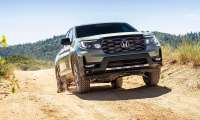
The trip came from Devin Pitcher in the Rivian Owners of Phoenix group, who said his Dual Performance Max "handled towing my ~4,500 lb. trailer like a champ" on the way to Overland Expo West in Flagstaff. He liked the instant power for passing slow trucks and trailers uphill, but he also gave the part that matters more to people planning the same kind of trip: "To Flagstaff: 1.10 mi/kWh avg. Return trip: 1.32 mi/kWh avg."
That is where the story gets useful
The first number is not bad because the truck could not tow. The opposite is true. The driver specifically praised the power. The number is useful because it shows how quickly a big-battery EV pickup becomes a planning exercise once a trailer, a mountain route, and a destination power need are added together.
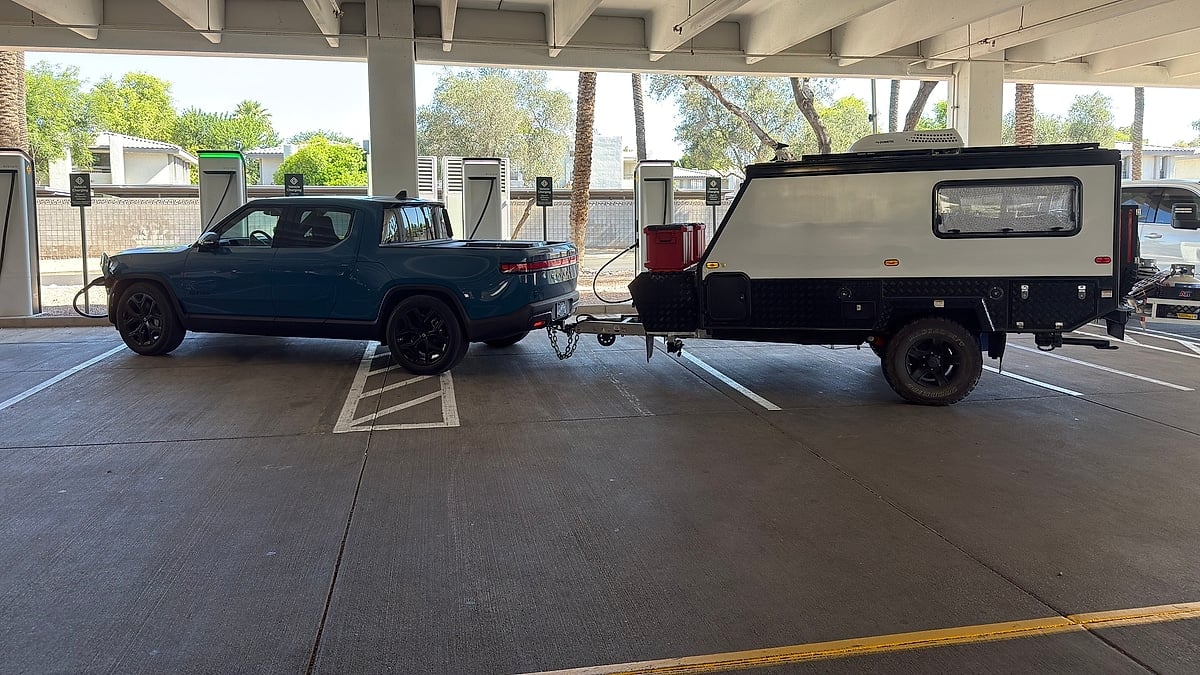
That distinction matters because the Facebook post was not a formal range test, but it did contain enough real-world data for Torque News to extract a useful towing lesson.
What Torque News Checked
Torque News checked five things before treating this as a story rather than a repost.
First, the timing and destination fit. Overland Expo West was scheduled for May 15-17, 2026, at Fort Tuthill County Park in Flagstaff, Arizona, which matches the event context in the post.
Second, the truck configuration matters. Rivian's R1T Dual and Performance Dual configurations with the Max battery are the long-range versions buyers usually consider when towing and road-tripping. Rivian's current comparison material lists Max-battery R1T range in the roughly 410-mile class, depending on configuration and wheel/tire setup. That is the unloaded promise buyers start with before they add a trailer.
Third, the energy math is reproducible. At 1.10 mi/kWh, the uphill towing leg works out to about 90.9 kWh per 100 miles. At 1.32 mi/kWh, the return works out to about 75.8 kWh per 100 miles. Put another way, the climb required about 20 percent more energy per mile than the return.
Fourth, the route is not flat. Phoenix sits at an elevation of around 1,100 feet, while Flagstaff is commonly described as being around 7,000 feet. Even before wind, speed, trailer shape, and traffic are considered, this is a serious energy test for any EV towing setup.
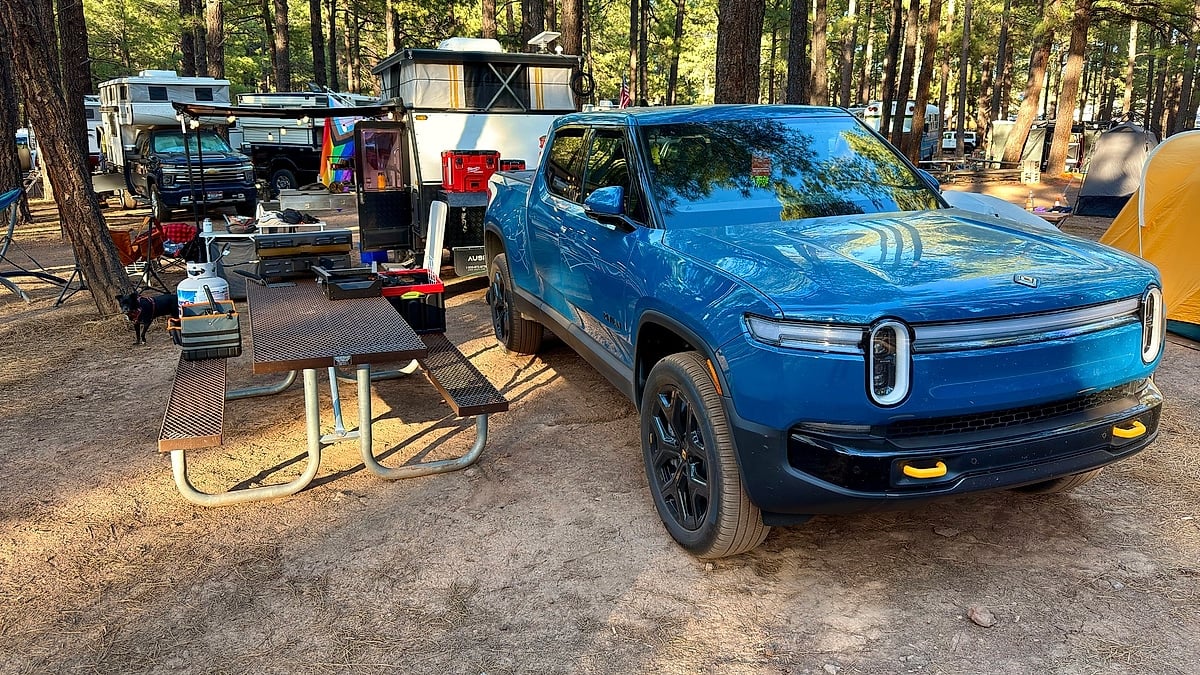
Fifth, the camp-power complaint is real enough to matter. Pitcher said he charged to 100 percent in Flagstaff partly so he could power his Dometic fridge, then asked why Rivian did not put a DC outlet in the bed, calling the DC-to-AC-to-DC path "stupid." Dometic's CFX3 support material says the cooler line can run on 12/24V DC or 100-240V AC, which is why that complaint is technically understandable. If an accessory already accepts DC power, converting battery energy to AC and then back to DC is not ideal.
Overlooked issues with EV trucks
The most interesting sentence in the post may not be the efficiency number. It may be this one:
"Charging with a trailer is a pain, but it was easy in Flagstaff since they had a dedicated trailer spot."
That is the overlooked EV-truck issue. A tow rating tells you what the truck can pull. A range rating tells you what the truck can do under a standardized test without your trailer. Neither tells you whether the charger you need is easy to use while hitched.
This is where EV towing differs from gas or diesel towing in a way buyers can feel immediately. With a combustion truck, the trailer problem is usually fuel economy and pump access. With an EV truck, the problem is fuel economy, charger speed, charger location, stall layout, and whether you have to unhitch a trailer just to plug in. A single trailer-friendly stall can turn a frustrating stop into a normal stop.
The data also shows why trailer weight alone is too crude. A roughly 4,500-pound trailer is not close to the R1T's maximum towing capability when properly equipped, but the owner still saw 1.10 mi/kWh uphill. That does not mean the truck was struggling. It means aero drag, elevation, and speed can dominate the battery math.
Another comment in the same discussion made the contrast sharper. A different Dual Max driver said he saw 1.7 mi/kWh going up and 2.55 mi/kWh coming down without towing. Those numbers are not a controlled test, but they are a useful reminder: the trailer is not just weight. It is a shape being pushed through the air all the way up the grade.
For people shopping for an R1T, a Ford F-150 Lightning, a Chevy Silverado EV, a GMC Sierra EV, or a Cybertruck as an adventure tow vehicle, the Flagstaff trip points to a better question than "What is the tow rating?"
Ask what your setup does in kWh per 100 miles on your actual route
At 1.10 mi/kWh, every 100 miles takes about 91 kWh before reserve. At 1.32 mi/kWh, every 100 miles takes about 76 kWh before reserve. Those numbers are much easier to plan with than a vague "range drops when towing" warning. They also make clear why drivers may choose to charge higher at the destination than they would on a normal road trip. Pitcher was not only trying to get home. He was also using the truck as part of the campsite's power system.
That is where Rivian's adventure pitch is strongest and weakest at the same time. The R1T has the torque, battery size, ride height, storage, and lifestyle fit for this trip. But once the truck becomes the tow rig and the power source, small details start to matter. A dedicated trailer charging spot matters. A 12V or 24V DC accessory path matters. A fridge running overnight matters. A headwind on the return would matter. So would one blocked pull-through stall.
None of that makes the R1T a poor tow vehicle. Pitcher's own verdict was positive. He said the truck handled the trailer well and praised the uphill passing power. The lesson is more specific: EV towing is not mainly a horsepower problem anymore. It is a planning problem.
The practical checklist for a trip like this is simple:
- Know your trailer's real loaded weight and shape, not just the brochure weight.
- Track mi/kWh on the outbound climb and convert it to kWh per 100 miles.
- Identify at least one charger you can use without unhitching.
- Charge higher at the destination if the truck will also power camp gear.
- Use DC power for DC appliances when possible, instead of converting DC to AC and back to DC.
- Keep enough reserve for wind, traffic, detours, and blocked charging stalls.
For buyers, the Flagstaff run is not a warning against towing with a Rivian. It is a warning against shopping by two ratings alone. If your trips include mountain grades, tall trailers, and camping loads, the number to ask about is not only pounds. It is mi/kWh, charger layout, and how much battery you still need after you park.
If you tow with a Rivian, F-150 Lightning, Silverado EV, Sierra EV, or Cybertruck, what is the most honest mi/kWh number you have seen with your trailer, route, speed, and elevation? Please include the trailer weight and whether you had to unhitch to charge.
Let us know in the comments below.
Images by Devin Pitcher of the Rivian owners of the Phoenix Facebook Group
About The Author
Noah Washington is an automotive journalist based in Atlanta, Georgia, covering sports cars, luxury vehicles, and performance culture. His reporting focuses on explaining the engineering, design philosophy, and real-world ownership experience behind modern vehicles.
Noah has been immersed in the automotive world since his early teens, attending industry events and following the enthusiast communities that shape how cars are built and driven today. His work blends industry insight with enthusiastic storytelling, helping readers understand not just what a car is, but why it matters.
Noah is also a member of the Southeast Automotive Media Association (SAMA), a professional organization for automotive journalists and industry media in the Southeast.
His coverage regularly explores sports cars, luxury vehicles, and performance-driven segments of the automotive industry, including the evolving culture surrounding Formula Drift and enthusiast builds.
Read more of Noah's work on his author profile page.
You can also follow Noah here:
Set Torque News as Preferred Source on Google
Follow us today...




Comments
For me infrastructure is 100…
Permalink
For me infrastructure is 100% the issue when towing.
Kyle, I think that is…
Permalink
In reply to For me infrastructure is 100… by Kyle Renzelman (not verified)
Kyle, I think that is exactly right. The range loss matters, but towing exposes the charger problem faster. If the next charger is hard to access with a trailer, blocked, unreliable, or requires unhitching, then the real issue becomes infrastructure.
Agreed. I tow a horse…
Permalink
Agreed. I tow a horse trailer and with live cargo there's no way I'm going to travel very far without knowing for sure what the charging options are and how reliable they are. (You can't unhitch a horse trailer with horses in it, so I HAVE to have trailer friendly charging.)
Live cargo makes this a…
Permalink
In reply to Agreed. I tow a horse… by Erin Harty (not verified)
Live cargo makes this a completely different discussion. A horse trailer is not something you can casually unhitch in a busy charging lot. Trailer-friendly charging is the requirement that makes the trip possible in the first place.
I think specially and others…
Permalink
I think specially and others may agree or disagree but it’s really just challenging easy access when towing a rig. Sometimes a pain to pull in some locations. Cause if you look at it with infrastructure you got Tesla, now IONNA (which is amazing), ChargePoint etc. the list goes on. Though it’s tiresome to plan, again to someone else’s point, it is the planning of charging that induces indirect range anxiety not necessarily the availability of charging or miles it is capable of doing.
Plus gas is available everywhere people don’t realize they gas up on average every 170/200 mi and that’s not including towing.
A lot of the stress comes…
Permalink
In reply to I think specially and others… by Serge Harvey (not verified)
A lot of the stress comes from access and planning. There may be chargers along the route, but towing adds a second test: can you pull in, fit the rig, charge without unhitching, and get back out without turning the stop into a project?
Gas stations usually make that part easy. EV charging still has a lot of catching up to do there.
I'm sorry, but this is 100%…
Permalink
I'm sorry, but this is 100% an EV towing problem.
If the Rivian towing draws 1.1 mi/Kwh, has the largest 141 Kwh battery, and charges 20% to 80%, then it has to charge every 84.6 Kwh, or 93 miles. I see online that the Rivian large pack charges 20% to 80% in 45 minutes.
So every 93 miles, you're charging for 45 minutes.
Until BYD-level charging (e.g. 5-6 minutes 20% to 80%) is brought to America, towing will remain a pain in the EV butt.
My wife and I are full-time…
Permalink
My wife and I are full-time RV'ers, pulling a Bowlus Endless Highways with an R1S dual max (range wheels). A month ago we drove from Pismo Beach CA to Westfield NJ for a wedding. We took the southern route to avoid weather and mountains. The Bowlus weighs about 4k lb and is as aerodynamic as a travel trailer gets.
The Rivian charging network often includes trailer pull through spots, especially out west. But we used other charger frequently (lots of Teslas) and only had to detach once or twice. We did lots of level II charging in parks.
The R1S' stats page says we are averaging 1.7mi/kWh over 14,873 total miles towing during the 13 months we've owned the vehicle/trailer combo.
It's the way to go!