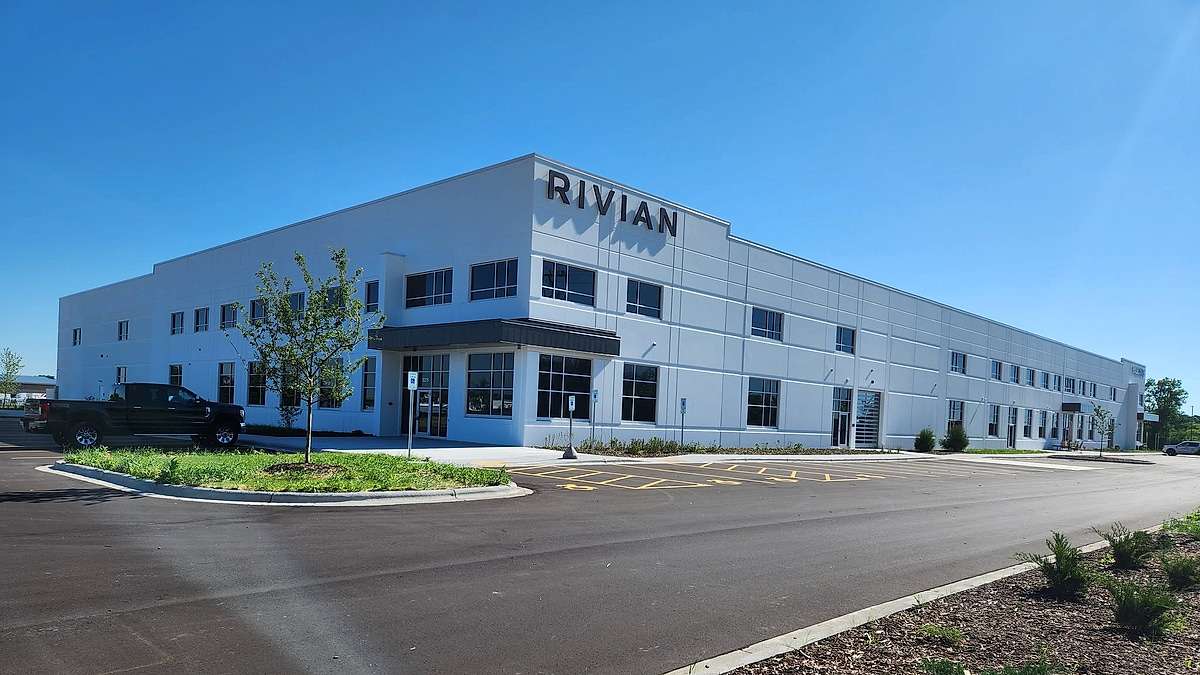

A Rivian owner in Appleton, Wisconsin, drove past the new Rivian Service and Demo Center and saw the kind of progress owners care about: finished asphalt, painted parking lines, completed landscaping, a Rivian sign on the building, and the neighboring Paul Davis operation already moved in.
That is a long way from a permit filing.
Jeff Schmeichel shared the update in a Rivian owners group after stopping by the Appleton site. He said he had not been past the building in at least a month, and the change was obvious. The outside looked complete. The lot looked complete. The sign was up. The question left hanging was the one Rivian owners in northeast Wisconsin actually care about: when does the place start taking customers?
One reply captured the mood cleanly: “Can’t wait not to have to go to MKE.”
I understand that sentence better than any corporate network-expansion paragraph. A service center only feels abstract to people who live near one.
Rivian Appleton, Wisconsin Service Center
- Rivian is adding an Appleton Service Center at 3275 E Winslow Ave, Appleton, WI 54911, based on Rivian’s own Appleton Service Center job postings.
- The Appleton site is expected to serve the Fox Valley and northern Wisconsin better than the Milwaukee-area location, with Rivian public policy noting that Menomonee Falls covers southern Wisconsin while Appleton helps cover the northern part of the state.
- It is planned as both a service and demonstration center, meaning owners can get warranty/service work handled while shoppers can do demo drives and learn the vehicles in person.
For everyone else, service becomes a calendar problem, a spouse problem, a loaner problem, a workday problem, and sometimes a weather problem. Wisconsin adds its own seasoning. Winter roads, salt, distance, and a customer base spread across small cities and rural corridors. A Rivian that needs service in Green Bay or Appleton should not automatically turn into a Milwaukee errand.
The Appleton building changes the geography.
A finished-looking building can still be waiting on the hard part
The owner’s photo update tells us the physical site appears close. That does not mean Rivian can throw the doors open tomorrow.
A modern EV service center needs more than a sign and a clean parking lot. It needs trained techs, lifts rated for heavy EVs, high-voltage tooling, parts inventory, charging infrastructure, diagnostic equipment, insurance approvals, final inspections, software access, scheduling integration, and enough staff to handle both customer vehicles and demo traffic without creating a line before the coffee machine has even been plugged in.
I’ve watched enough service-network growing pains to respect the boring middle of the process. The construction crew finishes. The sign goes up. The public assumes opening day is imminent. Then the real machinery starts: hiring, training, parts stocking, inspections, internal systems, fire-code boxes, and the thousand small approvals that make a building into an operating shop.
Rivian has no room to make Appleton a decorative outpost.
The company is entering a different phase. Early adopters tolerated long drives and sparse service coverage because they bought into the adventure, the engineering, and the startup promise. R2 buyers will be less patient. They will expect the ownership experience to behave as the price tag belongs in the mainstream. That means local service, local demos, local delivery, and a path to repair that does not require burning a vacation day.
Appleton is a smarter location than it looks
Appleton does not have the national ring of Chicago, Milwaukee, Seattle, or Atlanta. That is exactly why the location is worth studying.
The Fox Valley sits in the practical middle of a lot of Wisconsin driving. Appleton is about 30 miles from Green Bay and roughly 100-plus miles from Milwaukee, depending on the route. It pulls in owners from Green Bay, Oshkosh, Neenah, Appleton, Fond du Lac, Wausau, and the upper slices of the state that would otherwise look south every time Rivian service came up.
That matters to ownership quality.
A Milwaukee-area center can serve southeastern Wisconsin. It cannot feel local to the whole state. Appleton gives Rivian a northern anchor without pushing all Wisconsin volume through one funnel. It also puts the brand in a place where trucks and SUVs make cultural sense. This is not a shopping-mall vanity location built for people who want to pose beside a camp kitchen. Northeast Wisconsin has farms, snow, lake houses, work trucks, hunting land, campers, bad roads, and real weather. If Rivian wants R1T and R1S ownership to feel natural outside coastal money belts, places like Appleton carry more weight than another urban showroom with nice flooring.
I like this move.
I like it because it looks like infrastructure following use, not image.
The Amazon van angle may be the real service load
Schmeichel pointed out an Amazon distribution center near Appleton with a visible population of Rivian delivery vans. He also said a local Rivian-authorized body shop told him it sees many of those vans, mostly for sliding-door abuse rather than drive-unit problems.
That is the detail I would circle in red.
Rivian’s commercial vans live a brutal life. A family R1S may open its doors a dozen times a day. An Amazon delivery van can see its sliding door opened and closed hundreds of times in one shift, through rain, salt, heat, cold, and drivers who are paid to finish routes, not baby a latch mechanism. Door tracks, seals, rollers, hinges, sensors, trim, and harnesses take a beating.
That kind of failure load teaches an automaker fast.
A service center near an Amazon van cluster gives Rivian two advantages. First, it shortens repair loops for a fleet customer with high daily utilization. Second, it feeds Rivian a steady diet of commercial-use data. A private owner complains when something breaks. A fleet exposes weakness by repetition. The same part cycles until the design either proves itself or folds.
Rivian should want that information close.
The Appleton center will probably serve R1T and R1S owners, future R2 buyers, demo customers, and Amazon vans. That blend can keep a shop busy from day one. It can also bury a thinly staffed facility if Rivian opens with too little capacity.
The R2 makes every service center more valuable
Rivian has said it plans to add more than 50 service centers through next year and reach more than 150 by the end of 2027. That expansion lines up with the R2 era.
Good. It has to.
Rivian’s first wave of customers bought expensive vehicles and accepted some startup friction. The R2 changes the math. A lower-priced, higher-volume SUV brings different buyers into the tent. More commuters. More families. More first-time Rivian owners. More people who have never read a service-forum thread in their life and will be furious if their new EV needs a tow across half the state for a simple repair.
Rivian says R2 buyers will pick up vehicles at their nearest Service + Demo Center, where staff will give a hands-on walkthrough. That turns these buildings into more than repair shops. They become delivery rooms for Rivian’s next business model.
Appleton could become a pressure valve for Wisconsin R2 volume.
The service center is now part of the sales funnel. Every local delivery creates a local relationship. Every demo drive teaches a shopper where the truck or SUV will go if something breaks. Every fleet repair trains the local staff. Every shorter service trip removes one more objection from a buyer deciding between a Rivian and a more ordinary SUV from a dealer ten minutes away.
Service coverage sells vehicles before anyone says the word “service.”
Rivian cannot afford pretty empty buildings
The owner says the building looks ready. A commenter jokes that maybe it will help with two-month wait times.
That joke has teeth.
A shiny service center does very little if the appointment calendar remains ugly. Rivian’s real test in Appleton will be throughput. How many technicians? How many bays? How much parts inventory? How much van fleet work gets mixed with retail owner work? How much mobile service support reaches north and west from the building? Will R1 owners still wait weeks for routine repairs? Will R2 deliveries clog the same staff needed to fix customer vehicles?
Those answers will decide whether Appleton becomes a genuine improvement or a nice sign on a crowded system.
I would rather see Rivian open one week later with the right parts and staffing than rush a ceremonial opening that produces a month of frustrated owners. A rushed opening gives everyone a ribbon-cutting photo. A properly stocked service operation gives owners their trucks back.
There is a difference.
Wisconsin owners should watch the first 90 days
When Appleton opens, the first wave of owner reports will be more useful than the launch announcement.
Watch how quickly appointments appear in the app. Watch whether mobile service routes expand into Green Bay, Oshkosh, Wausau, and the smaller towns around the Fox Valley. Watch whether Amazon vans occupy a large share of the lot. Watch how often parts delays show up in owner posts. Watch whether demo drives are easy to book. Watch whether R2 pickup logistics run through Appleton once volume builds.
The building looks close. The network effect starts after the first service tickets clear.
For current Wisconsin Rivian owners, Appleton should cut dead miles and stress. For shoppers, it should lower the fear of buying an EV from a company with no traditional dealer network. For Rivian, it is a chance to prove the service expansion can land where owners actually live, not only where marketing departments like to take photos.
I would be eager to see it open if I lived nearby.
I would be even more eager to see the appointment calendar three months later.
What Wisconsin Rivian owners should do next?
Do not assume the Appleton center is open until Rivian lists it in the app or on its location page. Keep using official scheduling until the site appears in Rivian’s system.
If you live in Green Bay, Appleton, Oshkosh, Wausau, or the surrounding area, check your service options weekly once the center appears. If you have a non-urgent repair, Appleton may soon save you a Milwaukee round trip. If you are shopping an R1S, R1T, or R2, wait to see how Appleton handles early appointments before treating it as a finished support solution.
The building is the first sign. The service calendar will tell the truth.
Wisconsin Rivian owners, what are you seeing?
If you are in Wisconsin and have used Rivian service through Menomonee Falls, Chicago-area locations, mobile service, or an authorized body shop, share your wait time, repair type, distance traveled, and whether Appleton would change your ownership experience.
First image by Jeff Schmeichel
About The Author
Noah Washington is an automotive journalist based in Atlanta, Georgia, covering sports cars, luxury vehicles, and performance culture. His reporting focuses on explaining the engineering, design philosophy, and real-world ownership experience behind modern vehicles.
Noah has been immersed in the automotive world since his early teens, attending industry events and following the enthusiast communities that shape how cars are built and driven today. His work blends industry insight with enthusiastic storytelling, helping readers understand not just what a car is, but why it matters.
Noah is also a member of the Southeast Automotive Media Association (SAMA), a professional organization for automotive journalists and industry media in the Southeast.
His coverage regularly explores sports cars, luxury vehicles, and performance-driven segments of the automotive industry, including the evolving culture surrounding Formula Drift and enthusiast builds.
Read more of Noah's work on his author profile page.
You can also follow Noah here:
Set Torque News as Preferred Source on Google
Follow us today...