

Santiago Gomez plugged his Rivian into a normal 120V outlet and got the kind of charging speed that makes gasoline people feel temporarily clever.
Two miles an hour.
Maybe three, if the app is feeling generous.
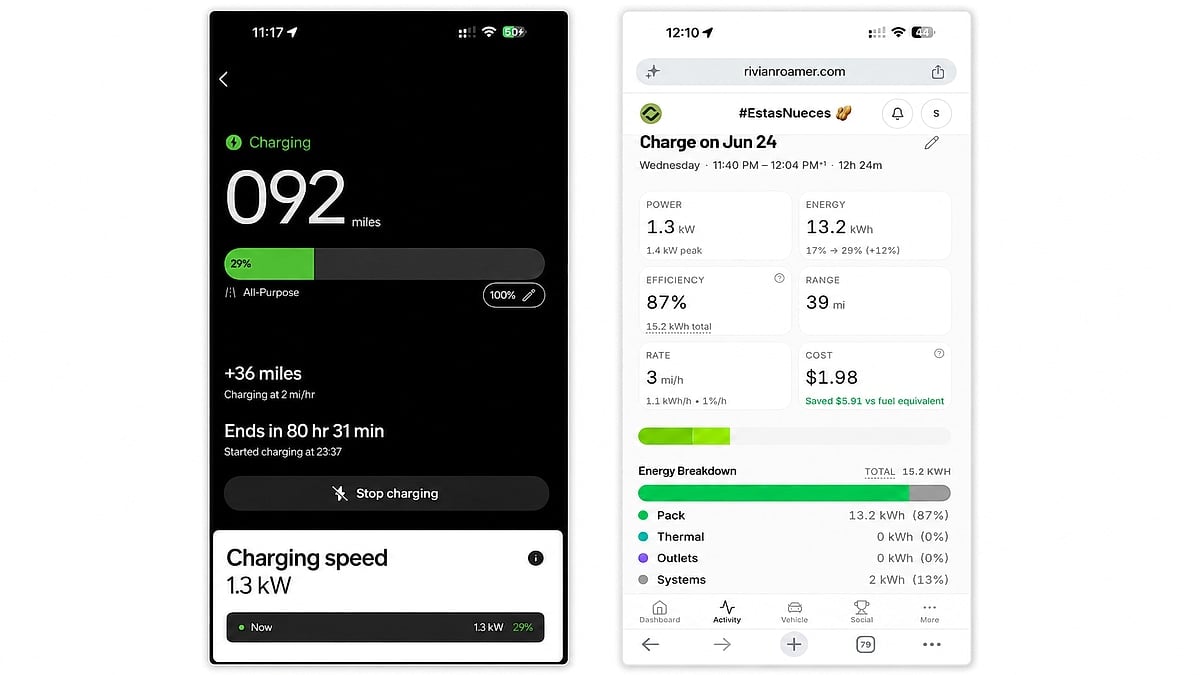
His Rivian display showed 1.3 kW. RivianRoamer logged a 12-hour-and-24-minute session, 15.2 kWh total pulled from the wall, 13.2 kWh delivered to the pack, and a state-of-charge move from 17 percent to 29 percent. Range added: 39 miles. Cost: $1.98.
That is not much if you are standing beside the R1S waiting.
It is plenty if the truck was going to sit there anyway.
- Level 1 charging works best when paired with long dwell times, overnight stays, weekend trips, or extended parking, where even slow gains can meaningfully improve your departure range
- Efficiency matters more at low power levels, so expect a noticeable portion of energy to go toward system overhead rather than directly into the battery
- Treat a 120V outlet as a supplemental tool, not a primary solution. It’s ideal for topping off or reducing reliance on public chargers, but not for recovering large amounts of range quickly
That is the part many people miss about Level 1 charging. A 120V outlet does not behave like a fuel pump, a DC fast charger, or even a decent 240V garage setup. It behaves like time. Leave the truck parked long enough, and the miles arrive quietly.
Gomez knew that. He posted the numbers with the right attitude: trickle charging is accurate, and it is not something to rely on for a rescue plan. But if the Rivian is parked for a weekend, a beach trip, a cabin stay, an airport layover, or a visit to family, plugging in can turn dead time into driving range.
Two miles an hour sounds ridiculous until the alternative is zero.
The Outlet Did Exactly What Rivian Says It Will Do
Rivian’s Portable Charger with the 120V adapter is rated at 12 amps and 1.3 kW. Gomez’s app showed 1.3 kW. That part checks out cleanly.
The RivianRoamer screen showed 15.2 kWh total energy used during the session, with 13.2 kWh reaching the battery pack. That is 87 percent charging efficiency. The remaining 2 kWh went to vehicle systems and ordinary losses.
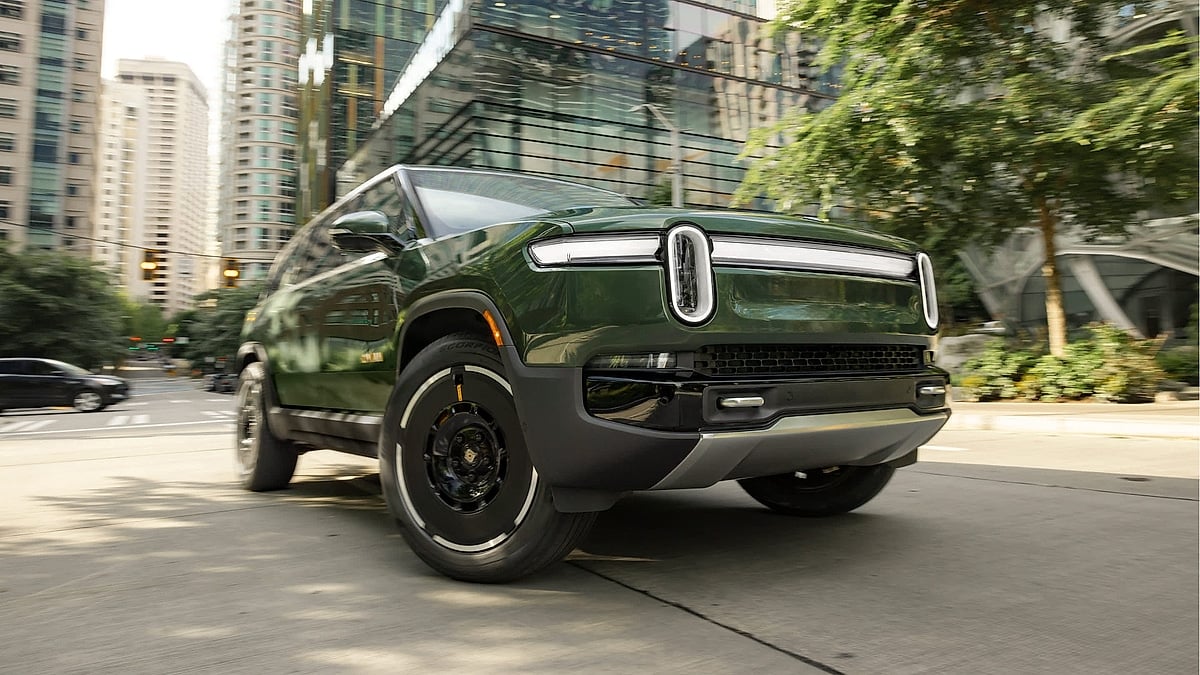
At first glance, that waste looks annoying. It is also the price of waking up a large electric truck or SUV for a very small electrical meal. The vehicle still has computers, relays, thermal logic, battery management, and overhead. When the charging power is only 1.3 kW, even a modest fixed load becomes noticeable.
That is why Level 1 can feel slightly cruel on a Rivian.
The pack is enormous. The outlet is ordinary. The vehicle is awake. The math is honest.
The session added 39 miles in 12 hours and 24 minutes, just over 3 miles per hour by the RivianRoamer calculation. The Rivian app screenshot showed 36 miles added and a current charging rate of 2 miles per hour, likely reflecting the live rate at that moment rather than the full-session average.
Either way, nobody is mistaking this for road-trip charging.
Still, 39 miles is not imaginary. It covers a grocery run, dinner in town, a morning errand, or the difference between arriving home comfortably and stopping at a public charger for ten minutes you did not want to spend.
Level 1 Is A Destination Tool
The mistake is treating a 120V outlet like a charging stop for the R1S.
Gomez treated it like a parking benefit.
If a R1S owner arrives at a rental house with 17 percent battery and needs to leave two hours later, a wall outlet is almost worthless. If the same owner is staying for three days, the outlet becomes useful.
Using Gomez’s session as a guide, a full day plugged into a normal outlet could add something like 70 miles under similar conditions. A long weekend could add enough energy to erase a local driving deficit. A week at a cabin could turn an otherwise annoying public charging stop into a non-event.
The truck will not charge quickly.
It will charge while life happens.
A gas vehicle cannot do that. It sits in the driveway with the same fuel level it had when it arrived. The Rivian sits there slowly improving its situation, one dull hour at a time.
That is why the comments under Gomez’s post had the right flavor. Some people joked. Others said they do the same thing at the beach, at home, or at long-term parking. One owner said he charges from a regular outlet every night. Another said airport parking with normal outlets is perfect for long stays.
That is the right use case. Slow charging works best when the owner’s schedule is slower than the outlet.
The Cost Makes The Slowness Easier To Forgive
The session cost $1.98.
That works out to about 13 cents per kWh from the wall, based on the 15.2 kWh total shown in the RivianRoamer log. For 39 miles of added range, the cost comes to roughly five cents per mile.
Public DC fast charging can easily cost three or four times that per kWh. A Rivian using a fast charger on the road may recover energy in minutes instead of hours, but the driver pays for the speed, the site, the hardware, and the convenience.
The wall outlet is cheap because it is primitive.
That trade is fine when the truck is asleep at the destination. Nobody should spend 12 hours at a cabin outlet when a fast charger is needed to continue a trip. Nobody should ignore a proper 240V installation at home if the daily driving pattern requires consistent overnight recovery. A Rivian Wall Charger or a 240V NEMA 14-50 outlet changes the ownership rhythm completely.
The 120V outlet belongs in a different category.
It is not the main kitchen.
It is the granola bar in the glovebox.
The Safety Part Is Boring Until It Is Expensive
A regular outlet can charge a Rivian. A bad outlet should not.
That warning matters more than the range estimate.
The Rivian Portable Charger pulls a continuous load for hours. Old wiring, loose receptacles, shared circuits, cheap extension cords, power strips, adapters, corroded outdoor outlets, and mystery garage wiring can turn a harmless-looking plug into heat.
Rivian’s own guidance is clear: use a grounded outlet, do not use extension cords or power strips, avoid damaged or loose outlets, and use a dedicated outlet if possible. If the outlet has two sockets, avoid plugging another device into the second one while the truck is charging.
That last point is easy to ignore until the breaker trips or a warm outlet gives up on itself.
A Rivian owner borrowing power at a cabin, rental house, campground, garage, or family driveway should inspect the outlet before trusting it overnight. The plug should fit tightly. The faceplate should not be cracked. The outlet should not feel loose in the wall. The circuit should not be shared with refrigerators, space heaters, old freezers, sump pumps, or anything else that cycles on while the truck is already drawing current.
After the first hour, touch the outlet and charger plug carefully. Warm can be normal. Hot is a warning.
Level 1 charging is simple only when the circuit is healthy.
The Real Lesson Is To Take The Miles That Are Sitting There
Gomez’s post works because he did not oversell the experience.
He did not pretend that a household outlet turns a Rivian into a road-trip weapon. He did not claim that Level 1 charging replaces a home charger. He looked at 2 or 3 miles per hour and still found a use for it.
That is the mature EV owner move.
Take the miles that are available.
At home, a proper Level 2 setup is better. On a trip, DC fast charging is better. At a destination where the truck is parked for a day or two, a normal outlet may be enough to charge the drive home.
The Rivian gained 12 percent while doing nothing. It added 39 miles for less than two dollars. It turned a low battery at arrival into a more comfortable departure.
There is no glory in 1.3 kW.
There is usefulness.
That is the whole point.
What Rivian Owners Should Remember
A 120V outlet should be treated as a backup, a destination helper, or a low-mileage routine. It should not be the plan for a long-distance recovery unless the owner has several days to wait.
Use it when the vehicle is parked for a long time. Verify the outlet first. Avoid extension cords and shared loads. Expect 2 to 3 miles per hour. Remember that the truck’s systems consume part of the wall energy before it reaches the pack.
If the same situation happens often, install a 240V charging.
If it happens once during a trip, plug in and enjoy the slowest bargain in EV ownership.
Thirty-nine miles is thirty-nine miles.
Rivian Owners, Where Have You Used Level 1?
If you have trickle-charged an R1T or R1S from a regular outlet, share the location, hours plugged in, miles added, outside temperature, and whether the circuit handled it cleanly.
Let us know in the comments.
One image by Santiago Gomez
About The Author
Noah Washington is an automotive journalist based in Atlanta, Georgia, covering sports cars, luxury vehicles, and performance culture. His reporting focuses on explaining the engineering, design philosophy, and real-world ownership experience behind modern vehicles.
Noah has been immersed in the automotive world since his early teens, attending industry events and following the enthusiast communities that shape how cars are built and driven today. His work blends industry insight with enthusiastic storytelling, helping readers understand not just what a car is, but why it matters.
Noah is also a member of the Southeast Automotive Media Association (SAMA), a professional organization for automotive journalists and industry media in the Southeast.
His coverage regularly explores sports cars, luxury vehicles, and performance-driven segments of the automotive industry, including the evolving culture surrounding Formula Drift and enthusiast builds.
Read more of Noah's work on his author profile page.
You can also follow Noah here:
Set Torque News as Preferred Source on Google
Follow us today...