
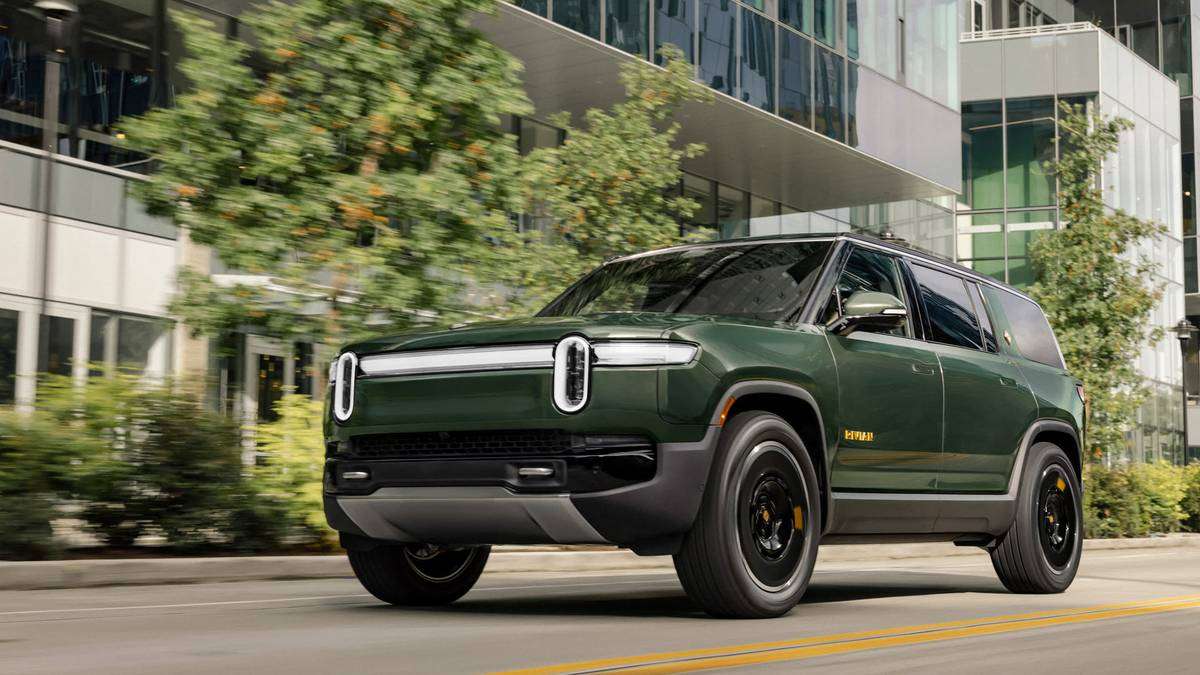

The truth of any automobile rarely reveals itself in the showroom or on a spec sheet. It shows up later, somewhere after the honeymoon period, when miles accumulate, and small irritations either fade away or grow impossible to ignore. In the electric era, that truth often rolls on tires selected as much for efficiency targets as for how they feel at highway speed. The Rivian R1S is a deeply impressive machine, engineered with uncommon care and ambition, but like every modern vehicle, it leaves the factory wearing compromises. Chief among them are its OEM Pirelli tires, optimized for range and certification rather than the long-term sensory experience of daily driving.
That distinction became clear when one R1S owner decided to share his experience publicly, not as a complaint, but as a carefully observed report from the real world. Writing in the Rivian Electric Vehicles Discussion group on Facebook, Laurens Rhinelander explained his decision to replace the factory tires well before they were technically worn out:
“’23 R1SSo, I made it to about 19,000mi on the OEM 20” Pirellis. I still had 3-4,000 miles of tread left,t but the vibration and noise were driving me loco. These LTX Platinums are an absolute game changer in terms of the noise and vibration - feels like a new, much quieter car. They look really great, too! Handling-wise, I haven't noticed any difference, but we're mostly dry and sunny here in San Diego. My mileage on the Scorpions was 2.04, hoping these will end up somewhere similar. Will report back in a couple of thousand miles.
Discount Tire gave me a great deal (sale + Costco price match), but trashed all of my Twrap wheel decals - $50 and a couple of hours to remove and replace all.”
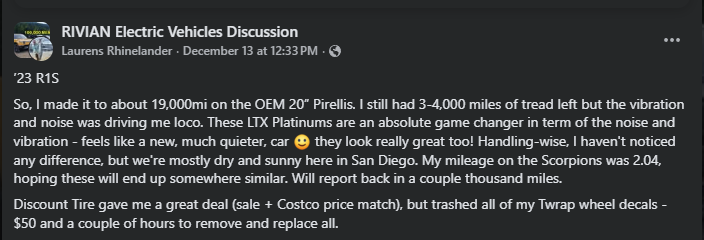
What stands out is not frustration, but clarity. The Pirelli Scorpions had done their job, delivering acceptable efficiency and broadly competent performance. Yet in an electric vehicle, where the absence of engine noise amplifies everything else, tire roar and vibration take on outsized importance. At 19,000 miles, Rhinelander still had usable tread remaining, but comfort had become the limiting factor. This is the quiet reality of EV ownership that rarely makes it into official literature: efficiency gains can come with acoustic consequences that only emerge over time.
Rivian R1S: Electric Capability
- The R1S combines three-row seating with an electric platform, positioning it as a practical alternative to traditional adventure-focused SUVs.
- Independent motor control supports traction across varied terrain, contributing to stable handling on loose or uneven surfaces.
- Cabin layout takes advantage of a flat floor and vertical space, improving comfort for passengers in all seating rows.
- Adjustable air suspension allows the vehicle to balance highway refinement with increased ground clearance when driving conditions change.
The switch to Michelin LTX Platinums was not framed as a performance upgrade or stylistic statement. It was a recalibration. Touring-oriented tires have long been favored by drivers who value calm, controlled progress over theoretical maximums, and the R1S proved no different. Rhinelander reported a dramatic reduction in noise and vibration, enough to make the vehicle feel new again, without any noticeable loss in handling under his typical Southern California driving conditions. The tires also subtly altered the visual stance of the vehicle, a point noted by other owners, though appearance was clearly secondary to comfort.

The comment section filled in the broader picture. One owner pointed out the importance of alignment to preserve tire life, a reminder that heavy electric SUVs magnify small setup errors. Another described a garage already stocked with replacement tires, waiting only for the OEM rubber to wear down enough to justify the swap. His Scorpions had surpassed 35,000 miles and still performed adequately in cold, snowy conditions, but he admitted they were far from quiet. It was a familiar story of modern ownership, balancing thrift against quality of life.
Concerns about efficiency inevitably surfaced, but they were notably restrained. One driver running alternative all-terrain tires reported a range reduction of roughly two percent over several thousand miles, paired with a quieter and more composed ride across long interstate journeys. In practical terms, that loss amounts to a handful of miles per charge. For most R1S owners, it is a negligible trade in exchange for reduced fatigue and a calmer cabin, especially given the vehicle’s substantial battery capacity.
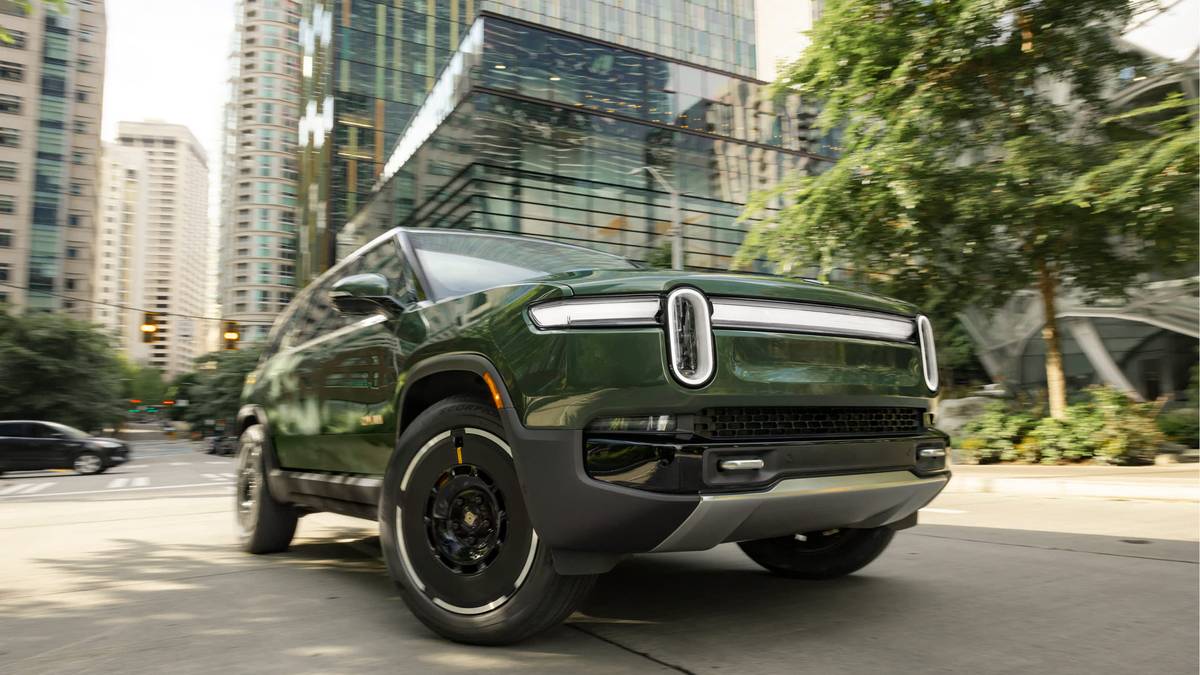
Even the minor mishaps told part of the story. Rhinelander’s note about damaged wheel decals during installation was not an indictment of the shop, but a reminder that deviating from factory specification carries small, sometimes annoying consequences. Aftermarket choices demand attention and follow-through, whether that means reapplying decals or scheduling alignments. These are the unglamorous details of ownership that separate theoretical decisions from lived ones.
What emerges from this exchange is not criticism of Rivian or its suppliers, but a mature understanding of compromise. OEM tires are chosen to satisfy regulators, test cycles, and broad customer expectations. They are rarely wrong, but they are rarely perfect for everyone. In this case, one owner decided that silence and comfort mattered more than extracting the last ounce of efficiency, and the result was a vehicle that better suited his daily life.
The lesson is straightforward. Electric vehicles are still cars, subject to the same laws of physics and human preference that have always governed driving enjoyment. Tires remain one of the most influential variables an owner can change without altering the soul of the machine. For this Rivian R1S, the move from Pirelli to Michelin did not change its capabilities or its mission. It simply made every mile quieter, calmer, and more satisfying, which for many drivers is the metric that matters most.
Image Sources: Rivian Media Center
Noah Washington is an automotive journalist based in Atlanta, Georgia. He enjoys covering the latest news in the automotive industry and conducting reviews on the latest cars. He has been in the automotive industry since 15 years old and has been featured in prominent automotive news sites. You can reach him on X and LinkedIn for tips and to follow his automotive coverage.
Set Torque News as Preferred Source on Google
Follow us today...



Comments
Who puts decals on their…
Permalink
Who puts decals on their WHEELS, and why???
This is exactly what I did…
Permalink
This is exactly what I did on my R1t.
There is no exclusion on the Michelin tires for electric vehicles. Have put 20k miles on them and still quite. I strongly suggest Rivian owners to take note of this article
This is exactly what I did…
Permalink
This is exactly what I did on my R1t.
There is no exclusion on the Michelin tires for electric vehicles. Have put 20k miles on them and still quite. I strongly suggest Rivian owners to take note of this article
Michelin Defender LTX…
Permalink
Michelin Defender LTX Platinum is the model of the tire. 70k mile warranty, nice tire.