
Extreme weather has a way of turning modern vehicles into tools their designers never officially advertised.
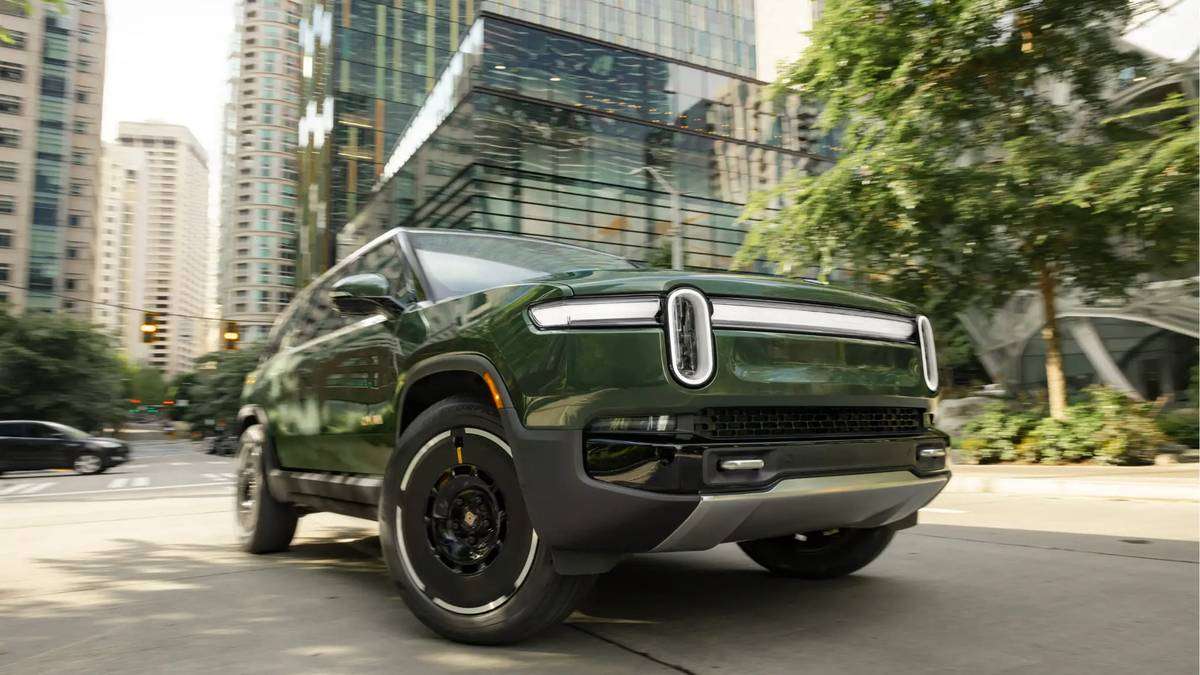
During the recent Texas deep freeze, one Rivian R1S owner discovered that his electric SUV could double as something far more utilitarian than a people mover.
Faced with plunging temperatures and a vulnerable home setup, he pressed the Rivian into service as an emergency garage heater, not for comfort, but to keep his plumbing alive.
The situation was shaped by a regional quirk that still surprises anyone who has lived through northern winters.
The owner’s tankless water heater is mounted on an exterior wall of the garage, a common practice in parts of Texas but one that becomes problematic when temperatures dip into the teens and single digits.
Previous cold snaps had already resulted in frozen pipes, even with water left dripping. This time, with a Rivian R1S sitting just 18 inches from the wall where the heater is installed, inspiration struck.
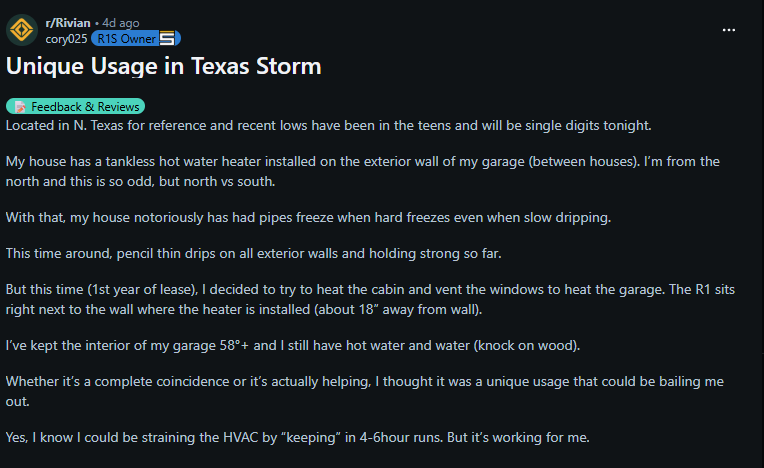
“Located in N. Texas for reference and recent lows have been in the teens and will be single digits tonight.
My house has a tankless hot water heater installed on the exterior wall of my garage (between houses). I’m from the north, and this is so odd, but north vs south.
With that, my house notoriously has had pipes freeze during hard freezes, even when there is slow dripping.
Advertising
This time around, pencil-thin drips on all exterior walls are holding strong so far.
But this time (1st year of lease), I decided to try to heat the cabin and vent the windows to heat the garage. The R1 sits right next to the wall where the heater is installed (about 18” away from the wall).
I’ve kept the interior of my garage 58°+ and I still have hot water and water (knock on wood).
Whether it’s a complete coincidence or it’s actually helping, I thought it was a unique usage that could be bailing me out.
Yes, I know I could be straining the HVAC by “keeping” in 4-6-hour runs. But it’s working for me.”
Instead of relying solely on pencil-thin drips and hope, the owner began running the Rivian’s HVAC system and venting heat into the garage by cracking windows. The approach was simple, almost improvised. Heat the cabin, let that warmth bleed outward, and use the mass of the vehicle and its resistive heating system as a giant electric space heater. The sessions ran in four to six-hour stretches, long enough to stabilize the space without completely draining the battery.
Rivian R1S: Air Suspension & Battery Capacity
- The R1S packages three rows into a relatively compact footprint, offering genuine passenger flexibility while leaving the third row best suited to shorter trips or smaller occupants.
- Air suspension enables meaningful ground-clearance adjustment, supporting off-road use but adding system complexity compared with conventional fixed suspension setups.
- Interior design prioritizes clean surfaces and durable materials, creating a modern, outdoors-oriented cabin rather than a traditional luxury SUV environment.
- Large battery capacity supports long-trip capability, though curb weight and tire choice have a noticeable impact on real-world efficiency and braking feel.
The results, at least so far, have been convincing. The garage temperature has held at 58 degrees or higher while outdoor temperatures dropped into the teens and threatened to go lower. More importantly, hot water continued to flow, and pipes stayed intact. Whether the Rivian was the decisive factor or merely a helpful supplement remains an open question, but when your plumbing survives a freeze that previously caused failures, correlation feels close enough to causation.
There is an interesting technical layer beneath this anecdote. Depending on the generation, Rivian HVAC systems either use resistive heating or a heat pump. In the resistive case, the vehicle is essentially converting battery energy directly into heat, making it a very large, very expensive space heater.
In the heat pump scenario, things get more nuanced, since the system is primarily moving heat rather than creating it. Several commenters debated whether running AC or heat would be more effective, and whether opening doors or windows would improve airflow. The takeaway is that even among EV owners, the thermodynamics are still being actively explored in real-world use.
Concerns about stressing the HVAC system were raised, but experienced Rivian owners were quick to reassure. Extended HVAC operation is not unusual for these vehicles, especially among people who camp, road trip, or use Pet Comfort Mode for days at a time. Running climate control for hours at a stretch is well within the system’s design envelope, particularly compared to the loads imposed during driving.
The broader context here matters. Texas has now experienced multiple deep freezes in just a few years, yet building practices in many areas still assume cold snaps are rare anomalies. Exterior-mounted tankless water heaters, lightly insulated garages, and exposed plumbing all reflect that assumption. As one commenter noted bluntly, the state may need to rethink how homes are built, because these conditions are no longer outliers.
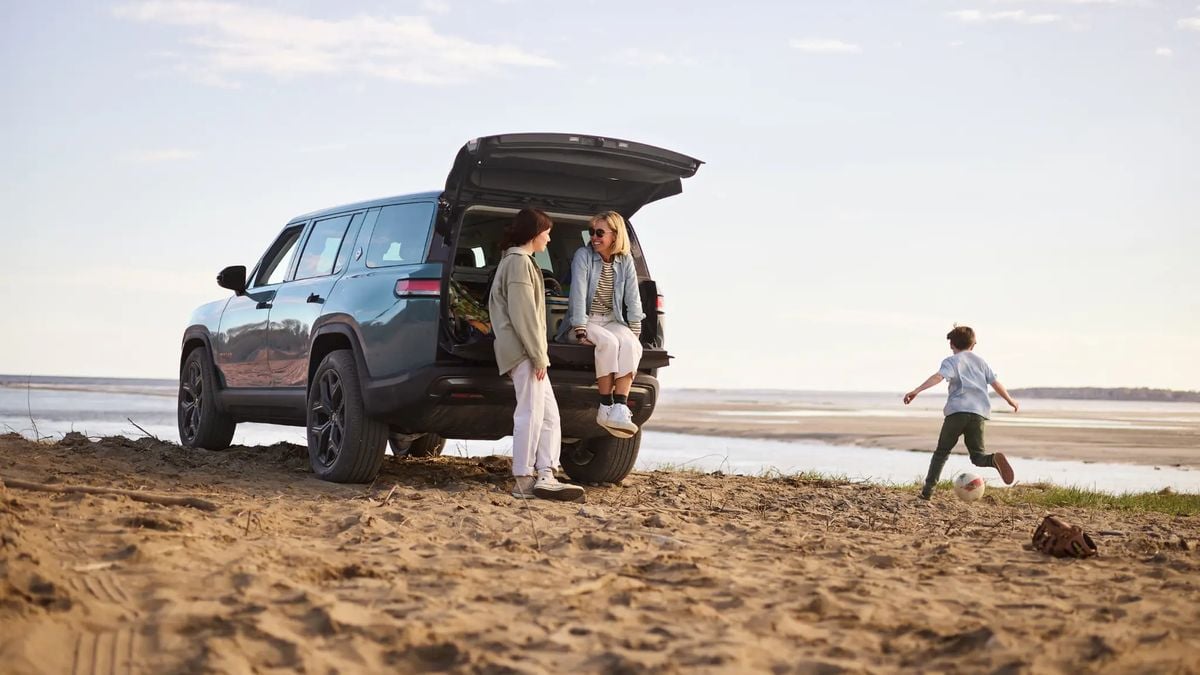
What makes this story compelling is not just the ingenuity, but what it says about the evolving role of electric vehicles. The Rivian was not plugged into a fast charger, saving the grid or powering a house through bidirectional charging. It was simply sitting there, quietly radiating heat, acting as a thermal buffer between fragile infrastructure and an unforgiving environment. No app update required, no special mode activated.
This is not a recommendation so much as an observation. When temperatures fall and systems are stressed, people use what they have. In this case, an electric SUV with a large battery and robust HVAC became a temporary piece of home infrastructure. It may not be what Rivian had in mind, but it worked. And in a Texas freeze, “it worked” is often the only metric that matters.
Image Sources: Rivian Media Center
Noah Washington is an automotive journalist based in Atlanta, Georgia. He enjoys covering the latest news in the automotive industry and conducting reviews on the latest cars. He has been in the automotive industry since 15 years old and has been featured in prominent automotive news sites. You can reach him on X and LinkedIn for tips and to follow his automotive coverage.
Set Torque News as Preferred Source on Google
Follow us today...