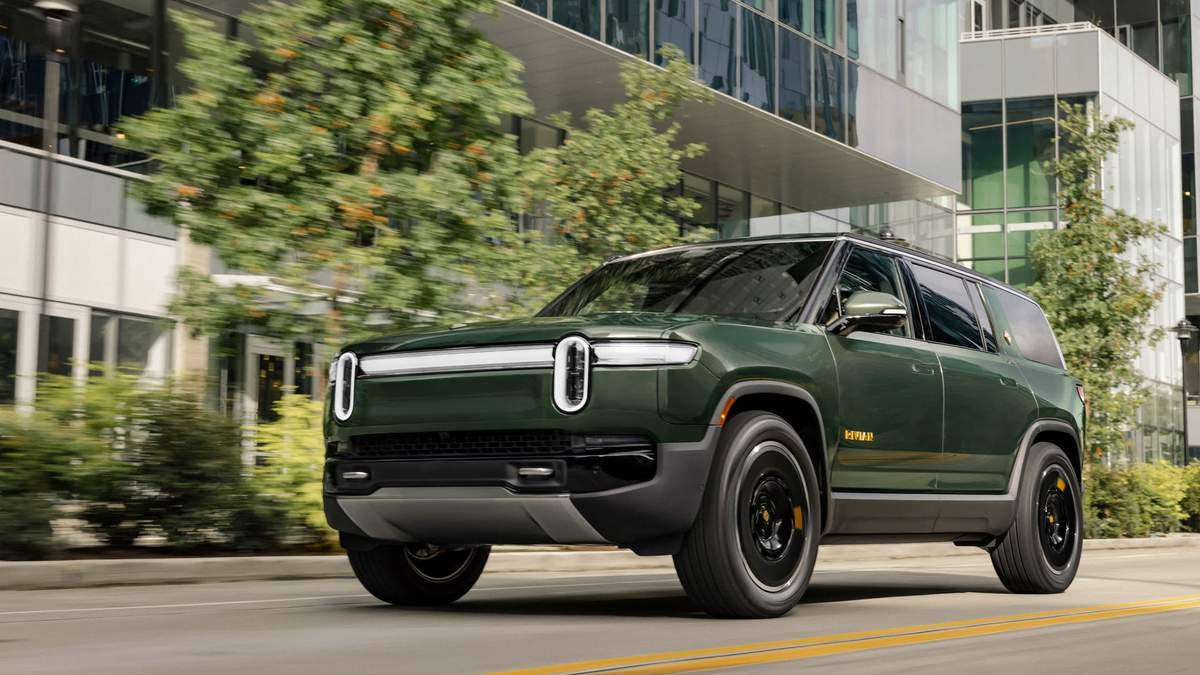

The Rivian R1S is many things, but gentle on tires has never been one of them.
With curb weight north of three tons, instant torque on tap, and suspension tuning that encourages more enthusiasm than its size suggests, rubber life is always going to be a negotiation.
For one owner, that negotiation ended abruptly at 20,000 miles when the factory Pirelli Scorpion tires, priced at nearly $580 apiece, were already worn smooth.
What followed is a familiar modern ownership story, part frustration, part discovery, and, unexpectedly, part redemption.
Posting to r/Rivian, the owner laid out the case plainly. The OEM Scorpions were not disastrous out of the gate, but they deteriorated quickly, growing louder as the miles stacked up and offering tread life that felt wildly out of proportion to their cost.
Bald tires at 20K miles are not unheard of on heavy EVs, but they sting more when the replacement quote approaches luxury-car absurdity.
Faced with that math, the owner started looking elsewhere and landed on an unlikely candidate: the Hankook iON HT.
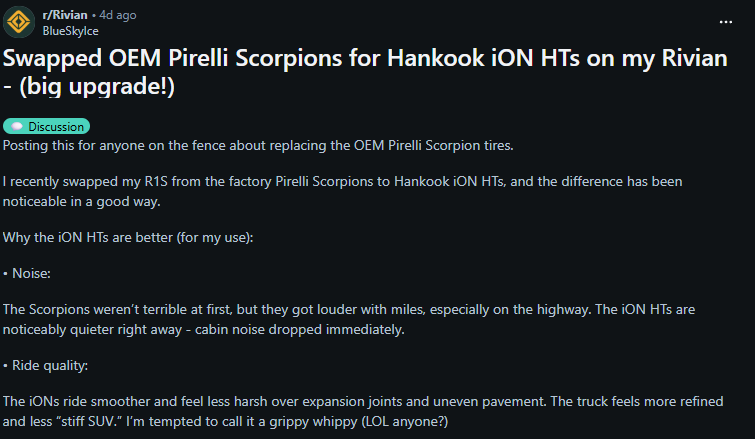
“Posting this for anyone on the fence about replacing the OEM Pirelli Scorpion tires.
I recently swapped my R1S from the factory Pirelli Scorpions to Hankook iON HTs, and the difference has been noticeable in a good way.
Why the iON HTs are better (for my use):
Noise:
The Scorpions weren’t terrible at first, but they got louder with miles, especially on the highway. The iON HTs are noticeably quieter right away - cabin noise dropped immediately.
Ride quality:
The iONs ride smoother and feel less harsh over expansion joints and uneven pavement. The truck feels more refined and less “stiff SUV.” I’m tempted to call it a grippy whippy (LOL, anyone?)
Efficiency/range:
I expected a range hit because the iON HTs look more aggressive and all-terrain-like than the Scorpions. Surprisingly, range has stayed about the same for me so far with no meaningful drop in efficiency. And I’ve also been doing snow mode a lot lately with these storms. Big surprise for me that I don’t see a big shift here.
Advertising
Tread life & construction:
The OEM Scorpions wore faster than I expected, given the price. And that is putting it nicely. IMHO, the Scorpions are awful. The lifespan of the Pirellis is stupid low, and mine went bald after 20k miles. The iON HTs have a higher treadwear rating and feel more confidence-inspiring for daily driving.
Wet traction:
Wet performance has been better for me, too, with more confident launches and braking compared to the Scorpions.
Looks:
Subjective, but I think the iON HTs actually look more aggressive than the OEM Scorpions. They have a subtle all-terrain vibe without going full A/T, which fits the Rivian well. And they have this cool lightning bolt type pattern, which IMO looks cool.
Price:
This was a big factor for me. And this is the primary reason I even looked at Hankooks. I’ve never bought, had, or considered Hankook ever in my life, and only found them when researching what very few options we have in the Rivian community. As many of you are aware, it’s been either the Michelin Defender or the Pirelli Scorpions. The OEM Pirelli Scorpions are nearly $600 per tire (I was quoted ~$578 each). (And what a stupid price for a crappy short-life tire!). The Hankook iON HTs came in around $340 per tire. That’s a massive gap for a tire that, in my experience, performs better on-road.
Bottom line:
If you use your Rivian mostly on pavement with bad weather mixed in, the Hankook iON HTs feel like a better overall match than the factory Pirellis - quieter, smoother, just as efficient, and way easier on the wallet.
TLDR:
Expected range hit = nope
Wallet happier, cabin quieter, zero “regrets.”
Pirelli = thanks for your service, but go take a walk.
Side note: if anyone found this post helpful and wants to use my Rivian referral to help a brother out, please feel free to DM me - much appreciated!”
At roughly $340 per tire, the Hankook immediately reset expectations. This was not a marginal discount, but a dramatic one, especially in a tire category where Rivian owners have relatively few options. Skepticism was understandable. Hankook is not the default prestige brand in this space, and the iON HT’s appearance suggests something closer to an all-terrain tire than a slick efficiency play. The assumption was that range would take a hit and refinement would suffer. Instead, the opposite happened.
Rivian R1S: Three-Row Electric SUV
- The R1S fits three rows into a footprint smaller than many full-size SUVs, prioritizing versatility while leaving the third row better suited for shorter trips or smaller passengers.
- Adjustable air suspension allows meaningful changes in ride height, supporting both highway comfort and off-road use, though it adds complexity and weight.
- Cabin materials emphasize durability and simplicity, aligning with outdoor-oriented use rather than traditional luxury SUV expectations.
- Vehicle mass plays a clear role in daily driving, influencing braking feel and efficiency, especially when fitted with larger wheels or all-terrain tires.
Noise was the first revelation. Where the Scorpions grew increasingly vocal over time, especially at highway speeds, the iON HTs quieted the cabin immediately. Road roar diminished, the background hum softened, and the R1S took on a calmer demeanor that better matched its premium interior. Ride quality followed suit. Expansion joints and broken pavement were handled with more composure, taking some of the edge off the Rivian’s otherwise taut, SUV-forward tuning.
Efficiency, the ever-present concern for EV owners, turned out to be a non-issue. Despite weighing roughly 11 pounds more per tire, real-world range remained effectively unchanged. Even with frequent use of snow mode during winter storms, the owner reported no meaningful drop in efficiency. Other commenters echoed the experience, suggesting that lower rolling resistance may be offsetting the additional mass. Physics is rarely kind, but sometimes it balances the books.
Wet-weather performance further tilted the scales. Compared with the outgoing Pirellis, the Hankooks delivered more confident braking and cleaner launches in the rain, reinforcing the sense that this was not a compromise tire chosen solely on price. The tread design, which carries a subtle all-terrain aesthetic without fully committing to it, also earned unexpected praise. On the R1S, it looks purposeful rather than misplaced, giving the vehicle a tougher stance without signaling weekend rock-crawling cosplay.
Then there is the warranty, the quiet headline hiding behind all the subjective impressions. The iON HT carries an 80,000-mile treadwear warranty, a figure that eclipses most competitors in this size and class. Michelin comes close. The OEM Pirellis, by comparison, offer little reassurance once installed from the factory. For owners staring down the long-term cost curve of EV ownership, that warranty alone changes the equation. It all but guarantees that the next tire replacement will not arrive as a financial ambush.
The comment section filled in the rest of the picture. Other R1S and R1T owners confirmed similar experiences, reporting stable efficiency and improved daily drivability. Some admitted their biggest range variable lived between the seat and the steering wheel, not in the tire compound. Others thanked the original poster for providing the kind of real-world, organized feedback that is still rare in the Rivian ecosystem, where many products are new and long-term data is still forming.
What makes this swap notable is not just that it worked, but that it worked so completely. Quieter ride, better wet grip, unchanged range, dramatically lower cost, and an 80,000-mile warranty is not a trade-off. It is an outright win. The Rivian R1S did not become a different vehicle on Hankook iON HTs, but it did become a more relaxed, more livable one, without asking its owner to pay a premium for the privilege.
This story lands differently. Sometimes the aftermarket does not just fix a problem. Sometimes it exposes one. The factory Pirelli Scorpions did their job, briefly. The Hankooks appear ready to do it for four times as long, at nearly half the price. For an SUV built to go the distance, that may be the most important upgrade of all.
That small, telling victory matters because it arrives at a moment when Rivian is asking owners to recalibrate expectations, about value, about polish, and about how much friction is acceptable in exchange for something that still feels genuinely special. The R1S remains an enormously appealing object, but increasingly its story is shaped less by singular breakthroughs and more by accumulation: small wins, small regressions, and the owner’s tolerance for living with both at the same time.
For the R1S, the news is less about a single new model year feature and more about how the vehicle fits into Rivian’s shifting business reality. In 2025, Rivian delivered 42,247 vehicles versus 51,579 in 2024, an 18% decline, and Q4 2025 deliveries were just 9,745 units, 31% down year over year and slightly below Wall Street expectations.
What do you think is next for Rivian? Let us know in the comments below.
Image Sources: Rivian Media Center
Noah Washington is an automotive journalist based in Atlanta, Georgia. He enjoys covering the latest news in the automotive industry and conducting reviews on the latest cars. He has been in the automotive industry since 15 years old and has been featured in prominent automotive news sites. You can reach him on X and LinkedIn for tips and to follow his automotive coverage.
Set Torque News as Preferred Source on Google
Follow us today...