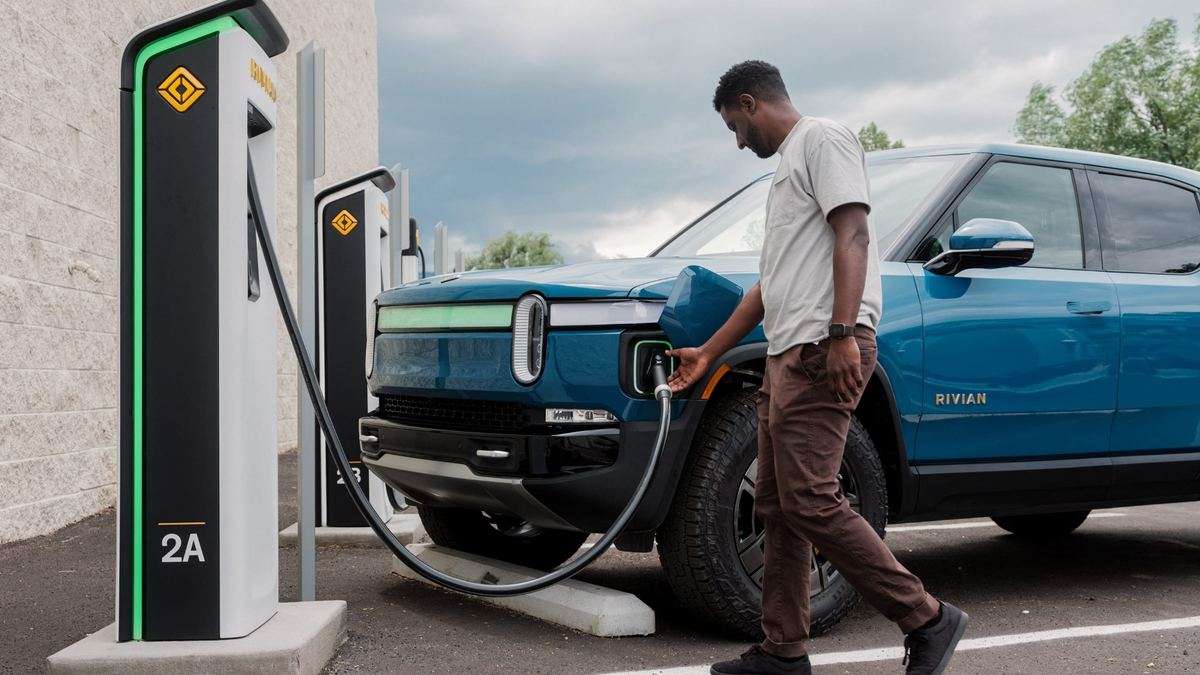

The promise of electric adventure vehicles like the Rivian R1S often conjures images of effortless traversal over challenging terrain, from rocky trails to deep snow. Yet, for one owner, a recent encounter with a seemingly innocuous snowbank led to unexpected frustration, exposing a peculiar software hiccup rather than a mechanical deficiency. This incident reveals the evolving nature of vehicle reliability, where traditional hardware concerns are increasingly intertwined with the complexities of advanced software.
Ivan Gordienco, in the "RIVIAN Electric Vehicles Discussion" group, recently shared his experience:
"UPDATE: A few weeks ago, I posted about my R1S refusing to climb on and off a snowbank like it suddenly forgot it was an SUV. The comment section immediately diagnosed the problem: “All-season tires!” Bold theory, but Incorrect theory. Also, for the record, not the driver's fault and absolutely not the driver’s parents.
The solution was the automotive equivalent of “have you tried turning it off and on again?” I did a hard reset.
Now it climbs up snowbanks like a champ. All four tires in snow, zero drama. Turns out it just needed a quick nap."
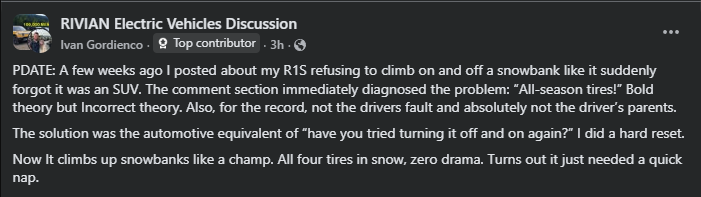
Gordienco's initial post about his R1S struggling with a snowbank immediately drew a flurry of comments, many of which defaulted to the common wisdom regarding winter performance: the tires. It's a reflex in the automotive community, and often a correct one, to point to the contact patch as the primary determinant of traction. However, this incident serves as a stark reminder that in the age of sophisticated electronic control units and complex algorithms, the problem isn't always mechanical.
Rivian R1S: Understanding Its Off-Road and Software Capabilities
- The Rivian R1S is an all-electric SUV designed for both on-road comfort and significant off-road prowess, featuring independent air suspension and advanced torque vectoring. Its quad-motor setup provides precise control over each wheel's power delivery, crucial for challenging terrain.
- Standard R1S models typically come equipped with all-terrain tires that offer a balance of on-road manners and off-road grip, though dedicated winter tires are recommended for optimal performance in severe snow and ice. The vehicle's ground clearance can be adjusted from 7.9 to 14.9 inches, enhancing its ability to clear obstacles.
- Rivian vehicles rely heavily on over-the-air (OTA) software updates, which can introduce new features, improve existing ones, and address bugs or performance issues. These updates are a cornerstone of the modern EV ownership experience, continually evolving the vehicle's capabilities.
- The R1S's sophisticated traction control and stability systems are managed by complex software algorithms that interpret sensor data from all four wheels, the suspension, and steering to optimize grip and stability in various driving conditions. A temporary software glitch can disrupt this intricate coordination.
The assumption that "all-season tires" were the culprit, while a reasonable first guess for any vehicle struggling in snow, misses the fundamental shift in modern automotive engineering. Today's vehicles are as much rolling computers as they are mechanical marvels.
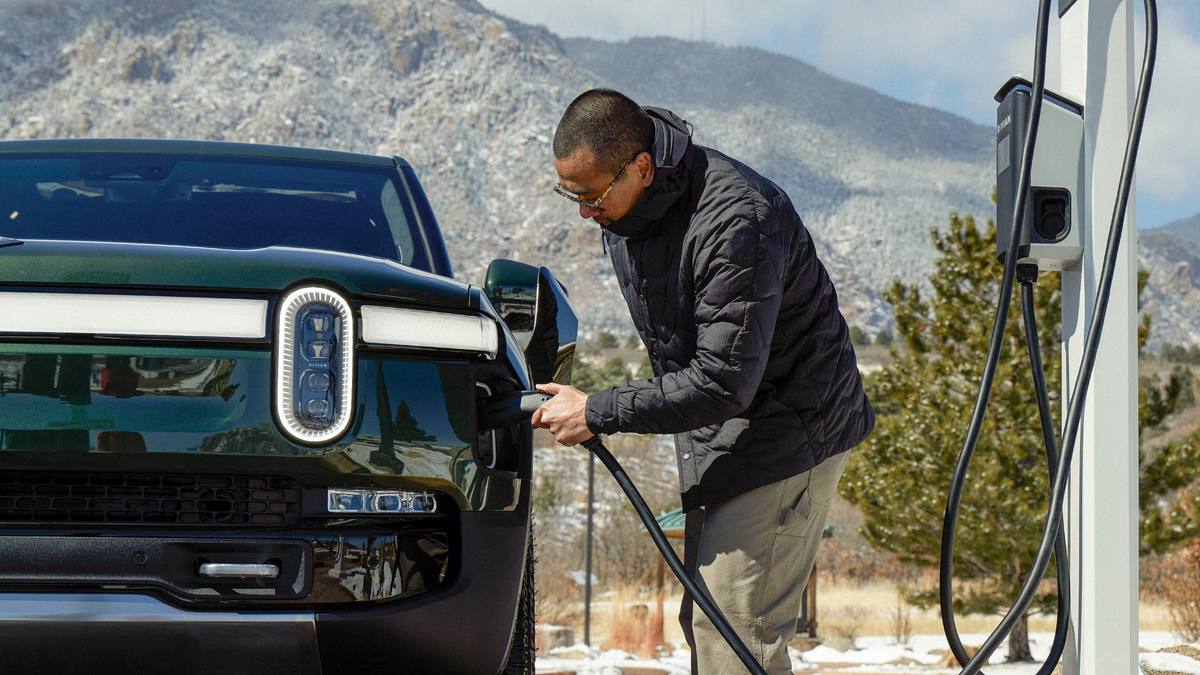
To immediately blame the tires without considering the vehicle's sophisticated traction control, torque vectoring, and suspension management systems is to overlook the very technology that defines a vehicle like the R1S. It's akin to blaming a flat tire when the car's navigation system suddenly stops working; the two are often unrelated.
The resolution, as Gordienco described, was disarmingly simple: a hard reset. This "automotive equivalent of turning it off and on again" suggests a software hang-up, a temporary glitch in the R1S's electronic brain that prevented its advanced systems from properly engaging. The fact that a full system reboot restored full capability, allowing the vehicle to "climb up snowbanks like a champ," points directly to a software anomaly rather than a physical limitation.
This scenario is not unique to Rivian; it's an increasingly common occurrence across the automotive landscape, particularly with vehicles packed with cutting-edge technology. Manufacturers are pushing the boundaries of what software can control, from powertrain management to chassis dynamics. While these systems offer unparalleled performance and safety, they also introduce new vectors for intermittent issues that can be perplexing to diagnose and resolve. A hard reset, much like rebooting a smartphone, clears temporary memory and reinitializes software, often resolving minor, non-critical glitches.
The incident shows a critical aspect of modern vehicle ownership: understanding the interplay between hardware and software. For decades, troubleshooting involved checking fluid levels, tire pressure, or battery terminals. Now, owners must contend with potential software bugs that can manifest as performance limitations, even in a vehicle designed for extreme capability. It forces a re-evaluation of what "reliability" truly means in the 21st century.
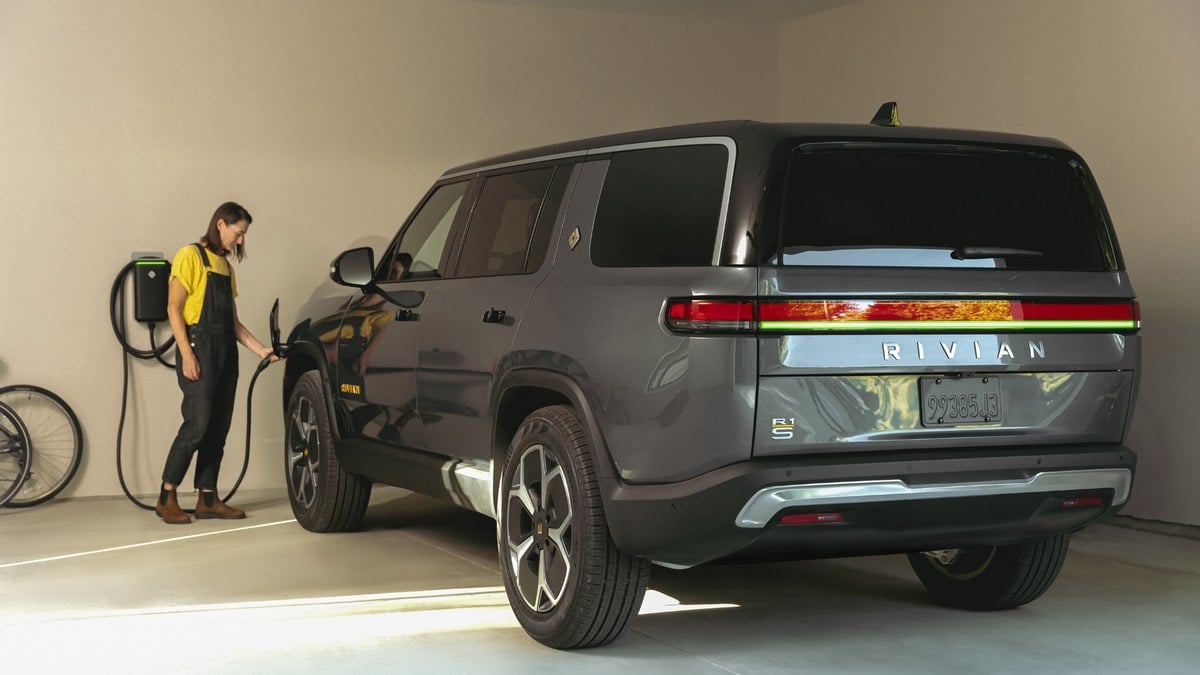
This isn't to say that tire choice is irrelevant for snow performance; far from it. Proper winter tires remain the single most effective upgrade for cold-weather traction and safety. However, Gordienco's experience illustrates that even with the right rubber, a vehicle's inherent capabilities can be temporarily hobbled by an electronic oversight. It's a nuanced problem that requires owners and service technicians alike to expand their diagnostic toolkit beyond the purely mechanical.
The R1S's swift recovery after a hard reset is a testament to the power of software to both hinder and restore functionality. It also serves as a valuable lesson for the broader automotive community: not every performance anomaly, particularly in a highly computerized vehicle, is a hardware defect or a driver error. Sometimes, the solution is as simple as letting the system take a "quick nap" and wake up refreshed.
Image Sources: Rivian Media Center
Noah Washington is an automotive journalist based in Atlanta, Georgia. He enjoys covering the latest news in the automotive industry and conducting reviews on the latest cars. He has been in the automotive industry since 15 years old and has been featured in prominent automotive news sites. You can reach him on X and LinkedIn for tips and to follow his automotive coverage.
Set Torque News as Preferred Source on Google
Follow us today...