
Peter Culin’s return run from San Diego produced the kind of EV towing record I trust: four driving legs, three meaningful fast-charge sessions, and numbers ugly enough to teach us something.
The Rivian R1S covered 374.2 miles while pulling a dual-axle Passport travel trailer. It consumed 342.7 kWh, averaged 1.09 miles per kWh, spent 7 hours and 43 minutes moving, and remained plugged in for another 2 hours and 36 minutes. Charging added 269.6 kWh. Peak power reached 199.1 kW. Desert temperatures at the charging stops ran from 106 to 113 degrees.
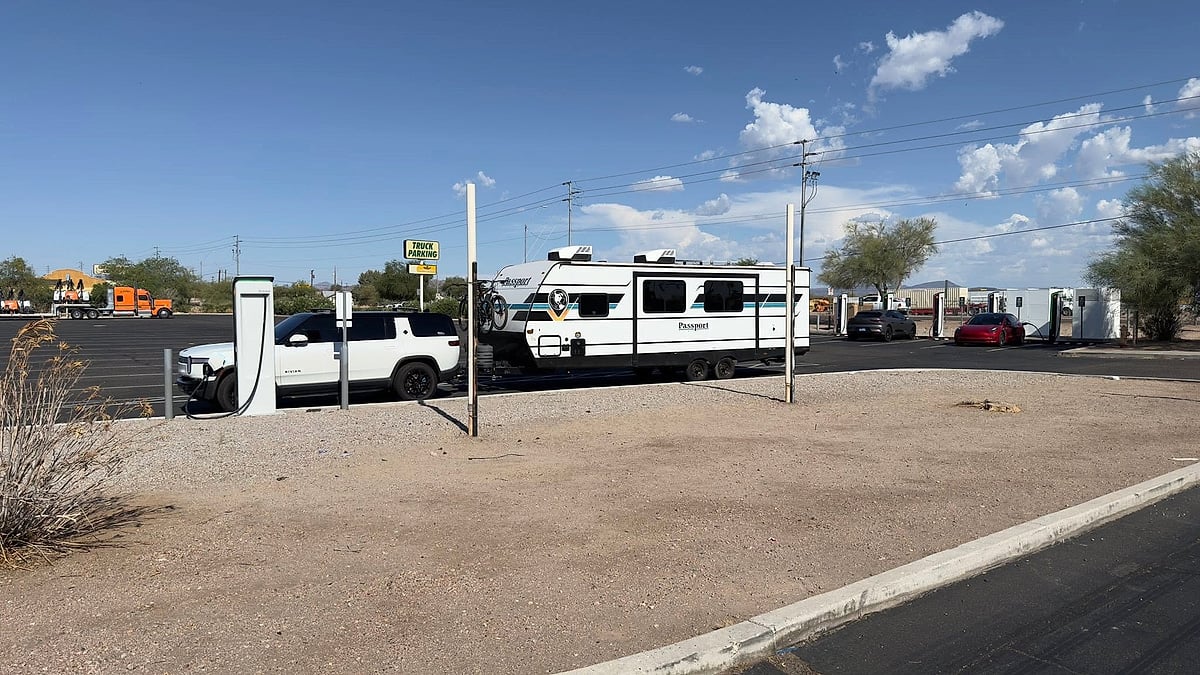
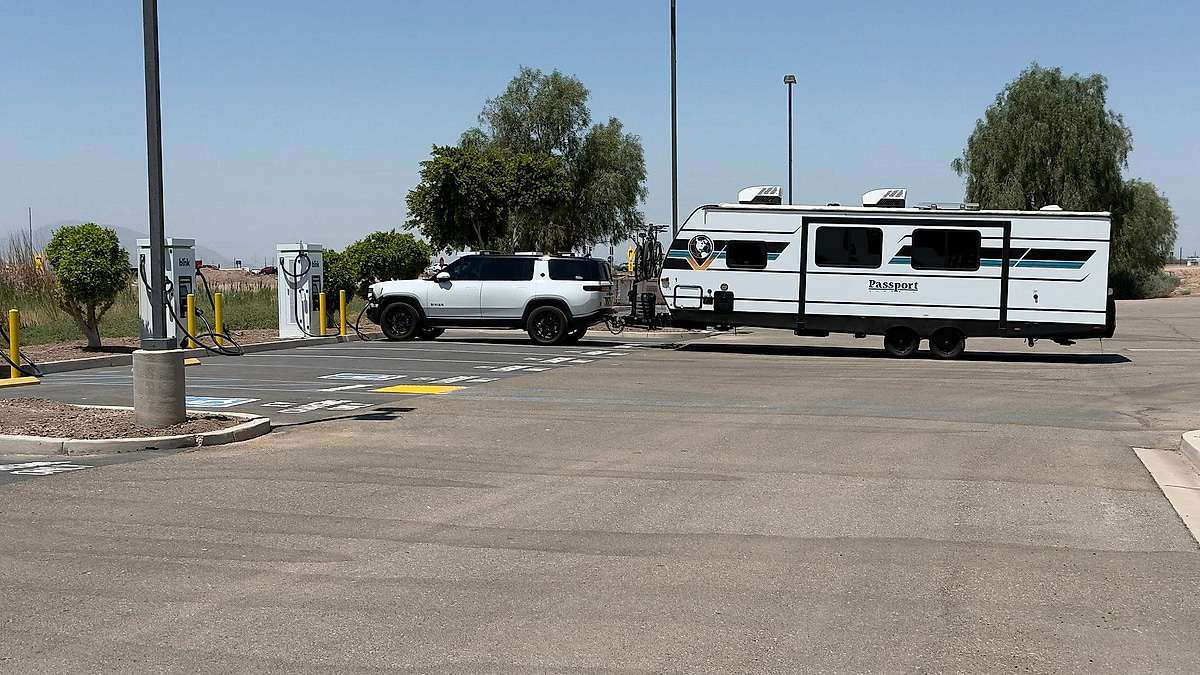
According to the Facebook post, the trip’s most useful technology sat outside the Rivian: enough pavement around the chargers to leave the trailer attached.
What This Trip Reveals About Real-World EV Towing
- The practical towing range was closer to 75-125 miles per leg than Rivian's unloaded range estimates. The longest stretch was 123.7 miles, and it arrived with just 9 percent battery remaining in extreme desert heat.
- Charging speed mattered less than charging access. All three major stops allowed the trailer to remain attached, eliminating the time, hassle, and risk of unhitching a travel trailer at every charging session.
- The first charge stop consumed nearly half of the total charging time. Charging from 9 to 90 percent took 73 minutes, while the later sessions ending at 64 and 73 percent took just 43 and 40 minutes, highlighting how expensive the final 20 percent of battery capacity can be in both time and convenience.
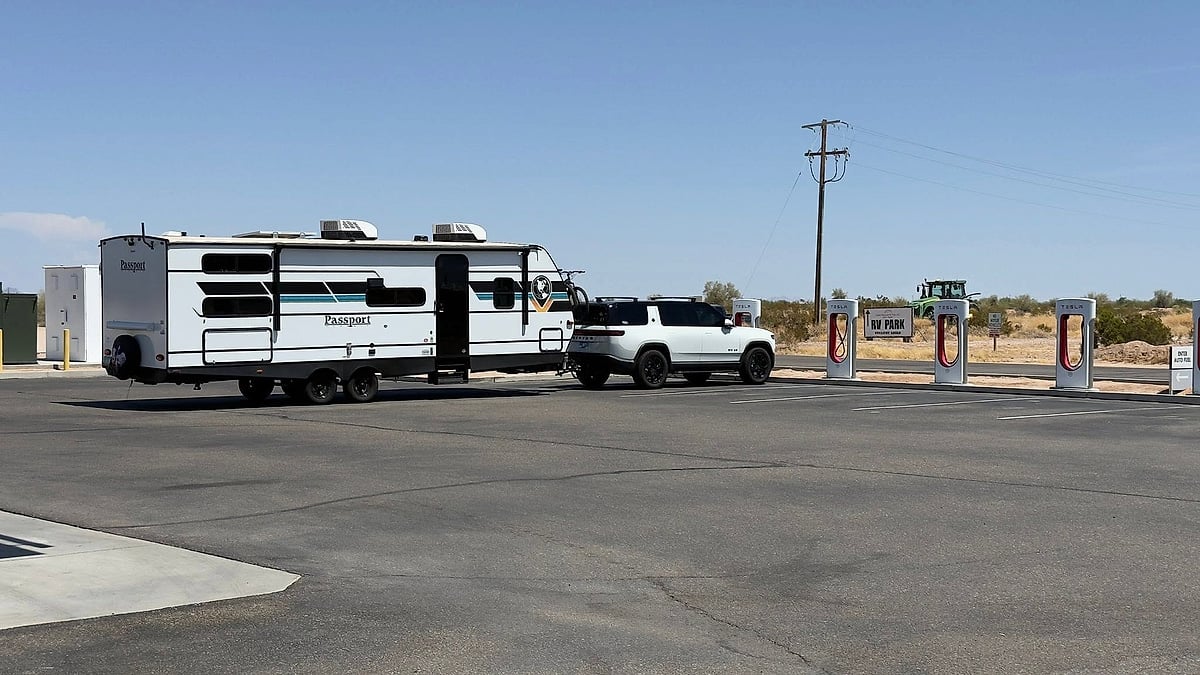
Culin found a dedicated trailer space at the Rivian Adventure Network site in Gila Bend, generous maneuvering room around Tesla’s Tacna Superchargers, and a new Blink site in Heber, California, with 20 plugs and a lot large enough for trucks and RVs. Pull in. Plug in. Pull out.
That sounds embarrassingly basic. It may decide whether electric towing grows beyond hobbyists who enjoy solving logistics puzzles.
The R1S Paid 916 Watt-Hours For Every Mile
Divide 342.7 kWh by 374.2 miles, and the R1S used about 916 Wh per mile. The app showed a rated baseline of 2.66 miles per kWh. Towing delivered roughly 41 percent of that figure, a 59 percent efficiency loss.
Heat, speed, grades, trailer shape, air-conditioning load, and rolling resistance all took their share.
The first leg covered 123.7 miles and pulled the battery from 100 percent to 9 percent. A straight extrapolation from that first leg puts full-pack towing range near 136 miles under the day’s conditions. No sensible route plan should count on using the final mile, so the practical leg was shorter.
The log still carries unusual value. Few owner posts provide four legs, state-of-charge changes, energy use, charging power, and elapsed time in one place.
The Charging Curve Wrote The Schedule
The first 123.7-mile leg used 113.6 kWh and ended at 9 percent. The following charge added 109.2 kWh, took the battery to 90 percent, and lasted 1 hour and 13 minutes. Average power was 97.2 kW, with a 147.4-kW peak.
The next drive covered 99.8 miles, used 99.6 kWh, and ended around 11 percent. Culin then charged from 10 to 64 percent in 43 minutes, adding 77.3 kWh. Average power climbed to 113.2 kW and peak power reached 194.3 kW.
The third stop worked even better. After a 75.8-mile leg, the R1S arrived at 15 percent and charged to 73 percent in 40 minutes. It added 82.7 kWh at 130.2 kW average, with the trip-high peak of 199.1 kW. The final 74.9-mile drive ended at 18 percent.
The pattern deserves a circle in red pencil. Charging to 90 percent consumed 73 minutes. The later stops ended at 64 and 73 percent, and each took around 40 minutes. High state of charge slows a session, while extreme heat gives the battery cooling system another full-time job.
The 90-percent stop may have been required by the next charger gap. Route geometry gets the final vote. Still, owners should study this log before treating a 90-percent target as free insurance. A large battery absorbs energy greedily at lower state of charge, then becomes increasingly stubborn near the top.
Across the trip, one hour of charging bought just under three hours of driving. Charging occupied about 25 percent of the combined drive-and-charge time. Add those figures and the return journey took 10 hours and 19 minutes. Effective progress averaged about 36 mph.
The numbers are rough and honest. Some plug time can overlap with food, restrooms, and a break from the wheel, but the vehicle still occupied a charger for 156 minutes.
The Best Charger Feature Was Room
Charger power gets the headlines. Stall geometry controls the day.
Imagine unhitching at all three major stops. Five minutes to disconnect and five minutes to reconnect adds half an hour across the route. Real life can take longer: chocks, jack, safety chains, electrical connector, weight-distributing hardware, uneven pavement, and the small argument that begins when a hot coupler refuses to cooperate.
A trailer-friendly stall returns that time before charging starts.
It lowers the driver’s mental load too. A tow vehicle arriving at 9 or 10 percent in 110-degree heat should slide into a space, plug in, and cool down. Blocking several chargers while attempting a desperate parking maneuver serves nobody.
Gila Bend solved the problem with a dedicated towing space. Tacna solved it through open travel-center geometry. Heber solved it with scale, twenty plugs, and enough room to swing wide. Three different layouts produced the same result: the Passport stayed connected.
I would take a dependable 200-kW charger with a straight exit over a 350-kW cabinet trapped against a curb. Culin’s highest observed peak was 199.1 kW. Another three-digit boast on the dispenser would have changed little unless the R1S could accept it. The pull-through space saved time immediately.
Charger companies still market the cabinet as though its rating completes the job. The site includes the approach lane, cable reach, bollards, turning circle, parking angle, trailer clearance, lighting, and escape path. Trailer-friendly design acts like charging speed because it gives time back. A site that saves 10 minutes of hitch work has improved the trip with no change to electrical output.
Heat And Public-Charging Prices Took Their Cut
Culin said the charging sites were between 106 and 113 degrees. A battery arriving hot from towing has to manage propulsion heat, ambient heat, cabin cooling, and fast-charging heat at once.
The first session peaked at 147.4 kW and averaged 97.2 kW. Later sessions peaked near 200 kW. Battery state, preconditioning, charger capability, and thermal conditions shaped each stop. The owner called heat the only battle. The data backs him up.
The cost screen needs an asterisk the size of the trailer. The trip summary lists $5.47 in charging spend and one cent per mile, but Culin said the software applied his home solar rate to public DC fast-charging sessions.
The $5.47 charging spend and one-cent-per-mile figure cannot support a cost comparison. The separate $76.93 gas-equivalent estimate may use its own assumptions, but the screenshots do not reveal them, so I would not build a savings claim around it.
The trip added 269.6 kWh at public chargers. At 40 cents per kWh, that energy costs about $108. At 50 cents, about $135. At 60 cents, about $162. The full battery at departure adds another cost unless it came from surplus solar or free electricity.
Public charging can erase much of an EV’s fuel-cost advantage when a trailer drives consumption to 916 Wh per mile. Owners need actual receipts before declaring victory over gasoline.
The geometry succeeded. The economics depend on the route.
Rivian Knows The Trailer Is There. Charging Maps Need To Catch Up.
Rivian’s trailer profiles learn a trailer’s mass and aerodynamic behavior, then adapt the range estimate as the vehicle gathers data.
That software becomes more valuable when the route planner understands charging-site geometry with the same precision.
“Trailer accessible” needs a real definition. Can a truck-and-trailer rig enter without reversing into traffic? Can it charge without blocking neighboring stalls? Can it leave if another driver parks badly? Is the towing stall occupied by an unhitched car? Does the cable reach the charge port from the intended lane?
These are navigation questions now.
A charger map that knows plug count but ignores trailer clearance is half awake. Rivian, Tesla, Blink, IONNA, Electrify America, and every other network should publish verified approach diagrams for towing sites. Satellite imagery and owner photographs currently fill the gap, which is useful until construction, parked cars, or a badly placed bollard changes the answer.
Culin’s run proves the Phoenix-San Diego corridor can support electric towing with the right stops. The next attempt could move faster by leaving the first charger as soon as the next leg has a healthy reserve, unless the gap truly demands 90 percent. The later 64- and 73-percent departures produced better time efficiency. I would choose trailer-friendly locations first, charger brand second, and verify every layout before departure.
In 110-degree weather, I would carry a wider reserve. The owner’s legs ranged from about 75 to 124 miles. That is the useful planning range from this trip, far more useful than the unloaded EPA number.
The R1S used 342.7 kWh to pull a travel trailer 374.2 miles. It crossed the desert corridor without a single unhitch.
One figure describes the physical cost.
The other describes the infrastructure breakthrough.
Electric towing becomes easier when both receive equal attention.
Rivian Owners, Where Can You Charge Without Unhitching?
If you tow with an R1S or R1T, share the charger location, trailer length, stall layout, miles between stops, efficiency, temperature, and whether you stayed connected.
Comment down below.
Images by Peter Culin
About The Author
Noah Washington is an automotive journalist based in Atlanta, Georgia, covering sports cars, luxury vehicles, and performance culture. His reporting focuses on explaining the engineering, design philosophy, and real-world ownership experience behind modern vehicles.
Noah has been immersed in the automotive world since his early teens, attending industry events and following the enthusiast communities that shape how cars are built and driven today. His work blends industry insight with enthusiastic storytelling, helping readers understand not just what a car is, but why it matters.
Noah is also a member of the Southeast Automotive Media Association (SAMA), a professional organization for automotive journalists and industry media in the Southeast.
His coverage regularly explores sports cars, luxury vehicles, and performance-driven segments of the automotive industry, including the evolving culture surrounding Formula Drift and enthusiast builds.
Read more of Noah's work on his author profile page.
You can also follow Noah here:
Set Torque News as Preferred Source on Google
Follow us today...