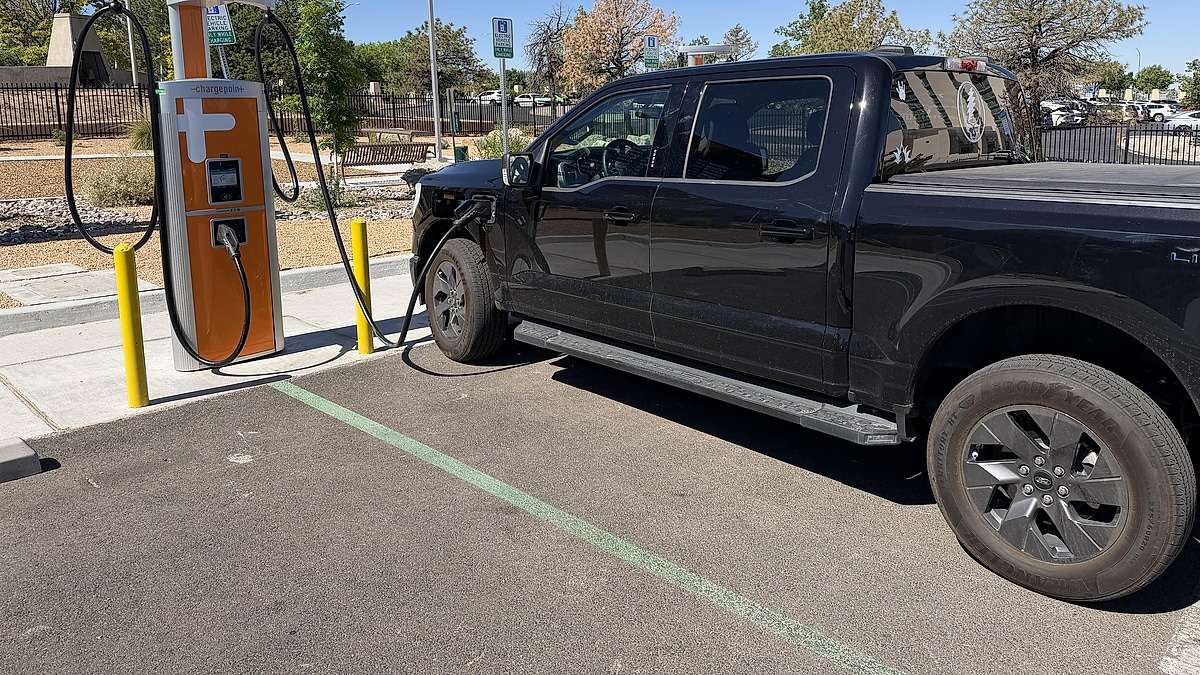

The construction crew at Albuquerque International Sunport got free entertainment with lunch.
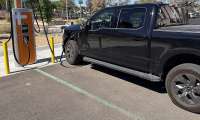
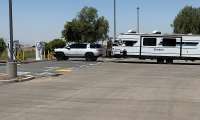
A Ford F-150 Lightning owner pulled into the airport’s cellphone waiting lot to try public DC fast charging for the first time. The truck’s navigation had found the new 160-kW station without drama. He grabbed the cable, lined up the connector, pushed, and waited.
Nothing.
He tried again. Then he tried the other cable. The plug never locked, so the session never began. A row of workers on break had front-row seats while a grown man with a new electric truck appeared unable to perform the automotive equivalent of plugging in a toaster.
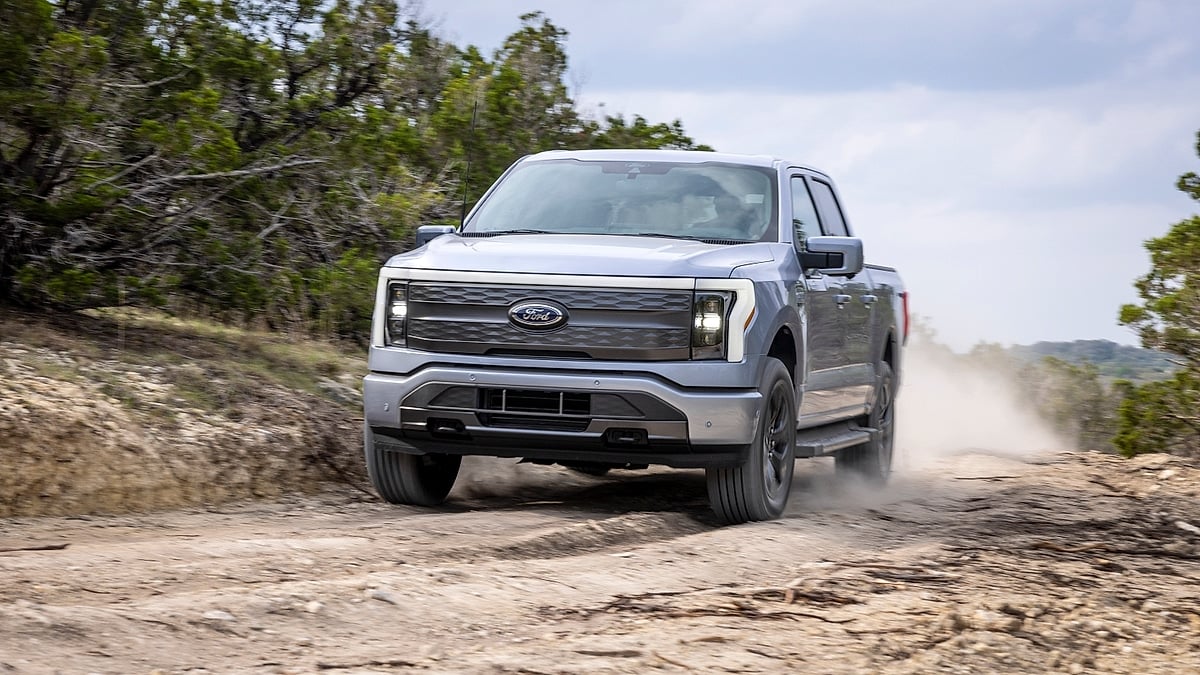
The culprit was caution.
BosqueBuddhist, posting on r/F150Lightning, had never handled a liquid-cooled fast-charging cable. The thing was heavier and less cooperative than he expected, and he stopped pushing before the connector seated fully. Once he gave it a firmer shove, the lock engaged and the charger came alive.
A DC fast-charging cable does not accept a polite handshake. It wants commitment.
Fifteen minutes later, his 2025 Lightning Flash had climbed from roughly 50 to 80 percent. The session cost about $15. The truck worked. The charger worked. The owner left with enough knowledge to avoid repeating the show when the stakes were higher.
That small embarrassment may have been the smartest thing he has done with the truck so far.
Fifteen minutes erased the comedy
The charging result was excellent for the hardware involved.
Ford equips the 2025 Lightning Flash with a 123-kWh usable battery. A 30-percentage-point gain represents roughly 36.9 kWh if the displayed percentages were exact. Delivering that much energy in 15 minutes implies an average near 148 kW, remarkably close to the station’s 160-kW ceiling.
Every EV Owner Has A First-Charge Story
- The Albuquerque Sunport chargers are rated at 160 kW and currently priced at $0.30 per kWh, making them significantly cheaper than many public DC fast chargers that often charge $0.50-$0.70 per kWh.
- A 30% charge gain on a 123-kWh Lightning battery equals roughly 37 kWh of energy, enough for approximately 80-100 miles of real-world driving depending on speed, weather, and payload.
- First-time EV owners can avoid most charging headaches by testing a public fast charger close to home before a road trip, when a failed session is an inconvenience rather than a stranded-on-the-highway emergency.
Battery percentages round, charging losses exist, and the owner described the figures conversationally rather than posting a detailed receipt, so the calculation should remain an estimate. The broad result holds: the truck used nearly everything the charger could give it.
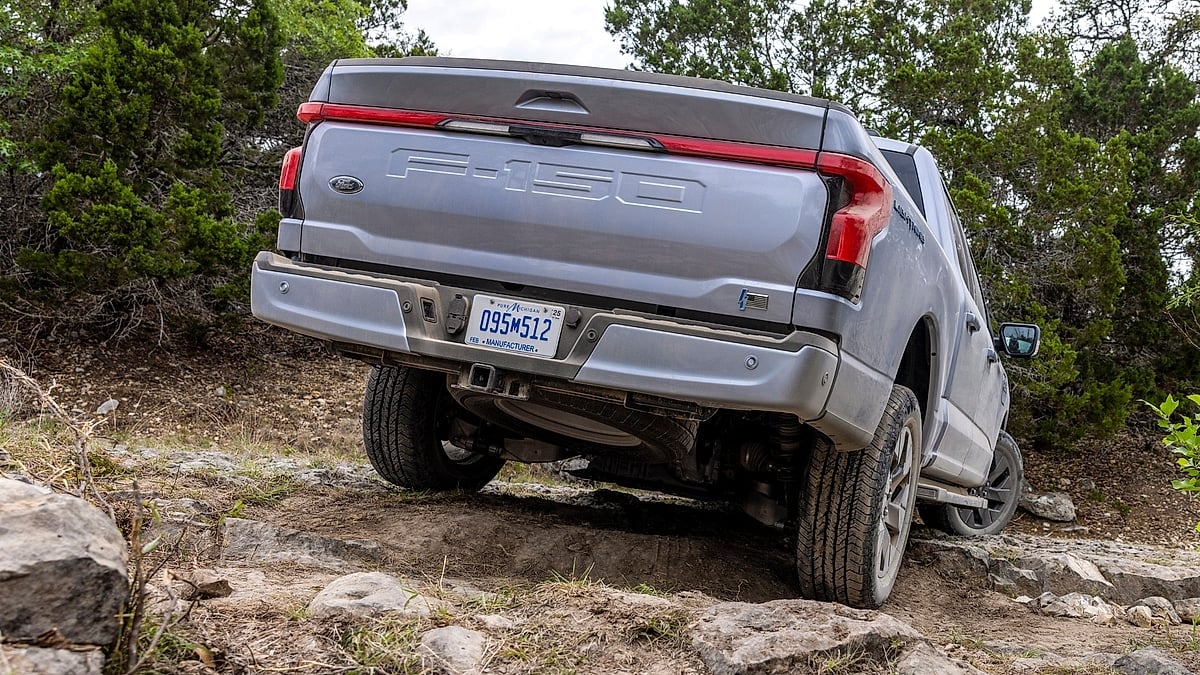
Ford estimates that an extended-range 2025 Lightning can move from 15 to 80 percent in about 38 minutes at a sufficiently powerful DC station. This owner entered at 50 percent, where the truck could still pull hard, and left before the slow upper end of the curve began consuming his afternoon.
The contrast with his home setup borders on absurd.
He normally charges at about 1.1 kW from a 120-volt outlet. Replacing the same 30 percent at that rate would take roughly 34 hours before accounting for losses. At the airport, it took around a quarter-hour.
One truck. A power difference of more than 130 to one.
That is why home charging and road charging should be treated as different tools. Level 1 quietly replaces ordinary daily mileage while the owner sleeps. DC fast charging shoves a road-trip-sized chunk of energy into the battery while somebody visits a restroom and buys coffee.
His first session showed the Lightning can handle both worlds.
The charger was brand new, cheap, and slightly annoying.
The Sunport had opened the chargers only weeks earlier at The Holding Pattern, its cellphone waiting lot. The installation consists of two ChargePoint PL2000 Power Link and Block units rated at 160 kW. The city set the energy price at 30 cents per kWh, a refreshingly sane number in a market where public fast charging can wander past 50, 60, or even 70 cents.
The project received Volkswagen diesel-settlement funding.
There is a certain automotive poetry in that. A diesel scandal helped pay for an electric Ford owner’s first fast-charging lesson at an airport in New Mexico. The car business occasionally writes better jokes than any journalist could manage.
ChargePoint supplied the punchline.
The owner paid an extra dollar because he did not use the company’s app. ChargePoint’s current guest fee for a DC fast-charging session is 99 cents. Even registered users pay 49 cents. On a reported $15 session, app avoidance consumed roughly seven percent of the total bill.
That fee deserves contempt.
The station already charges for electricity. A driver using a credit card has completed a normal commercial transaction. Charging another dollar because the customer declined to install an app feels like a toll booth placed six feet beyond the toll booth.
The owner called it stupid. He was right.
Ford’s navigation found the charger. The charger accepted the truck. The payment system still demanded a separate relationship. That seam between finding, plugging, and paying remains one of public charging’s most stubborn irritations.
The industry keeps announcing network size. Drivers experience individual moments. Heavy cable. Sun glare. Hidden prompt. Unknown fee. App login. Credit-card hold. Release button. A charging map can contain a million plugs and still leave a first-time owner standing beside one like he has discovered alien farm equipment.
Public charging has a driver-training problem
The replies beneath the owner’s post read like an initiation ceremony.
One Lightning driver spent 15 minutes panicking because he forgot to press the button that releases the connector. Another tried to brute-force a cable loose and carried part of the charger home without realizing it. One owner called support and received a patient explanation of his “stupidity.” Two men met at a charger immediately after buying their EVs, admitted neither knew what to do, and learned together.
These are capable adults operating expensive vehicles. The charging ritual lacks a common physical language.
Gas pumps earned their familiarity over generations. Drivers know the sequence before they own a car: open door, remove cap, choose grade, insert nozzle, squeeze handle, replace nozzle. Minor regional variations rarely change the basic choreography.
Public EV charging still improvises.
Some stations require plugging in first. Others want payment first. Some use Plug & Charge. Some need an app. Some accept cards. Some hide the final confirmation prompt in a sun-washed corner of the display. Connectors can weigh enough to surprise a first-time driver. Vehicle locks and release buttons vary. A cable that looks seated may be a fraction of an inch short.
I would make one live DC fast charge part of every EV delivery.
A salesperson should accompany the buyer to a nearby station, route the car there, explain preconditioning, seat the connector, start payment, verify charging power, stop the session, and release the cable. Fifteen minutes of training would prevent a great deal of roadside panic.
The truck itself could help. It knows whether it has ever completed a DC session. On the first arrival at a fast charger, the center screen could display a short checklist:
-
Seat the connector firmly.
-
Confirm the latch.
-
Authorize payment.
-
Verify charging has started.
-
Stop the session before unplugging.
-
Unlock the connector and remove it without force.
That would be more useful than another animated welcome screen.
He chose the perfect place to fail
The owner deserves credit for where and when he attempted this.
He arrived with about 50 percent battery. He was close enough to home that failure would have been inconvenient rather than catastrophic. He had already dropped his wife at the airport and wanted to test high-speed charging before depending on it during a longer trip.
That is exactly how a new EV owner should learn.
Practice locally. Pick a station with alternatives nearby. Arrive with enough battery to leave if the unit fails. Set up payment beforehand. Learn how the connector feels. Learn where the release button lives. Watch the truck’s display long enough to understand what a successful session looks like.
Do not save the first attempt for midnight, 12 percent battery, two tired children, and a charger beside a closed furniture warehouse.
After the airport session, he drove toward Sandia Crest to explore the truck on steep mountain roads. The crest was closed for fire-prevention work, but he still reached the upper stretches, enjoyed the Lightning through the bends, and recovered about five percent on the descent through regenerative braking. He even praised the adaptive cruise control on the mountain hairpins.
That sounds like a good day with a new truck.
The construction workers may have enjoyed his charging struggle. He joked that they could remember it later while paying $5 per gallon. Fair enough. The sharper victory was quieter: he removed one unknown from future road trips.
Cheap tuition
A first public fast charge teaches things no brochure covers.
The cable has weight. The lock needs a full connection. Navigation and payment may live in separate worlds. Guest access can carry petty fees. The peak number printed on the charger means little until the truck begins pulling power. The release sequence deserves as much attention as the connection sequence.
BosqueBuddhist learned all of it with half a battery, a safe route home, and a construction crew available to provide witnesses.
The lesson cost about $15, 15 minutes, and a small bruise to his pride.
Cheap tuition.
Next time he will push until the connector locks, watch the kilowatts climb, and leave before anybody gets the popcorn.
Lightning owners, what tripped you up?
What happened during your first public fast charge: a cable that would not seat, a connector that would not release, an app failure, a hidden screen prompt, or a station that simply refused to cooperate?
Let us know in the comments below.
First image by BosqueBuddhist
About The Author
Noah Washington is an automotive journalist based in Atlanta, Georgia, covering sports cars, luxury vehicles, and performance culture. His reporting focuses on explaining the engineering, design philosophy, and real-world ownership experience behind modern vehicles.
Noah has been immersed in the automotive world since his early teens, attending industry events and following the enthusiast communities that shape how cars are built and driven today. His work blends industry insight with enthusiastic storytelling, helping readers understand not just what a car is, but why it matters.
Noah is also a member of the Southeast Automotive Media Association (SAMA), a professional organization for automotive journalists and industry media in the Southeast.
His coverage regularly explores sports cars, luxury vehicles, and performance-driven segments of the automotive industry, including the evolving culture surrounding Formula Drift and enthusiast builds.
Read more of Noah's work on his author profile page.
You can also follow Noah here:
Set Torque News as Preferred Source on Google
Follow us today...