

Matthew Henry’s red Ford Maverick Hybrid looks like it is trying to pass a stress test it never volunteered for.
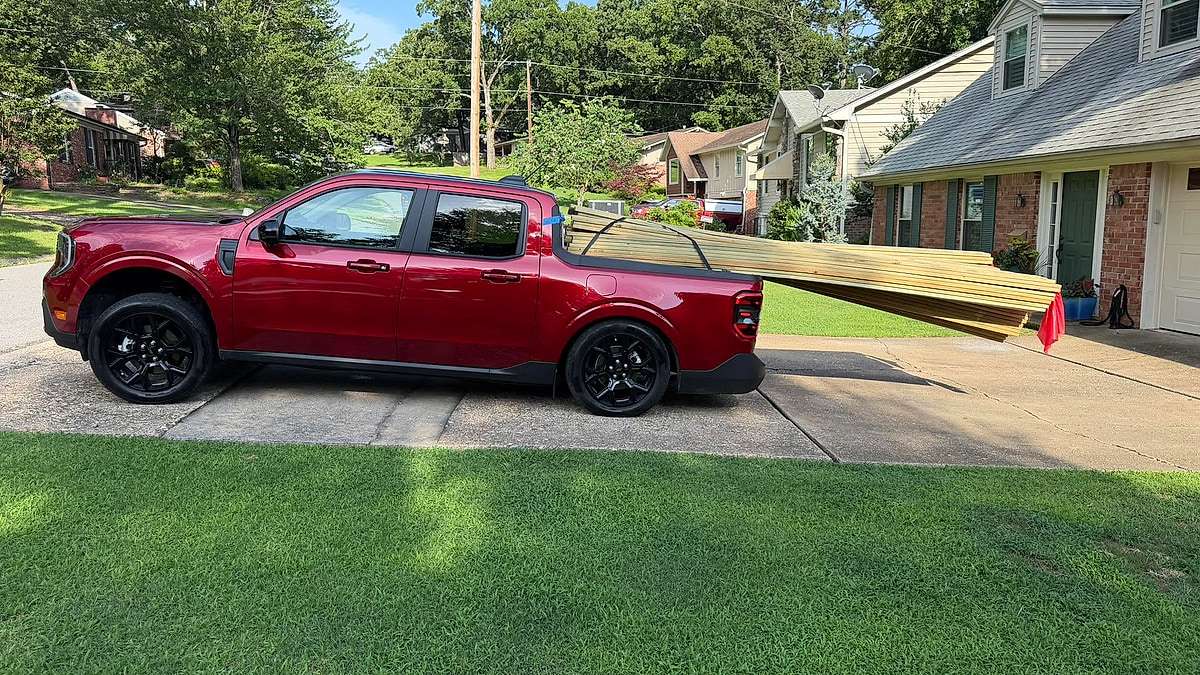
The photo shows a long stack of lumber loaded through the 4.5-foot bed and extending far past the rear of the truck. A red warning flag hangs from the end. The boards appear to be resting high over the closed tailgate, with most of the length hanging out behind the Maverick. The rear suspension looks loaded. The truck is sitting in a residential driveway, clean enough to remind you this was a normal homeowner errand, not a commercial jobsite run with a lumber rack and a fleet number on the door. Henry admitted the obvious. He overloaded it.
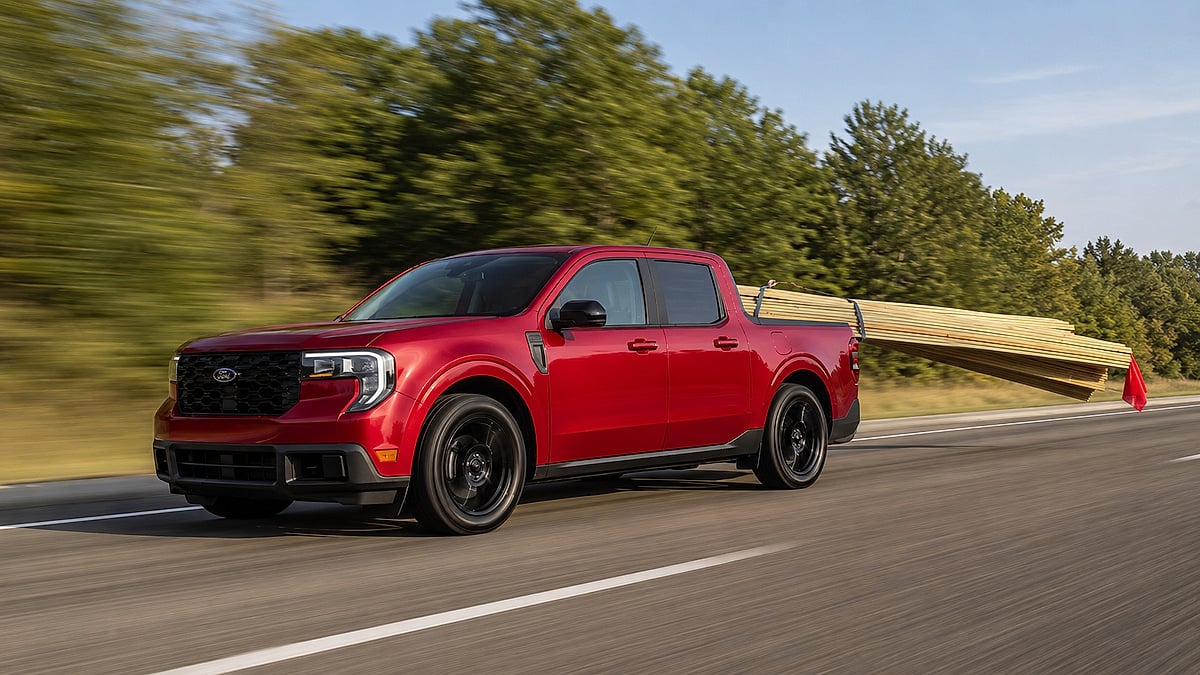
Then he drove 30 minutes on the freeway at about 60 mph. He said it was “not fun.” The truck returned 32 mpg anyway. His tailgate suffered but survived. His verdict was short: tough little truck.
The 32 MPG Number Is Impressive, But It Is Not The Main Lesson
Thirty-two mpg while carrying a load like this is a wild little reminder of why the Maverick Hybrid has become such a useful truck.
A larger pickup would have carried the lumber with more physical confidence, but it would not have returned 32 mpg doing it. A crossover might have delivered good fuel economy, but it would not have had an open bed for dirty, awkward materials. The Maverick sits in the middle: compact, efficient, cheap to run, and just truck enough to tempt owners into jobs that look slightly unreasonable.
That is how this happens.
The fuel economy is real praise for the hybrid system. A freeway lumber run with a compromised aerodynamic load, extra weight, and a cautious 60-mph pace still landed near what many older midsize trucks might get empty on a good day. The Maverick’s 2.5-liter hybrid setup keeps doing the thing owners love: it makes boring errands cheap. But the gas mileage should not distract from the load.
A truck can be efficient while being used badly. A truck can survive a trip that should have been planned differently. A truck can feel “tough” because it made it home, while the owner got lucky on load security, tailgate stress, braking margin, and freeway behavior.
This photo is both a compliment and a warning.
The Bed Is 54.4 Inches Long, And The Lumber Clearly Needed More Truck
Ford lists the Maverick bed floor at 54.4 inches. That is a useful bed for mulch, tools, bags of concrete, coolers, bikes, short boards, trash runs, small furniture, and the endless suburban jobs that make the Maverick so appealing.
Long lumber exposes the bed’s limit immediately.
The photo looks like a stack far longer than the truck’s cargo floor can properly support. The boards extend well beyond the rear bumper, with much of the mass and leverage working against the tailgate area. That is where the danger lives. The problem is not only total weight. It is where the weight sits and how much leverage the overhang creates.
A 500-pound load spread evenly across the bed is one thing.
A long bundle balanced across a short bed with most of its length acting like a lever is another.
That leverage beats on the tailgate, the straps, the bed structure, and the driver’s nerves. Every bump turns the boards into a spring. Every freeway expansion joint shakes the stack. Every gust of air asks whether the straps are tight enough. Every stop asks whether the load wants to slide forward or backward.
Henry said the tailgate suffered.
The photo explains why.
The Tailgate Position Was The Comment Section’s First Fight
Several commenters asked why he did not lower the tailgate.
That reaction is understandable. Dropping the tailgate gives a Maverick owner more supported length. Ford even designed the Maverick bed with multiple DIY-friendly positions and load-management ideas. For moderate lumber loads, tailgate down can help.
This particular load is messier.
One commenter argued the boards would sag so much with the tailgate down that they could hit the ground. Looking at the photo, that concern is believable. The lumber appears long and flexible. Dropping the tailgate might have given more horizontal support near the truck but also changed the angle and increased the chance of the rear ends dipping lower.
The better answer was not simply “tailgate down.”
The better answer was external support.
A hitch-mounted bed extender, a small utility trailer, a ladder rack, or a proper lumber delivery would have changed the physics. A bed extender gives the load a support point farther behind the truck instead of forcing the tailgate and straps to manage everything. A trailer puts the long material on a platform made for length. A rack supports the boards above the cab and bed. Delivery costs money, but so does a damaged tailgate, lost load, traffic incident, or injured driver behind you.
The Maverick is useful because it lets owners avoid delivery fees often.
This was the kind of load where the delivery fee starts looking smarter.
Overloaded Does Not Always Mean Over Payload
Henry said he overloaded the truck. He may mean visually overloaded, structurally awkward, over the bed’s practical limit, or actually over the payload rating. We cannot tell from the photo alone.
Ford rates the Maverick Hybrid at up to 1,500 pounds of payload in FWD form and 1,400 pounds in AWD form, depending on configuration. That payload includes people, cargo, accessories, and anything else added to the vehicle. A stack of lumber can get heavy fast, especially if the wood is pressure-treated or wet. But the photo does not give board count, size, species, moisture content, or actual scale weight.
The load may have been under the official payload number and still unsafe.
That is the key distinction.
Payload rating tells you how much weight the truck can carry under specified conditions. It does not magically make a long, flexible, poorly supported load behave. A short pallet of bagged material near the cab may stress the truck less than a lighter stack of boards hanging several feet behind the tailgate.
Weight matters.
Geometry decides whether the trip feels sane.
Three Things The Owner Gets Right And Wrong
- The red flag at the end was the right instinct, because rear overhang needs to be visible.
- The load appears too long, overloaded and poorly supported for a short-bed freeway trip.
- The 32 mpg result is impressive, but fuel economy does not measure safety.
Why 60 MPH Felt Bad
Henry said 60 mph was “not fun.”
Good. It should not have been.
A long bundle like this changes the way the truck feels. Air moves around the stack. The boards can bounce. The rear suspension carries a load with leverage. The driver becomes aware of every pavement joint. Braking feels more consequential. Lane changes get slower. Other drivers sit too close because they do not understand the risk hanging off the back.
The Maverick’s hybrid system may be calm, but the load is not.
At freeway speed, long lumber is not passive cargo. It is a flexible object in moving air. If the straps loosen or one board shifts, the whole stack can change character. If a strap breaks, the load can scatter. If the driver brakes hard, the boards can move. If another driver cuts in front, the Maverick has less room for error.
That is why the comments sounded harsh.
People were not only criticizing the truck use. They were imagining the boards coming loose in traffic.
The Red Flag Helps, But It Does Not Make The Load Secure
A red flag is a warning device.
It is not load support.
It tells drivers behind you that something extends from the vehicle. It does not reduce bounce, tighten straps, lower the center of gravity, support the far end, or prevent the boards from becoming road debris. State rules vary on how far a load can extend and when flags or lights are required, but the legal question is only one piece of the problem.
The practical question is simpler.
Could the load survive an emergency stop, a hard swerve, a pothole, and a strap failure?
If the answer is no, the trip plan needs work.
I would want multiple straps, not one. I would want the boards bundled tightly so individual pieces cannot walk out. I would want the load tied forward and downward, not merely cinched across the top. I would want the front of the stack contained so it cannot slide into the cab area. I would want rear support. I would want no sharp edges cutting into straps. I would stop after a mile, recheck everything, then recheck again before highway speed.
Even then, I would rather have a trailer.
The Tailgate Damage Is A Warning, Not A Badge
Henry said the tailgate suffered but remained in good shape.
That is a lucky ending.
Tailgates are strong for normal use, but they are not magic beams. A closed tailgate with long boards levering across it can take dents, scratches, bowing, cable stress, latch stress, paint damage, and internal damage. The Maverick tailgate is part of the truck’s practical charm, but it was not designed to be the only meaningful support for a long, heavy lumber bundle at freeway speed.
A damaged tailgate can become more than cosmetic.
Latches need to close correctly. Cables need to hold. The panel needs to align. The camera, handle, wiring, and lock mechanism all live in or around that assembly. A few scratches are one thing. A bent structure or compromised latch is another.
After a run like this, I would inspect the tailgate carefully.
Open it. Close it. Check gaps. Check cable mounts. Check the top edge. Check paint chips where moisture can start working. Check whether the handle and lock still behave normally. Check the bed sides and tie-down points too. If the tailgate took enough force to “suffer,” the truck deserves a closer look.
The Maverick Is Tough, But It Is Still A Unibody Compact Pickup
This is where Maverick owners need to stay honest.
Ford built a remarkably useful compact pickup. It has a unibody structure, a small footprint, good fuel economy, and enough payload to handle real homeowner work. It is exactly the right truck for people who do not need an F-150 every day.
That does not make it an F-150.
It does not have a full-size bed. It does not have the same wheelbase, axle capacity, frame structure, mass, or margin. It can haul far more than skeptics expect, but it rewards careful loading. Push it into full-size truck jobs and the weak point may become the tailgate, the bed length, the rear suspension, or the way a long load behaves in wind.
The Maverick did not fail here.
The loading plan did.
That distinction matters because the truck’s reputation should not be blamed for a job that needed a better support method.
A Hitch-Mounted Bed Extender Would Have Changed Everything
One commenter mentioned a bed extender that slides into the trailer hitch receiver.
That is the right tool for this kind of occasional job.
A hitch-mounted load extender creates a rear support point for long material. It lets the boards rest on something other than the tailgate edge and straps. It can be adjusted to bed height, used with the tailgate down, and paired with proper tie-downs. It costs far less than repairing bodywork or explaining to insurance why lumber left the truck on the freeway.
For Maverick owners who haul lumber even a few times a year, it belongs on the short list.
The other option is a small utility trailer. The Maverick Hybrid can tow 2,000 pounds in standard form, and the 2025 hybrid AWD with 4K Tow can go higher when properly equipped. A trailer also lets the boards sit flat, support more length, and keep the truck bed from becoming a lever point. For long lumber, a trailer often feels less stressful than loading the bed to the edge of comedy.
The third option is delivery.
Nobody wants to pay for delivery until the lumber load looks like this.
The MPG Number Shows Why Owners Keep Testing The Limits
This is the uncomfortable truth.
The Maverick Hybrid encourages behavior like this because it keeps rewarding owners.
It gets good mileage. It fits in a garage. It drives easily. It hauls more than people expect. It takes on errands that used to require borrowing a truck. It turns “maybe I can do this myself” into a lifestyle. Then one day, the owner sees a stack of long lumber, looks at the bed, thinks about the delivery charge, and decides the little truck can probably handle it.
Most of the time, it does.
That success builds confidence.
Then confidence becomes overconfidence.
Henry’s 32 mpg result will make some owners smile and think the truck is a legend. The photo should make them add a footnote: the Maverick is capable, but physics still charges interest.
How I Would Have Hauled This Load
If I needed to move this lumber with a Maverick, I would start by asking the store what delivery costs.
If I refused delivery, I would use a utility trailer or hitch-mounted bed extender. I would lower the tailgate only if the load geometry made sense and support existed farther back. I would bundle the boards tightly. I would use at least two or three quality ratchet straps, arranged to prevent sliding forward, backward, and side to side. I would pad sharp edges. I would flag the rear. If driving near dusk or in rain, I would use a light as required by local rules. I would avoid the freeway if possible.
If the freeway was unavoidable, I would keep speed down and recheck the straps shortly after leaving.
The goal is not to prove the Maverick can survive a bad idea.
The goal is to get home without creating one.
The Best Part Of This Story Is The Honesty
Henry did not pretend this was ideal.
He said he overloaded it. He said 60 mph was not fun. He said the tailgate suffered. That honesty makes the post useful. He did something many owners are tempted to do, made it home, got excellent mileage, and gave everyone else a photo that should start a better conversation.
The comments were rough, but the concern was real.
A compact pickup loaded beyond its practical bed length can become dangerous quickly. A stack of lumber extending far behind the truck can hurt someone if it comes loose. A tailgate can be repaired. A freeway incident can become much worse.
The Maverick earned some respect here because it handled the errand better than many people would expect.
The owner should earn a different kind of respect if the next lumber run uses a trailer, rack, extender, or delivery truck.
That is how you learn from a close call without pretending it was a best practice.
The Real Maverick Lesson
The Ford Maverick Hybrid is one of the most useful homeowner vehicles on sale because it can do real truck errands while returning small-car fuel economy. This photo proves that appeal and exposes the trap inside it.
A 32-mpg lumber haul sounds fantastic.
A tailgate-stressing, long-overhang freeway run looks like a warning.
Both things happened on the same trip.
The smart takeaway is not that the Maverick is weak. It is not that owners should baby it. The smart takeaway is that small trucks need smart loading. Use the payload rating. Respect the bed length. Support long cargo. Keep the load low and tied down. Know when a $70 delivery fee is cheaper than a damaged truck or a dangerous drive.
Henry called it a tough little truck.
I agree.
Tough little trucks still deserve better plans.
How Much Have You Hauled In A Maverick Hybrid?
If you own a Ford Maverick Hybrid, what is the heaviest or most awkward load you have carried, how did you secure it, and what MPG did you see? Include whether you used the tailgate down, a bed extender, a trailer, or paid for delivery after deciding the load was too much.
Come back tomorrow, or check our Torque News Home Page for more interesting automotive news articles.
One image by Matthew Henry from Facebook.
About The Author
Noah Washington is an automotive journalist based in Atlanta, Georgia, covering sports cars, luxury vehicles, and performance culture. His reporting focuses on explaining the engineering, design philosophy, and real-world ownership experience behind modern vehicles.
Noah has been immersed in the automotive world since his early teens, attending industry events and following the enthusiast communities that shape how cars are built and driven today. His work blends industry insight with enthusiastic storytelling, helping readers understand not just what a car is, but why it matters.
Noah is also a member of the Southeast Automotive Media Association (SAMA), a professional organization for automotive journalists and industry media in the Southeast.
His coverage regularly explores sports cars, luxury vehicles, and performance-driven segments of the automotive industry, including the evolving culture surrounding Formula Drift and enthusiast builds.
Read more of Noah's work on his author profile page.
You can also follow Noah here:
Set Torque News as Preferred Source on Google
Follow us today...


Comments
For all here who do not have…
Permalink
For all here who do not have a lot of experience hauling loads, this is an example of what not to do. Hopefully, it's posted as a joke, as fluent as I am in sarcasm, I still can't tell for sure.
Real story, plenty of…
Permalink
In reply to For all here who do not have… by Todd Henderson (not verified)
Real story, plenty of warnings of not to do it inside of the article itself.
But why would you wanna…
Permalink
But why would you wanna overload your pick up so much that you cannot steer? The Maverick is great for small loads. You know like the groceries are hauling a lawnmower or something.
I think he overestimated the…
Permalink
In reply to But why would you wanna… by Robert Hammerstein (not verified)
I think he overestimated the abilities.
That rear suspension will…
Permalink
That rear suspension will never be the same.
Yes, it was damaged but…
Permalink
In reply to That rear suspension will… by Sonny Sanders (not verified)
Yes, it was damaged but performed great.
Are we really promoting…
Permalink
Are we really promoting improper use of vehicles on public roads with dangerous loads here?
I wouldn't want to be following within 500 feet of that thing, 'bout to scatter wooden missiles all over the highway.
Regular Cab trucks FTW! …
Permalink
Regular Cab trucks FTW! Proof that large cab trucks are just bulky poor sedans. An actual sedan designed with a strengthened roof for tray carrier would work better.
I think so as well.
Permalink
In reply to Regular Cab trucks FTW! … by anonymous (not verified)
I think so as well.
A small utility trailer…
Permalink
A small utility trailer would go a long way in making this lumber move safer.
I think it's too late for…
Permalink
In reply to A small utility trailer… by Igor Dmitry (not verified)
I think it's too late for that.
The picture of the truck on…
Permalink
The picture of the truck on the highway at speed is clearly AI. The back end isn't drooping at all and it seems incredibly unlikely he had a chase car to take that picture.
I'm beginning to doubt this entire story honestly.