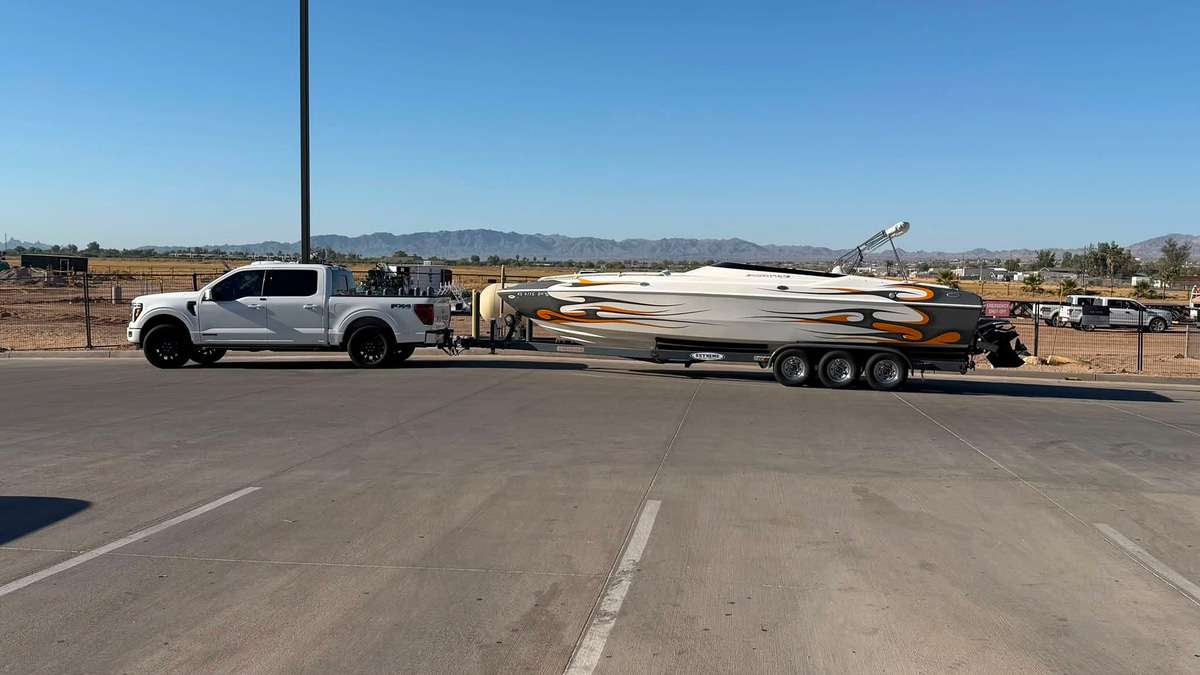

When the primary tow rig loses its fuel injectors, the boat does not get any lighter.
Brian M. Cooper told members of the Ford F-150 Powerboost Owners 21+ group that his heavy-duty truck went down at exactly the wrong time.
“My Superduty had fuel injectors go down, so the Powerboost had to step up to save the week's boating trips”
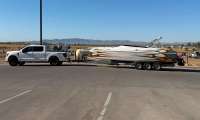
The photo shows Cooper’s silver F-150 PowerBoost FX4 hitched to a triple-axle trailer carrying a large Shockwave performance boat. He identified it as a “29’ Shockwave Magnitude.” When another member asked how the half-ton handled the job, Cooper gave the result that matters first.
“It did fine, only had to tow about 50 miles each way”
That is a specific owner report. By Cooper’s account, the PowerBoost took over for a disabled Super Duty, completed the tow, and kept the boat from spending the week parked.
The comments quickly moved toward the usual half-ton towing argument. Matt Stok called the PowerBoost the “Best tow vehicle ever.” George Edison looked at the same photo and wrote, “That might wiggle a bit.” Those reactions reach opposite conclusions, and the thread still lacks the measurements needed to calculate Cooper’s actual margin.
The PowerBoost Completed a Real Backup-Truck Job
Ford launched the PowerBoost with 430 horsepower and 570 lb-ft of torque. In the 2021 chart, a PowerBoost SuperCrew 4x4 could reach a 12,400-pound conventional tow rating with the 3.73 axle and Max Trailer Tow Package. Another 4x4 entry was rated at 11,000 pounds. The exact axle ratio, tow package, model year, and certification labels on Cooper’s truck were not provided.
Those numbers explain why the truck could feel strong with a substantial boat behind it. Ford’s published 570 lb-ft peak arrives at 3,000 rpm, and the truck uses a 10-speed hybrid transmission. Cooper’s account also provides a useful boundary: roughly 50 miles each way, under conditions he considered uneventful.
Cooper’s report of a completed tow shows that the combination handled that route on that day without a reported problem. It leaves the reserve margin unquantified. Speed, grades, ambient temperature, wind, trailer-brake performance, and fuel economy were not reported.
Ron Lowenberg asked how the truck pulled the boat out of the water, but Cooper’s quoted follow-up addressed the road tow. Launch-ramp traction and retrieval performance remain unreported.
The Boat’s Published Weight Is Already Close to the Truck’s Curb Weight
Cooper called the boat a 29-foot Shockwave Magnitude. Shockwave currently spells the model name “Magnatude” and lists the 29-footer at 102 inches wide, approximately 5,500 pounds, with a 100-gallon fuel capacity and single- or twin-engine configurations.
That current specification provides context rather than an exact weight for Cooper’s boat. Its year, engine package, fuel level, equipment, and modifications remain unknown. The current Shockwave page describes a tandem trailer, while Cooper’s photo clearly shows three axles.
The comparison is still striking. Ford lists a 2021 PowerBoost SuperCrew 4x4 with the 145.4-inch wheelbase at a 5,517-pound base curb weight. The pictured FX4 appears to share that broad crew-cab, short-bed layout, although its exact model year and equipment cannot be confirmed from the image.
Shockwave’s approximate boat figure is therefore almost identical to the truck’s published base curb weight.
The trailer package weighs more than the boat alone. The total also includes the triple-axle trailer and any fuel, added equipment, and trip gear not captured by the approximate boat figure. Cooper did not publish a loaded scale weight, so a reader cannot responsibly turn the 5,500-pound manufacturer figure into an exact total.
The 50-mile distance defines the use case. It does not change the truck’s GVWR, rear GAWR, receiver rating, tire limits, or trailer-brake requirements.
Power Was Available; Payload and Axle Load Decide the Margin
Acceleration is the part a driver feels. Reserve is the part a scale reveals.
Ford’s 2021 specifications list a maximum payload of 1,830 pounds for a 145.4-inch-wheelbase PowerBoost SuperCrew 4x4. That is a best-case configuration figure.
Ford also states that maximum towing and payload vary with configuration, options, accessories, cargo, and passenger count, which is why the door-jamb payload label on Cooper’s individual truck matters more than the highest number in a chart.
Tongue weight consumes that payload before people, a hitch, tools, or bed cargo are added. Ford uses 10 percent of loaded conventional-trailer weight in its towing calculations and says tongue load, passengers, and cargo must stay within the truck’s GVWR and rear GAWR.
An 8,000-pound loaded trailer would place about 800 pounds on the truck at that percentage. A 10,000-pound trailer would place about 1,000 pounds on it. Those are illustrations, not estimates of Cooper’s actual setup.
Boat-trailer manufacturers can specify a different target based on trailer construction and design. Load Rite, for example, publishes ranges from 7 percent to 12 percent and tells owners to measure the trailer with the boat fueled and equipped as it will be towed.
Cooper’s Extreme trailer may carry its own requirement, which should control the setup. The useful number is measured tongue weight at normal towing height.
This distinction has already surfaced in another PowerBoost towing case. Torque News examined a 2022 truck pulling a camper with a 6,733-pound dry weight and an 895-pound dry tongue weight. The engine could move the camper, while payload margin became the sharper question once passengers, cargo, hitch hardware, propane, batteries, and water entered the calculation.
Cooper’s truck may have been comfortably within every rating. It may have been close to one limit while remaining below the others. The door sticker and axle scale weights would answer that in minutes.
The Hitch Photo Raises the Hardest Technical Question
The side view appears to show a conventional ball mount. Traditional weight-distribution spring bars or equalizing arms are not visible. That is a visual observation from one distant image, so it cannot establish every component in the system.
Ford’s 2021 towing guide lists the F-150 factory receiver at 5,000 pounds of trailer capacity and 500 pounds of tongue load in weight-carrying mode. The same chart lists up to 14,000 pounds and 1,400 pounds in weight-distributing mode, then directs owners to the rating label attached to the receiver.
Ford also identifies equalizing arms, snap-up brackets, and sway-control equipment as parts the owner must obtain when the setup requires them. Ford separately recommended a Trailer Tow or Max Trailer Tow Package for 2021 F-150 trailers over 5,000 pounds.
The 2023 guide retains the same 5,000-pound weight-carrying ceiling, while receiver hardware and maximum ratings vary by tow package.
That creates a precise question. If Shockwave’s approximate 5,500-pound boat figure is representative of Cooper’s hull, the boat-and-trailer package would exceed 5,000 pounds before fuel and trip gear. The exact model-year receiver label, ball-mount rating, coupler rating, trailer-manufacturer guidance, and hitch configuration become essential.
The photo does not establish a rating exceedance. It does justify asking for a close-up of the receiver label and the complete hitch. That evidence has more value than another argument about whether a half-ton “feels” powerful enough.
Boat owners will recognize another complication. The coupler in the photo appears consistent with a surge-brake actuator. When weight distribution is used on a pole-tongue boat trailer, the hardware must permit that actuator to move as designed.
Equal-i-zer, one manufacturer of compatible systems, tells owners to confirm permission from the trailer and surge-brake manufacturers before installation. Cooper’s exact actuator, hitch hardware, and manufacturer guidance were not provided.
A 29-Foot Boat Does Not Tow Like a 29-Foot Camper
Ron Lowenberg pushed back on the idea that every boat longer than 24 feet automatically requires a three-quarter-ton truck. His point deserves a fair hearing because trailer length alone is a poor vehicle-selection rule.
A low, tapered performance boat on an open trailer presents a very different aerodynamic load from a tall travel trailer or enclosed cargo box. Ford warns that a large frontal area can add substantial drag and says a low-drag, rounded trailer front maximizes towing performance.
PowerBoost owners have reported a difference in fuel economy. In another Torque News case, an owner said his truck returned about 9.8 mpg with a 4,500-pound enclosed trailer and about 15.7 mpg with a 5,500-pound boat.
The routes, speeds, wind, and loads were uncontrolled, so the numbers are owner-reported context rather than a test. They still show why a heavier boat can demand less highway power than a lighter box trailer.
That aerodynamic advantage reduces steady-speed drag. Weight, braking, tongue load, tire capacity, crosswinds, downhill control, and hitch setup remain part of the decision. A 29-foot boat can be an easier highway pull than a 29-foot camper while still placing a serious load on the truck and receiver.
The “Wiggle” Comment Cannot Be Proven From a Parking-Lot Photo
George Edison predicted that the setup “might wiggle.” Troy Hingston replied that trailer movement comes from too much weight behind the axles.
Rear-heavy loading can reduce tongue weight and contribute to instability. Ford warns that too little tongue load can reduce rear-wheel traction and lead to tail wagging or jackknifing. Its towing guide also calls for secure, properly distributed cargo.
The supplied image cannot establish how this trailer behaved at speed. It does not show measured tongue weight, the boat’s fore-aft position relative to the axles, tire pressures and load ratings, axle alignment, bearing condition, brake function, road speed, crosswind, or steering corrections.
Cooper’s report that the truck “did fine” is stronger evidence than speculation from a still photo. A scale ticket and setup details would be stronger than both.
What Cooper’s Tow Actually Proves
Cooper says the PowerBoost did the job he asked of it. His Super Duty was sidelined by an injector problem, the F-150 took over, and the boating week continued.
For owners who buy a PowerBoost partly because one truck must commute, tow, and cover for another vehicle, that versatility is the useful part of his story.
His reported result also pushes back on blanket rules based only on trailer length or a half-ton badge. Ford published substantial tow capacity for properly equipped PowerBoost configurations. The individual truck, loaded trailer, receiver mode, tongue weight, axle loads, brakes, tires, route, and driver determine whether a specific combination has comfortable reserve.
Cooper’s reported successful 50-mile-each-way trip leaves one central question open: how much reserve remained when the truck, passengers, cargo, hitch, and loaded boat were all counted?
His report tells us the trip succeeded.
A scale ticket would turn a compelling owner story into a repeatable towing reference. The most valuable follow-up would be a loaded scale session with the truck and boat exactly as they traveled, plus the door-sticker payload, receiver label, measured tongue weight, front- and rear-axle weights, trailer-brake type, cruising speed, route, and hand-calculated fuel economy.
PowerBoost owners towing 28- to 30-foot boats, what do your actual scale ticket, payload sticker, hitch setup, and fuel numbers show?
One image by Brian M Cooper
About The Author
Noah Washington is an automotive journalist based in Atlanta, Georgia, covering sports cars, luxury vehicles, and performance culture. His reporting focuses on explaining the engineering, design philosophy, and real-world ownership experience behind modern vehicles.
Noah has been immersed in the automotive world since his early teens, attending industry events and following the enthusiast communities that shape how cars are built and driven today. His work blends industry insight with enthusiastic storytelling, helping readers understand not just what a car is, but why it matters.
Noah is also a member of the Southeast Automotive Media Association (SAMA), a professional organization for automotive journalists and industry media in the Southeast.
His coverage regularly explores sports cars, luxury vehicles, and performance-driven segments of the automotive industry, including the evolving culture surrounding Formula Drift and enthusiast builds.
Read more of Noah's work on his author profile page.
You can also follow Noah here:
Set Torque News as Preferred Source on Google
Follow us today...