
An empty trailer can still be full of trouble. At 65 mph, the trouble is air.
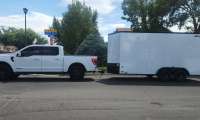
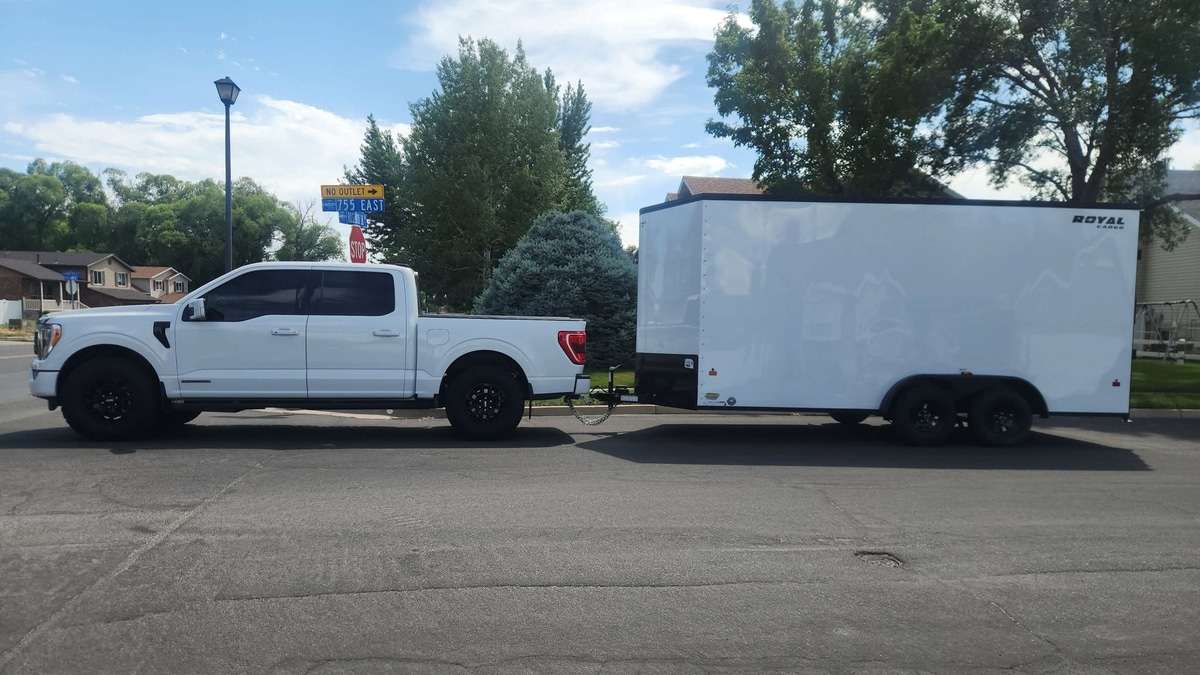
Chris Kirby says his Ford F-150 PowerBoost averages around 22 mpg on the dashboard at 70 to 75 mph, despite riding on 34-inch BFGoodrich All-Terrain T/A KO3 tires. Then he attached a 16-foot tandem-axle enclosed trailer and watched the display fall to 7 or 8 mpg at an indicated 65 mph.
The trailer was empty. Loading it barely changed the result according to Facebook.
Kirby expected the white box behind his truck to act like a parachute. The size of the penalty still surprised him.
“I’m aware that having a trailer behind me acts as a big parachute, but I didn’t expect such a large drop.”
His dashboard figures describe a 64 to 68 percent reduction from the unhitched 22-mpg baseline. Over 1,000 miles, 22 mpg consumes about 45 gallons. Seven to eight mpg consumes 125 to 143 gallons. That is roughly 80 to 97 additional gallons bought to move the same truck the same distance.
Kirby’s numbers come with a major qualification. He has not corrected the truck’s programmed tire size for the 34-inch KO3s. That can make the indicated speed, distance, and calculated fuel economy inaccurate. The exact correction requires the programmed diameter and the tires’ actual loaded circumference, neither of which he supplied.
Larger-than-programmed tires generally make the truck travel farther per wheel revolution than its computers expect. The displayed speed and odometer can read low, which can also make the dashboard's MPG read low. The same tires were installed for Kirby’s hitched and unhitched figures, so they do not erase the comparison. They may mean his indicated 65 mph was faster in the physical world, where a few additional mph can become expensive behind a tall trailer.
The missing calibration prevents an exact correction. It cannot plausibly account for a drop of roughly two-thirds by itself.
The Empty Trailer Kept Its Largest Load
Cargo affects acceleration, climbing, rolling resistance, braking, and how much work the truck must do every time speed changes. A tall enclosed trailer adds another bill that remains after the cargo leaves: frontal area.
Kirby’s photograph makes the problem visible. The trailer is taller and wider than the F-150’s cab, with a flat nose exposed above and beside the truck. Air pushed around the pickup meets another wall, spills into the gap between truck and trailer, travels along a long rectangular body, and then separates into a turbulent wake.
At steady highway speed on reasonably level pavement, removing cargo does little to shrink that wall.
Brian Hargreaves supplied the most useful comparison in the owner discussion. He reported approximately 9.8 mpg while towing a 4,500-pound, 8-by-16-foot enclosed trailer. When he switches to a 5,500-pound boat, fuel economy reportedly improves to about 15.7 mpg.
The boat is 1,000 pounds heavier, yet Hargreaves’ raw figures imply that it uses about 38 percent less fuel per mile. His routes, speeds, winds, and loads were not controlled, so that percentage cannot serve as an engineering test. It does show why trailer weight alone is a poor predictor of highway fuel economy. A pointed boat on an open trailer can present a much cleaner shape than a lighter cargo box.
Other PowerBoost owners landed close to Kirby. Tommy Woah reported 7 to 9 mpg with a 7-by-12-foot trailer on stock wheels and suspension. Robert Simpson said his leveled truck on 35-inch tires averaged 11 mpg while towing a 24-foot travel trailer to Orlando. Branson Brown reported 9.5 mpg over 500 miles with a roughly 7,000-pound, 33-foot camper.
The trailers and conditions differ, but 7 to 11 mpg is clearly familiar territory in this owner group.
The same aerodynamic collection notice appears on electric trucks and SUVs. A Cybertruck owner reported using exactly twice the energy at 70 mph while towing a pop-up camper, even though a folded camper seems modest beside a full-height travel trailer. A Kia EV9 owner averaged 1.3 mi/kWh with a travel trailer and stopped after roughly 80 miles.
Gasoline, electricity, and hybrid assistance change how the energy is stored and delivered. The atmosphere sends everyone an invoice.
Locking Out Ninth and Tenth Needs a Controlled Test
Kirby found owners who lock out ninth and tenth gears in the F-150’s 10-speed transmission while towing. The theory sounds plausible. Blocking the two tallest ratios raises engine speed and gives the engine more mechanical leverage at the wheels, potentially reducing the boost required to hold speed.
The tradeoff arrives immediately. Higher engine speed adds friction, noise, and pumping losses. A transmission allowed to choose all ten ratios may already downshift when load demands it. Terrain, axle ratio, trailer shape, wind, speed, and the engine’s operating point determine whether eighth gear saves fuel or merely makes more heat.
The comments split in both directions. Brown said locking out the ninth and tenth helped while pulling his 33-foot camper. Ryan Stoehr said the practice did nothing for his mileage and increased engine temperature by 3 to 5 degrees.
Neither result settles the question. Both tell Kirby how to test it.
First, correct the tire size so speed and distance are credible. Then use the same loaded trailer, road, direction, cruise speed, fuel grade, and weather window. Run one leg in Ford’s Tow/Haul mode with the transmission managing all gears. Refill at the same pump. Repeat with the ninth and tenth excluded, then reverse the order on another day. Record hand-calculated mpg, average speed, transmission temperature, engine coolant temperature, wind, and how often the truck entered each gear.
One display reading from one direction can reward a tailwind and blame a transmission.
Ford provides Tow/Haul mode and manual range selection because towing sometimes requires different shift behavior and additional engine braking. That does not make a permanent eighth-gear ceiling the efficient answer for every trailer. Owners should follow the manual for their model year and use data before adopting a Facebook calibration as doctrine. Ford’s official owner-manual portal provides year-specific instructions.
The KO3s Matter, but They Did Not Grow a Trailer
Several commenters blamed Kirby’s 34-inch KO3 tires. Heavy all-terrain tires can increase rotational inertia and rolling resistance, and an uncorrected diameter muddies the dashboard numbers. Kirby’s response was fair: the same tires were on the truck before and after he connected the trailer.
The tires help explain why his absolute results may differ from a stock PowerBoost. They cannot explain the entire hitched-versus-unhitched collapse because they did not suddenly gain weight at the coupler.
They can amplify the penalty in less obvious ways. The wrong calibration may hide the true road speed. Aggressive tread and greater rotating mass add losses the powertrain must carry in both conditions. A lift or level, if present, can expose more tire and underbody area to the air. Kirby disclosed the tires but did not say whether the truck is leveled, what KO3 size and load range he uses, or what the original programmed tire was.
The tire-pressure advice in the discussion also needs a guardrail. One commenter said towing below 45 psi makes low mileage the owner’s fault. NHTSA says the correct cold pressure is the value on the vehicle’s Tire and Loading Information Label or in the owner’s manual, not an arbitrary number and not the maximum printed on the tire sidewall.
Aftermarket tire size, load range, axle load, and wheel limits can require professional load-table work. Forty-five psi is neither a universal efficiency setting nor a substitute for weighing the rig.
Four Numbers Would Explain Most of the Mystery
Kirby has already supplied the most revealing observation: loading the trailer does not materially change the reported mileage. The next test needs four measurements.
- Actual trailer height and width, which establishes the frontal-area problem.
- Loaded and empty scale weights, including tongue weight and truck axle loads.
- GPS-verified speed and distance after the 34-inch tire correction.
- Hand-calculated fuel economy over repeated runs in both directions.
Wind belongs beside those measurements. A headwind added to 65 mph increases the airspeed striking the trailer, while a tailwind subtracts from it. The truck’s dashboard knows road speed. The trailer feels airspeed.
Speed is the cheapest variable to test. The U.S. Department of Energy notes that fuel economy generally falls significantly above 50 mph. A 60-mph run followed by an otherwise comparable 65-mph run would tell Kirby more than arguing over boost from a driveway.
The time difference over 100 miles is about eight minutes. The fuel difference behind that box may be much larger than eight minutes feels.
A previous Torque News report found a Maverick Hybrid falling to 22 mpg while carrying kayaks, another reminder that awkward objects can punish efficiency without approaching the vehicle’s maximum weight rating. PowerBoost owners also have to account for software behavior beyond fuel use. One owner found that his newer F-150 disabled lane keeping with a trailer connected, even though his 2021 truck had allowed it.
Kirby’s PowerBoost may be operating normally. Seven mpg can still be unacceptable for his use. Those statements can coexist.
An enclosed trailer turns highway speed into a recurring purchase, and its empty interior offers no refund. Before Kirby changes the transmission strategy, he should correct the tires, verify the true speed, weigh the rig, and test 60 mph. If the ninth and tenth still look guilty after that, a controlled back-to-back run can put numbers behind the suspicion.
PowerBoost owners towing enclosed trailers, what are your trailer dimensions, true loaded weight, GPS speed, tire size, axle ratio, and hand-calculated mpg? Those details can separate a normal aerodynamic penalty from a truck that deserves diagnosis.
One image by Chris Kirby
About The Author
Noah Washington is an automotive journalist based in Atlanta, Georgia, covering sports cars, luxury vehicles, and performance culture. His reporting focuses on explaining the engineering, design philosophy, and real-world ownership experience behind modern vehicles.
Noah has been immersed in the automotive world since his early teens, attending industry events and following the enthusiast communities that shape how cars are built and driven today. His work blends industry insight with enthusiastic storytelling, helping readers understand not just what a car is, but why it matters.
Noah is also a member of the Southeast Automotive Media Association (SAMA), a professional organization for automotive journalists and industry media in the Southeast.
His coverage regularly explores sports cars, luxury vehicles, and performance-driven segments of the automotive industry, including the evolving culture surrounding Formula Drift and enthusiast builds.
Read more of Noah's work on his author profile page.
You can also follow Noah here:
Set Torque News as Preferred Source on Google
Follow us today...