
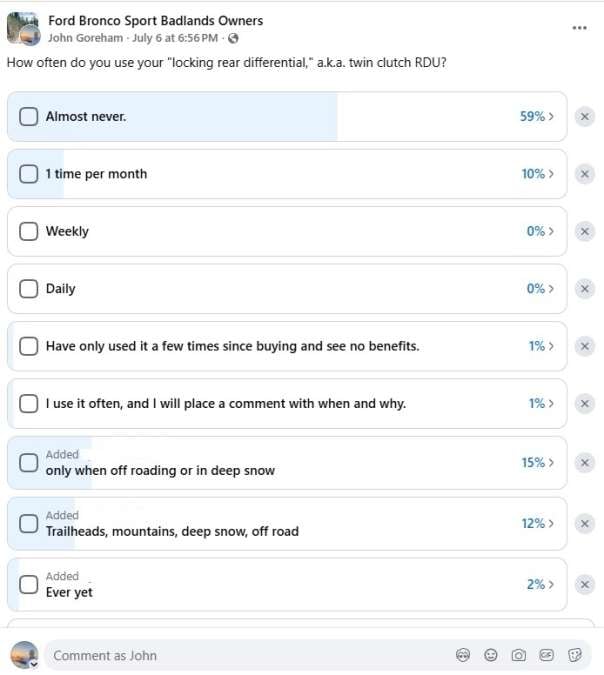
When Ford launched the Bronco Sport, the Badlands and First Edition trims arrived with a piece of driveline hardware that no other vehicle in the compact crossover segment offered, a twin-clutch rear drive unit with a “differential lock” feature. The Heritage Limited later joined the short list of trims to carry it. It sounds impressive on a spec sheet. Yet when we polled Bronco Sport owners, 62% percent told us they don’t use or have never even tried it. Less than a third of owners make use of this special option on a regular basis. That raises a fair question. What is this hardware actually for, and does it deliver anything the typical Bronco Sport owner will ever need?
How the Twin-Clutch Rear Drive Unit Operates
In most Bronco Sport trims, a single clutch connects the propshaft to a conventional open rear differential. The higher-trim Badlands hardware replaces that arrangement with the “Twin-Clutch Rear Locking Differential,” as Ford officially terms it. The unit itself is a Dana AdvanTEK Ultra rear drive module. When engaged, the vehicle's computer modulates each clutch individually, deciding in real time how much torque each rear wheel receives.
The Bronco Sport can route up to roughly half of the engine's output to the rear axle, and nearly all of that rear torque can flow to a single wheel. When you press the rear differential lock button, you don’t actually mechanically lock anything. Rather, you allow the software to apply more clutch pressure, more often, prioritizing traction. Even when “locked,” the clutches will still permit the slip needed to negotiate a tight turn, something a true mechanical locker cannot do.
What It Is Supposed to Achieve?
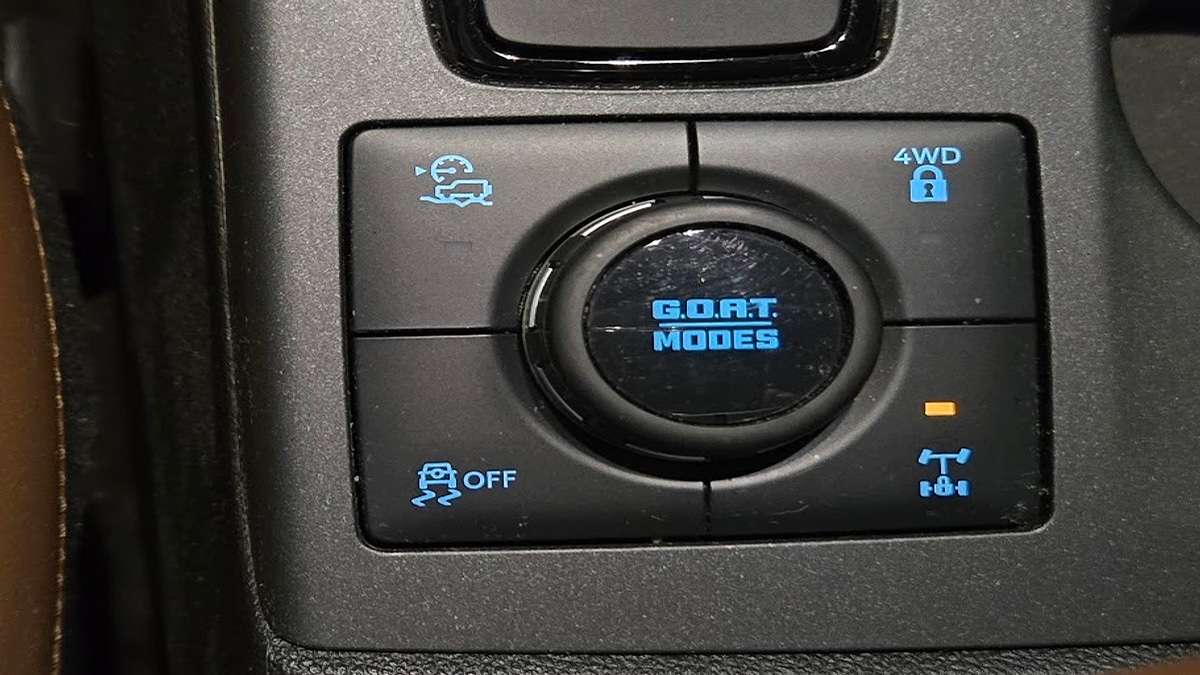
The goal of the higher trim Bronco Sport Trims’ RDU is simple. In a cross-axle situation where one rear wheel hangs in the air or spins on mud, an open differential will send power to the wheel with the least grip. The twin-clutch unit intervenes here and does the opposite. It shifts the torque to the wheel that can use it. Ford also tuned the hardware to work with the G.O.A.T. mode dial. When engaged, it is designed to mimic the steady pull of a locked axle. Ford’s intent was to give the unibody Bronco Sport crossover SUV the low-speed trail traction normally associated with body-on-frame trucks.
Does It Actually Work?
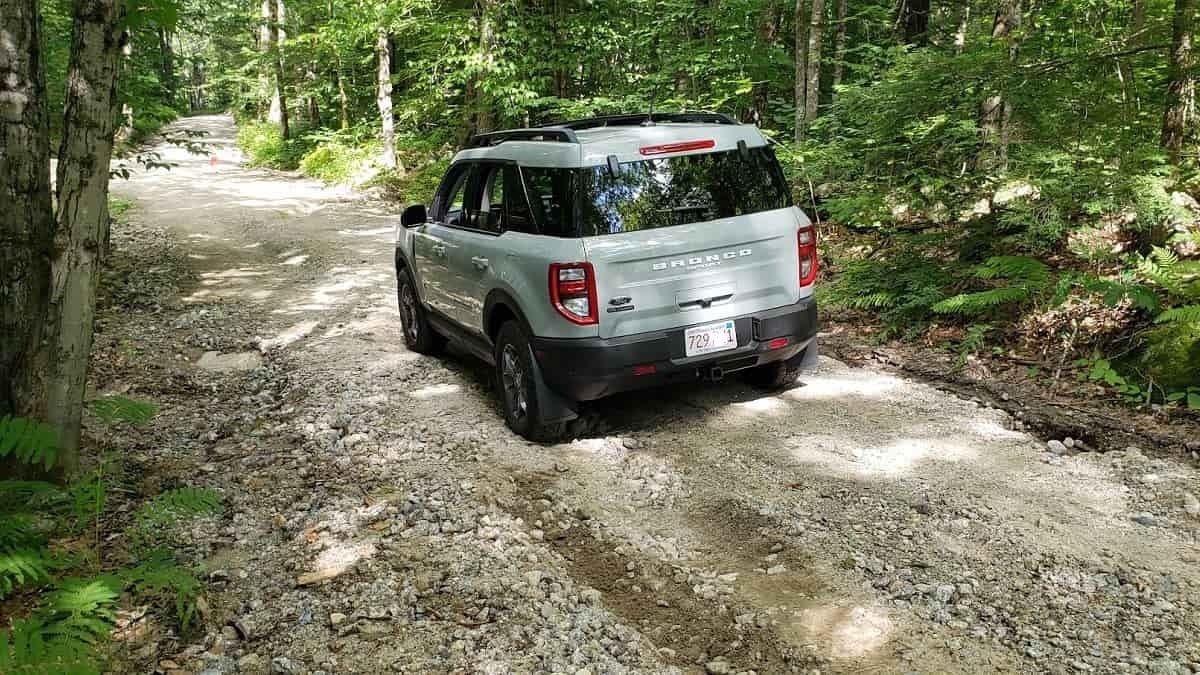
Here is where owner honesty is required. In our own testing on the wooded trails and washed-out dirt roads of Central New Hampshire, where our Bronco Sport lives its greatest moments, any decent brake-based traction control would handle nearly every low-grip scenario an owner would encounter. The twin-clutch unit is intended to work faster and without the brake intervention, but the difference only becomes obvious in highly technical terrain, deep sand at speed, or a true diagonal wheel lift. Those are conditions our poll suggests most owners never seek out.
Does It Help In Snow?
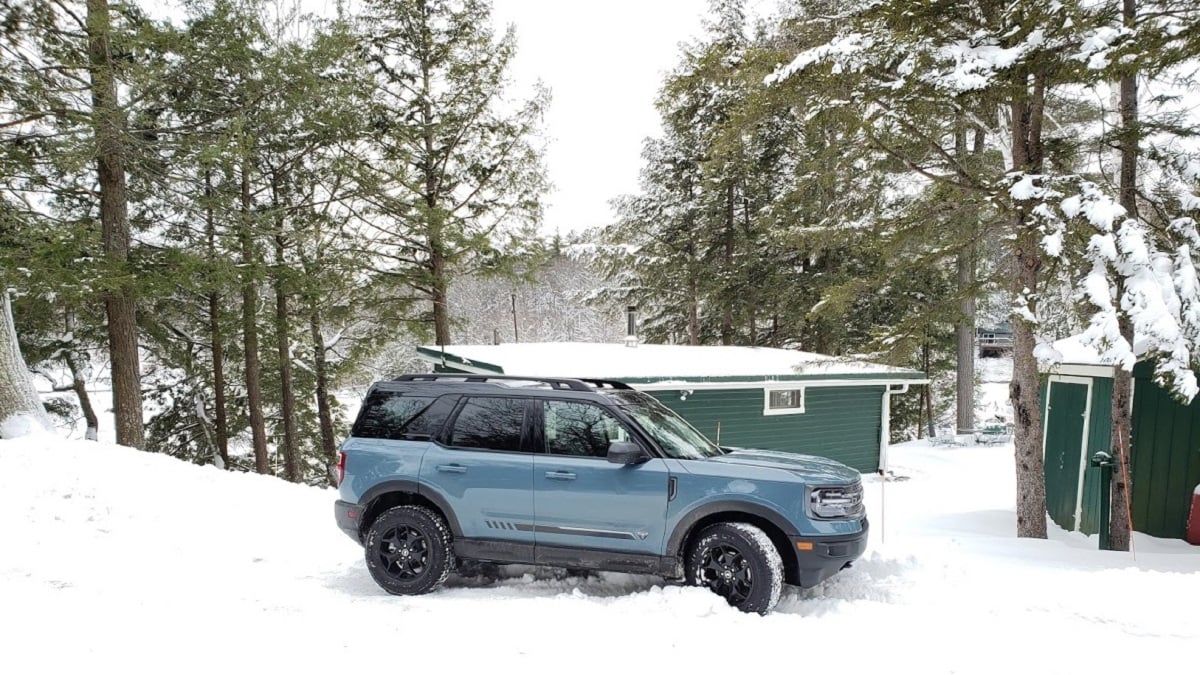
While I drive off-pavement nearly every time I take my Bronco Sport Badlands out, my adventures are solo. Without a spotter and a backup vehicle or winch, getting stuck miles from cell coverage is not an ideal way to spend a weekend day. I have tried the “rear locker.” Mostly in the snow. Here, I find it has zero value. The Bronco Sport Badlands is a front-drive crossover SUV that reluctantly sends power to the rear. You can see that on the display of the torque distribution. I’ve been to the point of being stuck in snow in a Bronco Sport, and engaging the “locking rear differential” offered no help. Frankly, it is hard to know if it is doing anything.
A Better Informed Owner/Expert Weighs In
I’m not the authority on driving Bronco Sport Badlands SUVs on rugged trails with mud and rocks. Ryan Douthit of Driving Sports TV is. We reached out to Ryan and asked him if he could shed some light on the “locking rear differential” of the BadSport. Ryan owned a Bronco Sport Badlands, and his was newer than mine, made after the refreshed and updated powertrain changes were added. In addition, he owns many other top-ranked off-road SUVs, including a Bronco. He was generous enough to offer us some great insights.
TN: Ryan, is the rear drive unit really that useful? Are we just not using it properly?
RD: The twin-clutch rear drive unit on the Bronco Sport Badlands is nearly as good as the proper locker found on the full-size Bronco.
TN: Give us a scenario where we might put it to use.
RD: It's especially useful when climbing rough trails.
TN: How would you rank it against other types of limited-slip rear diff, like those on Subarus?
RD: The brake-based systems found on most other CUVs are far less effective and can also damage trails as they struggle to shift power, spinning wheels in between brake pulses. The twin-clutch on the Badlands engages on demand and minimizes unnecessary wheel spin by effectively locking the two rear wheels together. In everyday situations, this twin clutch drive unit isn't necessary, but when things get challenging, it can make the difference between climbing the trail and turning around and going another way.
We are grateful to Ryan for helping us to better understand how the RDU works and when it is most helpful.
If you are a Bronco Sport fan or owner, please feel free to weigh in on this subject. Our comments section awaits.
About the Author:
John Goreham is a 14-year veteran of Torque News. An accomplished writer and a long-time expert in vehicle testing, Goreham also serves as the Vice President of the New England Motor Press Association and has a growing social media presence. He’s also a 10-year staff writer and community moderator for Car Talk. Goreham holds a B.S. in Mechanical Engineering and an undergraduate Certificate in Marketing. In addition to vehicle and tire content, he offers deep dives into market trends and opinion pieces. You can follow John Goreham on X and TikTok, and connect with him on LinkedIn.
Set Torque News as Preferred Source on Google
Follow us today...