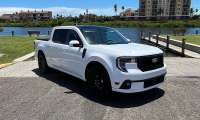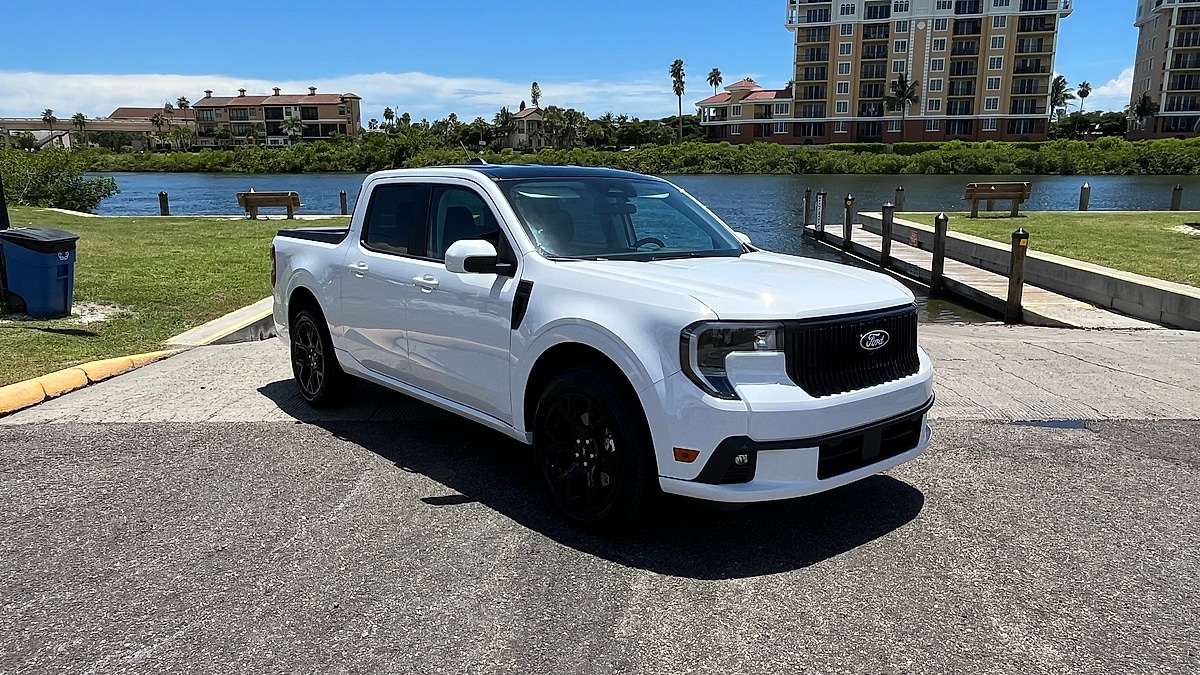

Michael Radvansky loaded his 2025 Maverick Hybrid AWD with a claimed 1,100 pounds of bagged gravel, rebar, and supplies, added his 250-pound body weight to the calculation, and drove away with 1,350 pounds of total payload. The dashboard showed 42.0 mpg over 28.8 miles in Tow/Haul mode. His arithmetic leaves 50 pounds beneath Ford's published maximum, while the absent door-jamb label leaves the truck-specific margin unresolved.
The arguments about whether a Ford Maverick qualifies as a truck have spent enough time in parking lots. Gravel is less sentimental.
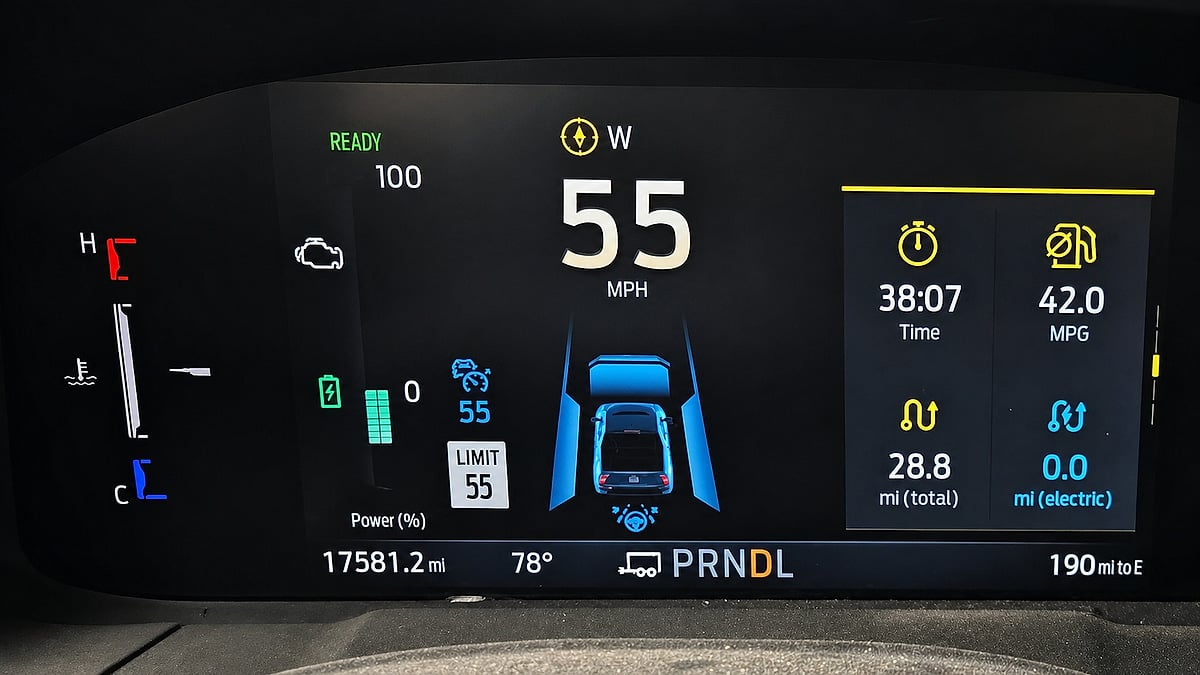
The display showed 42.0 mpg over 28.8 miles in 38 minutes and seven seconds. The truck was traveling at 55 mph when the photograph was taken, the outside temperature read 78 degrees, and the trip screen showed 0.0 electric-only miles. Radvansky's verdict in his Facebook post was simple: “This little truck keeps getting better and better.”
The result deserves attention because the numbers almost line up too neatly. Ford rates the 2025 Maverick Hybrid AWD at 40 mpg city, 34 highway, and 37 combined. Its technical specifications list a 5,320-pound GVWR and 1,400 pounds of maximum payload. Radvansky reports a load 50 pounds below that ceiling and a displayed fuel-economy result two mpg above the official city figure.
That is a fine outcome. It is also a 28.8-mile trip-computer result rather than a hand-calculated tank.
- The photograph confirms what the dashboard displayed. A fuel receipt and refill calculation would be needed to verify actual consumption.
- The owner's arithmetic properly counts his body weight as payload. Every passenger, tool, accessory, and loose item belongs in the same total.
- Ford says maximum payload varies with configuration and accessories. The yellow Tire and Loading Information label on this particular Maverick decides whether 1,350 pounds leaves 50 pounds of capacity.
The Payload Claim Works on Paper
Ford's published numbers support Radvansky's basic calculation.
The 2025 hybrid AWD has a listed base curb weight of 3,856 pounds and a GVWR of 5,320 pounds. Ford publishes 1,400 pounds as its maximum payload. The small mismatch between a simple subtraction and the published payload figure can reflect how the manufacturer defines and certifies the configuration, so owners should use the label fixed to their own vehicle.
Radvansky said the cargo itself weighed 1,100 pounds. Add his 250 pounds, and the total reaches 1,350.
The missing photograph is the door label.
Trim equipment, a moonroof, factory options, dealer-installed hardware, and accessories can eat into the capacity available on a specific truck. The hard tonneau cover visible in the loading photograph has weight. A factory-installed cover may already be reflected in the vehicle's certified payload; an accessory added later consumes part of the remaining capacity.
Ford makes the same point in its own payload disclaimer: check the door jamb for the carrying capacity of the specific vehicle and secure the cargo properly.
If Radvansky's label says 1,400 pounds, his 1,350-pound estimate leaves the stated 50-pound margin. If the label is lower, the calculation changes immediately.
Mild Squat Is Useful Information, Then the Scale Takes Over
Radvansky said the truck's squat “was not bad.” The loading photograph supports that impression. The bags sit low in the bed, concentrated around and ahead of the rear axle rather than stacked at the tailgate. That placement helps the truck carry the load with less rear leverage.
Ride height still gives only a visual clue.
A truck can sit level while exceeding a rating. It can also show a visible squat while remaining within every limit. Spring rate, load position, tire pressure, bed accessories, and suspension geometry all influence posture.
The useful numbers are the payload label, GVWR, rear GAWR, and actual axle weights. A single certified-scale pass with the driver and cargo aboard would settle the total and show how much of the load landed on the rear axle.
Cargo securement belongs in the same conversation. Gravel bags can tear, rebar can slide, and a panic stop can turn any unrestrained object into a battering ram. The photograph documents the loading stage, so the final tie-down arrangement remains unknown. The tonneau may contain small debris, but heavy material still needs restraint against forward movement.
42 MPG Display Is Plausible and Narrow
Payload adds rolling resistance and asks for more energy during acceleration and climbing. It has a smaller effect on steady-speed aerodynamics than a tall trailer, rooftop load, or ten extra miles per hour.
That distinction helps explain the dashboard.
Radvansky photographed the truck at 55 mph. His 28.8-mile trip took a little over 38 minutes, which works out to an average speed of roughly 45 mph. A warm, moderate-speed route with limited climbing and gentle acceleration can be kind to a hybrid even when the bed is heavy.
The load also sits inside the Maverick's body profile. The truck is pushing almost the same hole through the air as it would with an empty bed and a closed cover. The tires carry more weight, and the powertrain works harder, but the gravel does not present the broad frontal wall of a camper.
Ford rates the hybrid AWD at 40 mpg city and 37 mpg combined. A dashboard showing 42 mpg over one favorable 28.8-mile route fits within the realm of a good trip. It says little about a full tank that includes cold starts, hills, rain, faster interstate travel, and unloaded miles.
The next test is easy: reset a trip meter at the pump, drive a full tank through normal use, refill at the same pump if practical, and divide miles by gallons. Record the dashboard figure beside it. The difference shows how optimistic or conservative this truck's computer is.
A Maverick Can Overlap a Larger Truck's Door Sticker
One commenter said his boss's F-150 had only 180 pounds more payload than his Maverick. That can happen.
Payload is the capacity left after the truck's own weight is accounted for. A larger pickup may carry a higher GVWR and still consume much of that allowance with a crew cab, four-wheel drive, a large powertrain, luxury equipment, a panoramic roof, a generator system, skid plates, larger wheels, and accessories. A relatively light Maverick can arrive at the door sticker with a surprisingly competitive number.
That is the same arithmetic that tightened around a 2022 F-150 PowerBoost pulling a 6,733-pound dry camper. The full-size Ford had abundant power, yet an 895-pound dry tongue figure consumed most of the capacity that people and camping gear still needed.
That 180-pound overlap may be genuine for two specific trucks. Model-wide maximums tell a different story, and the door labels are required for a fair comparison.
The discussion also wandered into claims that a Nissan Frontier carries only 900 pounds and a Ford Ranger carries little more than a Maverick. The published figures are broader. Nissan's 2025 Frontier brochure lists maximum payloads from 1,020 to 1,620 pounds across the configurations shown. Ford advertises up to 1,788 pounds for the 2025 Ranger. Individual off-road and luxury trims can land much lower, which brings the discussion back to the sticker.
Truck size, tow rating, and payload do not rise in a perfect line.
This Is the Maverick's Best Kind of Work
The Maverick was designed around jobs exactly like this one: a hardware-store run large enough to punish a crossover's cargo area, small enough to fit in a compact pickup, and infrequent enough that driving a full-size truck every day may feel wasteful. That use case echoes an F-150 owner's claim that a Maverick Hybrid could cover 90 percent of his full-size truck duties.
Radvansky appears to have used nearly all of the hybrid AWD's published payload and achieved an excellent indicated fuel-economy result on one short trip. That is a credible demonstration of the Maverick's usefulness.
It also shows how quickly the margin disappears. Fifty pounds is one child, a toolbox, several gallons of water, or the difference between a generic maximum and the label on an optioned truck. Wet bulk material can introduce even more uncertainty than sealed bags with known weights.
Doing this once with a verified label, secured cargo, proper tire pressure, and a short route is a strong use of the truck. Living at the ceiling every weekend calls for more payload margin, fewer trips per load, delivery, or a higher-capacity vehicle.
The Maverick has already settled the parking-lot identity argument. The next useful photograph is the yellow door label, followed by a scale ticket and a hand-calculated tank.
Two images by Michael Radvansky
About The Author
Noah Washington is an automotive journalist based in Atlanta, Georgia, covering sports cars, luxury vehicles, and performance culture. His reporting focuses on explaining the engineering, design philosophy, and real-world ownership experience behind modern vehicles.
Noah has been immersed in the automotive world since his early teens, attending industry events and following the enthusiast communities that shape how cars are built and driven today. His work blends industry insight with enthusiastic storytelling, helping readers understand not just what a car is, but why it matters.
Noah is also a member of the Southeast Automotive Media Association (SAMA), a professional organization for automotive journalists and industry media in the Southeast.
His coverage regularly explores sports cars, luxury vehicles, and performance-driven segments of the automotive industry, including the evolving culture surrounding Formula Drift and enthusiast builds.
Read more of Noah's work on his author profile page.
You can also follow Noah here:
Set Torque News as Preferred Source on Google
Follow us today...