
A hybrid Maverick completed the long pull without trouble, according to owner Jimmy Sumerell. The truck’s 3-to-4-mpg swing between cruise control and manual driving may matter more to small-camper owners than another argument about whether the Maverick deserves to be called a truck.
The photograph looks like an answer drawn with a carpenter’s pencil.
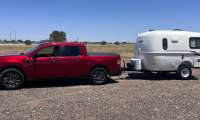
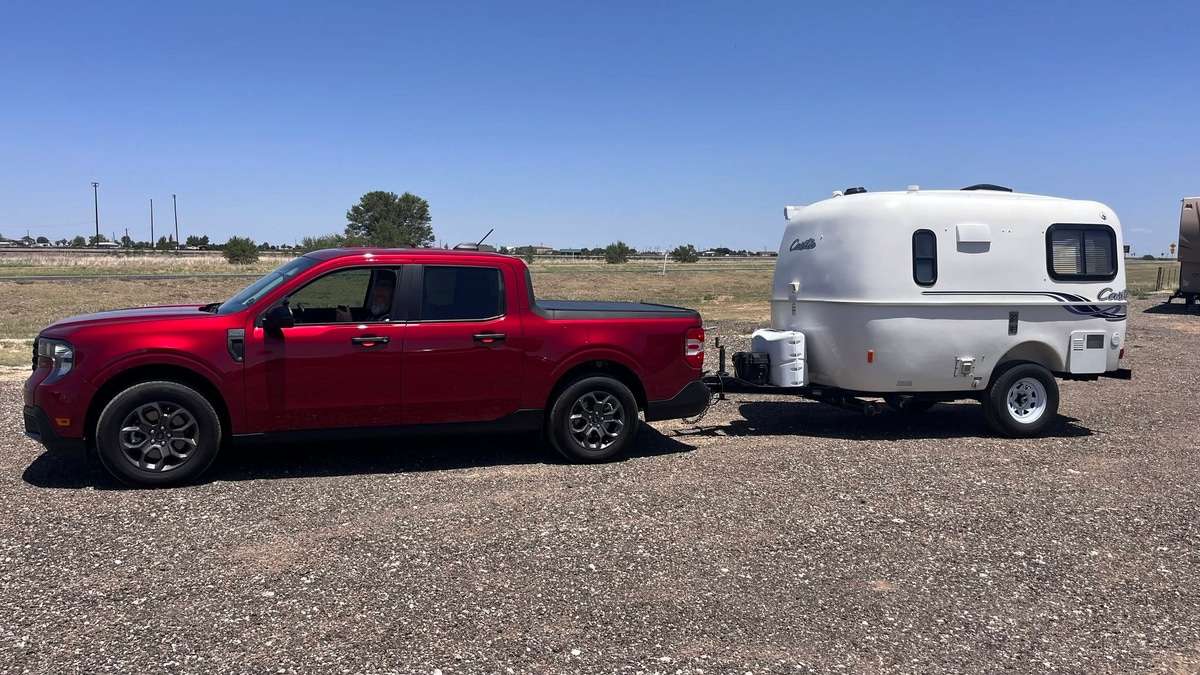
A red 2026 Ford Maverick sits level on the Texas gravel, hitched to a white 13-foot Casita that rises only modestly above the truck. No triple axles. No chrome smokestacks. No performance theater. Just a compact pickup and a small fiberglass room headed across a large country.
Jimmy Sumerell drove that combination from Texas to Raleigh, North Carolina. He reported no trouble and said the Maverick Hybrid averaged between 19 and 22 mpg while pulling the camper.
Then he gave the Ford Maverick Hybrid Only Facebook group a more interesting number.
“On cruise control, it gave 18. Today, going through the mountains without cruise control, it was 21-22 most of the day.”
Over 1,000 miles, 18 mpg requires about 55.6 gallons. At 21 mpg, the same distance takes 47.6 gallons. At 22 mpg, it takes 45.5 gallons. If those display readings held across comparable conditions, choosing how the truck manages speed could move roughly 8 to 10 gallons across the credit-card statement.
The conditions were not comparable enough to declare cruise control guilty. Sumerell changed terrain, traffic, and driving technique, and he did not publish a hand-calculated fuel log. His report still points toward a habit worth testing.
The 4K Package Gives the Hybrid a Serious Assignment
Sumerell identified the truck as a 2026 hybrid with the towing package. The supplied photograph shows an XLT badge, and Ford lists the 4K Tow Package as an option on the XLT.
Ford’s current specifications pair the 4,000-pound rating with all-wheel drive. On the hybrid, the package brings more than a receiver bolted under the bumper. Ford includes a Class III 2-inch hitch, 4-pin and 7-pin trailer connectors, an integrated trailer-brake controller, and an upgraded cooling fan.
Those parts are the difference between being able to drag a trailer and being equipped to manage one.
The hybrid powertrain uses a 2.5-liter Atkinson-cycle four-cylinder, an electric traction motor, and a power-split electronic continuously variable transmission. Ford lists 184 combined horsepower. The truck has no conventional stack of stepped gears to hunt through on a grade, but that does not make towing effortless or mechanically free. The engine, motors, battery, cooling system, brakes, tires, and trailer all remain inside the same energy ledger.
Sumerell’s reported 19-to-22-mpg range is 35 to 44 percent below Ford’s 34-mpg highway estimate for a non-Lariat hybrid AWD. That comparison provides scale, not a controlled towing penalty. EPA highway testing did not include his Casita, Texas, wind, mountain grades, or travel speed.
The result fits a pattern already emerging in owner reports. A different Maverick Hybrid owner saw 22 mpg while towing kayaks, while another 2025 Maverick Hybrid AWD displayed 42 mpg over 28.8 miles with a claimed 1,350-pound payload. Those loads and routes differ too much for a direct comparison. Together, they show how dramatically the Maverick’s efficiency changes with the job.
Cruise Control Can Spend Fuel Chasing the Number on the Dash
Sumerell believes manual driving helped because he could recover more energy downhill. That explanation contains a useful truth and an easy trap.
Cruise control has one blunt assignment: defend the selected speed. On a rolling road, it may add power aggressively as the truck climbs because allowing the speedometer to sag would mean failing its assignment. A human driver who sees the grade ahead can ease into the climb, accept a few lost mph, and let gravity return some speed on the other side.
That softer strategy can reduce the large power demands that hurt fuel economy. It can also prevent the truck from spending energy to crest a hill at an exact number, then immediately using regeneration or friction braking to remove speed on the descent.
Regeneration helps, but it does not refund the whole climb. Every conversion loses something. The gasoline engine turns fuel into motion, the truck trades motion for altitude, the motor captures part of the descending energy, and the battery returns only part of that energy later. The most efficient unit of energy is often the one the driver never demanded uphill.
Speed may matter even more. Sumerell did not answer the comment asking how fast he towed. Aerodynamic drag rises rapidly as speed increases, and even a small Casita presents far more frontal area than an empty Maverick. A run at 60 mph and a run at 72 mph can make the same truck look like two different powertrains.
This is where a longer test could become valuable. Run the same rolling 50-mile segment twice, once on cruise and once with careful manual speed control. Begin at the same fuel level and battery state, travel in similar weather, reverse the order on a second day, and hand-calculate the fuel at the same pump. The result would tell Maverick owners much more than either setting’s trip-computer screenshot.
The Tank Turns MPG Into the Next Fuel Stop
Ford gives the hybrid Maverick a 13.8-gallon fuel tank.
At Sumerell’s reported 19 mpg, simple multiplication produces 262 miles from completely full to completely dry. At 22 mpg, it produces about 304 miles. Neither figure is a sensible towing interval because drivers need a reserve, and pumps do not always appear exactly where the arithmetic wants them.
The useful consequence is the spread. Four miles per gallon can move the mathematical range by more than 50 miles. On an unfamiliar highway with a camper attached, one can decide whether the next stop is the cheap station beside lunch or the lonely pump reached with the warning light on.
Fuel range is the only limit. Ford lists a maximum payload of 1,400 pounds for the hybrid AWD, and the actual door-jamb sticker can be lower after options. Trailer tongue weight, passengers, bed cargo, and anything in the cab all consume that payload.
That point has surfaced repeatedly in longer towing stories. A Grand Highlander Hybrid Max owner completed 3,600 miles with a 3,500-pound Airstream while transmission fluid reportedly reached 248 degrees.
In another Ford case, an F-150 PowerBoost owner discovered that the newer truck disabled lane keeping while towing, even though his 2021 model had allowed it. Two ratings tell only part of the ownership experience.
The Missing Scale Ticket Is the Number That Protects This Story
The owner said his Casita is 13 feet long and is no longer produced. Casita’s current catalog begins with a 15-foot model listed at a 1,776-pound starting weight, followed by 17-foot and 24-foot trailers. That current number should not be assigned backward to Sumerell’s older 13-footer.
Several commenters asked for the trailer’s weight. Nobody supplied it.
That omission prevents any responsible claim about how much towing or payload margin remained. A camper’s brochure dry weight excludes some combination of water, propane, batteries, food, clothing, tools, dealer-installed equipment, and the miscellaneous cargo that reproduces inside an RV whenever nobody is looking. Tongue weight can become the tighter constraint before total trailer weight approaches 4,000 pounds.
The correct next stop is a public scale. Weigh the loaded truck and trailer with the hitch and cargo configured exactly as traveled, then record the steer axle, drive axle, and trailer axle. Weigh the truck alone afterward. The difference exposes the loaded trailer weight and helps calculate tongue load. Compare those figures with the truck’s door sticker, axle ratings, hitch rating, and trailer labels.
Sumerell’s drive still says something useful without that ticket. The Maverick Hybrid pulled the small Casita from Texas to North Carolina without the owner reporting trouble, and the trip computer lived mostly in the high teens to low twenties.
A second owner in the thread said his EcoBoost Maverick with the 4K package also returns more than 19 mpg while towing a 16-foot Scamp.
Those two reports make compact molded-fiberglass campers look like a sensible match for Ford’s compact truck. The scale decides how sensible each particular rig is.
Maverick owners towing Casitas, Scamps, or similar campers, what are your loaded trailer weight, tongue weight, average towing speed, hand-calculated mpg, and cruise-control setting? Five numbers from enough owners would give shoppers a far better answer than another argument about the Maverick’s right to call itself a truck.
One image from Jimmy Sumerell
About The Author
Noah Washington is an automotive journalist based in Atlanta, Georgia, covering sports cars, luxury vehicles, and performance culture. His reporting focuses on explaining the engineering, design philosophy, and real-world ownership experience behind modern vehicles.
Noah has been immersed in the automotive world since his early teens, attending industry events and following the enthusiast communities that shape how cars are built and driven today. His work blends industry insight with enthusiastic storytelling, helping readers understand not just what a car is, but why it matters.
Noah is also a member of the Southeast Automotive Media Association (SAMA), a professional organization for automotive journalists and industry media in the Southeast.
His coverage regularly explores sports cars, luxury vehicles, and performance-driven segments of the automotive industry, including the evolving culture surrounding Formula Drift and enthusiast builds.
Read more of Noah's work on his author profile page.
You can also follow Noah here:
Set Torque News as Preferred Source on Google
Follow us today...