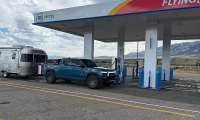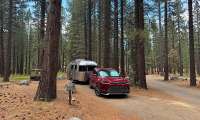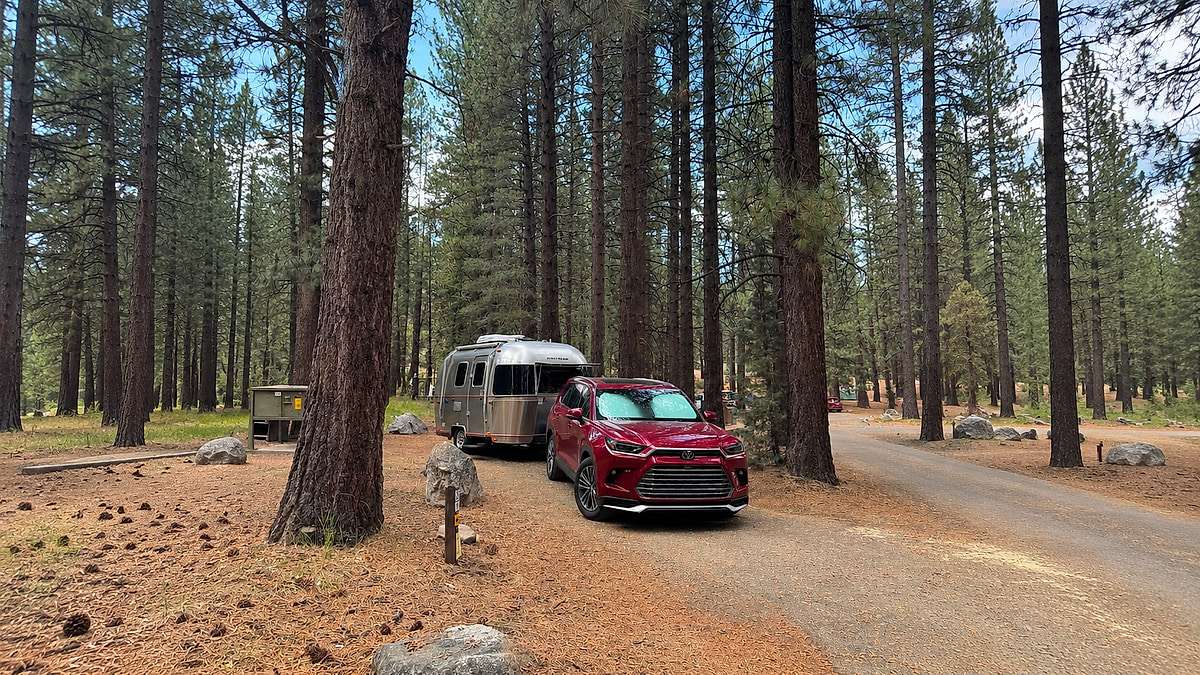

Dan Cherry’s Grand Highlander Hybrid Max Platinum did the road trip most family SUVs only pretend they’re ready for.
The route ran 3,600 miles over more than three weeks. Arizona to Utah. Great Basin National Park. Across the Sierra Nevada. Northern California. Oregon. Back through the Sierras, then into 106-degree heat near Las Vegas. His 16-foot Airstream sat behind the Toyota for about 95 percent of the trip.
The trailer weighed around 3,500 pounds. The Grand Highlander Hybrid Max is rated for 5,000.
On paper, that sounds comfortable.
On the road, and according to Facebook, it mostly was.
Cherry said the Grand Highlander Hybrid Max powertrain felt much stronger than the V6 in his previous 2018 Highlander, which had pulled the same Airstream.
- A 3,500-lb Airstream can still overload the rear axle once tongue weight, passengers, cargo, water, tools, and hitch hardware are added. A CAT scale ticket would tell owners far more than the tow-rating number.
- Camping gear piled inside the cabin can block or choke battery cooling vents. Before a hot mountain tow, the battery filter and intake area deserve the same attention as tire pressure.
- A 248°F scan-tool reading is useful, but owners should confirm which Toyota PID is being shown. Techstream or a dealer scan could separate a real fluid-temperature concern from a mislabeled or calculated value.
The six-speed automatic rarely left him wishing for a missing ratio. The SUV tracked well. Crosswinds moved the trailer enough to notice, yet never reached the white-knuckle zone. Coolant and engine-oil temperatures stayed under control, even with mesh installed behind the front grille to protect the A/C condenser. Then he started watching transmission-fluid temperature.
On hard climbs, the scanner showed 230 to 240 degrees. A few spikes crossed 240. After parking the trailer following the climb to Great Basin National Park, he saw 248°F. No warning light. No dash message. No obvious failure. Just a number on a Carista OBD scanner that changed the tone of the whole trip.
That number is where this owner report becomes useful.
The Powertrain Passed The Driver Test
The Hybrid Max setup suits this kind of towing better than many people expect.
Toyota pairs a turbocharged 2.4-liter four-cylinder with hybrid assist for 362 horsepower and 400 lb-ft of torque. The six-speed automatic gives the driver real gear steps under load, unlike the softer, more elastic feel many people associate with efficiency hybrids.
That matters when climbing with a trailer.
Cherry’s comparison to his 2018 Highlander is the cleanest part of the post. Same driver. Same trailer. Similar use case. The Grand Highlander Hybrid Max brought more shove when he needed it and felt calmer finding gears.
That is exactly what I’d expect from the Hybrid Max.
The electric assist helps cover low-speed demand. The turbo engine handles sustained work. The six-speed keeps the system from feeling busy. A 3,500-pound Airstream lands at 70 percent of the vehicle’s tow rating, before passengers and cargo, so the SUV had room on the trailer-weight side.
The setup still needed the right towing hardware. Cherry used a Redarc Tow-Pro Elite brake controller and a Blue Ox weight-distribution hitch. Someone in the comments dismissed that as “aftermarket stuff,” which misses the point.
A brake controller and a weight-distribution hitch are not performance modifications. They are responsible for towing equipment for a travel trailer of this weight behind a unibody family SUV.
I would not use this trip to judge a bare Grand Highlander with no brake controller and no proper hitch setup.
Cherry did the work correctly.
The Brakes Smelled Hot, But Kept Working
Descending the Sierras exposed another honest detail.
Cherry said the downhill sections required a lot of braking. At the bottom, he could smell hot brake pads, yet he reported no warped rotors and no loss of braking performance.
That result sounds believable. A 3,500-pound trailer, mountain descent, family SUV, and long grades will put real heat into the brakes. Trailer brakes help, but they do not make gravity disappear.
The brake-controller fault he mentioned also deserves attention. A red flash from the Redarc indicated a ground issue, and cycling the ignition cleared it immediately. That may have been a one-time communication hiccup. I would still inspect the trailer ground, 7-way connector, brake wiring, and controller connection before the next mountain trip.
Hot brakes are one thing.
A trailer brake controller acting odd during a trip through the Sierras deserves a second look at home, with tools, time, and no downhill grade waiting.
The downhill assist did not impress him. That tracks with what I’ve seen from many SUVs. Electronic descent modes can help on low-speed dirt grades, but a paved mountain descent with trailer weight behind the vehicle often comes down to proper speed selection, trailer-brake gain, driver discipline, and enough cooling time between hard braking events.
Pick a lower speed before the grade gets steep.
Do not wait until the pads start explaining thermodynamics through smell.
The Transmission Temperature Was The Smart Catch
Cherry’s best move was monitoring data that the dashboard never showed him.
The Grand Highlander did not throw a warning at 240-plus-degree transmission-fluid readings. That does not mean the number should be ignored.
Automatic transmissions generate heat through load, torque converter activity, climbing, ambient temperature, and gear selection. Hybrid systems can reduce some strain in certain situations and add complexity in others. A long, gradual climb in hot weather can be tougher than a short, steep one because heat builds slowly and cooling never gets a clean break.
Cherry found exactly that pattern.
Uphill grades and ambient heat pushed the fluid up. Flat or downhill sections brought it down quickly. That recovery behavior is encouraging. The system could shed heat once the load eased. His concern makes sense because repeated high-temperature events shorten the comfort zone for fluid life.
Toyota’s maintenance guide calls out extra attention under special operating conditions, such as towing and heavy loading. Cherry’s idea of changing transmission fluid more often, maybe every 20,000 to 30,000 miles while towing regularly, sounds reasonable to me. I would stay with Toyota-approved fluid while under warranty unless a Toyota dealer puts an alternative in writing.
The bigger lesson is simpler: owners who tow with Grand Highlander Hybrid Max should monitor transmission-fluid temperature on real grades, not just assume the dash will tell them everything early.
A $40 OBD tool can save a $60,000 SUV owner from guessing.
The Mesh Behind The Grille Did Not Show Up As A Problem
Cherry installed mesh behind the front grille to protect the A/C condenser.
That modification often triggers predictable concern. Anything placed in front of heat exchangers can reduce airflow if the mesh is too restrictive, poorly spaced, or clogged with debris.
On this trip, coolant and engine oil temperatures stayed fine.
That does not prove every grille-screen setup is safe. Mesh design, open area, bug buildup, dust, ambient temperature, towing load, and altitude all change the result. Cherry’s experience does show his specific setup did not create an obvious cooling problem while towing across major grades and desert heat.
I would still inspect the mesh after every long trip.
A clean screen can allow enough air to flow. A bug-packed screen at 106 degrees becomes a different part.
The fact that engine and coolant temperatures stayed controlled while ATF climbed tells us where the bottleneck lived. The front-end airflow was likely adequate for the engine cooling stack. Transmission heat remained the system Cherry needed to manage.
What I’d Do Before The Next Long Tow
I would pull a transmission-fluid sample or perform a drain-and-fill sooner rather than later.
The owner does not need to panic. He does need a baseline. Color, smell, and a sample report can tell whether this trip cooked the fluid or simply worked it. If he plans more mountain towing, a shorter service interval is cheap insurance.
I would also log data more deliberately on the next trip:
Speed, outside temperature, grade, gear, transmission temperature, engine oil temperature, coolant temperature, and trailer weight.
One number at the top of a climb helps. A pattern over ten climbs helps more.
If ATF spikes past 240 only briefly and drops quickly, that is one kind of story. If it sits at 235 to 245 for long stretches in hot weather, I would change driving style first and hardware second. Slow down. Let the drivetrain choose a lower load point. Avoid forcing cruise control to hold speed aggressively on long grades. Give the system airflow and time.
A second cooler may eventually enter the discussion, but I would not start there while the vehicle is under warranty. Data first. Dealer conversation second. Fluid service third.
Hardware changes come after the owner knows what problem actually needs fixing.
Grand Highlander Owners, Start Watching ATF
The Hybrid Max proved it can tow a 16-foot Airstream across serious terrain. Cherry’s report gives buyers real confidence in power, stability, and cooling.
It also gives them one warning.
The dashboard may stay calm while transmission fluid works hard.
If you tow with a Grand Highlander Hybrid Max, especially in heat or mountains, use a scanner and learn your temperatures before the trip gets difficult. Post trailer weight, road grade, outside temperature, speed, ATF reading, and whether the number dropped quickly after the climb in the comments below.
One image by Dan Cherry
About The Author
Noah Washington is an automotive journalist based in Atlanta, Georgia, covering sports cars, luxury vehicles, and performance culture. His reporting focuses on explaining the engineering, design philosophy, and real-world ownership experience behind modern vehicles.
Noah has been immersed in the automotive world since his early teens, attending industry events and following the enthusiast communities that shape how cars are built and driven today. His work blends industry insight with enthusiastic storytelling, helping readers understand not just what a car is, but why it matters.
Noah is also a member of the Southeast Automotive Media Association (SAMA), a professional organization for automotive journalists and industry media in the Southeast.
His coverage regularly explores sports cars, luxury vehicles, and performance-driven segments of the automotive industry, including the evolving culture surrounding Formula Drift and enthusiast builds.
Read more of Noah's work on his author profile page.
You can also follow Noah here:
Set Torque News as Preferred Source on Google
Follow us today...