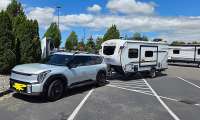

A Tesla Cybertruck owner found the useful towing number somewhere between Winston-Salem, North Carolina, and Mackinaw City, Michigan.
Ken Zelenka’s Rockwood pop-up camper made the truck consume “exactly double energy at 70 mph,” and he treated roughly 150 miles as the maximum distance between charges according to his Facebook post.
That result came with a route-planning rule simple enough to remember while pulling a trailer. If the next charger was 90 miles away, Zelenka wanted at least 180 miles showing on the truck. He doubled the road distance and compared it with the indicated range before leaving.
- The folded camper still rose about 18 inches above the Cybertruck. At highway speed, that blunt frontal area can hurt efficiency more than trailer weight alone suggests.
- The reported estimates suggest that slowing from 70 to 60 mph could save 25.5 kWh over 150 miles while adding about 21 minutes of driving. This still needs a controlled back-to-back test.
- The rig stayed connected at roughly 80% of charging stops, but some conventional sites required three or four parking spaces. Charger geometry became a second range limit.
It is crude math, and I mean that as a compliment. A driver on a long towing day needs a conservative decision more than a perfect model. Tesla warns that the Cybertruck's displayed miles are based on EPA-rated consumption and may fall faster than the actual miles traveled when speed, weather, load, and towing change the energy demand. Zelenka's rule gave the trailer's observed penalty priority over the friendlier number on the screen.
His post does not identify the truck's model year or trim, the camper's exact model and loaded weight, the wind, the temperature, or the state-of-charge window behind that 150-mile limit. Those omissions prevent a universal Cybertruck range claim. They do not erase the part that another driver can use.
At 70 mph, this combination required twice the energy.
The Pop-Up Still Put a Wall in the Air
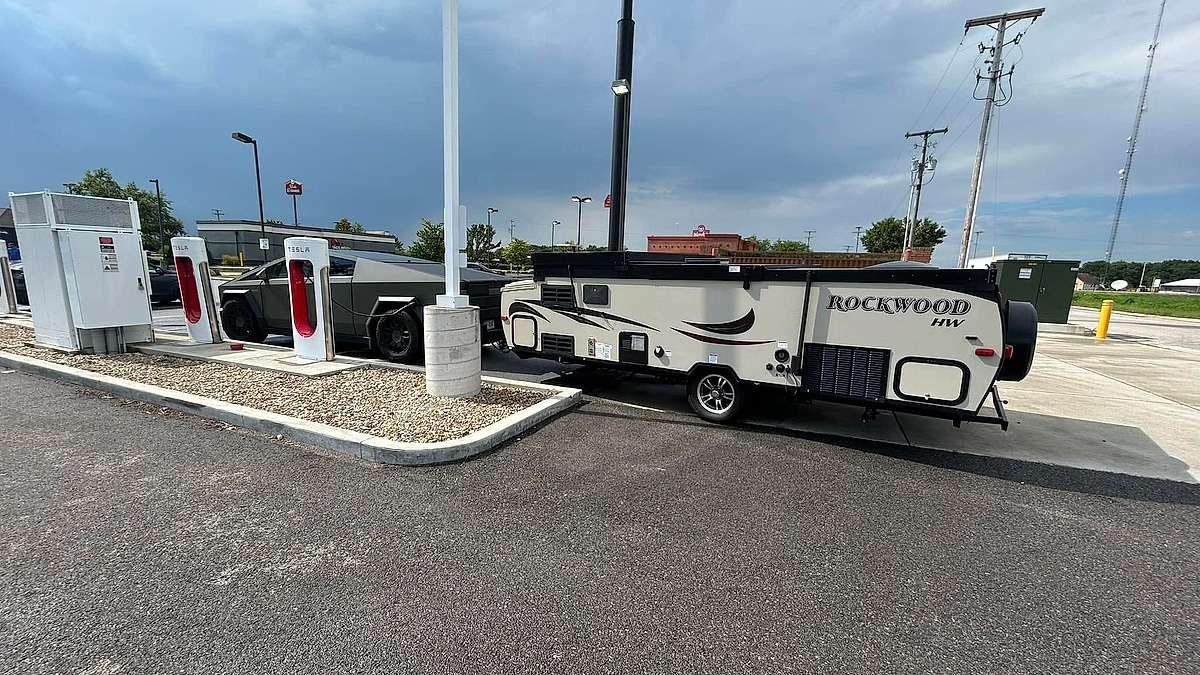
The word “pop-up” makes Zelenka's result sound worse than it is. Folded campers look small beside full-height travel trailers, yet his Rockwood is a high-wall design. Zelenka said the flat section rises about 18 inches above the back of the Cybertruck.
The highway sees an 18-inch step before the campground sees a tent. Air leaving the Cybertruck's sloping roof and bed has to meet a new vertical face, spill around the trailer, and organize itself again. At 70 mph, that disturbance becomes expensive.
This is where a useful comparison lives. A previous Cybertruck towing report involved a 4,500-pound, 22-foot Airstream Sport that averaged 520.8 Wh/mi over 200 miles. Its rounded shell, narrow body, and lower drag helped the Cybertruck far more than the trailer's weight alone would suggest.
Zelenka's camper folds lower and may weigh less, but its raised front section appears much blunter. The result is a good warning against shopping for an EV trailer by pounds alone. Loaded weight still governs ratings, tongue load, braking, tires, and stability. Once the rig settles at interstate speed, frontal area, shape, wind, and velocity write much of the energy bill.
Tesla's current Cybertruck manual makes the same distinction in plainer terms. It says towing “significantly decreases range,” tells drivers to reduce speed, and asks owners to enter a trailer's mass and dimensions in a saved profile so the truck can estimate consumption more accurately. The manual also lets drivers inspect the effect of mass, drag, and trailer accessories in the Energy app.
Ten MPH Was Worth 25.5 kWh Over 150 Miles
Mathias Smyser, another commenter who said he has the same pop-up, put numbers on the speed choice. He estimated that 60 mph could return about 580 Wh/mi instead of the roughly 750 Wh/mi implied by Zelenka's description at 70 mph.
That was a comment, not a controlled back-to-back test, and it may reflect a different truck, load, route, temperature, elevation, or wind. The arithmetic is still worth doing because it shows the size of the decision.
At 750 Wh/mi, a 150-mile leg consumes 112.5 kWh. At 580 Wh/mi, the same leg consumes 87 kWh. Slowing down saves 25.5 kWh.
Driving 150 miles at 70 mph takes about two hours and nine minutes without traffic or stops. At 60 mph, it takes two hours and 30 minutes. The slower run adds roughly 21 minutes of driving. Whether that saves total trip time depends on the charger, arrival state of charge, charging curve, and whether the preserved energy eliminates a stop or shortens one.
Using the same 112.5-kWh energy budget for illustration, 580 Wh/mi would cover about 194 miles. That is roughly 44 miles beyond Zelenka's 150-mile planning limit. It is not a measured 60-mph result from his trip. It is what the commenter's two consumption figures predict if every other condition stays fixed, which real towing conditions rarely allow.
The size of the difference makes physical sense. Aerodynamic power rises sharply with speed, and the energy needed to fight drag over each mile rises roughly with the square of speed. A move from 60 to 70 mph raises that aerodynamic portion by about 36 percent before rolling resistance, grades, climate use, and other loads join the calculation. The U.S. Department of Energy says efficiency generally drops quickly above 50 mph and notes that blunt external cargo creates its largest penalty at interstate speeds.
We saw the same speed sensitivity when an Ioniq 9 road trip at 80 to 85 mph lost more than 100 miles from its familiar range estimate. Put a high-wall camper behind the vehicle, and the air has a larger invoice to deliver.
Zelenka plans to build a hinged ramp or fairing ahead of the trailer's raised face. I want to see that test. A clean result would require the same truck and load, the same tire pressures, the same loop in both directions, and repeated runs at the same speed. Wind should be recorded. The truck's Energy app should provide Wh/mi rather than relying on the range display.
A 60-mph baseline belongs in that experiment. The fairing may help, especially if it guides flow over the trailer without creating a new pocket of turbulence. Slowing down costs no fabrication time, adds no structure that must survive crosswinds and road vibration, and produces an immediate comparison point. Any homemade device also needs secure mounting and enough clearance for turning, suspension movement, and the trailer's motion relative to the truck.
The Charging Lot Became Part of the Tow Rig
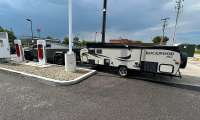
Zelenka said he charged without disconnecting the trailer at about 80 percent of the stations. Pull-through chargers solved the problem cleanly. At quiet conventional sites, he sometimes occupied three or four spaces to reach a cable while remaining attached.
The photograph explains the compromise. The Cybertruck is beside a Supercharger cabinet, while the Rockwood stretches along the perimeter of a mostly empty site. The cable works. The parking geometry requires far more asphalt than one charging stall was designed to provide.
That approach depends on the station being quiet. A driver who uses several spaces at an empty site is improvising around the hardware. The same maneuver at a busy bank can block other drivers from charging. If the lot fills, the trailer comes off.
Tesla's Trip Planner can route a Cybertruck through Superchargers and predict arrival energy. Its public support page says the system can add charging stops based on state of charge, and the Cybertruck Energy app can project range from recent consumption over 10, 100, or 200 miles. Tesla does not promise that every selected location has a pull-through stall or enough room for a connected trailer.
That missing piece has shown up in other electric-truck trips. A Rivian R1T towing a 19-foot Airstream averaged 1.3 mi/kWh over roughly 1,000 miles and had to unhook at two of five fast-charging stops. A GMC Sierra EV towing a 6,000-pound boat found the opposite: a covered Pilot and GM Energy location gave the hitched combination room to charge in the rain.
Charging power gets the brochure. Approach angle, cable reach, stall orientation, curbs, and room to leave get the trailer to the next morning.
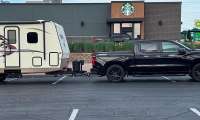
Chris Robertson added another Cybertruck example in the comments. He reported similar range behavior while pulling an aluminum trailer with a utility vehicle for about 600 miles round-trip. Only one charging setup, at a Sonic between Idaho and Nevada, felt precarious, he said, in a stretch where gasoline was also scarce. His photo shows the connected trailer bending around a curb at a perimeter charger.
That is a useful context because electric towing discussions often assume the inconvenience begins and ends with battery capacity. Zelenka's trip suggests two separate limits. The first is how far the truck can pull its particular shape at the chosen speed. The second is whether the next charger can physically accept the whole combination.
He managed both. The Cybertruck and Rockwood reached northern Michigan. The trip required 150-mile thinking, a conservative range rule, and charging stops selected with the trailer still in mind. Now he wants to make the camper cleaner through the air.
I would start the next test with 60 mph, record the actual Wh/mi in both directions, then add the fairing and repeat it. If the consumption falls, the gain will show up in energy, range, and charging time. If it does not, the data will save the next owner from copying an elegant piece of aluminum that only looked fast in the driveway.
Cybertruck drivers who tow, share the truck trim, trailer model, loaded scale weight, frontal height above the truck, average speed, weather, Wh/mi, longest leg, arrival state of charge, and the number of times the trailer had to come off. Those details can turn a camping photograph into a route another owner can plan.
One image by Ken Zelenka
About The Author
Noah Washington is an automotive journalist based in Atlanta, Georgia, covering sports cars, luxury vehicles, and performance culture. His reporting focuses on explaining the engineering, design philosophy, and real-world ownership experience behind modern vehicles.
Noah has been immersed in the automotive world since his early teens, attending industry events and following the enthusiast communities that shape how cars are built and driven today. His work blends industry insight with enthusiastic storytelling, helping readers understand not just what a car is, but why it matters.
Noah is also a member of the Southeast Automotive Media Association (SAMA), a professional organization for automotive journalists and industry media in the Southeast.
His coverage regularly explores sports cars, luxury vehicles, and performance-driven segments of the automotive industry, including the evolving culture surrounding Formula Drift and enthusiast builds.
Read more of Noah's work on his author profile page.
You can also follow Noah here:
Set Torque News as Preferred Source on Google
Follow us today...